
Xinzhiyuan reports

On October 6, OpenAI released 722 mathematical manuscripts generated by internal AI models all at once.
Just one day later, three of them were announced as withdrawn.
The reason all three manuscripts failed turned out to be just a sign error: one contained a mistake, while the other two followed the same construction and were withdrawn as well.
After AI turned in its exam papers en masse, two tech giants joined forces to pay for the “grading.”
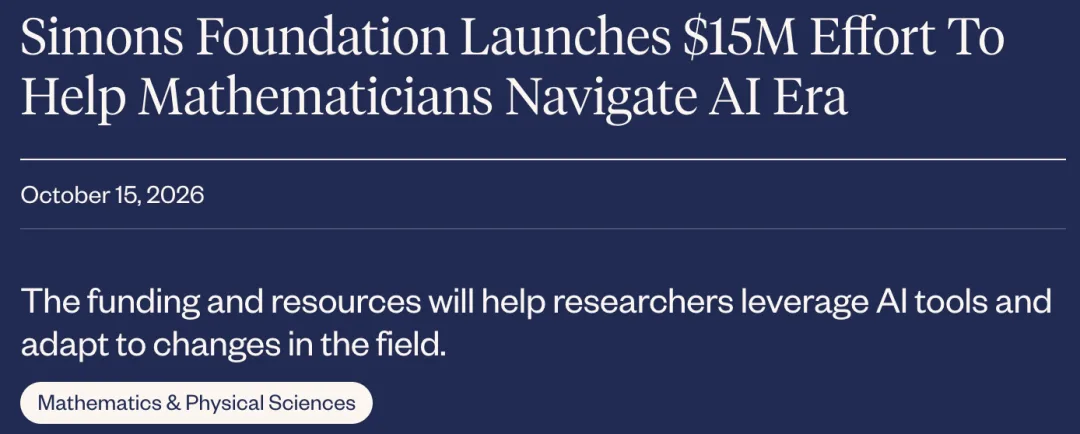
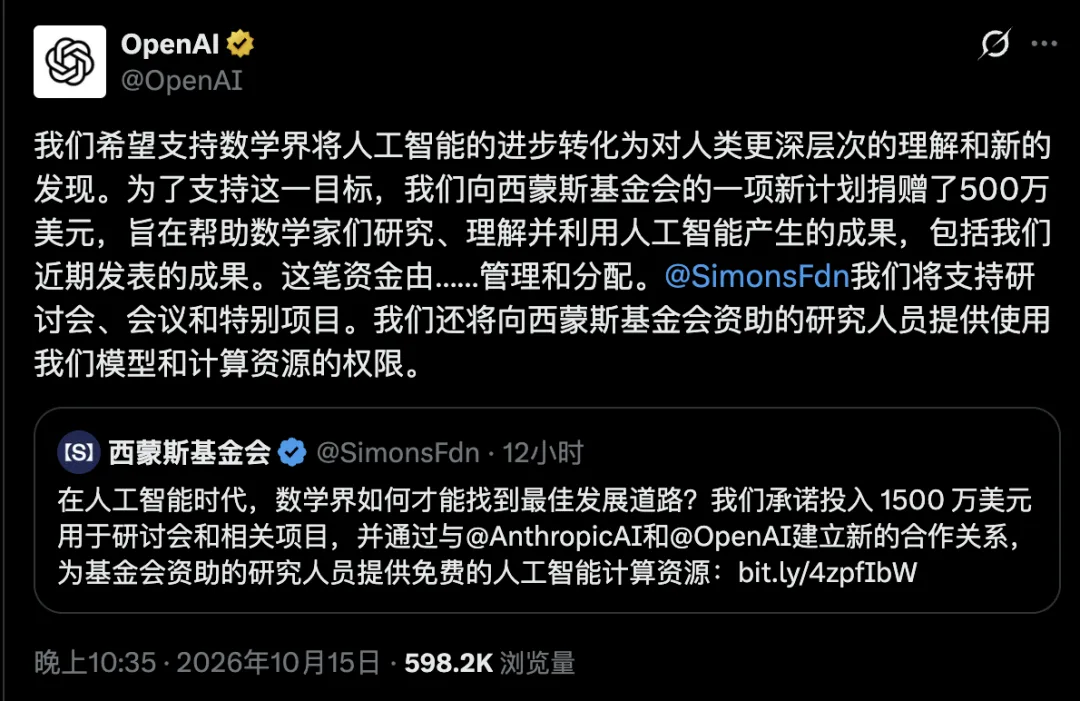
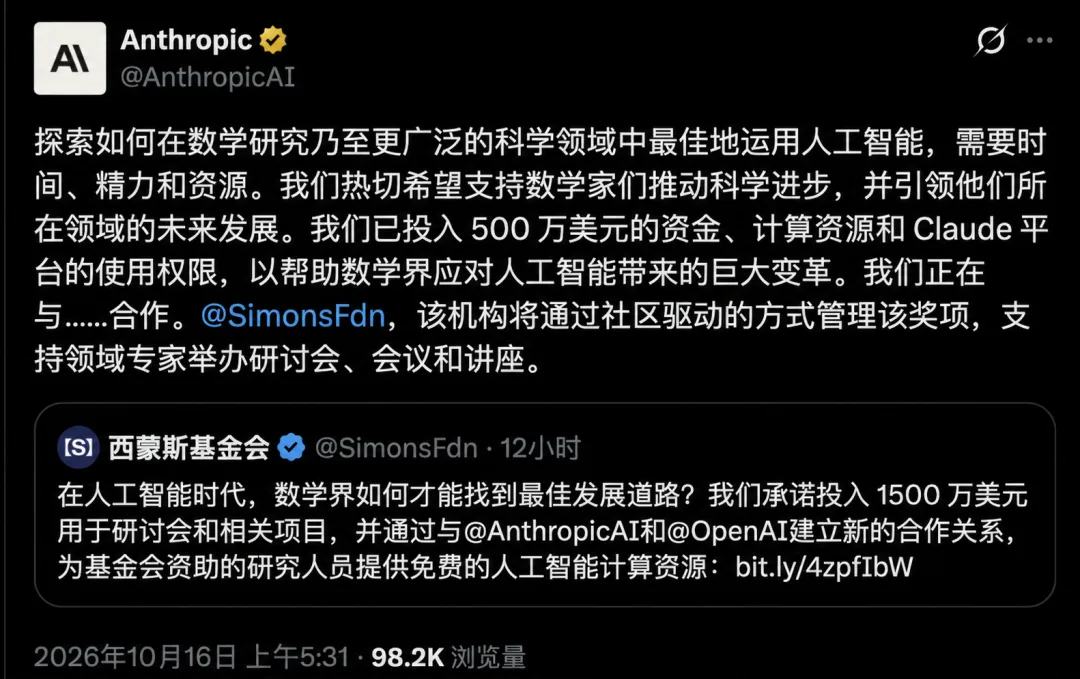
On October 15, the Simons Foundation announced that it, OpenAI, and Anthropic had jointly pledged $15 million in funding and resources to support mathematicians in validating, understanding, and building on AI’s results.
OpenAI is contributing $5 million and providing models and computing power, with the aim of turning advances in AI into deeper human understanding and new discoveries.
Anthropic’s pledged $5 million in support includes funding, computing power, and access to Claude. It also candidly acknowledged that making effective use of AI in mathematics and scientific research more broadly requires time, energy, and resources.
The funding will be managed by the Simons Foundation for activities such as workshops and conferences.
In short, this is support for mathematicians to grade AI’s papers, make sense of those lengthy proofs, explain them clearly, and then put the valuable methods to use.
In recent months, OpenAI has repeatedly set off “earthquakes” in the mathematical world:
First, it announced research results addressing 10 long-standing open problems; then it announced a proof of the Navier–Stokes problem, a Millennium Prize Problem; and then it released hundreds of mathematical manuscripts in one go.
The results came flooding in, and humanity was having a bit of trouble “digesting” them.
Terence Tao incisively pointed out that mathematics is moving from a period of “scarce proofs” to one of “abundant proofs,” but humanity’s ability to verify and understand them may not keep pace.
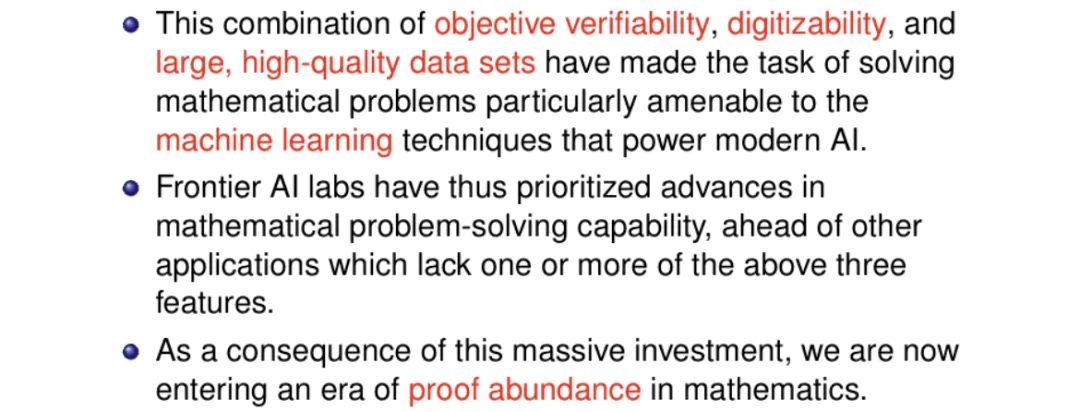
Tao proposed the idea of an “era of abundant proofs” in his lecture.
MIT Associate Dean of Engineering Education Justin Solomon frankly admitted on a podcast that, after reading the first few pages of OpenAI’s Navier–Stokes proof, he couldn’t continue.
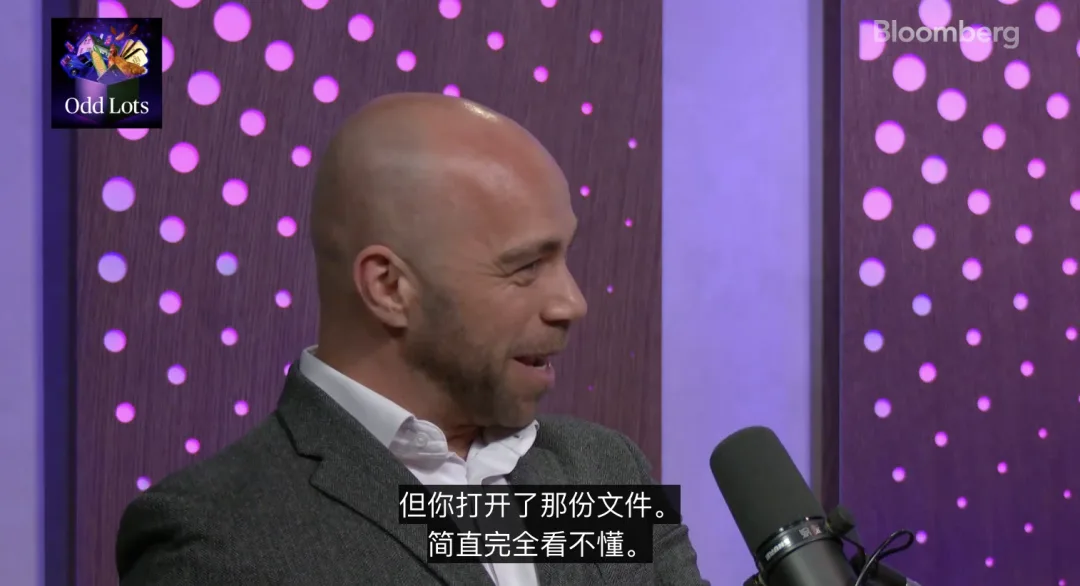
Solomon frankly admitted on the “Odd Lots” podcast that, faced with OpenAI’s Navier–Stokes proof, he couldn’t even get through the first few pages.
AI can quickly produce long-form derivations, but human understanding does not automatically follow.

722 Manuscripts
From “Writing It” to “Understanding It”
On October 6, OpenAI made this batch of results from an internal, unreleased model public on GitHub. The next day, its changelog contained the awkward record of three withdrawn papers and 14 revisions.
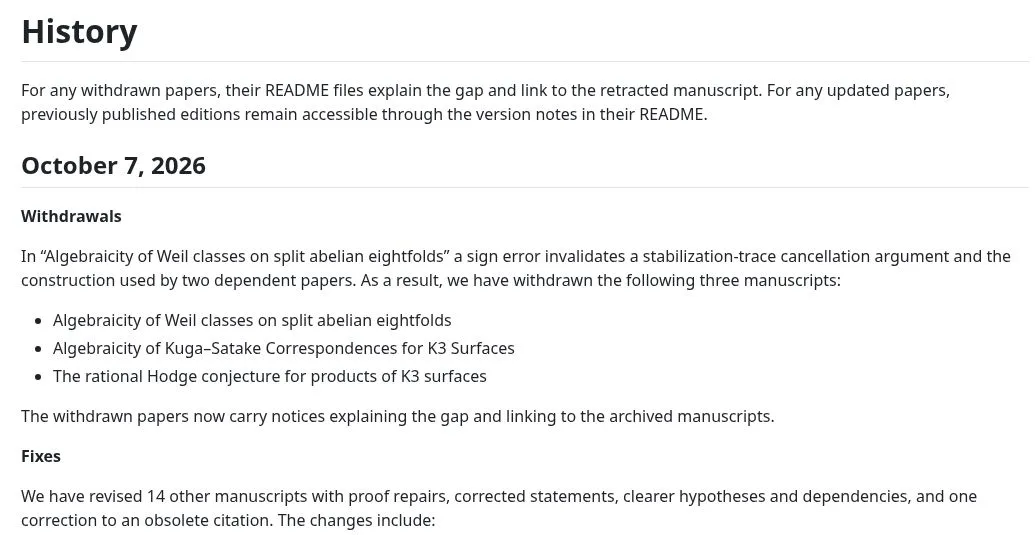
October 7 changelog: Three manuscripts withdrawn, and another 14 revised.
The problem lay in a single sign:
Under the paper's sign convention, it should have been -1, but the AI calculated it as +1 in the proof. After the correction, the count that was expected to become zero was not zero, and the hypothesis of the theorem being used collapsed outright.
Two other manuscripts used the same method and were also withdrawn; one of them studied the rational Hodge conjecture for products of K3 surfaces.
This body of results came from the model's attempts at roughly 4,000 problems and the subsequent screening process.The sheer number is astonishing, but verification has not kept pace::
About 42% of the main results come with Lean formalizations that allow computers to check the reasoning process. Some results that have not yet been formalized may still contain errors.
Even if the proof itself is sound, the research is not over.
Merely knowing that the calculation is correct is not enough; one also needs to understand how the correct result was obtained: What is the key method? Can the conditions for its applicability be relaxed? Can it be used to solve other problems?
In mathematical research, the author must understand their own proof and take responsibility for it.
But the AI may write out a long sequence of deductions that even the researcher who posed the problem cannot understand, much less check for correctness.
So finding the error is only one step.
More importantly, the useful methods within it need to be clearly explained so that others can learn them, apply them, and take the research further.
The Academic Backlash
How much can $15 million solve?
This also completely stoked the academic community’s anger.
What people are debating is no longer just whether the three manuscripts contain errors, but who will take the time to check them for errors, understand them, and continue the research from there.
On October 7, the Association for Human Mathematics (AHM) issued a stern statement, criticizing the act of dumping more than 700 files all at once as a “display of power,” and even calling on mathematicians to stop collaborating with OpenAI.
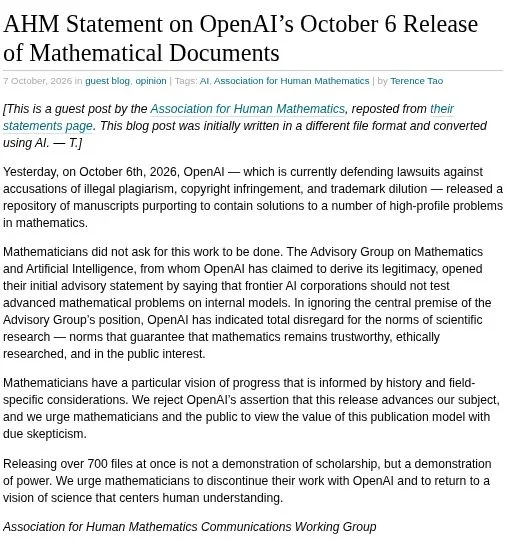
The AHM guest statement published on Tao’s blog retains the working group’s byline.
This statement, circulated by the association under the working group’s byline, was also posted as a guest article on Tao’s own blog.
Cornell University mathematician Alex Townsend’s recommendation was very direct:
OpenAI should first publish the manuscripts verified using Lean, release the other materials separately, ask everyone to help check them, and not mix the verified and unverified ones together.
MIT Senior Research Scientist Andrew Sutherland praised OpenAI for rapidly correcting its errors, but also said that more work would be needed to regain trust.
What people are worried about is this: AI companies use internal models unavailable to the academic community to produce results ahead of everyone else; mathematicians, lacking the same tools, instead fall behind the progress in their own field.
AI companies release large batches of manuscripts all at once, but the burden of checking them for errors and understanding them falls on human researchers.
The advisory group at the Institute for Advanced Study at Princeton (AGMAI) had argued as early as late September that AI labs cannot focus solely on publishing results; they must also provide funding and resources to support people in understanding those results.
OpenAI and Anthropic’s joint support directly answers the calls academia had previously made.
But this support does not mean buying control over the discourse: academia’s acceptance of support does not mean academia endorses all the practices of AI labs.

According to the announcement, the foundation will publicly call for project proposals and support researchers in examining AI outputs, learning new tools, and discussing together how those tools should be used and according to what standards.
AGMAI had previously suggested organizing summer schools focused on complex proofs or forming long-term collaborative research groups, giving people the time and resources to break down AI-written proofs step by step and explain them clearly.
David Spergel, president of the Simons Foundation, also stressed:
These discussions must be led by the mathematics community.
AI companies can provide resources, but what to research, how to validate it, and where to go next remain for humans to decide.
Even as the academic community accepts funding, it must preserve room for questioning and independent judgment.
AI Submits Papers in Bulk
Humanity Continues to Uncover Knowledge
David Spergel emphasized in the announcement that mathematics should not be viewed merely as a collection of proofs and theorems, but as a collective understanding driven by human curiosity.
When AI can mass-produce research materials, measuring scientific progress must also take the follow-up work into account.
It is not enough to marvel at how many papers AI has written; more importantly, we must ask:Which results withstand scrutiny? Can others understand them and continue using them? What new avenues of exploration do these achievements open up?
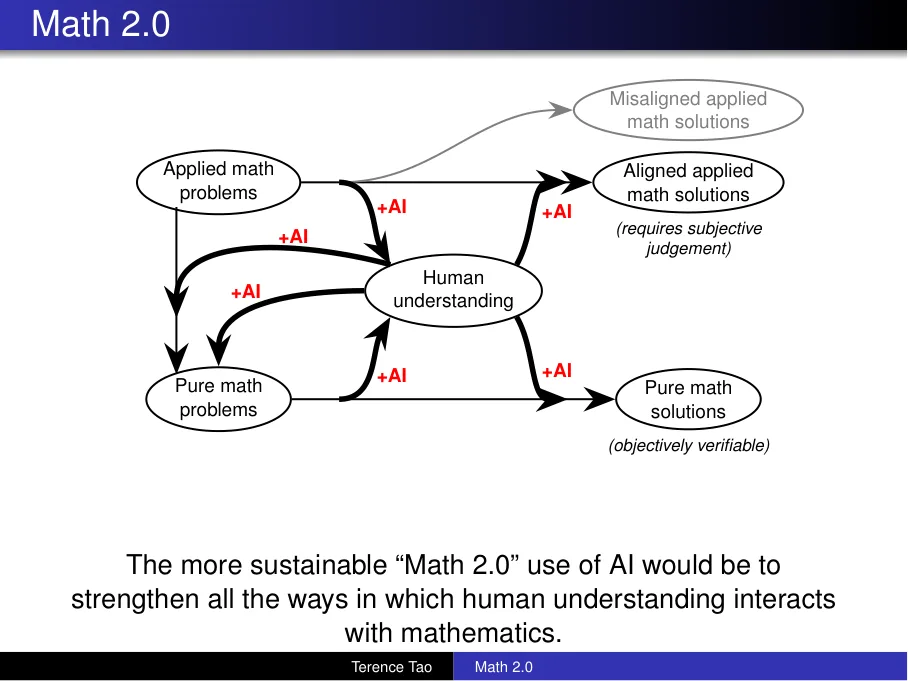
Terence Tao’s Math 2.0 diagram places “human understanding” at the center.
And this discussion has already extended beyond mathematics.
The Simons announcement explicitly notes that the tools and computing resources provided by OpenAI and Anthropic will also be used in fundamental science research beyond mathematics.
Who will check for errors, who will be able to understand the work, and who will be responsible when problems arise—other disciplines need to think about this in advance as well.
Recently, a reversal emerged in a theoretical physics test:
GPT-6 Astra was marked incorrect, but after experts reviewed the results, they found that some of the reference answers were themselves wrong. After correction, Astra answered 49 of the 50 research-level questions in TheoPhysEval correctly, achieving an accuracy rate of 98%.
AI’s answers need to be checked, and so do experts’ reference answers.
And once complex derivations are explained clearly enough for others to understand and use them, these achievements can become the starting point for the next discovery.
References:
https://x.com/OpenAI/status/2110741355739963884https://www.simonsfoundation.org/news/simons-foundation-launches-15m-effort-to-help-mathematicians-navigate-ai-era/
https://openai.com/index/sharing-ai-progress-in-mathematics/
https://x.com/AnthropicAI/status/2110846112152105136?utm_source=chatgpt.com
Editor: Yuan Yu
Catch up with ASI in seconds
⭐Like, share, and view—all in one click⭐
Tap the star to stay on top of New Zhiyuan’s breaking updates!