
A study led by Stanford University in the United States, published in Environmental Science & Technology last month, mapped 9,347 data centers in operation worldwide and found that around 25% are in regions where water demand exceeds supply for at least one month of the year.
According to the researchers, this proportion could reach 33% within up to ten years, under a scenario of 3 °C of global warming relative to 1900 levels. The survey also indicates that 41% of facilities directly compete for water resources with cities and municipalities.
For those in a hurry:
- A study led by Stanford University mapped 9,347 data centers worldwide and found that around 25% are in regions where water demand exceeds supply for at least one month of the year. This proportion could reach 33% under a scenario of 3 °C of global warming;
- Data centers consume large volumes of water for cooling and may compete for water resources with cities and agricultural areas. The impact also includes the indirect consumption of water associated with power generation;
- Among the alternatives for reducing consumption are closed-loop water systems and the use of reclaimed water. Researchers warn that expanding these structures requires solutions that consider water availability and environmental impacts.
Data centers and water consumption
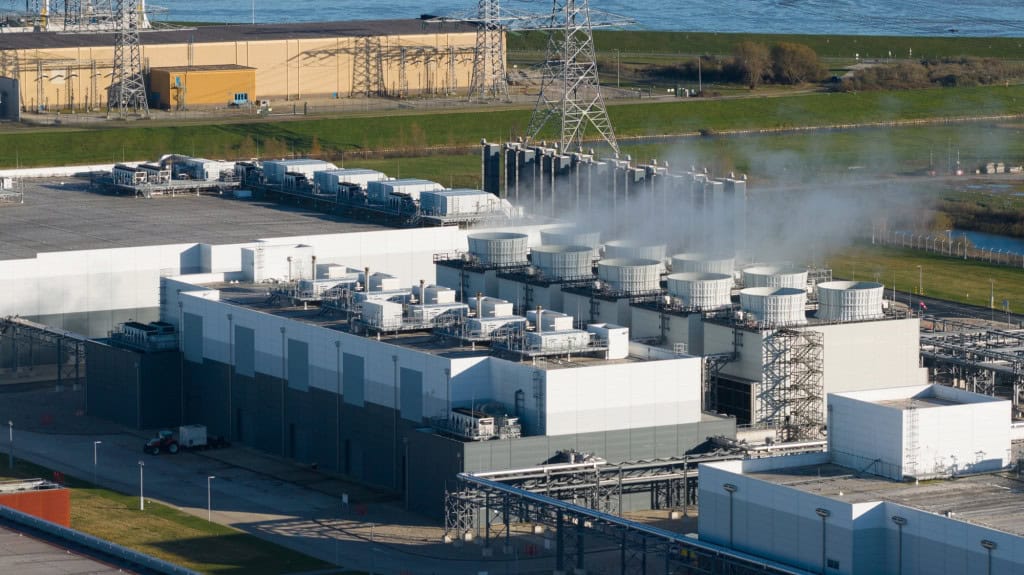 Data centers consume large volumes of water and energy, which has put pressure on investors to demand greater environmental transparency – Image: Make more Aerials/Shutterstock
The amount of water consumed by data centers has reached alarming levels. In 2025, Google’s data centers consumed approximately 10.9 billion gallons of water, equivalent to 41.3 billion liters, according to the company’s own data.
Studies published last year point to even more concerning results. Large data centers can consume 5 million gallons of water per day, equivalent to the consumption of a city of 50,000 people.
However, Mordor Intelligence, a market research company, compiled data showing that data centers in the United States consumed nearly 1 trillion liters of water. This is equivalent to New York’s annual water consumption. New York is one of the world’s largest cities, with 8.8 million inhabitants.
Beyond the cooling figures, new findings point to a significantly higher number. A report by The Wall Street Journal stated that the documents released by the companies account only for water used directly in the data center and do not include the chain effect it generates, such as increased energy consumption and the water used to generate that energy in some cases.
Risks to local water supplies
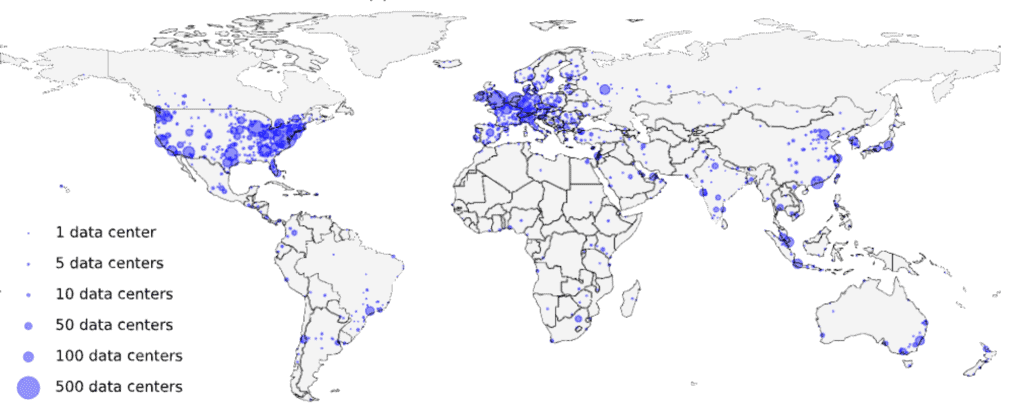 Data centers around the world – Image: Lorenzo Rosa/Disclosure
In addition to the unprecedented environmental impact, this data is important primarily because of the location of the data centers.
“These structures are not being installed in empty landscapes.“They are being installed over the water supply systems of cities and farms,” said Lorenzo Rosa, a chemical engineering researcher at Stanford University and one of the leaders of the study, in a statement.
According to the study, 25% of the sites mapped by the research face water stress in at least one month every year. The researchers also point out that 41% of the identified data centers are near cities and municipalities, showing that the impact of these structures affects various sectors of life on Earth.
These impacts may become even more significant as the world reaches alarming figures related to global warming and extreme heat. In an increasingly hotter world, water consumption levels rise, also increasing the amounts needed to cool data centers.
Based on these findings, the research also states that the 25% of affected sites could increase to 33% within ten years, with the situation intensifying in previously affected areas.
And the problem is not limited to water. Large technology structures also create so-called heat islands, potentially raising local temperatures by up to 9.1 °C, which could amplify extreme weather phenomena.
Read more:
- AI data centers hide enormous water consumption
- AI data center threatens to disrupt the climate in the Amazon
- US: New York suspends permits for large data centers for one year
Cooling alternatives
Under public pressure, and even from investors in some cases, some companies have sought new solutions to address this impact.
One such solution, and the most widely used, is the closed-loop water circuit. The concept is basically to reuse water that has passed through the data center’s cooling circuit more than once, without the need for daily replenishment.
Other plans seek to treat reclaimed water for cooling data centers. In Quincy, in the state of Washington, United States, a water treatment system was created to cool data centers. According to data from the initiative, the system could save approximately 522 million liters per year.
Some more ambitious plans seek to position data centers at the bottom of the ocean or within the Arctic Circle, but the environmental impact of these locations could be different. The heat islands generated by the structures could affect cold regions, altering their natural state, the environment, and local life.
With this difficulty in finding alternatives, some locations have begun to curb this expansion. The state of New York, for example, suspended the issuance of permits for new data centers for approximately one year. This period will be used to seek sustainable ways to implement the structures.
The action shows that the situation has become increasingly alarming worldwide, as well as demonstrating the need to seek more effective ways to mitigate the environmental impacts caused by data centers.

Enzo Monteiro is a writer at Olhar Digital.

Ana Figueiredo is a technology editor at Olhar Digital. She has a degree in Journalism from the Federal University of Uberlândia (UFU).


