
Synced reports

Anthropic's most closely guarded mysterious “Model 4”,has been exposed!
After secretly training from September to October, its internal comprehensive capability index (AECI) soared to the astonishing score of 178.6; the existing test battery can barely hold it back anymore.
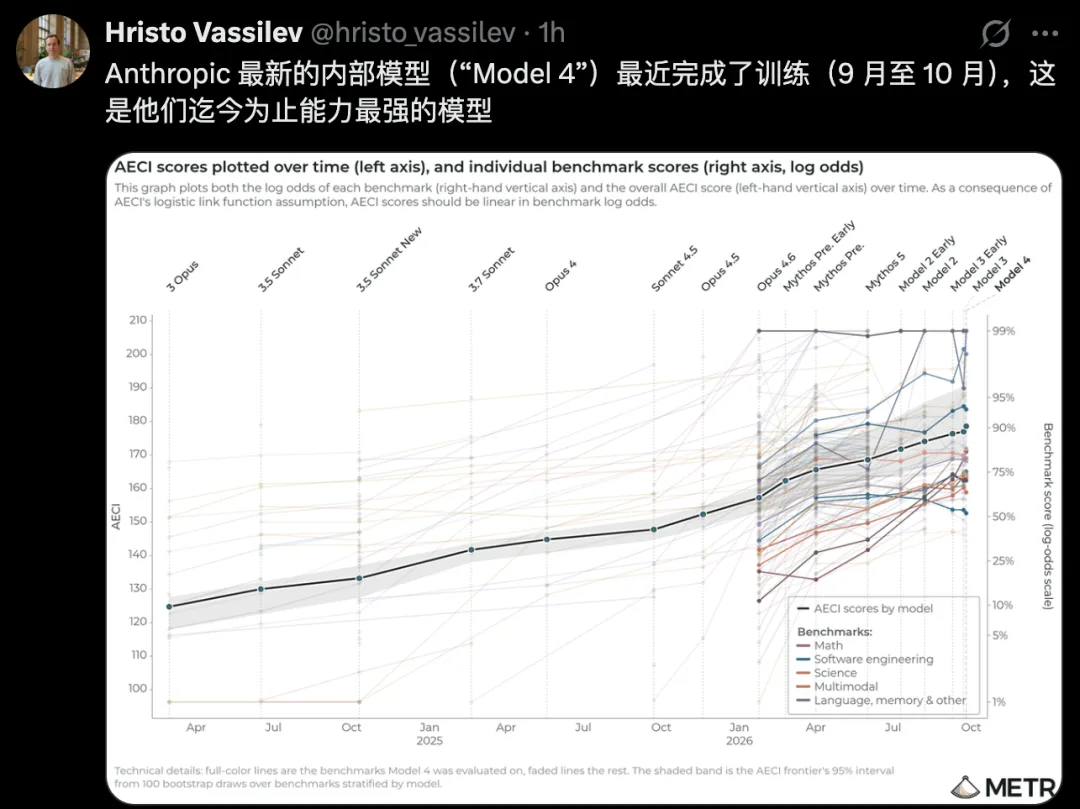
Today, the third-party evaluation organization METR released a major investigation.
After grinding through 11 straight weeks and digging deep into Anthropic's sensitive internal data, it finally reached just one conclusion—
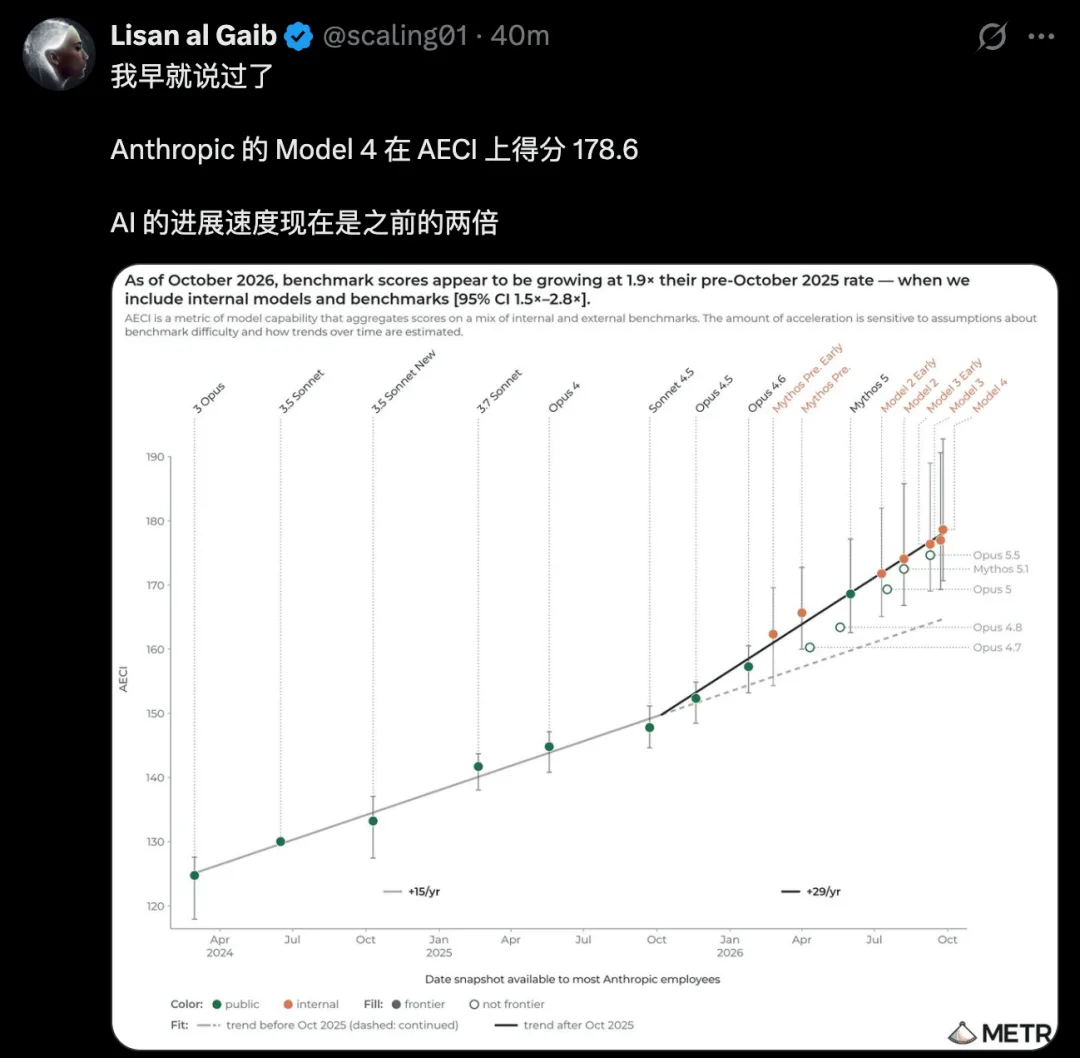
The rate of Anthropic's model evolution has completely spun out of control, doubling outright.

The most explosive numbers in the report are these.
As of October, Anthropic's rate of capability improvement on clearly defined tasks was already twice the rate from March 2024 to October 2025.
The turning point, came in October 2025
.Since then, the growth rate of the internal capability index AECI surged to 1.9 times its previous level, covering in one year the ground it had taken the past two years to cover.
Even more frightening, 80% of the momentum in this wild surge actually came from the AI itself! Claude is building a stronger Claude with its own hands.

METR researcherRyan Greenblatt said, “This report is a major signal that ASI could be achieved within one to two years.”
At this rate, the ASI from the “AI 2027” scenario will arrive in full in just four months!

Mysterious Model 4 Suddenly Appears
Over 50% on All 15 Test Papers
TAG185@@
The most striking thing about this report is a series of mysterious codenames never publicly disclosed by Anthropic.
In the report’s appendix, METR listedfour internal, unreleased models.
They are “Unreleased 2022,” trained in 2022; Model 2, trained in July 2026; Model 3, trained in August–September; and Model 4, freshly unveiled after training in September–October.
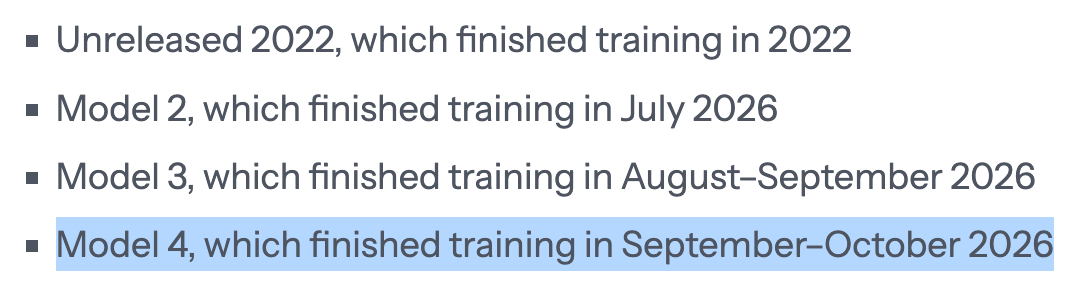
What truly set the entire internet ablaze wasModel 4, which had just finished training last month.
TAG224@@It scored 178.6 on AECI, far surpassing the public models Opus 5.5 (174.5) and Mythos 5.1 (172.5).
AECI is like the “college entrance exam total score” for large models, converting scores across the various subject benchmark tests into a single comprehensive tier score.
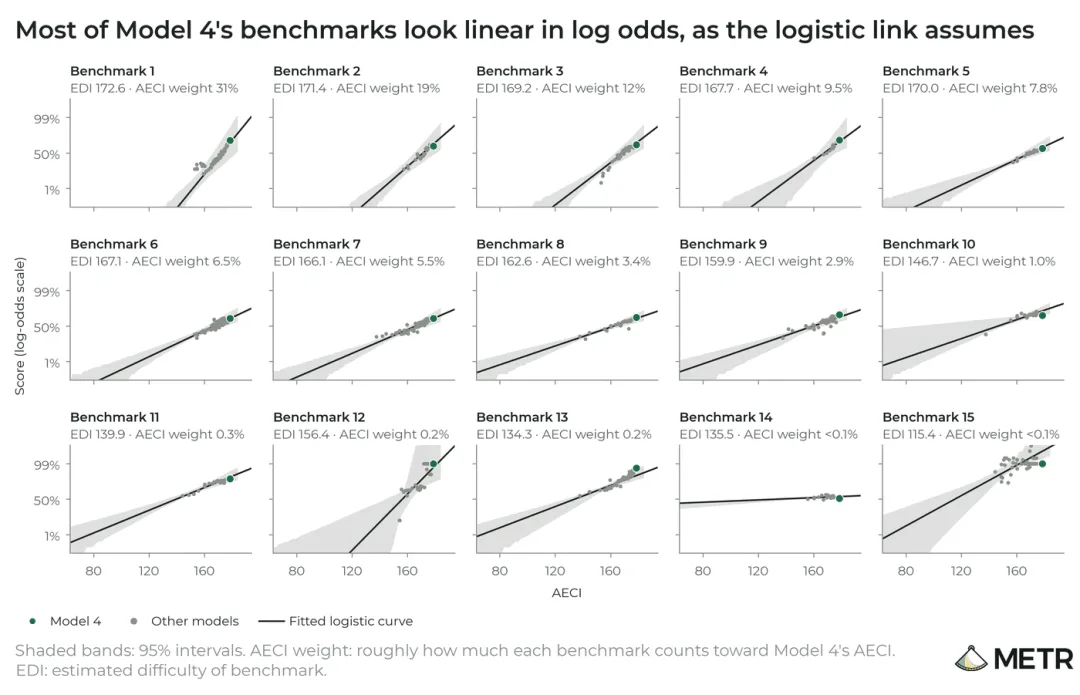
Looking at individual subjects, Model 4’s accuracy rate exceeded 50% on each of the 15 benchmark tests it took. Yet just nine months earlier, Opus 4.6 had failed to clear the halfway mark on numerous benchmarks.
But that is still not Model 4’s true limit!
The METR team even conducted a “de-bug test” in the report, finding that 3 of the 15 test benchmarks exhibited dips caused by overly difficult long-tail questions or corrupted test items.
Once these three confounding benchmarks are removed and the calculation is rerun, Model 4's AECI score will jump another 1.1 points, soaring to 179.7.
Even in terms of token consumption, Anthropic's internal testing has not yet fully tapped Model 4's potential.
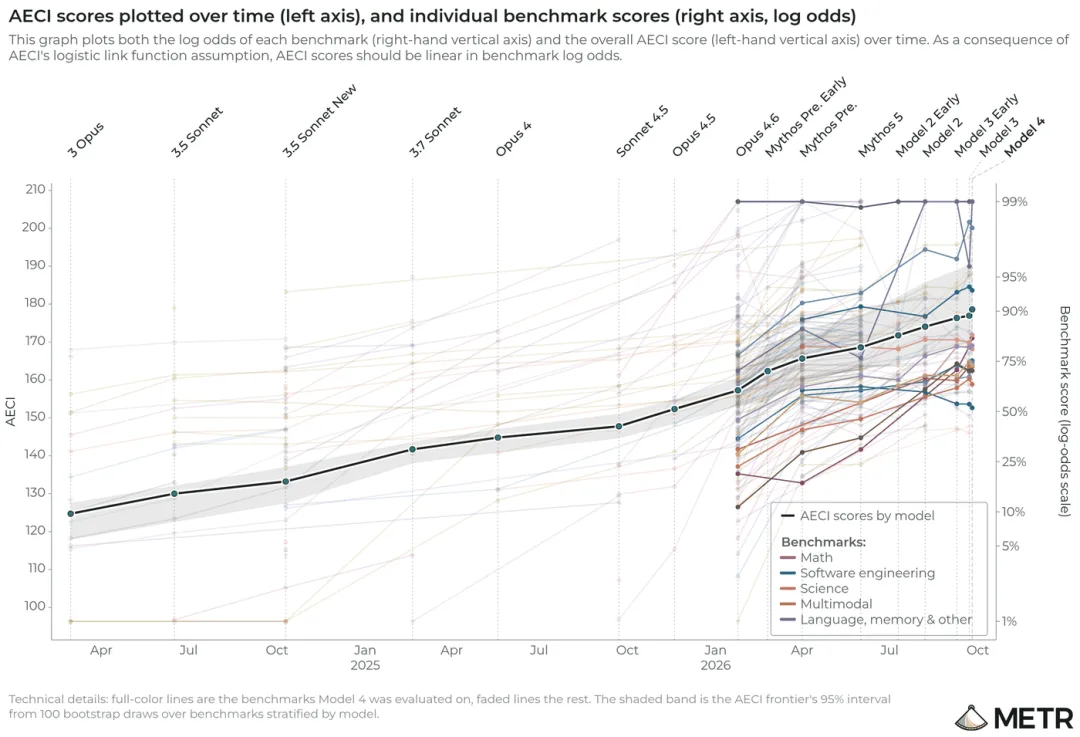
Running a standard benchmark test consumes an average of 2.5 million input tokens and generates more than 70,000 output tokens per task.
When an Agent is tasked with writing code, a single task consumes a full 10 million input tokens, with output also reaching 94,000 tokens.
Even more challenging for METR evaluators is that the existing tests are already close to being unable to measure Model 4's limits.
It is no wonder that Anthropic updated its S-1 prospectus once again ahead of its IPO, specifically adding a new risk disclosure.
Internal estimates suggest that future models will soon cross the threshold for "AI significantly accelerating R&D," completing in one year what previously took two years.
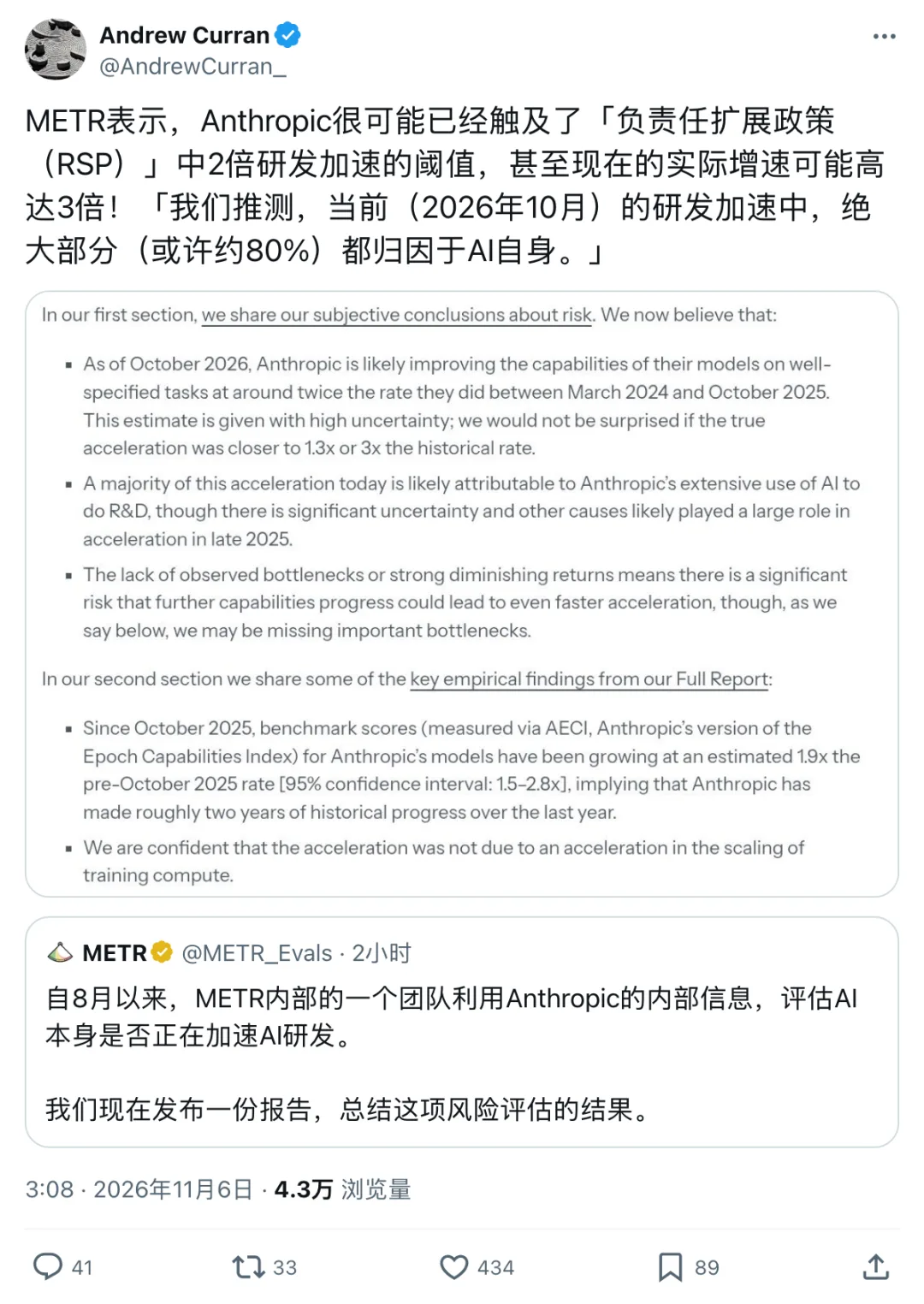
Model 4 is the best proof. As for Model 3 in the figure, netizens speculate that it is the rumored Mythos 5.5.
The AI itself accounts for the 80% speedup
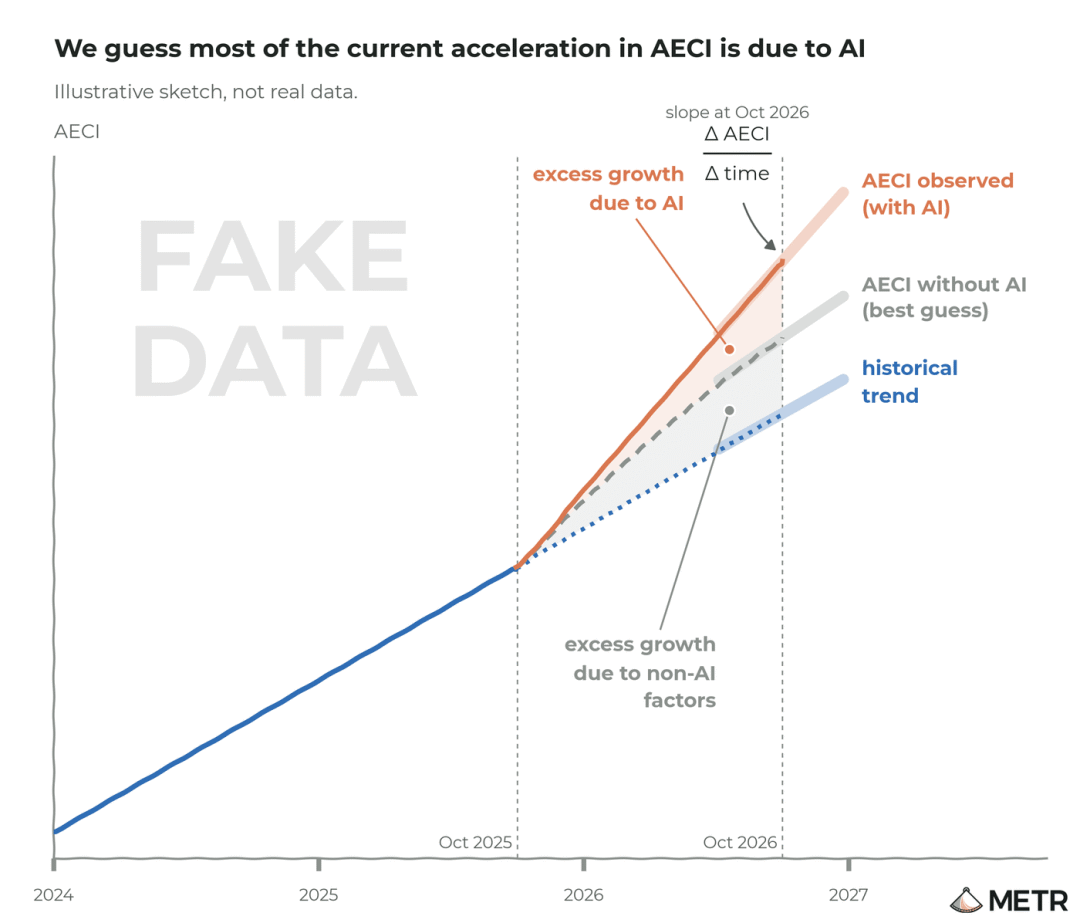
Model 4's ability to reach such a high score reflects the fact that the pace of model evolution is clearly accelerating.The historic inflection point occurred on October 7, 2025.
Before this dividing line, Anthropic models' AECI scores rose by roughly 15 points per year.
Starting in October 2025, the trend of this curve suddenly turned sharply upward, becoming a 29-point surge per year, with the growth rate reaching 1.9 times its previous level (95% confidence interval ranging from 1.5 times to 2.8 times).
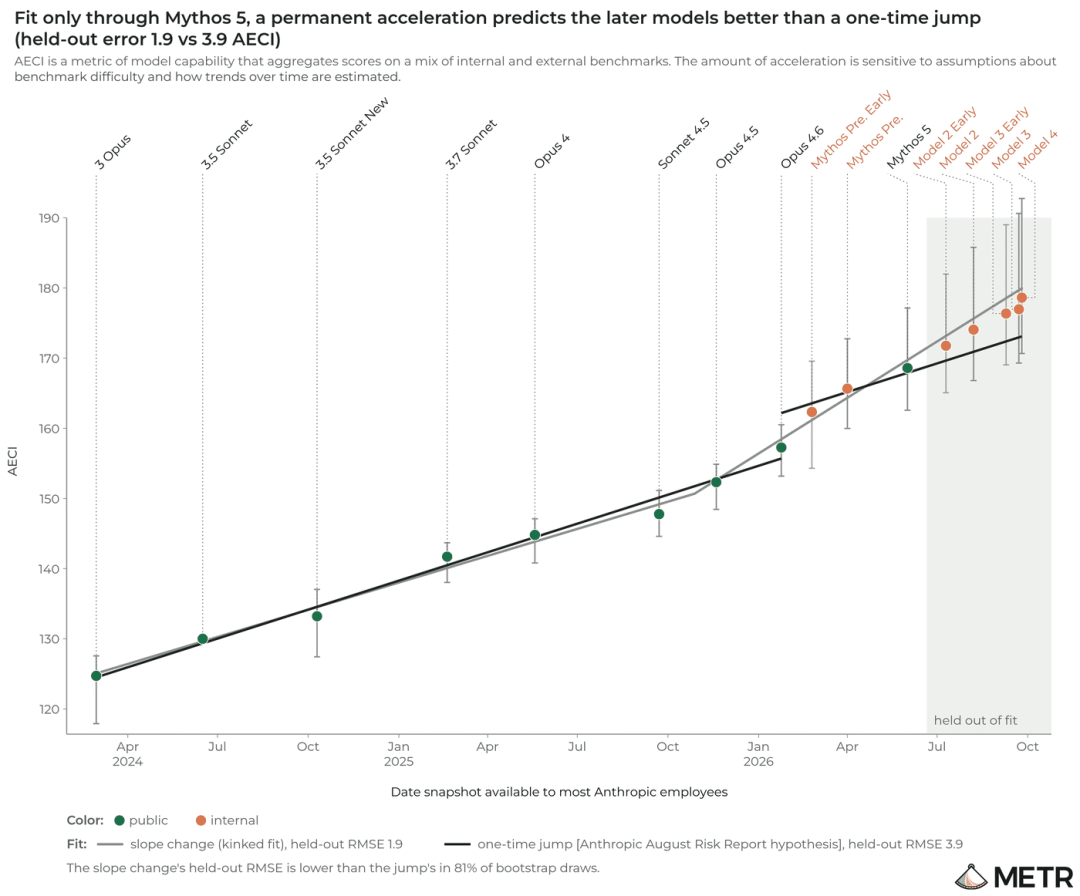
In its risk report this August, Anthropic proposed a moderate hypothesis, arguing that this was merely a one-time “step-change” brought about by the adoption of new tools and new evaluation methods.
METR therefore conducted a set of rigorous blind comparison experiments.
Researchers used data from Mythos 5 and earlier models to plot two predictive lines, then blind-tested the subsequently released Model 2, Model 3, Opus 5.5, and Model 4.
The results were very clear. In 81% of the statistical samples,the forecast based on “continued long-term acceleration” had an error of only 1.9 points and fit the actual data far better than the “one-time jump.”The latter had an error of as much as 3.9 points.
A 2x acceleration means that in the short span of just one year, Anthropic covered two full years’ worth of technological progress!!
In terms of exponential growth, an indicator that originally multiplied by 3 each year would, under 2x acceleration, multiply by 9 each year (3^2)!
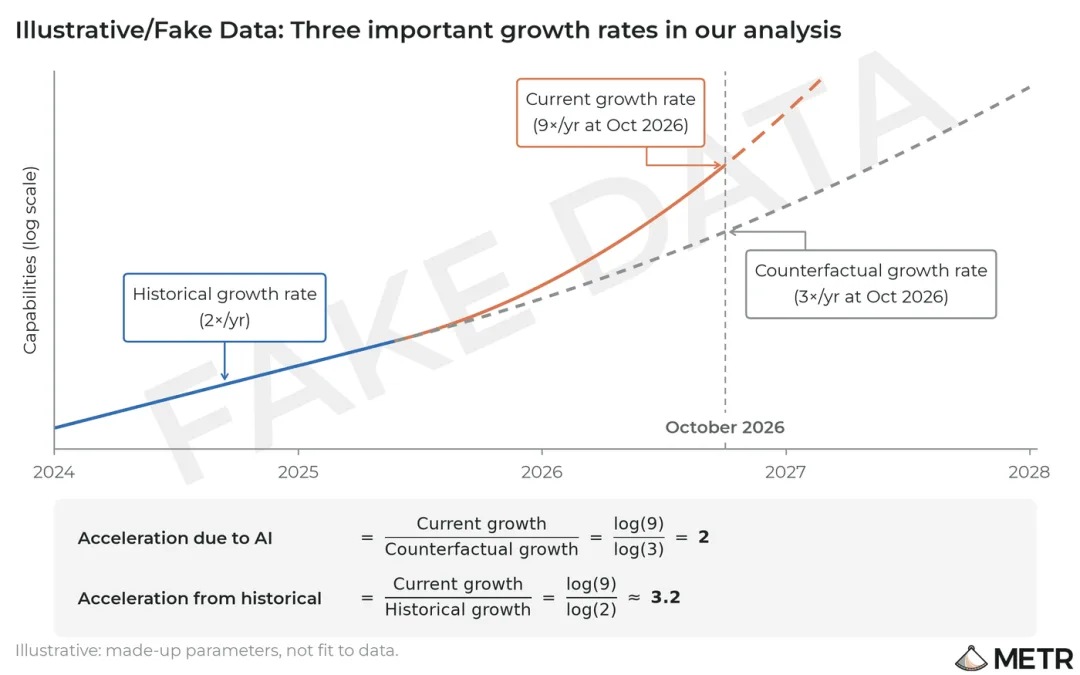
To find out where this driving force was coming from, METR separately accounted for compute, algorithms, and personnel investment.
METR explicitly ruled out the possibility of “accelerating by massively piling on training compute,” because after October 2025, the growth rate of training compute
was actually slower than before.The real driving force lay on the R&D side.
METR estimates that, of the current roughly 2x acceleration in R&D, the largemajority—about 80%—comes from AI's own R&D assistance, while only a small share comes from increases in researcher headcount and inference compute capacity.
Internal Employees: 12x Speedup
Throw 10 Ideas at an Agent at Once
Since no one outside Anthropic has yet been able to test Model 4 hands-on, the day-to-day testing by Anthropic's internal researchers has become the only window into it.
METR published a trend chart in its report based on an informal internal Anthropic survey and a company-wide Slack poll.
In spring 2025, when using 3.7 Sonnet and Opus 4, employees' self-reported efficiency gains were only 1.3x to 1.4x.
By June of this year, the self-reported speedup with Mythos 5 had jumped to around 5x.
By the time Model 4 came into use in October this year,employee self-reported R&D speedups had surged to around 12x, which, on an exponential fit, is equivalent to a 3.9x surge per year.
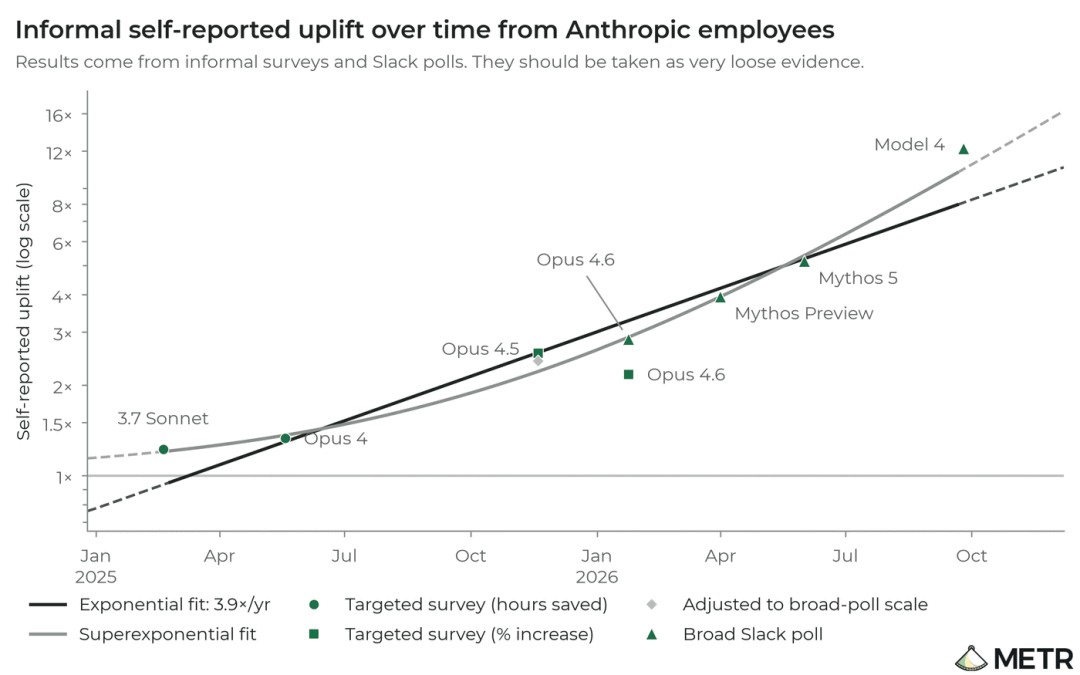
To understand where this 12x had come from, METR conducted in-depth interviews with 11 frontline technical researchers at Anthropic at the end of September.
Interviewee J summarized the changes in their workflow in three stages.
In the first stage, they merely used Claude for autocomplete and wrote the occasional one-off script.
The second stage shifted to humans monitoring a single Claude instance while having it develop complete features.
In the current third stage, an internal “all-in on Claude” movement took off, and researchers began directing large groups of Agents to run experiments in parallel.
According to researchers C, D, and E, the company launched a dedicated internal bounty this year, encouraging everyone to hand all the crazy ideas they would not normally dare try over to an AI Agent to run.
So everyone directly threw 10 research ideas at the internal Agent system all at once, to see which ones could produce results.

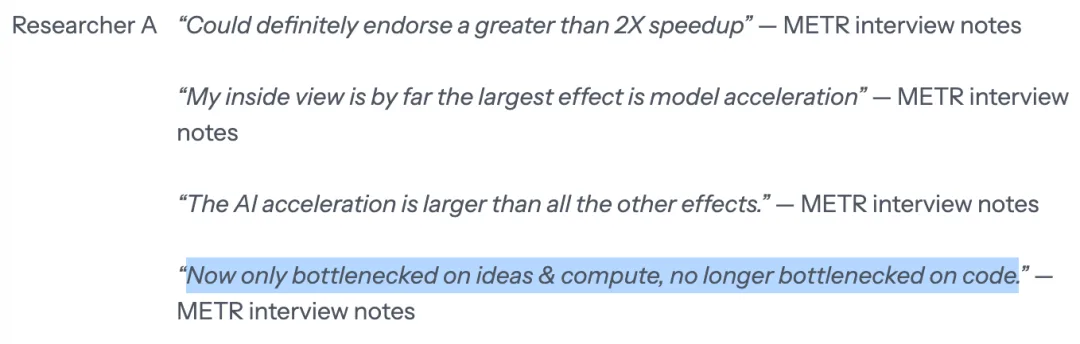
According to researcher A, manually writing code to run experiments had always been extremely time-consuming; with Claude’s help, the time from coming up with an idea to getting the experiment to work was cut by 80%.
In this researcher’s own words:
Now I’m only bottlenecked by ideas and computing power; I’ll never get stuck on writing code again.
Researcher B estimated a threefold overall speedup and said it felt as though they had suddenly gained several postdocs and graduate students who were available whenever called upon.
AI has not yet fully taken over core model-training design on its own, but several researchers confirmed to METR that autonomous AI contributions to core training had already begun to show clear “signs of life.”

The most jarring moment in the entire assessment is hidden in the pages that were not made public.
METR stated bluntly in an official post that they had submitted a full report of roughly 100 pages to Anthropic, but Anthropic removed most of the most information-rich core evidence from the public version.
Open the public version of the report, and the sensitive areas are littered with “[REDACTED]” blackout markers.
One table originally used to predict the capability scores of Anthropic’s new models over the coming months, together with the entire section of analysis, was blacked out in full.
In METR's view, over the next 12 months, whether it comes to algorithms, computing power, or data, they see no obvious bottleneck that would bring this accelerating machine to a halt.

A stronger Claude saves researchers 80% of their experimental time, and the time saved is immediately put to use incubating a Model 4 that scores 178.6.
And humanity's existing exam papers are already almost not enough for it to work through.
No bottleneck in sight, no brake found. And the speed is still doubling.
References:
https://x.com/METR_Evals/status/2118412183860351084
https://x.com/deredleritt3r/status/2118422855549358552
Editor: Moses Peach
Catching up to ASI in seconds
⭐Like, repost, and view — all three in one click⭐
Light up the star and lock onto New Intelligence's blazing-fast updates!