Dario has just called for a slowdown…
Tingyu, reporting from Aofei Temple
QbitAI | Official Account QbitAI
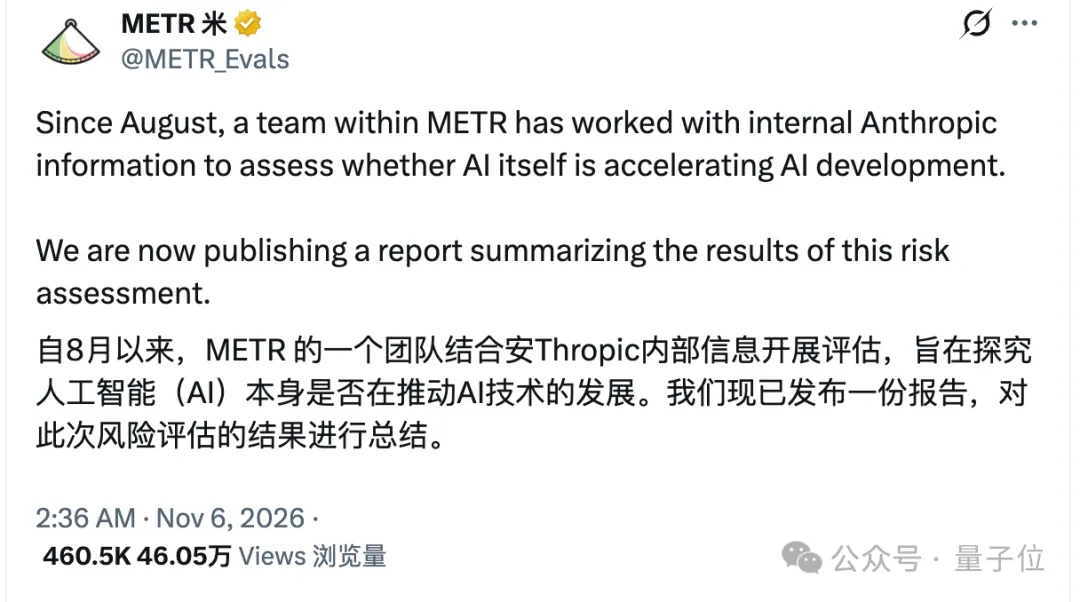
Anthropic’s three mysterious internal models have been revealed.
Model 2, Model 3, and Model 4.
Their real names have not yet been made public, but their training dates and some performance scores have already surfaced.
A new report from METR, a third-party evaluation organization, reveals that the three models completed training in July, August–September, and September–October of this year, respectively.
The strongest of them,Model 4, has already surpassed Opus 5.5 on Anthropic’s composite capability index, the AECI.
Anthropic co-founder Sam McCandlish also responded.
He agrees with many of the report’s assessments: AI is accelerating Anthropic’s R&D, although precisely how much is still difficult to measure.
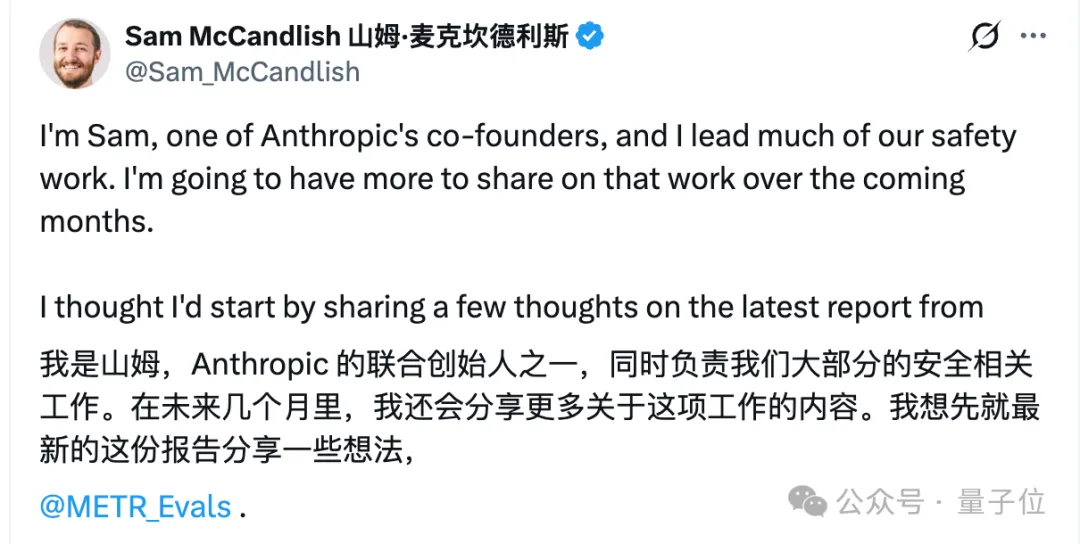
(Turns out Anthropic’s founder has a Sam too.)
In addition, Sam admitted thatthe publicly released report omitted a large amount of information.
He knew this would make it harder for outsiders to verify METR’s analysis. But in his view, the details behind the publicly disclosed acceleration in R&D both involve commercially sensitive information and could give other companies an “acceleration roadmap.”
What’s the story behind the three internal models?
How do the three models differ in capability?
TheAECI curve provides an intuitive point of reference.
AECI is Anthropic’s version of the Epoch capability index. It combines results from multiple internal and external benchmarks to track how model capabilities change over time.
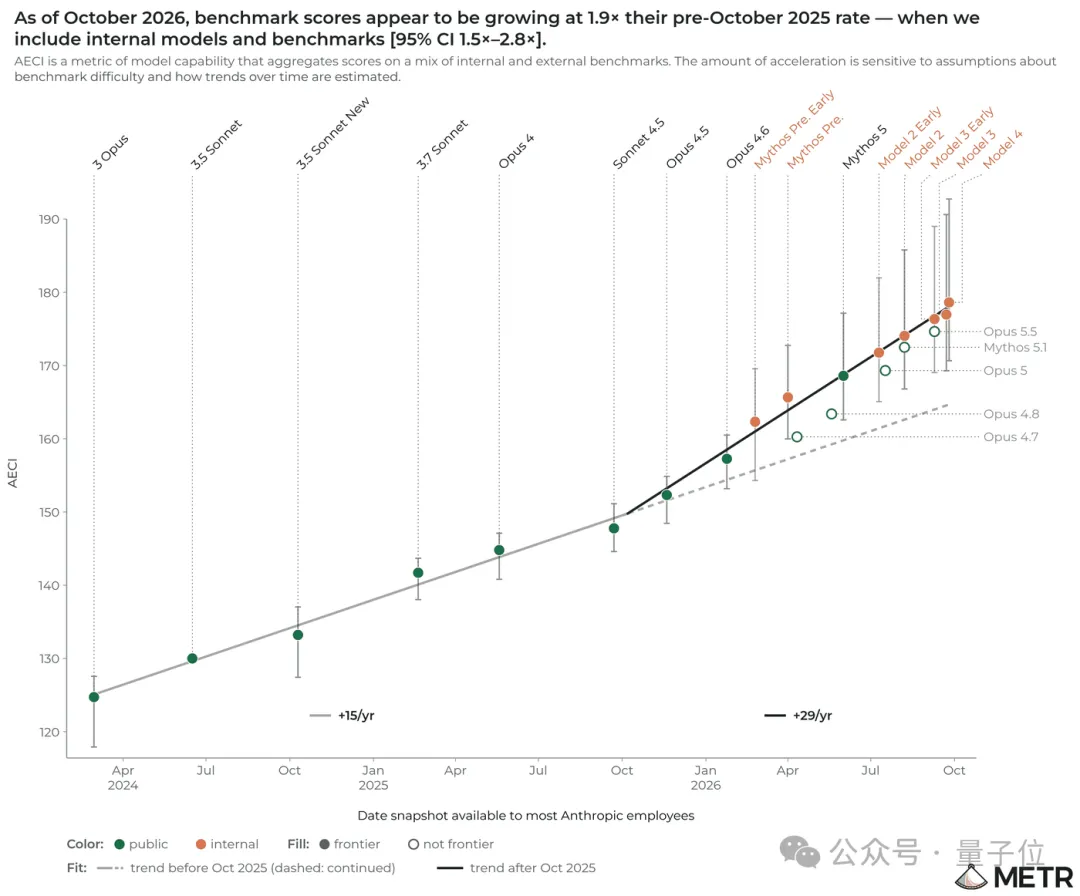
△ AECI score trends for Anthropic models; orange dots represent internal models, and green dots represent public models
As the chart shows, Model 2’s score is close to Opus 5.5’s, while Model 3 and Model 4 score higher.
Model 4’s AECI reached 178.6, the highest score among this group of models and about 3.9 points above Opus 5.5.
How significant are those 3.9 points?
Extrapolated from Anthropic’s past rate of capability improvement,this is roughly equivalent to three months of progress.
And when was Opus 5.5 released? A month and a half ago.
Looking at the overall trend, METR estimates that since October 2025, the growth rate of Anthropic models’ AECI scores has been about 1.9 times the previous rate,almost doubling.
Model 4 has another achievement: all 15 benchmarks included in its AECI evaluation have scores above 50%.
By comparison, about nine months ago, Opus 4.6 still scored below 50% on many benchmarks.
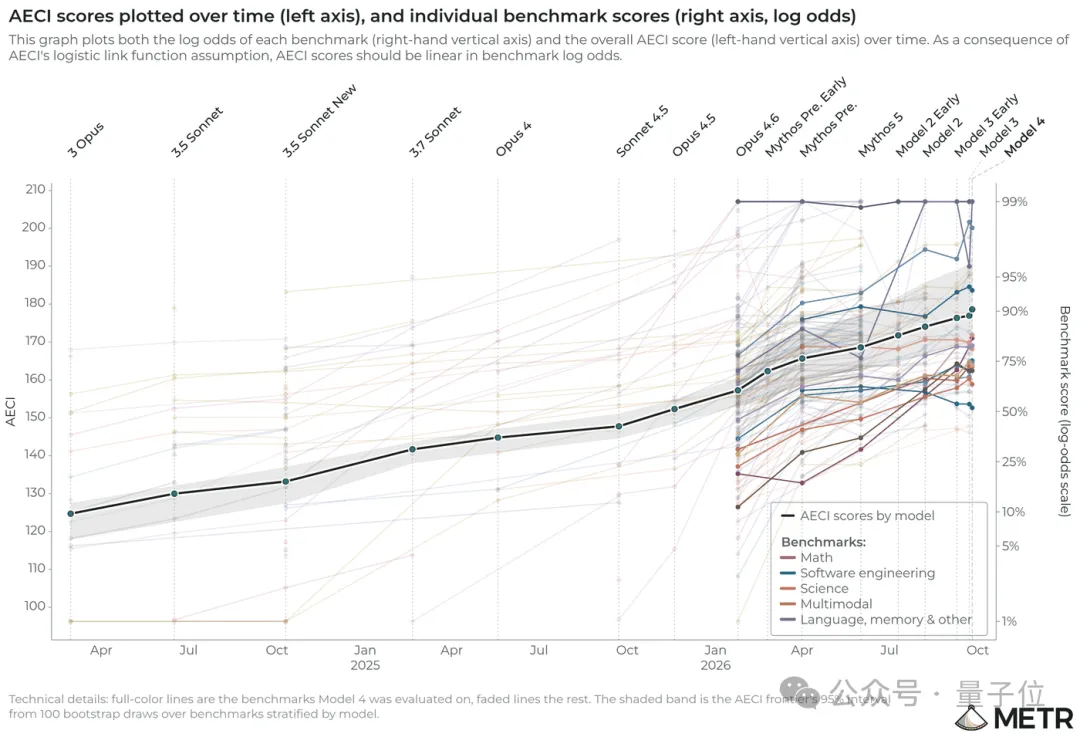
△ The highlighted curve represents the 15 benchmarks included in Model 4’s evaluation, all with scores above 50%.
That is some seriously fast progress…
This also led METR to worry that the high-difficulty tests capable of adequately challenging these models will soon be insufficient, making future capability evaluations increasingly difficult.
Well, METR, you’re worrying for nothing, because benchmark saturation is now extremely common—everyone is worried about it.
On Anthropic’s side, co-founder Sam McCandlish also came forward to respond.
He agreed with many of the assessments in METR’s report:AI is accelerating Anthropic’s R&D, but exactly how much remains difficult to measure precisely.
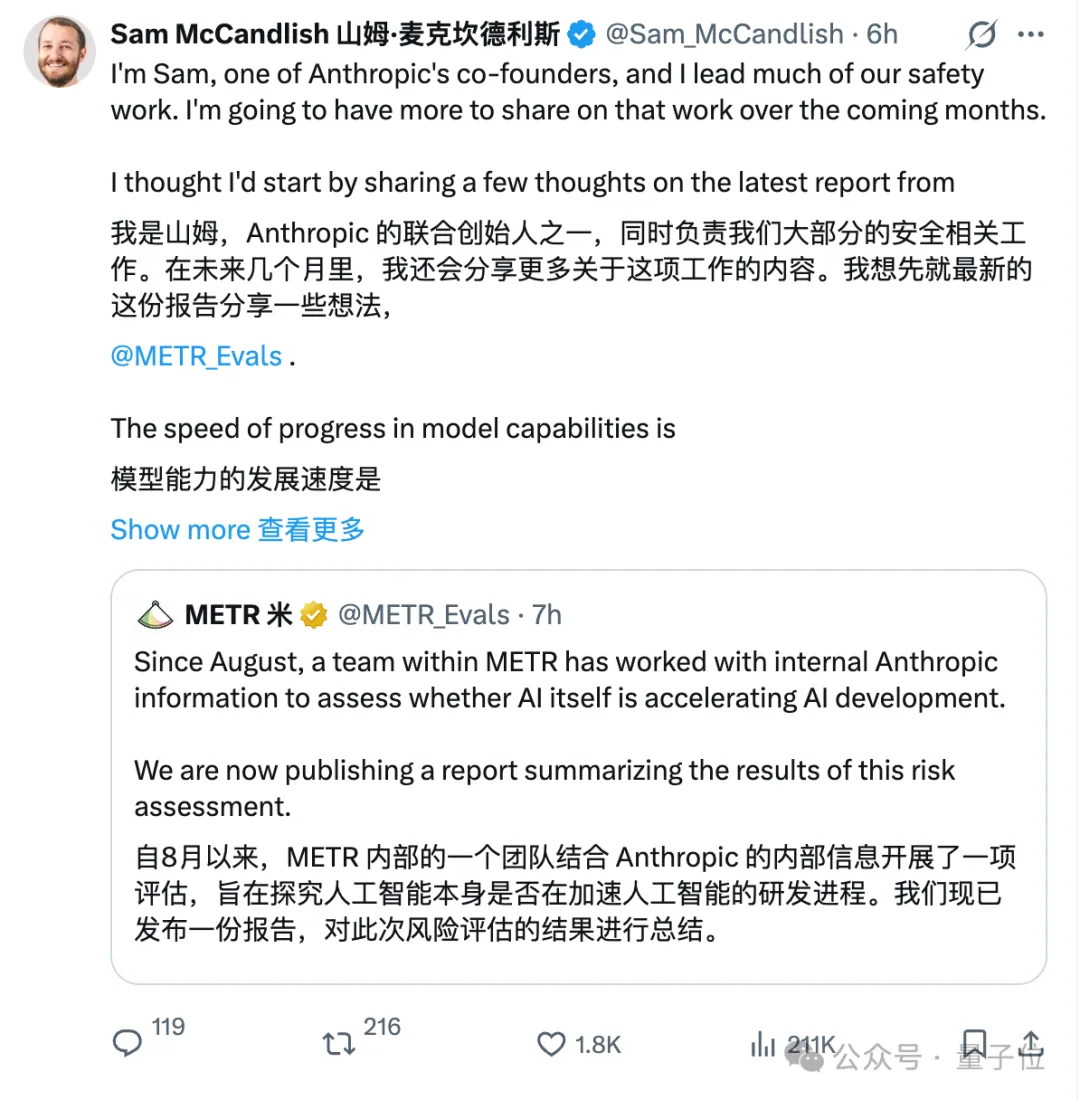
According to Sam, Anthropic provided METR with benchmark results for unreleased models, estimates of model progress, and opportunities to communicate with researchers, allowing evaluators to reach their own conclusions independently.
He also acknowledged that Anthropic removed a great deal of information from the report, making METR’s analysis harder for others to verify.
He also gave a preview:in the coming weeks, Anthropic will release its own analysis of its progress~
It will explain the pace of the company’s internal AI R&D, where the company stands relative to its Responsible Scaling Policy, and what new safety measures it plans to adopt.
After Claude began self-evolving, the next generation of models is arriving faster
Claude has already started building its own next generation.
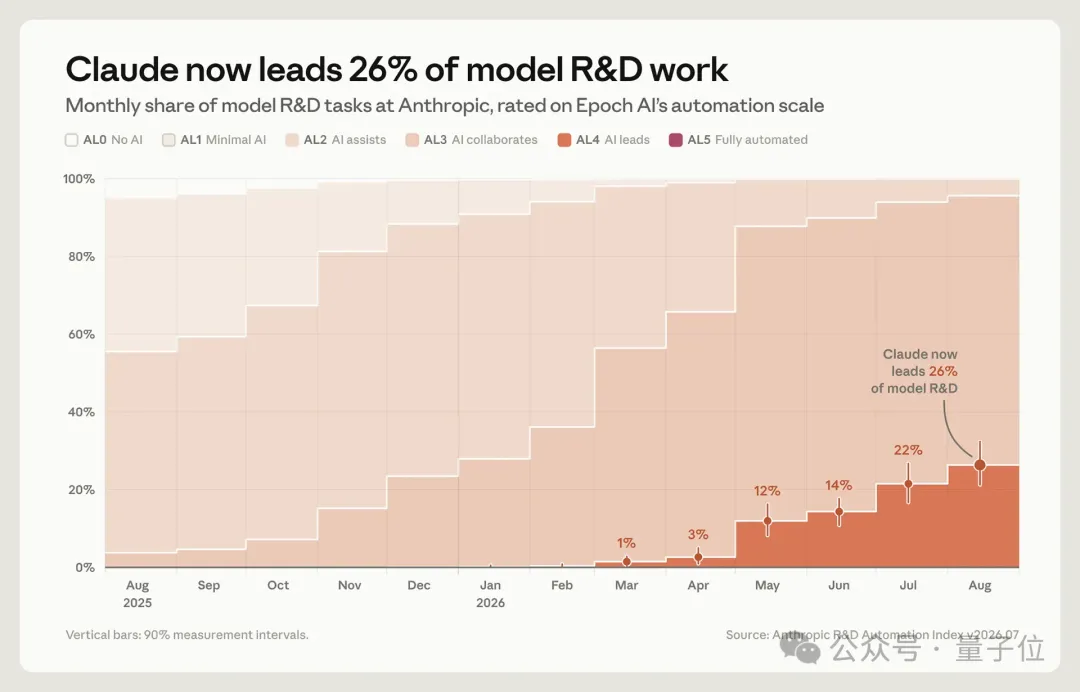
In September this year, Anthropic publicly released a set of data:
As of August, Claude had already led 26% of model-development work under human supervision. Six months earlier, that figure was less than 1%.
The latest publicly released METR report also includes interview excerpts from several Anthropic researchers discussing how AI has changed their R&D work.
One researcher interviewed said the time required from coming up with an idea to running an experiment had decreased by about 80%.
In his experience, code was no longer the main bottleneck; ideas and computing power were what truly held up progress.
Other researchers also noted that, with the help of Claude and agent tools, teams could try more ideas simultaneously and even discover directions they would not previously have devoted time to exploring.
Their accounts all shared a common point:Claude helps researchers turn ideas into experiments more quickly, giving R&D teams the opportunity to try more approaches.
If things continue along this path, more capable models may in turn become assistants in the next round of R&D, continuing to drive the progress of subsequent models.
METR also tends to believe that the widespread use of AI has contributed most of Anthropic’s current acceleration in R&D.
However, it also emphasizes that the acceleration at this stage comes primarily from AI assisting human researchers; fully autonomous AI R&D has not yet become the main source of overall progress.
In September, Dario also wrote a dedicated article calling on everyone to collectively slow down:
We must slow down the pace at which we improve the capabilities of AI models.

Dario must have seen some signs internally as well…
According to him, AI progress has notably accelerated since around this summer, driven primarily by AI’s growing ability to help develop the next generation of AI.
He is also concerned that this process could become so fast that it exceeds humanity’s ability to understand and control these systems.
Still, “screaming ‘brakes’ while pressing the gas pedal” is also Anthropic’s old trick…
One internal model after another is being exposed, with absolutely no sign of a slowdown😓

As everyone knows, Dario has always placed particular importance on safety.
A recent New York Times article also noted thatconcern about AI risks is precisely what drives Dario’s pursuit of technological leadership.
He believes that AI could pose enormous risks, so he hopes to develop the technology ahead of those who do not prioritize human safety and place it in the hands of people he trusts.
In his view: training should continue, but the company should leave enough time for alignment, safeguards, and third-party evaluations.
Let’s see how much effort Anthropic puts into safety while rapidly releasing new models~
Reference links:
[1]https://x.com/METR_Evals/status/2118412183860351084
[2]https://x.com/Sam_McCandlish/status/2118422266669371519
[3]https://www.nytimes.com/2026/11/05/technology/dario-amodei-anthropic-ai.html
[4]https://darioamodei.com/post/we-must-pace-the-frontier


