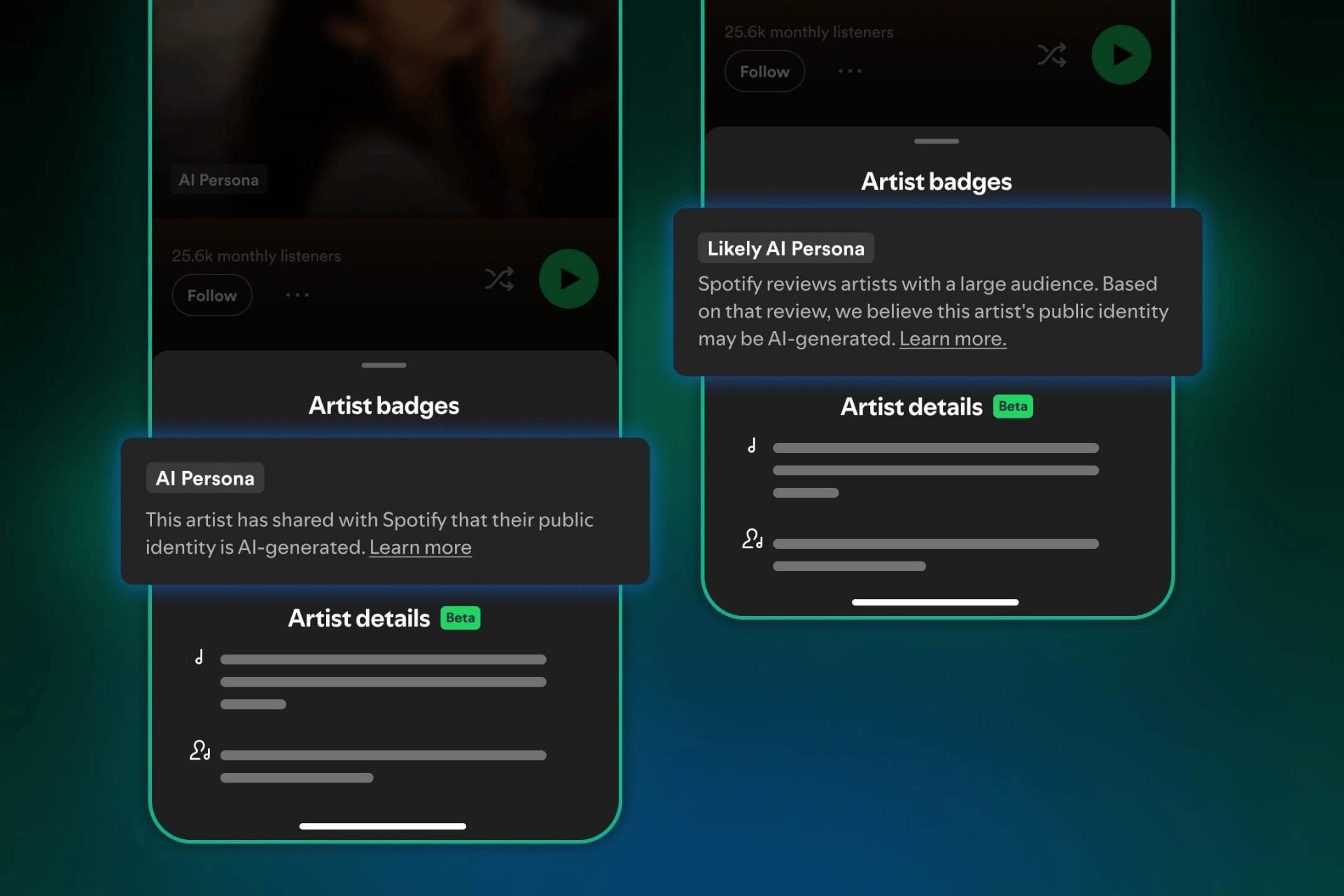
 © Spotify
A singer with 168,000 followers who never existed, songs generated on an assembly line, and listeners who see nothing but fire: Spotify is finally rolling out the labels. A Frenchman had shown the way.
On streaming platforms, artificial intelligence no longer merely assists musicians: it creates them from scratch, faces included. Spotify announced on Tuesday the rollout, starting from mid-September, of an “AI Persona” badge.It will flag artist profiles whose identity is AI-generated and does not correspond to any real person.
A badge that also reveals who cheated
The system initially relies on the goodwill of those concerned, since the human creators hiding behind these characters can declare themselves via Spotify for Artists. The mechanism extends the “AI credits” introduced earlier in the year, which make it possible to detail the use of AI in the production of a track. A coalition of artist and label organizations had, moreover, proposed a voluntary system of the same kind last month.
For the forgetful (or the discreet), Spotify is planning a process for reviewing suspicious profiles that have not declared anything, starting with artists exceeding certain audience thresholds, which were never specified in the announcement. The badge will appear on the profile banner, in the “About” section, in search results, and next to tracks in playlists. A delicious detail: the label will be clickable and will reveal whether the creator self-declared or whether Spotify had to unmask them. A little public humiliation by way of punishment.
The labeled characters will also disappear from algorithmic recommendations, except for listeners who already follow them. The loss of revenue may be very real. Enlly Blue’s flagship track—the singer has an airbrushed, Marilyn-style portrait and 168,000 followers—has amassed more than 29 million streams and could have earned more than $145,000.The song even climbed to 44th place in a Billboard chart of emerging artists in October. Behind the character, a decidedly human songwriter pockets the royalties.
A Frenchman had drawn his sword first, and he watches it all go by
Spotify, meanwhile, is not inventing anything here, since Deezer has explicitly been labeling AI-generated music since June 2025, a full year ahead of everyone else. The French company relies on an in-house detection tool deployed as early as January of the same year. The vantage point is unbeatable: more than 13.4 million AI-generated tracks detected and flagged in 2025 alone.
The pioneer’s figures show the scale of the tsunami. The share of fully AI-generated tracks among new daily releases rose from 10% in early 2025 to 50% in July 2026. It crossed 50% in June, with peaks of nearly 90,000 tracks uploaded per day. Yet this industrial output accounts for only 1% to 3% of streams, precisely because Deezer excludes it from its recommendations. That is the approach Spotify has just adopted.
The rest of the industry woke up this year, but in piecemeal fashion. Bandcamp has simply banned AI-generated tracks since January, while Apple Music has relied since March on a self-declaration-based labeling system, leaving the work to the record labels. Since July, Tidal has been labeling 100% AI tracks and stripping them of monetization. Deezer, for its part, plans to remove tracks that have gone unplayed for six months.In other words, Spotify wasn’t in any hurry.
👉🏻 Follow the latest tech news in real time: add 01net to your feeds on Google and subscribe to our WhatsApp channel.

Source: Spotify








- Google Play Store
- 4K Video Downloader Plus
- VLC Media Player
- Adobe Reader
- uTorrent
- WinRAR
- Xender
- Google Chrome
- CCleaner
- Mozilla Firefox
- Avast Free
- ChatGPT
- Microsoft 365
- Opera One
- Avast One










Download
- Google Play Store
- 4K Video Downloader Plus
- VLC Media Player
- Adobe Reader
- uTorrent
- WinRAR
- Xender
- Google Chrome
- CCleaner
- Mozilla Firefox
- Avast Free
- ChatGPT
- Microsoft 365
- Opera One
- Avast One


