zhidxcom
compiled | Jiang Yu
edited | Mo Ying
ZhiDongXi reported on November 12, that recently, the well-known venture capital firm a16z on its official website published an article titled "Welcome to the B2A Economy" (Welcome to the B2A Economy), putting forward a new judgment: AI Agents are becoming the main users of the internet, and companies in the future not only need to compete for human consumers, but also need to compete for the traffic and orders brought by AI Agents.
Over the past decades, internet companies have been trying to prevent robots from accessing websites, but now they may have to compete for the business of robots.
AI Agents have already contributed to most of the internet's traffic, written more than half of the new articles online, and generated most of the code deployed into production environments. As Agents shift from answering questions to executing tasks, they will increasingly replace humans in deciding which products to buy, which services to subscribe to, and where to spend money.
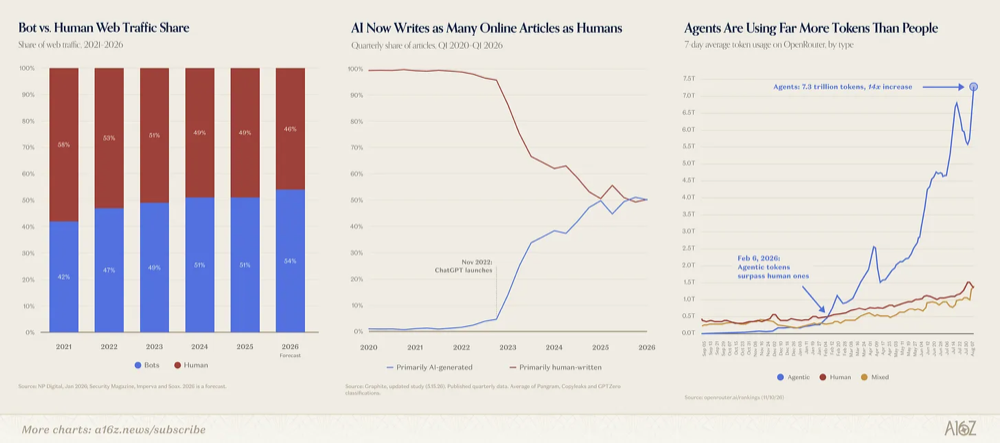
The article refers to this business model as B2A (Business-to-Agent), which is the economic model of enterprises targeting agents.
E-commerce platform Shopify disclosed that in the first quarter of 2026, the traffic from AI to its stores increased by eight times year-over-year, and the number of orders generated through AI search increased by nearly 13 times year-over-year. Cybersecurity company Human Security found that between August and October this year, the traffic from Agent browsers increased by eight times.
In the field of software development, Agents have already started to directly use third-party products. Database platform Supabase has more than 60% of its new databases created by AI tools, and cloud deployment platform Vercel has seen a 28-fold increase in deployments triggered by Agents over the past year.
The article believes that the business opportunities of B2A go far beyond AI shopping. When Agents start to replace humans in selecting and invoking products, the traffic distribution on the internet, software sales, and payment and authentication methods may all change accordingly.
I. AI-driven orders increase by nearly 13 times a year, the internet faces a new traffic entry point
Every platform change in the internet has changed the way users access services, and also created new business models.
In the Web era, enterprises could establish online stores accessible to anyone; in the mobile internet era, these stores were put into users' phones, giving rise to new products like Uber that rely on mobile devices.
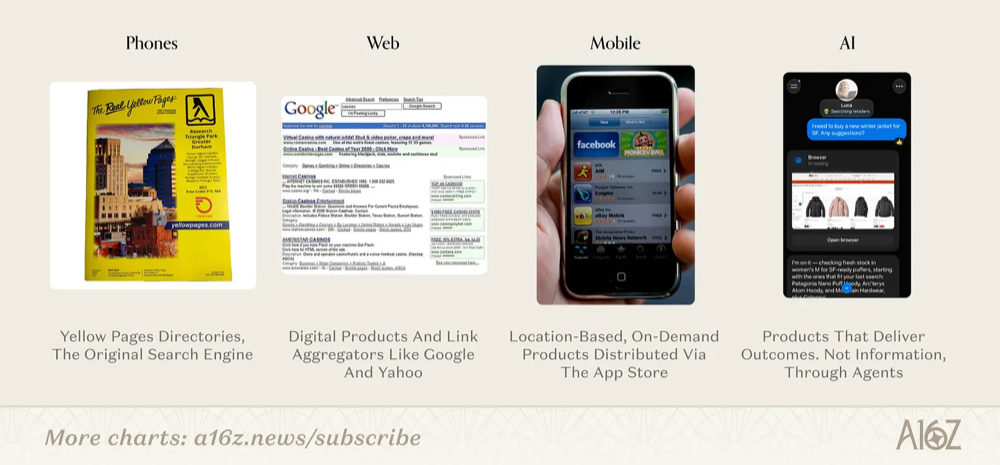
AI has already changed the tasks people can accomplish, but its impact on product distribution methods is just beginning.
The article argues that AI's development in product capabilities has far outpaced changes in distribution channels, which is also why, aside from ChatGPT, the large-scale popularization of consumer-level AI products remains limited.
If Agents can truly enter the daily lives of ordinary consumers and gain widespread use, AI will have the opportunity to make a leap from technological capability upgrades to internet platform changes.
Large model products such as ChatGPT, Claude, and Grok have already become important traffic sources for many enterprises.
Shopify disclosed that in the first quarter of 2026, the traffic from AI to its platform stores increased by eight times year-over-year, and the number of orders generated through AI search increased by nearly 13 times year-over-year.
Another set of data comes from the cybersecurity company Human Security. From August to October this year, the company observed an 8-fold increase in Agent browser traffic. Among this, Muse contributed about 60% of the activity, and products under OpenAI collectively contributed about 30%.
Compared to traditional search and advertising-driven traffic, Agent may become a more effective product recommendation channel. Agent has access to more specific user needs and preferences, allowing it to filter goods and services accordingly.The consumer traffic driven by AI recommendations has already shown higher user engagement, better revenue conversion rates, and lower bounce rates.
In the US, about 11% of consumers start their shopping process by visiting an AI service before proceeding to the actual transaction website.
As Agents gain more operational permissions, these traffic flows no longer need to appear as website visits. Users can directly request something from the AI, and the Agent can search for products, compare services, and decide which one to purchase.
For businesses, whether consumers can find their products will increasingly depend on whether the Agent is willing to recommend and use them.
ii. AI selects software and also recommends users to purchase paid packages
Agents can not only bring traffic to enterprises but also begin to directly decide which third-party tools to call.
Currently, most Agents still access the internet through browsers: either taking over the user's existing browser or creating their own virtual machines and browser instances, performing operations such as clicking, inputting, and page navigation to complete tasks like humans.
However, connectors, plugins, and model context protocols (MCP) are providing another way. Agents can directly access third-party tools and websites through these interfaces without relying on web operations.
The article compares this type of tool ecosystem to a more powerful Agent app store.
In the past, users had to compare software, register accounts, choose packages, and then operate different tools one by one. Agents can now connect multiple products around the final task.
AI platforms are gradually solving identity and authorization issues required for cross-product access.
For example, Sign in with ChatGPT allows users to log in to third-party products using their ChatGPT identity, providing a more convenient way for Agents to access external services.
As users can authorize their identity information or access tokens to third-party services, it will become easier for Agents to replace users in registering, using, and paying for products.
In the future, Agents will be able to select and install the tools needed to complete tasks without requiring human intervention one by one.
Claude already supports enterprise administrators to uniformly connect plugins for the entire organization, allowing enterprise employees to directly use these tools.
OpenAI recently launched Businesses in ChatGPT, enabling enterprises to claim their business information, add product data sources, and view how users interact with their business in ChatGPT.
As AI platforms integrate more third-party products into their own ecosystems, users may no longer need to directly open software or websites to complete tasks that previously required multiple applications.
Enterprises will also face a new challenge: how to ensure that Agents can find their products and prioritize using them when performing tasks?
iii. Four categories of opportunities in the B2A economy: from Agent applications to payment infrastructure
a16z categorizes potential beneficiaries of the B2A economy into four types, including companies that directly provide Agent capabilities and those that offer products and infrastructure for Agents.
- First category: Agent and large model companies.
Currently, agent products for consumers include independent applications such as Instinct, Muse, and Wabi.
However, in the future, agent capabilities may not necessarily exist only in dedicated agent products. As the underlying models gain stronger action capabilities, more existing products can directly perform tasks assigned by users.
Among them, ChatGPT has 120 million weekly active users, providing a significant user base during its transition to agent products.
- Second category: new products generated by Agent.
Amazon's business model relies on the internet, and Uber is built upon the foundation of widespread mobile internet usage. Agent may also lead to the emergence of previously unattainable product forms.
a16z mentioned three directions:
One is self-operating small and medium-sized enterprises. Agents can take on a large portion of the daily operations and management tasks within these businesses.
Two is transaction markets or network-based products mediated by AI. Agents can connect different users, merchants, and services.
Three is automatically optimized products, allowing agents to continuously monitor business operations. and adjust and optimize processes autonomously based on goals.
These products may no longer require users to repeatedly open software for operations, but instead be executed continuously by agents.
- Third category: existing companies optimizing for Agent.
As large models become a new source of traffic, the GEO (Generative Engine Optimization, Generative Engine Optimization) industry, which focuses on optimizing around generative AI search results, has already emerged.
Unlike traditional SEO, which mainly aims to secure search engine rankings, GEO helps businesses increase the chances of their products and content being discovered, cited, and recommended by large models.
However, GEO mainly addresses the issue of product discovery.
When agents have purchasing and execution capabilities, businesses not only need to inform AI about their products, but also need to be selected by agents when comparing multiple options, and ensure that agents can complete registration, subscription, or purchase smoothly.
This means that optimization for agents will extend from product discovery to product evaluation, selection, and transaction execution.
- Fourth category: Agent infrastructure companies.
To represent humans in completing tasks in the real world, agents also require accompanying payment, identity, anti-fraud, and communication tools.
Even with the relatively limited scale of agent usage currently, existing payment, identity verification, and communication systems have already begun to face pressure.
For example, after agents initiate transactions, payment platforms need to identify legitimate transactions from fraudulent ones; identity verification systems need to confirm whether the agent has obtained user authorization.
At the same time, agents also need to communicate with external users and services through channels such as iMessage, phone calls, and emails.
These systems were originally designed primarily for human users. As more agents begin to execute tasks, existing infrastructure will face new usage demands.
Currently, many large companies still block agent traffic due to concerns about fraud and chargebacks.
But if the Agent can continuously bring in high-quality customers and transactions, these companies may have to re-adjust their access rules, shifting from preventing robots to actively serving robots.
Four, AI creates 60% of new databases, programming Agents have already benefited a batch of software companies.
Changes in product usage driven by Agents have already appeared in the programming field.
According to data published by GitHub, as of September 2026, more than 40% of code merge requests (Pull Request, PR) on the platform start with drafts generated by Agents, compared to 17% six months earlier.
Agents are no longer just assisting developers to write a few lines of code, but are beginning to take on a series of tasks from development to deployment.
For example, when a user asks the Agent to build a website, it may need to call different services such as databases, cloud hosting, authentication, email sending, and monitoring.
Users only need to express their website-building needs, and the Agent can select the required external tools during the development process.
Therefore, the development of AI programming not only drives the growth of Agent products such as Cursor, Codex, Claude Code, and Cognition, but also promotes the development of natural language programming platforms such as Replit, Lovable, and Base44.
Companies that provide database, payment, and application deployment services have also received a large number of usage demands from Agents.
Database platform Supabase disclosed in June 2026 that more than 60% of new databases are created by AI tools.
Another database platform, Neon , disclosed in May 2025 that automated Agents have already contributed to 80% of its new database deployments.
Payment company Stripe disclosed in June 2026 that Agents contributed to nearly 40% of its document access traffic, as well as 70% of the command-line interface (CLI) requests targeting API resources.
Cloud deployment platform Vercel disclosed in October 2026 that in the past 12 months, the number of deployments triggered by Agents has increased 28 times.
In traditional software development processes, developers need to access databases, deploy, and handle payment platforms themselves, understand product features, and complete configurations.
Now, Agents can directly read documentation, call APIs, create databases, and deploy applications to the cloud.
The direct users of software companies are shifting from developers to Agents that perform tasks on behalf of developers.
In the global workforce, less than 1% are engaged in software development. If programming Agents have already driven the rapid growth in the usage of databases and cloud deployment services, then when the remaining 99% of the workforce starts using Agents to complete their work, the related service markets may undergo even greater changes.
The article argues that using "AI e-commerce" to summarize this market is far from sufficient. Agents will not only drive the transaction of physical goods and services, but also change the flow of traffic between digital products, token consumption, and revenue distribution.
Five, from job hunting to stock trading, a16z outlines seven Agent application tracks.
In addition to programming, AI Agents are entering the work and daily lives of ordinary people. At the end of the article, a16z provided two Agent economic ecosystem charts, one covering Agent applications for users, and the other covering the infrastructure that supports Agent operations.
Among them, the application landscape is divided into seven directions: general-purpose agents, work, travel, home, social, recruitment, and personal finance and investment.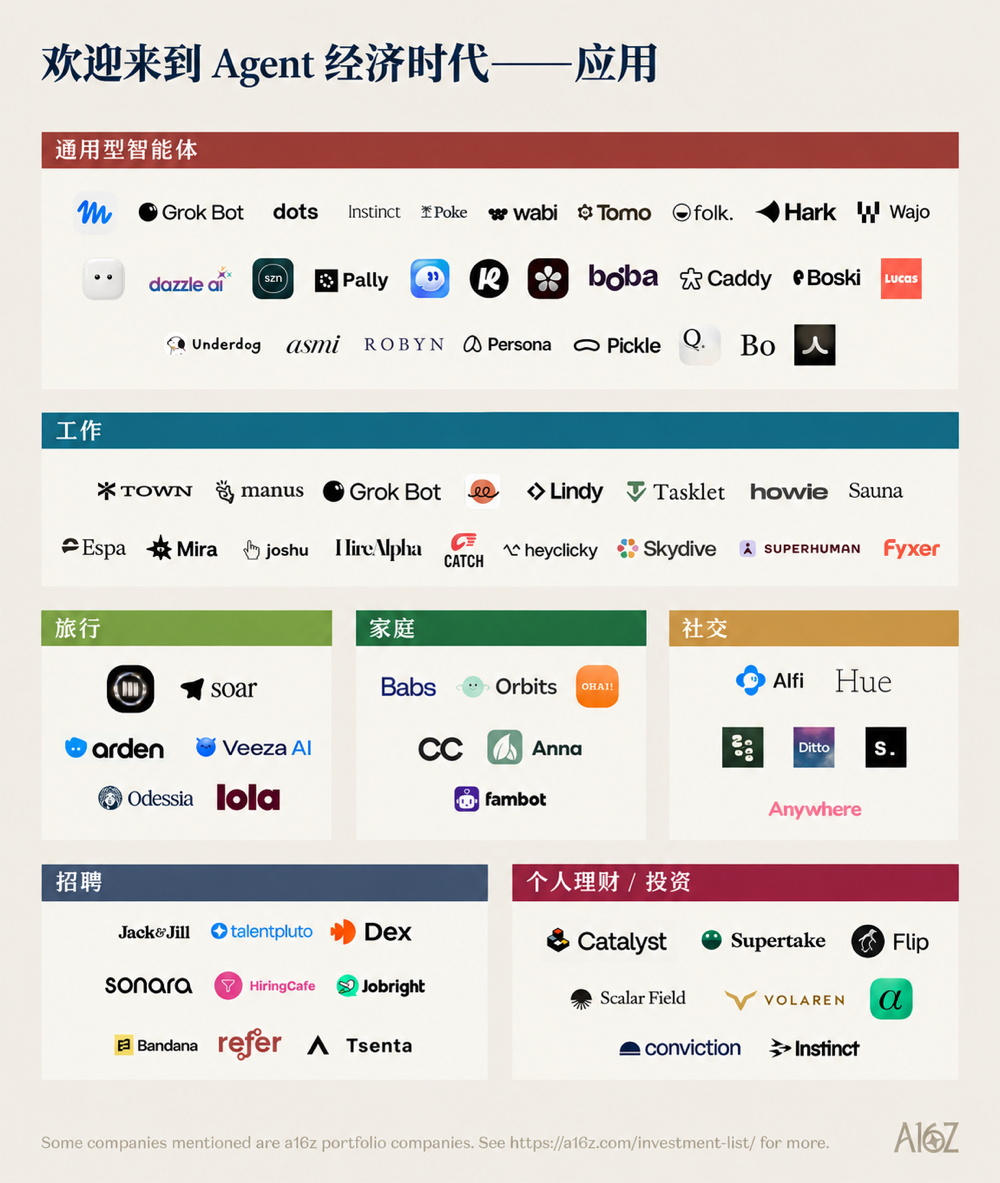
▲a16z's Agent application ecosystem map
(1) In the general-purpose agent field, giants such as Meta, xAI, and OpenAI have successively launched independent products.
In September of this year, Meta launched its personal AI Agent Muse, which can replace users in sending emails, booking travel, filling out forms, and purchasing goods. Muse has its own independent cloud virtual machine and browser, allowing it to continue executing tasks even after the user closes the app. Meta also integrated Stripe's payment tool Link, enabling Muse to directly complete shopping checkouts.
xAI, under Elon Musk's leadership, launched Grok Bot in August of this year, positioning it as an AI teammate that can work around the clock. Each Bot has its own computer and can log into the software users regularly use, handling tasks such as sales outreach, marketing activities, daily office work, and code fixes across applications, and initiating confirmations when user approval is needed.
OpenAI introduced Dots in September, also featuring an independent cloud computer capable of executing tasks around the clock. Dots can connect to over 4,000 applications via plugins and gradually learn users' preferences and work styles through long-term interactions.
(2) In the work scenario, Manus is a representative that achieved scaled commercial revenue earlier.
Manus can autonomously conduct tasks such as data research, data analysis, and web development according to user requirements. This year, Manus disclosed that its annual recurring revenue (ARR) has exceeded $100 million (approximately 667 million RMB), achieving this revenue scale within just 8 months since its launch.
Manus also disclosed that the platform has processed over 147 trillion Tokens and created more than 80 million virtual computer environments.
(3) Compared to general-purpose agents, products in vertical fields such as travel, home, and social are beginning to provide services around specific life needs.
In the travel field, Lola attempts to integrate hotel booking, restaurant finding, and itinerary planning into a single AI conversation.
Lola, supported by the travel booking giant Booking Holdings, can recommend hotels, restaurants, performances, and other activities based on users' budgets, travel preferences, and destinations, while also providing real-time pricing and booking services.
For example, users can inform Lola of their plan to attend a concert in a certain location, allowing the AI to arrange the itinerary around the event time and recommend nearby hotels and restaurants. Lola also launched a membership service, with the VIP package charging $25 per month (approximately 166.7 RMB).
In the home field, Ohai.ai attempts to have agents take on household management tasks such as scheduling, reminders, and appointments.
Users can allow Ohai to integrate family members' calendars, organize school and event notifications, and send task reminders to other family members. In August of this year, Ohai collaborated with Ferry Health to launch a medical appointment feature, enabling users to directly request the agent to help family members schedule, reschedule, or cancel doctor's appointments.
In the social scenario, Alfi has already processed over 60 million messages.
Alfi, developed by Text.ai, can join users' group chats and help friends organize gatherings, recommend restaurants, create schedule reminders, and even directly book restaurant reservations within the chat. Its products have covered over 500,000 users, with more than 60 million messages processed in total. Unlike ordinary chatbots, Alfi also remembers the dietary preferences and shared experiences of group members, offering suggestions for group social activities. Similarly, the recruitment field is also a concentrated area for Agent applications. Among them, Jack & Jill simultaneously serves job seekers and recruitment companies with AI Agents. Job seekers can communicate with AI Agent Jack to exchange information about desired positions, salaries, and locations, and have it help find suitable job opportunities; companies can use Jill to find and contact candidates. According to the recruitment report released by Jack & Jill in November this year, over 400,000 candidates have already had conversations with Jack. Another company, Sonara, which is also included in the map, focuses on automated job searching. After users set their job preferences, Sonara can continuously search for positions that match the criteria and apply on their behalf. In the field of personal finance and investment, Agents are moving from providing investment information to formulating trading strategies. In September this year, the venture capital firm Union Square Ventures launched an incubation project called Supertake, attempting to help users convert their market trend judgments into actual investment portfolios. For example, users can express an investment view that a certain industry will experience rapid growth in the future, and Supertake uses AI to analyze the relevant markets and assets, and builds an investment portfolio around this view. Another investment Agent, Volaren, can connect users' bank and securities accounts, monitor changes in holdings, analyze market information, and prepare or execute trades within the user's set permissions and budget. Volaren supports interaction with users via text messages, and when the AI proposes a trade suggestion, the user can directly reply to confirm. Overall, the services of Agents have covered different fields such as consumption, work, and finance. Users no longer need to operate multiple software separately, but can directly request services from Agents, which will find and call the relevant services for them. Six, Agents need their own browsers, email, and wallets, and Infra companies have started to compete for business. If AI Agents are to complete the above tasks on behalf of people, they also need to be able to access websites, log in to accounts, contact external services, and complete payments. a16z has further divided the Agent infrastructure into seven directions: search and access, account access, real-world tasks, computer and mobile device usage, messaging communication, memory and personalization, and payments and settlements. ▲ a16z's map of the Agent infrastructure ecosystem (1) In the field of search and access, Exa has become one of the representative companies in the Agent search market. Unlike traditional search engines aimed at human users, Exa mainly provides web search and data retrieval capabilities to AI applications through APIs. According to market research firm Sacra, Exa's monthly search volume increased from about 1 billion in April to about 2 billion in October. The estimated annualized revenue in September reached $100 million (approximately 667 million RMB), a growth of about 10 times year-on-year. This field also includes tools that help Agents obtain product information, such as Shopify Catalog, tools that enable Agents to invoke external tools, such as Composio, and platforms that provide personnel data search, such as Ploid. (2) In the account access field, password management company 1Password has already launched a product specifically for Agents. On October 22nd of this year, 1Password released 1Password for Agents, allowing Agents to log in to third-party websites and services without directly accessing and storing users' passwords. For example, when an Agent needs to log in to a website to complete a task, 1Password can initiate an authorization request to the user. After the user approves, the system will automatically fill in the login credentials on the page, and the Agent does not need to read the actual password. (3) In the field of real-world tasks, platforms that allow AI to hire humans have emerged. For example, RentAHuman allows Agents to post paid tasks via API or MCP to find individuals who can perform real-world tasks. These tasks can include on-site photography, checking stores, retrieving items, or product testing and data collection that require human involvement. The Agent is responsible for posting the request, screening personnel, managing tasks, and arranging payments. Once the hired person completes the work, they submit the corresponding proof. (4) In the field of computer and mobile device usage, companies such as Browserbase and E2B have begun to provide runtime environments for Agents. Browserbase provides cloud-based browsers for Agents, enabling AI to access websites, fill out forms, and operate web pages as a human would. Its platform runs over 35 million browser sessions per month and serves more than 10,000 customers, including Microsoft, Ramp, and Lovable. E2B provides isolated cloud computing environments for Agents, allowing AI to run code, perform development tasks, or test applications. As of October of this year, E2B has launched over 2 billion sandbox environments, and the monthly download volume of its related SDK has exceeded 15 million times. In terms of mobile device operations, products such as Phone Use also offer cloud-based phones and simulators, enabling Agents to invoke mobile applications, read the screen, and perform actions such as clicking and inputting. (5) In the messaging and communication field, Agents are beginning to have their own phone numbers and email addresses. Linq provides APIs for iMessage, RCS, and SMS communication, allowing developers to integrate these capabilities into Agents, enabling them to communicate with human users via text messages. Its infrastructure has processed over 200 million messages. In terms of email, AgentMail specifically provides email services for AI Agents. Developers can create independent email addresses for Agents via API, allowing them to send and receive emails, manage conversations, and interact with other services through email.(6) In the memory and personalization domain, companies like Mem0 are trying to solve the long-term memory issue for Agents.
Agents need to remember users' past preferences, completed tasks, and progress on long-term projects. Mem0 provides independent memory storage and retrieval capabilities, extracting important information from conversations and invoking it in subsequent tasks, reducing the need for repeated input and the token cost of long context.
(7) In the payment and settlement domain, a16z further divides into four sub-directions: agent payment, agent account and spending control, identity and trust, and checkout.
Among them, Crossmint has launched payment tools for Agents, supporting Agents to purchase goods and services using bank cards or stablecoins.
In October this year, Crossmint released the Agent Commerce Toolkit, integrating capabilities such as bank card credential management, agent payments, and merchant checkout into a single development toolkit.
Nevermined focuses on payment authorization and spending control for Agents. Users can predefine the payment budget, number of transactions, and validity period for Agents, allowing them to purchase external APIs, computing resources, or other services within the authorized scope.
Identity verification company Prove has launched products related to agent identity authentication and payments, helping merchants verify which user the Agent represents and what transaction permissions it has obtained.
For the checkout process, Rye provides a general-purpose checkout API, helping Agents handle processes such as product pricing, taxes, shipping costs, and order payments.
For example, when an Agent has already helped a user select products, Rye can further process the checkout flow on the merchant's website, converting product links into actual orders.
From Exa providing search, to Browserbase executing web operations, to 1Password handling logins, and Crossmint completing payments, when an Agent executes a task, it can continuously call the infrastructure of multiple companies in the background.
These companies do not need to directly face end consumers, and may also gain more API usage, software subscription revenue, and transaction revenue as the scale of Agent usage expands.
Source: A16Z NEWS
@@TAGn@@