


OpenAI is changing the way ChatGPT presents answers. With the arrival of GPT-6, the company began to release a new interface called Intelligent UI, capable of combining text, images, and interactive elements within the conversations themselves.
Instead of responding only with text or static images, ChatGPT could create resources such as interactive charts, diagrams, buttons, forms, and custom calculators for each question. The idea is to adapt the interface to the type of task requested by the user.
According to OpenAI, GPT-6 was trained to decide how to present each answer. A comparison might appear side by side, while an explanation of a complex concept could gain an interactive diagram. When text is sufficient, the system could simply respond in the traditional way.
ChatGPT will start creating tools during the conversation
- One of the most interesting novelties is the possibility of asking the chatbot to create a specific tool for a certain task;
- OpenAI cites examples such as a calculator to track savings growth, a tool to split a dinner bill among friends, and even games that can be run directly in the conversation;
- The company also showed applications for everyday situations. The system can present a recipe with visually organized information, create a map for a trip, or generate a representation of an activity the user is trying to understand;
- In a demo presented to TechCrunch, OpenAI showed the case of a student who wanted to understand how an airplane wing produces lift. When making the question, ChatGPT quickly created a series of diagrams to explain the functioning visually;
- The technology can also be used to explain bicycle mechanics, organize a multi-day trail, or help someone visualize how much their savings could grow over time.
Responses can be manipulated by the user
The difference compared to simply inserting images in responses lies in the possibility of interaction.
The elements created by Intelligent UI can include buttons that can be activated, graphs that can be modified, and other components with which the user interacts directly. OpenAI claims that the technology allows, for example, to alter an input to observe how it changes the result of an explanation.
For this purpose, the company created a library of native components that can be combined by the model. A compiler processes the interface while it is being generated, allowing parts of the response to appear progressively without needing to wait for the conclusion of the entire response.
OpenAI also trained GPT-6 to make decisions on content, organization, visualization, and interaction, evaluating the produced interfaces according to criteria such as clarity, usefulness, and completeness.
Read more:
- OpenAI is criticized by a former employee who warns about AI risks
- ChatGPT starts to display ads next to generated images
- OpenAI will place an invisible watermark on ChatGPT texts
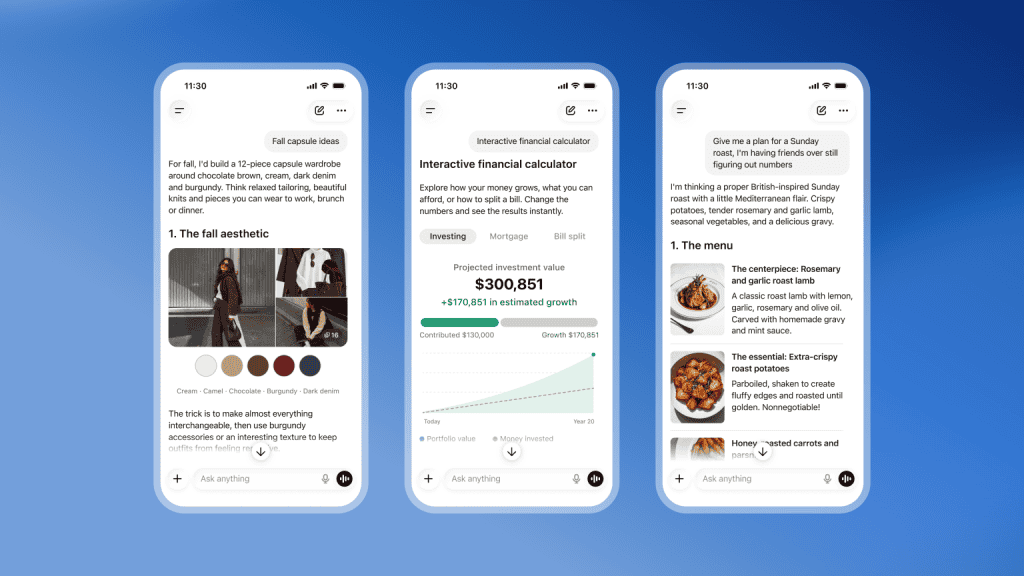 Example of using the new ChatGPT interface – Image: Disclosure/OpenAI
GPT-6 also changes the way it responds
The new model does not represent just a visual change. According to OpenAI, GPT-6 was also developed to start responding more quickly and continue thinking while providing additional information.
Instead of waiting for the completion of the entire reasoning process to deliver a response, the model can interleave thought and response, building the information progressively. The company states that the goal is to reduce wait time without compromising the quality of the final response.
In an internal evaluation involving agent tasks considered important for daily use, the GPT-6 Extra High would have started responding within the same interval as the GPT-5.6 Medium, but achieved an overall score higher than that of the GPT-5.6 Extra High.
For questions requiring web research, OpenAI states that the GPT-6 Instant begins to respond, on average, 44% earlier than the GPT-5.6 Instant. The company also states that the model has improved in deciding when to research and in its ability to find information supporting its answers.
Security was also strengthened
OpenAI states that the GPT-6 received security improvements based on real user experiences.
Training was updated to strengthen protections against high-risk uses involving cyberattacks, biological threats, and violence. In adversarial tests, according to the company, the model showed greater resistance to attempts to bypass its protections, especially when attacks adapted over multiple interactions.
The model also began using conversation history and relevant context to identify risks that might not be apparent in a single request. OpenAI still claims that GPT-6 has improved in identifying and communicating its own limitations.
When will the new ChatGPT be available?
The GPT-6 with Intelligent UI has started to be released globally on this Thursday (7) for users of the Plus, Pro, Business and Enterprise plans on ChatGPT.
Starting from Friday (8), the distribution will be expanded to the Free and Go plans. In Enterprise, availability depends on the settings defined by the organization's administrators.
In the Plus, Pro, Business and Enterprise plans, ChatGPT uses the GPT-6 Sol; in the Free and Go plans, the experience uses the GPT-6 Luna. The change applies to the Chat experience, while the models used in Work and Codex are not altered by this release.
The Intelligent UI can also be customized. Users who prefer answers with fewer visual elements can reduce the amount of graphical resources displayed.
With this new feature, OpenAI now treats its own interface as part of the response. Instead of forcing the user to learn how to operate a ready-made tool, the proposal is that ChatGPT build a specific experience according to what the person wants to do.

Rodrigo Mozelli is a journalist graduated from the Universidade Metodista de São Paulo (UMESP) and, currently, is a writer at Olhar Digital.


