The model is about to be open-sourced
Yishui, from Aofei Temple
QbitAI | WeChat Official Account QbitAI
Just now, Baidu released a new model, and netizens on X could hardly contain their excitement after seeing the demo.
Is Baidu finally stepping up??
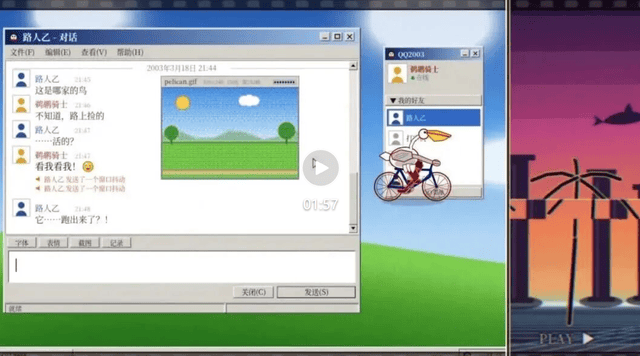
Everyone is saying that “a pelican riding a bicycle” is already old and outdated, but have you ever seen a version like this?
Video URL: https://mp.weixin.qq.com/s/Rj-T8unLFnHUk6R89rt02Q
△Concept design by Bilibili creator @近步抱告_
A pelican riding a bicycle journeyed from a 4,000-year-old Saharan rock painting straight into the code editor of the large-model era.
116 seconds, 20 artistic styles, with the entire animation orchestrated through Python code.
All we can say is that the pelican is still that pelican, but the玩法 is now on an entirely different plane...
And this is just the appetizer.
Right after making the animation, the model behind itturned around and dove into Unreal Engine 5.8, working continuously for 11 hours to create an Eastern wuxia game, “Yunxiu Xing”.
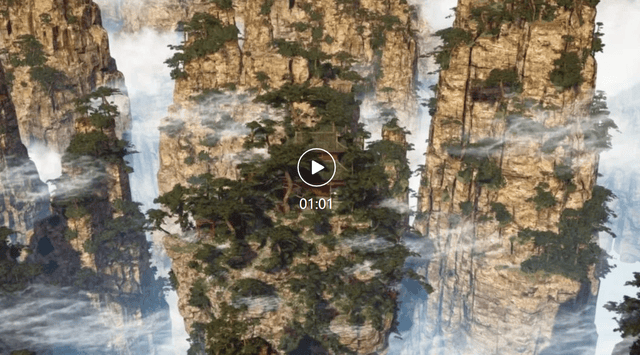
Zhangjiajie stone peaks, ancient temples atop cliffs, character movements, game logic... it handled everything.
Hold on, bro—first using code to make an animation, then using code to build a game; just what kind of trump card has Baidu been holding back this time??
The answer is revealed:
ERNIE 5.5 Flash Preview(ERNIE 5.5 Flash Preview).
Just one day before the Baidu World Conference, this new model officially made its debut and was announced as soon to be open-sourced.
With 280 billion total parameters, only 14 billion parameters are activated per inference, it supports a context window of one million tokens and generates at over 200 tokens per second.
And this time, the skill tree ERNIE focused on lighting up had just two words:
Programming.
Mind you, programming here long since means more than writing web pages or completing code. The model can also directly tackle complex tasks such as game development, 3D modeling and video arrangement that require consecutive tool calls and repeated testing and revisions.
In programming and agent evaluations such as Terminal-Bench and AutomationBench, ERNIE 5.5 Flash Preview has already demonstrated the strength to compete on the same stage as flagship models such as Claude Opus 5.5 and GPT-6.1 Sol.
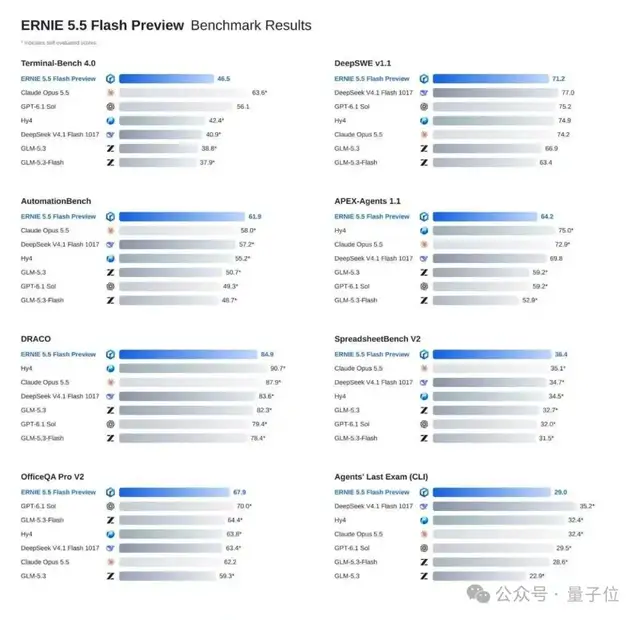
The mood has been built up to this point, so let's put it through its paces.
3D, games, web pages... ERNIE 5.5 Flash Preview, bring it on. (doge)
Hands-on test of ERNIE 5.5 Flash Preview
The model is currently available to try on both the web and through the API.

First question: let's start with a formidable character from the Classic of Mountains and Seas.
Nine-tailed fox.
But this time, I’m going to have Wenxin use code to create an animation of “a bronze mechanical beast awakening.”
Starting with an ancient manuscript, gears, armor plates, and a skeleton fly into motion on their own before assembling into a nine-tailed mechanical beast.
No external assets are allowed at any point; modeling, animation, and rendering must all be done with Python.
When I saw the result,
holy cow, this is no nine-tailed fox—it’s clearly a cyber-mechanical beast straight out of the *Classic of Mountains and Seas*!
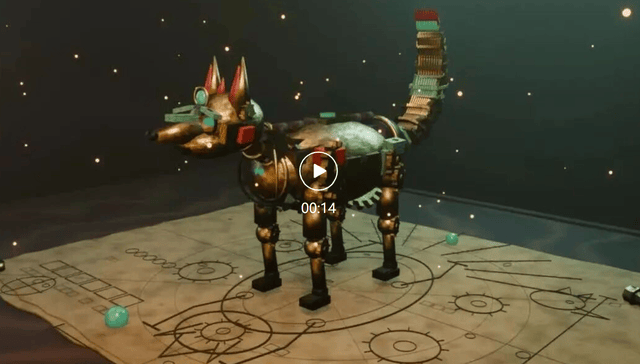
Video: https://mp.weixin.qq.com/s/Rj-T8unLFnHUk6R89rt02Q
If it can make videos, what about games?
For the second challenge, I decided to crank up the difficulty:build a playable “Backrooms.”
And it can’t get away with building just one yellow corridor; Wenxin has to create a complete collection and completion system—
the player needs to find three VHS tapes in a maze, encounter an entity chasing them along the way, and have stamina, failure, and exit mechanics. The final deliverable must be a webpage that can be opened directly in a browser.
In the end, Wenxin served me up a complete, single HTML file.
No game engine to install and no extra environment to configure—just click and play.
Yellow wallpaper, damp carpet, buzzing fluorescent lights, and an old VHS filter—the atmosphere was instantly there.
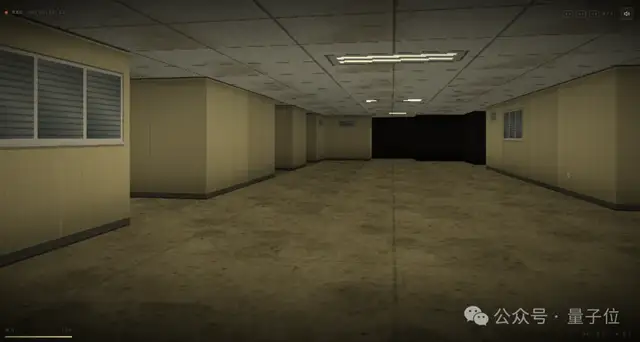
At first, I was still pretty relaxed.
All I was doing was wandering around the corridors and looking for the tapes along the way.
Then…
in one run, I suddenly got caught red-handed.
Holy cow, it gave me quite a fright out of nowhere.
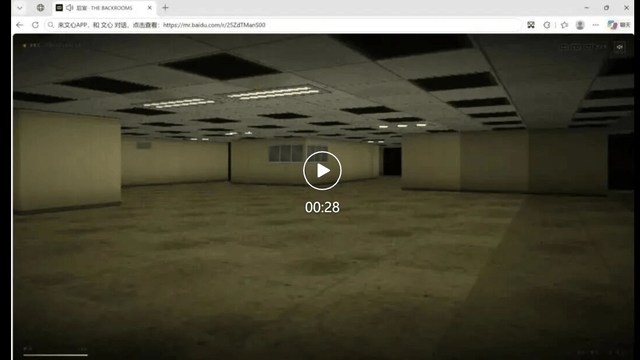
My heart was beating too fast, and it felt a bit too otherworldly, so let’s go with something beautiful from the human world instead.
For the third challenge, I’m going to throw Wenxin straight into Blender and have it build a Suzhou garden from scratch.
All the architecture, plants, water surfaces, and camera animations have to be built piece by piece through Python calls to the Blender API.Then Wenxin got to work building the garden in Blender, laboring away at it.
About half an hour later, the model returned the following “one-shot” result.
Honestly, the result did genuinely impress me…
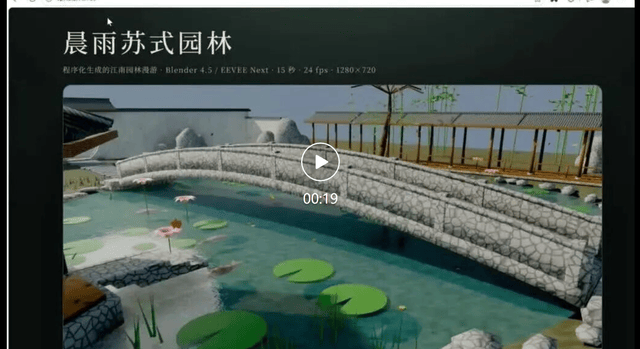
Anyway, this first hands-on test was, at most, an initial assessment.
The official complex demos that often take more than ten hours to run inevitably involve more detailed task design, tool coordination, and repeated debugging.
The upper limits of Wenxin 5.5 Flash Preview’s capabilities still need further testing.
But after this round of testing, I’m very curious about one other thing:
Both involve Coding, so how did ERNIE this time connect the “end-to-end chain” from understanding requirements to delivering the final project?
The answer may lie in a capability that even Jeff Dean once underestimated.
The “coding” Jeff admits he underestimated: what ERNIE has focused on making up for this time
Not long ago, during his conversation with Fei-Fei Li, Jeff Dean voluntarily admitted that he had misjudged one thing—
programming.
Gemini was also being trained on Coding in its early days, but coding was not placed at the very core. Only later did he realize that the impact of programming ability on a model’s ability to solve all kinds of problems was far deeper than imagined.
Put simply, programming is like a pair of hands growing out of a chat window. With them, a model can move beyond the realm of “armchair strategizing.”
But as things progressed, everyone’s expectations for programming grew higher and higher.
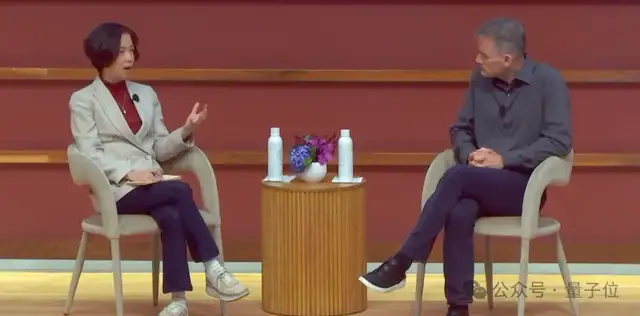
△Image source: YouTube account @stanfordhai
AI can already write code quite well. It can build a webpage or fix a bug and produce a result within minutes.
But when it really has to complete a project independently, the trouble begins.
Breaking down requirements, configuring the environment, testing and debugging—every step requires human supervision.
This is wild: so much for AI writing code, and yet humans still have to tag along for the entire run...
So ideal Coding should be:
Requirements go in, and a finished product comes out.
You just tell the AI what you want to build; breaking down tasks, writing code, invoking tools, testing, and fixing bugs are all completed by the AI itself, step by step.
This is what “end-to-end” means, and it is the capability ERNIE has focused on adding this time.
How exactly did ERNIE make up for it? Start with one number:
14 million.
This is the number of executable code tasks Baidu prepared for ERNIE 5.5 Flash Preview.
The number is large, but what matters even more is“executable”.
Every piece of code has to be thrown into a real environment and run, and the results are then used to determine whether the task has been completed.
However beautiful the code may be, it is all for nothing if it cannot run.
Think you can finish writing the code and turn it in?
Sorry, it is not that easy.
As for how to identify problems after the code is running and continue making changes, Baidu also used multiple Agent execution trajectories to teach the model when it should use tools, how it should interpret feedback, and how it should fix things when errors occur.
The case of “Yunxiu Xing” makes this easier to understand.
During development, the model encountered problems such as characters floating in midair, running in the wrong direction, and incorrect camera positioning.
But ERNIE 5.5 Flash Preview is a text-only model and cannot directly inspect the game screen to find bugs.
What should be done?
Baidu converted these visual problems into data that code could check, then had the model continue making revisions based on the test results.
And so it ran the game, checked for problems, modified the code, and then ran it again.
The debugging process that previously required developers to watch the screen was also built into the model’s own work cycle.

Of course, mastering this Loop doesn’t mean it can handle every kind of work.
Websites, games, 3D modeling, and video creation all look like coding, but the way they work under the hood is completely different.
So Baidu has been giving the model focused supplementary training for each specific use case..
When making games, it needs to understand gameplay mechanics and runtime state, while also supporting engines such as Unreal Engine, Unity, and Godot.
When it comes to Blender and CAD, it has to learn to invoke professional tools and run an entire modeling workflow straight through.
Video creation is even more complicated.
From scripts and storyboards to voice-over and editing, various tools have to take turns passing the baton. Baidu has prepared more than 1,000 Skills for creative work.
Just when it has finally learned to use the tools, a new problem comes up:
Memory.
An Agent that works for several hours in a row can easily end up “learning as it goes and forgetting what it learned earlier.”
So ERNIE 5.5 Flash Preview directly expanded the context window to1 million tokens, allowing it to hold more project files, code, and tool-call records.
Remembering more isn’t enough; at the crucial moment, it still has to find what it needs.
ERNIE also uses hybrid sparse attention to help the model quickly sift through a large volume of historical records for information that is genuinely useful right now.
Combined with multi-router MoE, ECHO multi-token prediction, FP4 expert weights, and other technologies, it ultimately pushed generation speed to over 200 tokens per second.
It should be noted that AI has already been involved in these optimization efforts. According to Baidu:
ERNIE 5.5 Flash Preview introduces its proprietary RSI technology for the first time, with ERNIE Evolve participating in model inference optimization and exploring a new path for AI to take part in model research and optimization..
Ultimately, if you want AI to complete an entire project from start to finish, there are really only two hardest challenges:
First, try not to require a human to take over midway.
Second, it needs enough staying power. The longer the job runs, the more it tests the model’s memory, context handling, and generation speed.
ERNIE 5.5 Flash Preview’s enhanced Coding capabilities are aimed squarely at these two hurdles.
From a piece of presentable code to a genuinely usable project, whether it can complete the entire journey on its own is where the real value of “end-to-end” lies.
One More Thing
Speaking of which, as I’ve been following Baidu ERNIE lately, I keep getting the feeling that:
This team seems to have become a little different.
It’s not because of any particular launch event or benchmark leaderboard.
The reason was actually pretty accidental.
A few days ago, while scrolling through Xiaomingshu, I saw Junyuan Shang from the ERNIE pretraining team at Baidu ERNIE post a video he had put together himself.
The cover featured just six Chinese characters—
Still a youth upon returning.
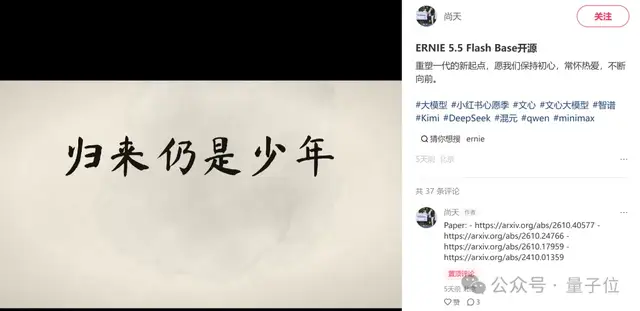
At first glance, it was a bit chuunibyou.
But paired with the line, “A new starting point for reshaping a generation. May we stay true to our original aspirations, always cherish our passion, and keep moving forward,” and then thinking about what Baidu ERNIE has been through over the years, it suddenly left me with a bittersweet feeling.
Baidu was among the first companies in China to venture into large AI models. It got a relatively early start and has substantial technical expertise to boot.
But as each new generation of models came out, doubts from outside never stopped.
Especially the line about “getting up early but still arriving too late”—the team has probably heard it until it is sick of it.
As the talk went on, the team's public persona gradually began to change...
I noticed that ERNIE's R&D staff were starting to step into the spotlight one after another, proactively engaging with netizens on Xiaohongshu and X.
They even began taking the old controversies and mockery head-on.

This sudden wave of “joining in en masse” even left netizens baffled:
Why has the entire ERNIE team come to X? Is there some metric behind it?

As for whether there are any metrics, we have no idea.
But from one person to a whole group, some R&D staff who had previously remained hidden behind the model's name really did begin to step into the spotlight.
They don't dodge complaints, and they are willing to respond to problems head-on.
Looking at these changes, one can indeed sense a certain drive:
This crew seems to have a fire in its belly, too—they want to do the job properly.
Attitude is all well and good, but “checking on people is no substitute for writing a big check”; you have to show people concrete action.
And yes, Baidu really has something to show this time.
Two concrete moves, in fact:
One is the announcement of an open-source initiative, and the other is a limited-time discount.
The model weights for ERNIE 5.5 Flash Preview are expected to be released in the near future under the Apache 2.0 License, with support for deployment using SGLang and vLLM.
Now there's nothing left to hide.
Developers who want to deploy it themselves, build on it, or simply pull it down and hunt for problems can all do so.
Pricing-wise, the model's API has also gone live simultaneously on Baidu AI Cloud's Qianfan Platform, currently at 50% off for a limited time (RMB 1 per million input tokens and RMB 4 per million output tokens; both rates double during peak hours).
This is actually quite important.
The gaming, 3D, and video tasks mentioned earlier generally consume a lot of tokens. However capable the model may be, it is no good if it is too expensive to use.
With “one release, one price cut,” the groundwork has been laid, and the rest is up to the developers—
Whether the model can actually deliver will soon be answered by everyone.
And now, recalling the line from the video above about “returning, still young,” does feel quite apt.
They set off so early back then, only to be mocked for “arriving too late.”
Now, it is still the same group of model builders, nursing a degree of unwillingness to accept the outcome and determined to push a little further.
As for whether they can catch up this time and make something a little different...
we'll just have to wait and see.
Portal:
https://ernie.baidu.com/web/new-chat
https://console.bce.baidu.com/qianfan/modelcenter/model/buildIn/list




