Zhidx (WeChat Official Account: zhidxcom)
Author | Wang Han
Editor | Yun Peng
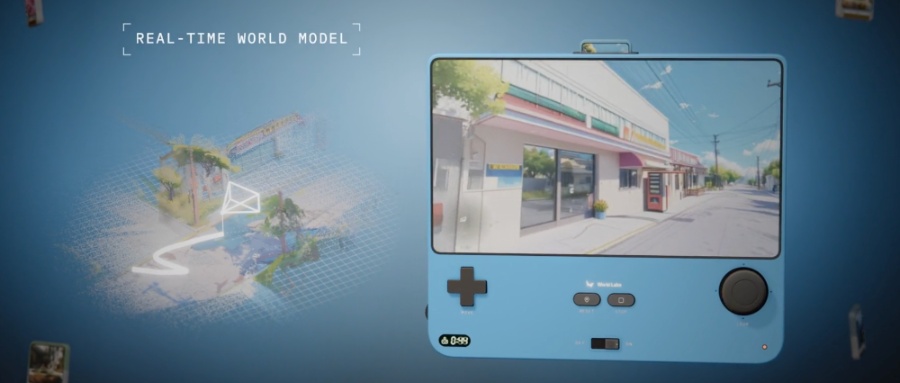
Zhidx reported on November 6 that World Labs, the world model team of “AI godmother” Li Fei-Fei, had just releasedFrameboy, a real-time streaming generation demo optimized on the basis of Atlas.
Frameboy streams frames from cloud GPUs, with speeds of up to 15 FPS, meaning that a new frame can be obtained roughly every 67 milliseconds.
In comparison, Genie 3, the world model released by Google DeepMind in August 2025, can deliver real-time interaction at 720p and 24 FPS, while Atlas can reach a maximum image resolution of 1440p.

Atlas is an autoregressive world model released in September 2026. It can generate frame by frame and provide pixel-precise camera control. (Li Fei-Fei released a world model that can “pause time”)
The Atlas variant provided by Frameboy has been highly optimized to deliver the fastest and most efficient inference possible while preserving its impressive generative novel-view synthesis capabilities.
The World Labs team also integrated this capability into the web appViewfinder, where users can build their own scenes frame by frame with Atlas and then explore them in real time through thestreaming Frameboy overlay.
Viewfinder is currently in closed beta, and users can join the waitlist on World Labs to try it out.
I. Real-Time Streaming Frame Output: Speed Is the Key to World Model Interaction
Last year, World Labs released a research preview of the efficient, lightweight frame-generation model RTFM. Atlas drew on RTFM’s approach and expanded upon it. Inspired by this, the World Labs team continued with the same approach and rebuilt Frameboy.
Compared with RTFM, Atlas has a much larger model and was trained on several orders of magnitude more data. RTFM was designed primarily to interpolate among a set of existing views, whereasAtlas can generate scenes from scratch, requiring as little as a single image or a text description as input.

At the same time, Atlas preserves and upgrades RTFM’s ability to synthesize novel views from multiple images. This capability enables users to roam through real-world scenes using Frameboy.

After Atlas was officially released, the World Labs team found thatgeneration speed was the core bottleneck affecting the user’s interactive experience.
If users have to wait tens of seconds or even several minutes to see the video generated by Atlas, they must carefully and methodically build the scene and plan the camera path. This lengthens the iteration cycle and makes it difficult for users to achieve the effect they want.
Conversely, if Atlas can generate at speeds sufficient for real-time interaction, users can rapidly conduct trial-and-error tests and repeatedly adjust their inputs.When latency and call costs drop low enough, users may not even notice a separate “generate” action, because the model will, as the user roams through the scene, continuously stream frames.
This gave rise to Frameboy.

2. Integration in streaming overlay rendering mode; currently dependent on cloud GPUs
Besides improving generation speed, the World Labs team also hopes that models like Atlas can become high-performance generative renderers: users need only provide simple, intuitive inputs (such as a set of images) to interactively construct and preview rich, complex 3D scenes.

To demonstrate this concept, the team integrated Frameboy’s real-time capabilities into the Atlas-powered web app Viewfinder using a streaming overlay rendering mode.
In Viewfinder, users can use input assets to build scenes frame by frame and roam freely, generating images with 3D consistency from different viewpoints as if operating a virtual camera.
The color and depth information for every frame is generated by Atlas to reconstruct the 3D space being built. Once the user is ready, they can enable the Frameboy overlay and continue receiving streamed visuals as they move through the scene.
At present, Frameboy still relies on high-performance cloud GPU servers to run, making it more expensive than local rendering solutions.
Conclusion: Further acceleration of world models requires overcoming the computing power hurdle
For world models, both the speed of model generation and the realism of the worlds they generate are critically important. This update focuses specifically on speed.
However, merely optimizing model algorithms is not enough to improve speed; inference efficiency, computing resources, and underlying hardware are also factors that cannot be bypassed.
In September 2026, AMD announced an all-stock acquisition of World Labs for approximately $8.2 billion. (Just now, Lisa Su bought Fei-Fei Li’s world model company! It cost 55 billion yuan)
For Fei-Fei Li’s team, this means its world model R&D can be further integrated with the underlying computing infrastructure, while opening up more possibilities for future optimization in areas such as GPU computing power, model inference, and generative rendering.
As software and hardware continue to evolve, capabilities that are currently relatively slow and costly are expected to become faster and cheaper in the future.
jQuery(document).ready(function($) { $.post('https://www.zhidx.com/wp-admin/admin-ajax.php', {action: 'wpt_view_count', id: '607939'}); });No text provided.

