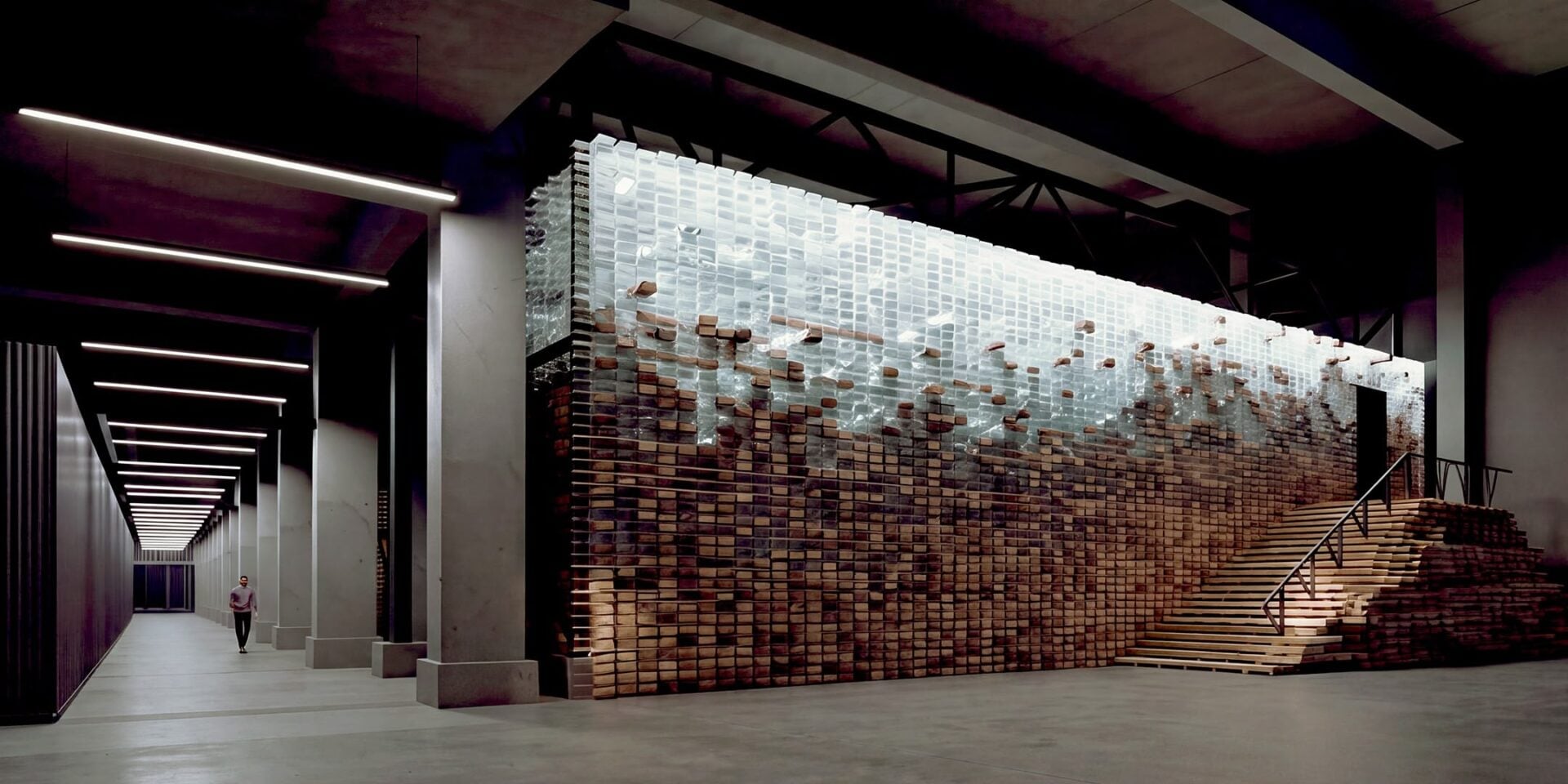
 Conceptual view of the data center commissioned from Bull © LUMI-AI and Nordic Architects
Europe has just commissioned from Bull an AI supercomputer worth €387.8 million for Finland. Just five months after moving under public ownership, the former flagship of Atos is filling its order book faster than Bercy issues its press releases.
Bull, you may have filed it away in the same drawer as the Minitel. An icon of the computing industry in the 1980s, nationalized under Mitterrand in 1982 and privatized in 1994, the manufacturer was absorbed by Atos in 2014. The state bought it back on March 31 for a valuation of up to €404 million.The company, whose plant is located in Angers, nevertheless announced this Monday, August 31, the signing of a contract worth €387.8 million with the joint undertaking EuroHPC, the EU’s arm for supercomputing. The order is for LUMI-AI, a supercomputer dedicated to artificial intelligence, expected in the second half of 2027 in Kajaani, in northern Finland.
Ten times LUMI’s AI computing power, half paid for by Brussels and half by six countries
Since 2022, the small town of Kajaani, nestled in central Finland, has hosted LUMI. For years the fastest supercomputer in Europe, it is housed in a former UPM paper mill, closed in 2008 and converted into a data center (Finland’s cold climate and cheap electricity help), and will soon welcome a new neighbor. LUMI-AI will indeed be installed right next door, in a new building, with an AI capacity ten times greater than that of its predecessor and nearly twice the conventional scientific computing power. A small detail that matters for what comes next: LUMI was built by the American company HPE, so its successor will be French. The machine will belong to EuroHPC and will be operated by CSC, the Finnish public computing center, for six countries (Finland, Czechia, Denmark, Estonia, Norway and Poland), which will pay half the bill, with Brussels paying the other half. This is the sixth contract signed by EuroHPC for its “AI factories.” An AI factory, in Brussels jargon, is a supercomputer with a service desk where researchers, SMEs and startups come to train their models. A shared kitchen, in short, except that the oven costs 388 million.
Under the hood, LUMI-AI is built on the BullSequana XH3500 platform, the company’s latest in-house architecture, equipped with AMD Instinct MI430X graphics cards and sixth-generation AMD EPYC processors with up to 256 cores. The most distinctly French contribution lies in two components Bull designs itself: the BXI network, which links the thousands of chips together (the machine’s internal road system, so to speak), and patented warm-water cooling. The recovered heat will supply Kajaani’s district heating, the electricity will be entirely renewable, and the Finnish company IQM will add a quantum computer named LUMI-IQ.
The Angers plant now operates for all of Europe
Despite its turbulent history, Bull remains determined and performs strongly in the global race for computing power. JUPITER, the first European exascale supercomputer, inaugurated in Germany in September 2025 at a cost of 500 million euros, is housed in Bull’s racks, specially fitted with Nvidia chips for the occasion. Alice Recoque, the French exascale supercomputer expected at the CEA in late 2026 and then in 2027, was awarded to the same company last November. It has the same platform and the same AMD cards, with European SiPearl processors as a bonus. Mimer, the Swedish AI factory, followed in April, and LUMI-AI brings up the rear. Bull therefore wins at least two of the six EuroHPC AI factory contracts, while Italy chose to award IT4LIA to Dell, using an Nvidia architecture. All of this comes from Europe’s only supercomputer plant, in Angers, which also builds the machines used by the CEA to model the French nuclear arsenal since testing was halted in 1996.
Here is the order book, and it casts new light on the March buyout. The French State, through the Agence des participations, has become the sole shareholder of a company with 3,000 employees, half of them in France, which generated €720 million in revenue in 2025. It promises 500 new hires this year. The price, however, has been reduced from the €500 million initially planned for the end of 2024 to a maximum of €404 million, with negotiations and a revised scope making this necessary. Roland Lescure saw it as “a decisive step toward technological sovereignty for France.” Emmanuel Le Roux, the head of Bull, likewise insists that his company is the only one in Europe to design and manufacture AI supercomputers on the continent. The word “sovereignty” nevertheless warrants a footnote. Assembly, networking and cooling are French, but the graphics cards that do most of the work come from AMD, a Californian company, as do those in JUPITER from Nvidia.
The French taxpayer now owns a manufacturer that sells supercomputers to Germany, Sweden, Finland and the French State itself. The chips running inside them, however, remain American, and it is at this particular boundary that European sovereignty currently comes to an end.
👉🏻 Follow the latest tech news in real time: add 01net to your Google sources and subscribe to our WhatsApp channel.
Source: Bull





- Google Play Store
- 4K Video Downloader Plus
- VLC Media Player
- Adobe Reader
- uTorrent
- WinRAR
- Xender
- Google Chrome
- CCleaner
- Mozilla Firefox
- Avast Free
- ChatGPT
- Microsoft 365
- Opera One
- Avast One





Download
- Google Play Store
- 4K Video Downloader Plus
- VLC Media Player
- Adobe Reader
- uTorrent
- WinRAR
- Xender
- Google Chrome
- CCleaner
- Mozilla Firefox
- Avast Free
- ChatGPT
- Microsoft 365
- Opera One
- Avast One