U.S.-based Open Standard announced on June 30 (local time) a new stablecoin, “Open USD,” for companies to transfer funds across borders. More than 140 companies from the payments, finance, IT, and crypto asset sectors participated, including U.S.-based Visa, Mastercard, Stripe, BlackRock, Coinbase, and Google. From Japan, Sumitomo Mitsui Financial Group, Mizuho Financial Group, Rakuten Group, PayPay, and others also joined.
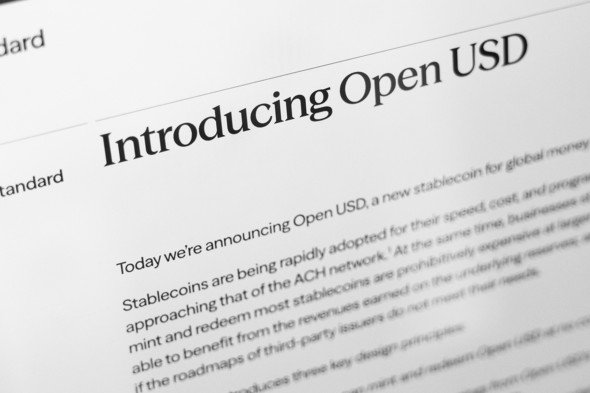 Source: From the press release; same below.
Open USD sets forth three design principles: (1) issuance and redemption are free regardless of transaction size, with no cap on transaction volume; (2) investment income earned on the backing assets, or “reserves,” held in an amount commensurate with the issuance value will be distributed to participating companies after deducting a small management fee to cover operating expenses; and (3) joint governance operated by a board of directors composed of participating companies, rather than by a single company. Operations will be handled by the independent company Open Standard.
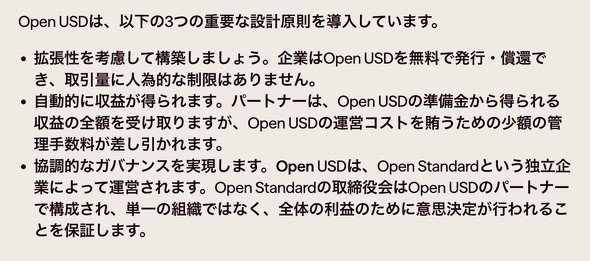 Three design principles (translation)
Stablecoins are a type of crypto asset that seeks to stabilize prices by linking them to fiat currencies and other reference assets. They have been gaining adoption in corporate settlements due to their fast transfers and low fees, but challenges remain: the larger the transaction volume, the more burdensome the issuance and redemption fees become; users cannot receive the returns generated by investing reserves; and there are few options when an issuer’s policies do not meet users’ needs. Open USD’s design principles address each of these issues, respectively.
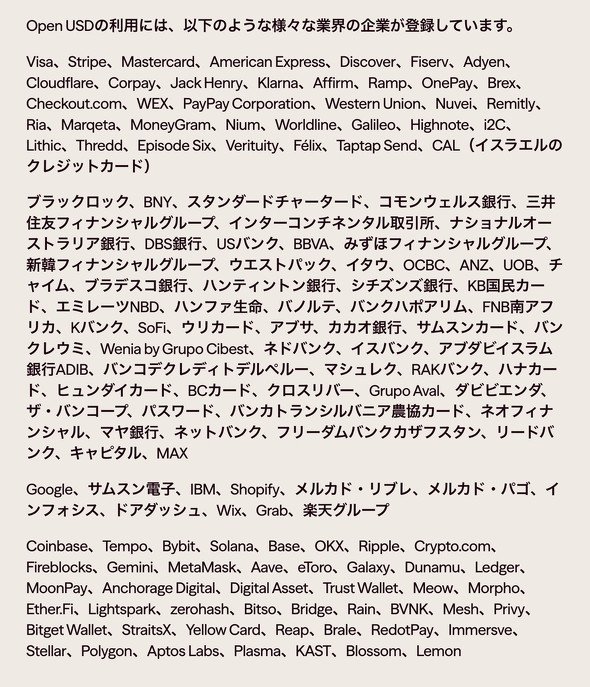 Some of the companies registered to use Open USD (translation)
The official launch of Open USD is scheduled for the second half of 2026. Each participating company will begin supporting Open USD in conjunction with the launch.

