Zhidx (WeChat official account: zhidxcom)
Author | Sanbei
Editor | Xinyuan
Zhidx reported on November 11 that Alibaba announced today the release of its next-generation large model, the Qwen4-Max Preview, debuting the Token Plan for the Qwen AI platform. For a limited time, users can pay 20% of the regular price, with new users receiving an additional 50% discount, allowing them to try the Qwen4 model for as little as 10% of the regular price.
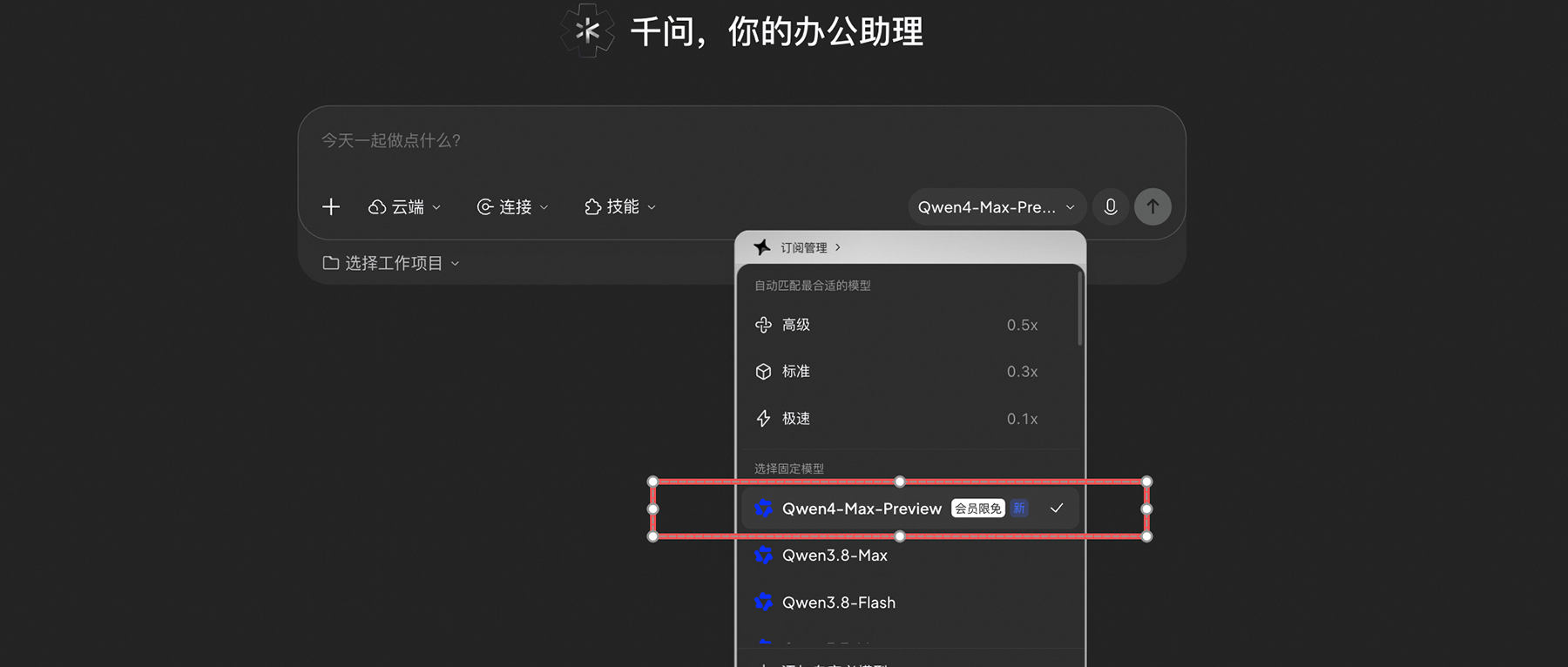
The Qwen4-27B that many developers had been looking forward to did not arrive, but users can at least get an early taste of the “large-cup version,” the Qwen4-Max Preview. The Qwen4-Max Preview launched today on Qwen Office, Qoder, the Qwen app, QwenStudio, and other platforms, allowing users to try it right away.

The detailed specifications and benchmark results for the Qwen4-Max Preview have not yet been released. According to the announcement, the Qwen4 model has stronger world knowledge and perception, and has further upgraded two key capabilities: programming and Agentic (agent operation). It can better complete real-world tasks such as complex programming, professional office work, frontend design, and professional software operation.
According to reports, results from developers’ advance internal testing show that Qwen4 delivered outstanding performance in areas such as 3D modeling, web design, and interaction.
Zhidx promptly tested the Qwen4-Max Preview in “Qwen Go!” on the Qwen app to explore these features.
After testing it, we found that the Qwen4-Max Preview exceeded expectations in its multimodal agent delivery capabilities. Instruction understanding and search execution were mostly accurate, while the quality of multimodal content generation improved significantly. Its 3D simulation and interaction precision was relatively high, and its content-generation speed was moderate. At the same time, when the modality of a task and the complexity of agent operations rose to a certain level, the content generated by the Qwen4-Max Preview began to show issues with multimodal consistency. For example, the subtitles did not always match the video footage, and some details contradicted the laws of physics.
First, as usual, we asked the Qwen4-Max Preview to generate an animated demonstration of a pelican riding a bicycle. The video accurately depicted the pelican, the bicycle, and their relative positions. The pedal motion and wheel rotation both conformed to the laws of physics, although the direction of relative movement of the road markings was incorrect. The console on the right allowed users to adjust parameters such as cycling speed, wing-flapping frequency, and camera zoom, with all controls responding accurately.

Next, we continued with a hands-on test of a typical programming scenario, asking Qwen4-Max Preview to perform the following task: build a self-contained HTML5 Canvas scene featuring a realistic physics simulation in which a train derails from a broken bridge and falls into the water.
As can be seen in the footage generated below, the physical details of the train falling into the water broadly follow the laws of the real world. Each carriage has its own collision volume, and the sounds of collisions and flowing water are simulated. It also provides adjustable parameters such as speed and gravitational acceleration, enabling more refined simulation and interaction than many comparable models.

Immediately afterward, inspired by OpenAI’s image-generation model recently adding a GIF-generation feature, we also asked the multimodal-capable Qwen4-Max Preview to create a GIF. We uploaded a photo of a squirrel plush toy and asked the model to generate “a squirrel rapidly typing on a keyboard, with the caption, ‘I’m writing, I’m writing~.’”
After a little over seven minutes, Qwen4-Max Preview generated the GIF below. The squirrel was accurately cut out from the image, and its occluded areas were completed. It successfully produced the requested action and caption, with smooth motion and clear visuals; the image size was 3 MB. Notably, the model also retained the flowers from the original image and incorporated them into the GIF to enhance the atmosphere.

With the recent variety show “Hui Hou You Qi” becoming a major sensation, we uploaded an image of the cliffside cabin conversation from the show and asked Qwen4-Max Preview to “generate a GIF based on this scene in which Li Na forgives Xu Fei, accompanied by a reconciliation dialogue.”
This task has a low barrier to entry but a very high ceiling, testing whether Qwen4-Max Preview can quickly search for and understand the show’s story background and popular memes, and then convert the information it has gathered into multimodal output. After approximately 14 minutes, Qwen4-Max Preview generated the GIF below.

Xu Fei can be seen speaking through tears, while Li Na goes from silence to tearful eyes before the two shake hands and make up. The animated GIF generated by Qwen4-Max Preview looks natural and fluid, even recreating both individuals’ characteristic expressions, especially Xu Fei’s sincerity and restraint.
More notably, the dialogue in the GIF also closely matches the actual story background. Qwen4-Max Preview used the “draw a circle and imprison yourself” meme, having Li Na respond with “I, too, am trapped in place and have never walked out.” Xu Fei then replies, “I’m sorry. From now on, let me be the one who walks toward you,” and Li Na finally says, “Okay. This time, let’s get off the train together,” completing the reconciliation.
There are, however, obvious problems with the GIF. The dialogue that should have been spoken by Xu Fei was instead spoken by Li Na, and the subtitles overlap slightly when they change. Further revisions through additional dialogue could optimize the result, but we did not pursue this further because of the time limit.

Many developers have also shared their experiences on social platforms at home and abroad. A developer named “quanxb” had Fable 5.2 and Qwen4-Max Preview perform the same task and concluded that Fable 5.2 was slightly better. The main issue was that Qwen4-Max Preview’s handling of light sources was somewhat inadequate. In addition, the latter’s Thunder Thinking took 12 minutes and ran at 53 tokens/s, leaving considerable room for improvement.

▲Developer comments on the social platform X
Overall, Qwen4-Max Preview has demonstrated several new strengths in multimodal generation, complex programming, and Agent task execution, but its generation speed, multimodal consistency, and handling of details still have room for improvement.
With the Preview version now available, developers have begun sharing their hands-on results on platforms such as X and comparing Qwen4 side by side with other models. Expectations for Qwen4 are shifting from the capabilities announced by the official release toward its performance on real-world tasks.
Qwen4-Max Preview is only the beginning. When versions such as the highly anticipated Qwen4-27B will debut, what more complete performance data Qwen4 will reveal after its official release, and whether it can truly rank among the first tier in Coding and Agent capabilities may be the aspects worth watching more closely next.