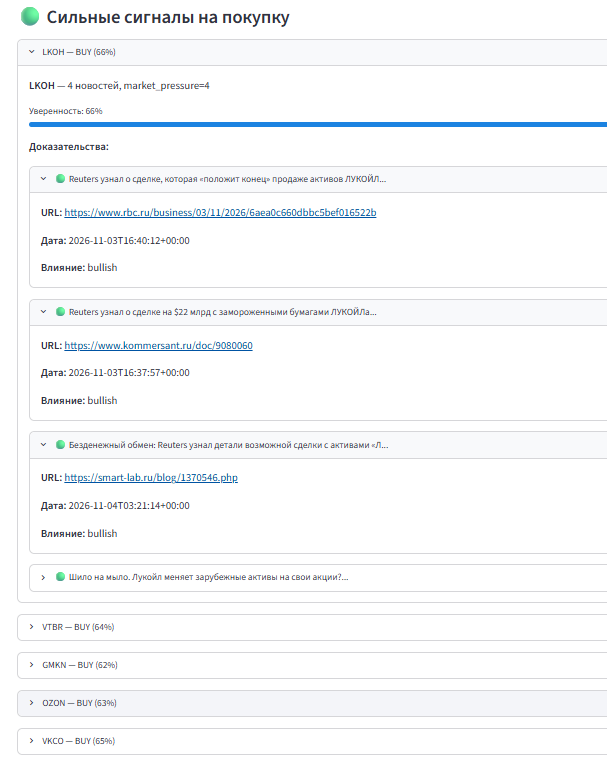
TAG224@@Key feature: Explainable AI. The trader sees not just “BUY,” but why the model decided that way. This reduces mistrust and makes it possible to quickly verify the context.
 TAG230@@6. The problem of mixed signals (and why we did not resort to a quick fix)
During testing, we noticed that VKCO received a BUY signal (64%), even though its news was neutral (market_pressure=0). The model had simply learned that the market rises 55% of the time.
We considered two options:
A: A hard filter in the API (if market_pressure == 0, set NEUTRAL).TAG241
TAG243
TAG245@@B: Add dominance features to the model (bullish_count, bearish_count, dominance).
TAG248We chose B, but postponed implementation until we accumulate 200+ records. The API is currently producing “dirty” signals, but we honestly document the reason and do not hide the problem behind stubs. This is deliberate technical debt.
6. Vision 2.0: Where We’re Heading
The project is not standing still. We have established a development concept (ADR-025), dividing the features into three tracks:
Quick Wins: Volume anomalies (volume_ratio), extraction of corporate events (buyback/SPO via LLM), and expected return E[return] for Risk/Reward calculations.
Core R&D: Event Horizons — forecasting the exit horizon (Take Profit) depending on the event type (geopolitical, macro, or corporate). Global Risk Factor — accounting for the influence of the global backdrop (VIX, S&P 500, Brent).
Moonshot: Fragility Score — detecting market “fragility” (drawing on the work of Nassim Taleb). We do not promise to predict a “black swan,” but we can signal a divergence between the news backdrop and the price reaction.
Conclusion
Building an end-to-end ML pipeline on local news is feasible. The key is to honestly acknowledge data limitations and not hack around where we need to wait.We have demonstrated that even with a small dataset (59 records), it is possible to build a working pipeline and UI with evidence, and the architecture (ADR, Vision 2.0) is ready to scale.
The pipeline architecture diagram (Mermaid) is available in the project documentation. The source code for the public portion is open.
GitHub link