SoulAgent is the Academy’s “personal AI agent that understands you better the more you use it.” In educational settings, SoulAgent focuses on areas such as “Help Me Listen to Classes,” teacher AI avatars, essay grading, and teaching Q&A, exploring how AI can help teachers improve teaching efficiency and preserve teaching content while supporting students in understanding problems, broadening their perspectives, and continuing to think through feedback and follow-up questions.

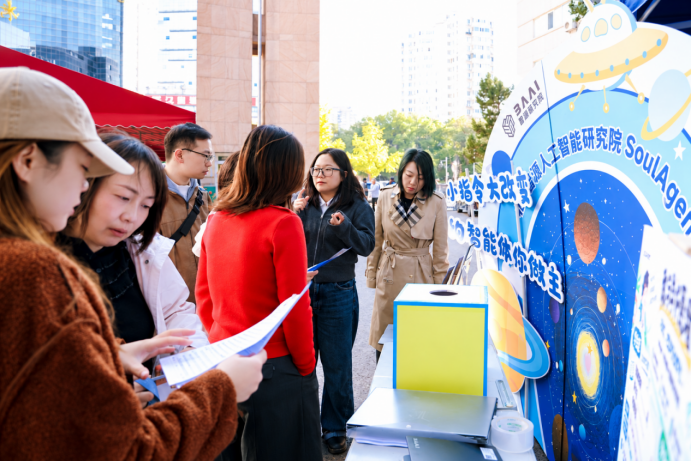
Image caption: SoulAgent visits campuses to conduct application exercises centered on authentic teaching and learning scenarios.
“Help Me Listen to Classes”: Listen to Multiple Classes at Once and Let Classroom Content Continually Support Teaching Research
In settings involving open classes, class observations, and teaching research, multiple courses often take place simultaneously. Teachers must both follow what happens in the classroom and record content, organize key points, and complete post-class reviews, making it difficult to cover all the courses they are interested in with limited time.
SoulAgent’s “Help Me Listen to Classes” uses AI-assisted note-taking, intelligent summaries, and continuous Q&A to help record classroom content and organize teaching priorities. Even when they cannot enter every classroom, teachers can review the classes that interest them after class and continue asking questions about the content, so “attending class” is no longer limited to entering one classroom at a time.
During the events on October 21, 27 open classes were connected to SoulAgent’s “Help Me Listen to Classes.” Through functions such as organizing classroom transcripts and identifying key teaching points, it provided teachers with references for reviewing classes and conducting post-class teaching reviews. That morning, multiple research classes ran in parallel, and the afternoon moved on to seven teaching research subforums. The resulting classroom notes and summaries also served as a shared reference for subsequent discussions, reducing the need to review classroom content repeatedly and freeing up more time for teaching analysis, experience sharing, and in-depth discussion.
From classroom records to after-class follow-up questions, and then to teaching reviews and research exchanges, SoulAgent aims to transform one-time classroom content into teaching resources that can be queried, reviewed, and used continually.
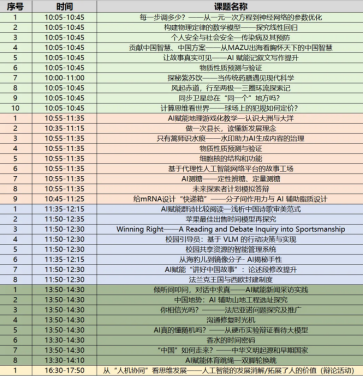
Image caption: Through classroom transcript organization, key teaching point identification, and continuous Q&A, SoulAgent provides teachers with references for reviewing classes and conducting post-class teaching reviews.
Teacher AI Avatar: Let AI First Understand the Teacher, Then Assist with Teaching
If “Help Me Listen to Classes” addresses how classroom information can be recorded and used more efficiently, the teacher AI avatar tackles the further question of how AI can truly adapt to different teachers’ teaching styles.
Different teachers have their own lesson designs, evaluation criteria, annotation habits, and priorities for instructional commentary, and authentic teaching does not follow a single completely uniform standard. SoulAgent continuously accumulates teachers’ course materials, evaluation standards, samples of their annotations, criteria for instructional commentary, and feedback from actual use to create a dedicated teacher avatar. On this basis, the teacher AI avatar can help with tasks such as essay grading, classroom summaries, and teaching Q&A according to the specific teacher’s professional standards, gradually aligning more closely with the teacher’s own evaluation criteria and teaching style through continued use.
Therefore, teacher AI avatars do not give all teachers the same set of “standard answers.” Instead, they distill and preserve each teacher’s own knowledge, experience, and professional standards, enabling the AI to understand the teacher first and then provide assistance according to the teacher’s requirements.
From Teacher AI Avatars to English Composition Grading: Moving into Real Teaching Tasks
In the context of English composition grading, teachers provide professional inputs such as scoring criteria, sample annotations, and materials for reviewing student work. The SoulAgent teacher AI avatar brings these teaching standards into the specific grading task, enabling a personalized grading report for an entire class to be generated quickly.
In practice, the SoulAgent teacher AI avatar can provide students with more targeted revision suggestions based on specific teaching needs. It also helps teachers organize common class-wide issues, typical cases, and directions for improvement, while continuously distilling and preserving valuable content for later use in review and commentary, lesson preparation, and teaching.
For students, feedback evolves from being a single score to providing specific problem analysis and revision suggestions; for teachers, it can reduce some repetitive analytical and organizational work, allowing more time to be devoted to classroom review and individual guidance; for teaching research, it enables common issues and teaching priorities to be identified more systematically based on real teaching data.
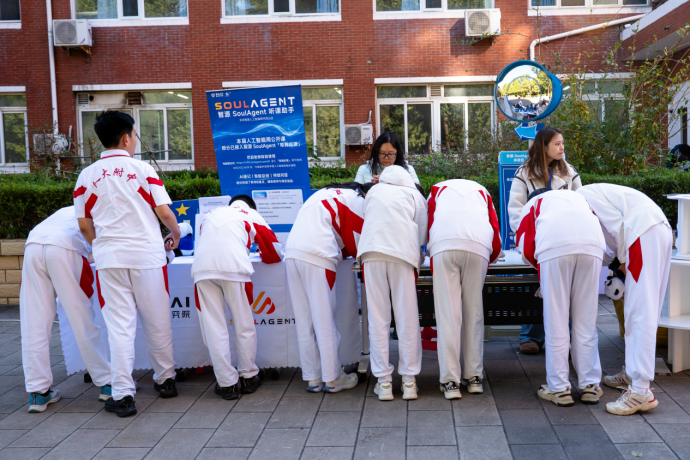 Caption: The SoulAgent teacher AI avatar draws on teachers’ professional standards to support composition grading, classroom review and commentary, and subsequent teaching.
On Campus: Face-to-Face Exchanges with Frontline Teachers and Students
During the two events, teachers from different disciplines learned about and experienced SoulAgent through practical tasks involving classroom records, lesson preparation, assignment feedback, and teaching Q&A. Students also interacted with it in scenarios involving knowledge Q&A, after-class learning, and continued follow-up questions. Through questionnaires, a co-creation wall, and face-to-face exchanges, teachers and students shared their firsthand impressions of and expectations for AI-assisted teaching and learning.
From helping teachers improve teaching efficiency to providing students with more specific feedback and support for continued follow-up questions, AI’s value is moving beyond “completing tasks faster” toward “supporting thinking better”: it allows teachers to devote more professional time to instructional design and student guidance, and students to devote more attention to understanding, judgment, and deep thinking.
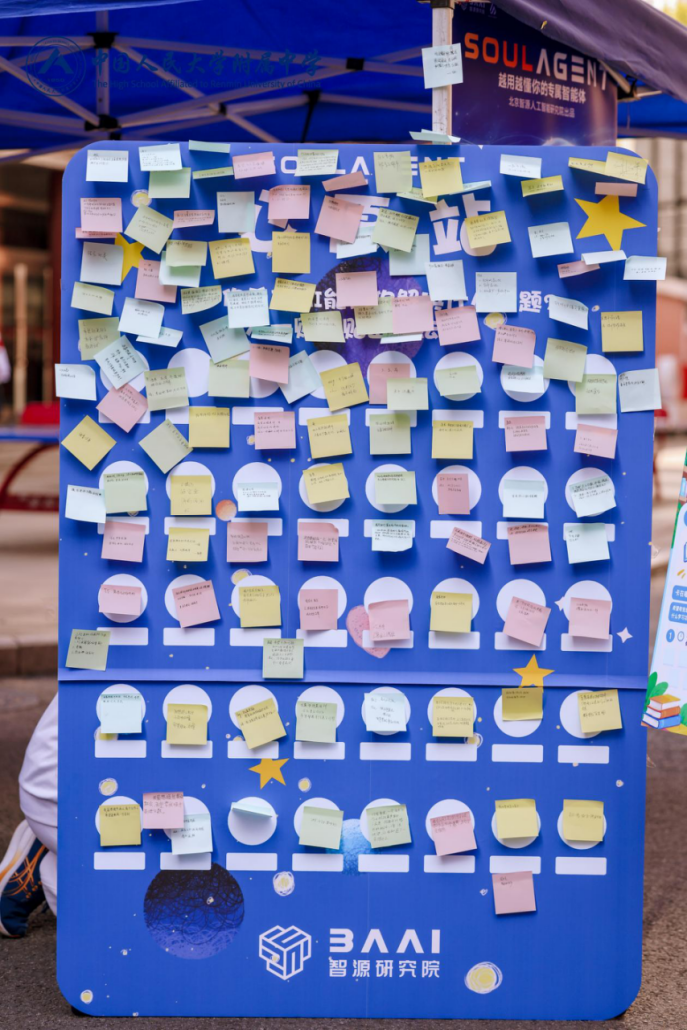
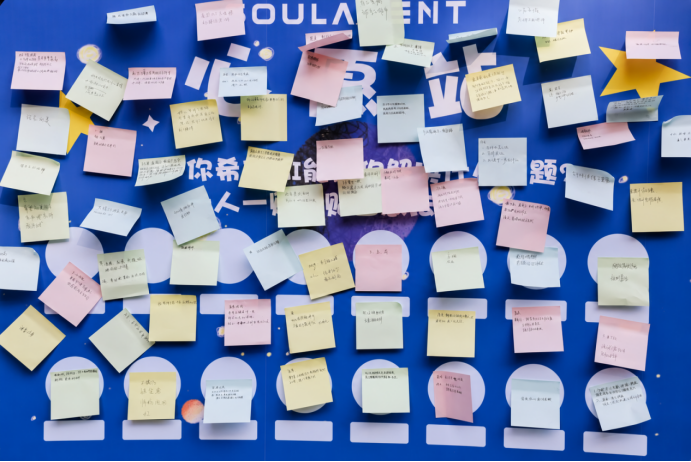
Caption: Teachers and students try out SoulAgent’s educational applications and exchange ideas on site.
In the future, the Beijing Academy of Artificial Intelligence will continue to deepen its collaboration with the High School Affiliated to Renmin University of China in the field of education, continuously exploring AI applications in education around real-world classroom, teaching research, and learning scenarios. At the same time, SoulAgent will further expand into more application areas, including education, intelligent meeting services, and expert avatars, so that personal agents that “understand you better the more you use them” can continue to deliver value in real-world settings.
SoulAgent is now open for registration. You are welcome to try it via the official website, soulagent.world, or the “SoulAgent” WeChat Mini Program.