
Employment growth among men has been greater than among women in occupations more exposed to artificial intelligence (AI) in the United States. This finding comes from a Pew Research Center survey that compared labor market data before and after the popularization of generative AI to identify differences between genders.
The study analyzed changes in the number of workers between 2017 and 2019 and from January 2023 to June 2026. The years 2020 through 2022 were excluded from the comparison because of the changes caused by the Covid-19 pandemic in the labor market. The results indicate that the greater the exposure of an occupation to AI, the greater the difference in employment growth between men and women.
Male employment growth exceeds female employment growth
According to the research, for every one-point increase in an occupation’s AI exposure scale, employment among men grew by 6.3%. Among women, the change was virtually zero, with an increase of just 0.2%.
The difference was even more evident in occupations with greater exposure to technology. Male employment grew by approximately 24% more in occupations most exposed to AI than in those with less exposure.By contrast, female employment growth remained virtually unchanged across the scale.
In professions less exposed to artificial intelligence, the situation was different: women experienced greater employment growth than men.
The survey emphasizes, however, that the relationship between AI exposure and hiring growth does not necessarily mean that technology is the direct cause of the differences. Other changes during the period may also have influenced the results.
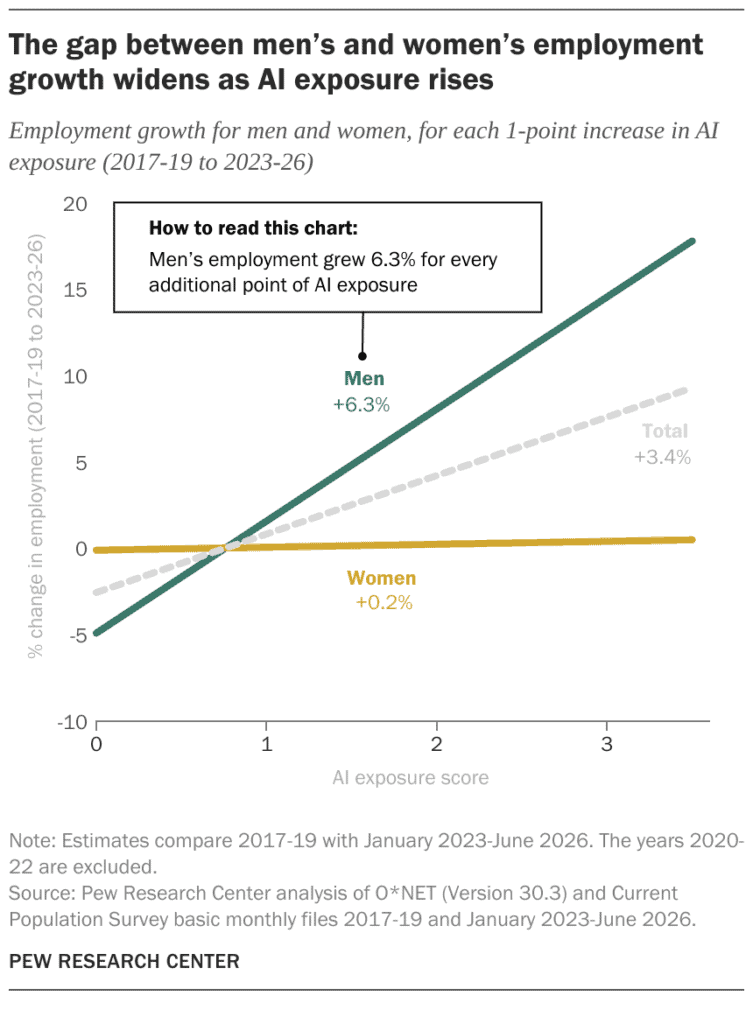 A Pew Research Center survey shows that male employment growth was greater in professions with higher levels of exposure to artificial intelligence – Image: Pew Research Center
Professions with greater exposure to artificial intelligence
To conduct the analysis, the Pew Research Center evaluated 480 occupations based on information from the Occupational Information Network (O*NET), a database of the U.S. Department of Labor.
The classification considers the tasks performed in each occupation, the possibility of those tasks being performed or assisted by generative AI, and the importance of those activities to the job.
The scale used ranges from zero to 3.5. The higher the score, the greater the proportion of important tasks in an occupation that can be performed or assisted by the technology.
Professions with very low exposure include truck drivers, construction workers, and cleaning professionals.In the middle tier are medical assistants, cashiers and audiologists.
Among occupations with very high exposure are accountants, software developers and financial managers. These activities involve tasks related to information processing, reading and writing, which may receive some form of assistance from generative AI.
Education level also influences the gap between men and women
The study found that the gap in employment growth also varies according to workers’ education levels.
Among people with a high school diploma or lower education, male employment grew by 8.8% for each additional point of AI exposure. For women with the same level of education, there was a decline of 9.5%.
The gap was smaller among workers who attended college but did not complete a degree. However, within this group, the difference between the outcomes for men and women remained significant.
Among people with a bachelor’s degree or higher education, there were no significant changes in employment growth for either gender as AI exposure increased.
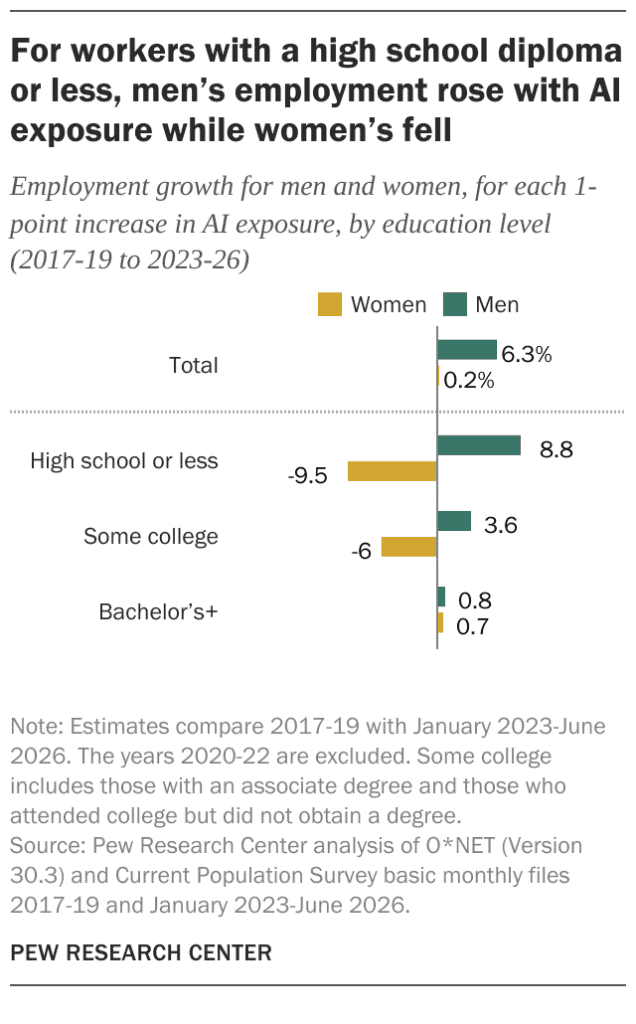 Among workers with a high school education or less, male employment grew by 8.8% for each additional point of AI exposure, while female employment declined by 9.5% – Image: Pew Research Center
The study also points to differences in the distribution of workers across professions.Men without a four-year university degree are mainly found in activities less exposed to AI, such as freight transportation, construction, and goods handling.
Women with this level of education, meanwhile, are more likely to work in roles such as secretarial work, reception, and customer service. These occupations are in intermediate or higher positions on the AI exposure scale, meaning that tools such as chatbots and automated systems may play a greater role in their activities.
Pew Research Center highlights that it is still too early to determine the long-term effects of artificial intelligence on the labor market. The analysis therefore shows observed differences in employment growth, without establishing a direct cause-and-effect relationship between technology adoption and changes in hiring.

Ana Figueiredo is a technology editor at Olhar Digital. She has a degree in Journalism from the Federal University of Uberlândia (UFU).