A composite image of the avatars used in the experiments. Credit: Jasmin Baake at al On TikTok there are exceptional "testimonials" like Nikola Tesla or Marie Curie delivering short science-related messages that have garnered millions of views. This is just one of many examples where AI-generated avatars are used to communicate science—a strategy that might also have its drawbacks. The generation of images and animations through artificial intelligence is
Latest AI News
In science communication, realistic avatars may foster more trustworthiness than cartoon-like ones
How blockchain, IoT, and AI shape digital transformation
US eyes AGI breakthrough in escalating China tech rivalry
OpenAI funds $1 million study on AI and morality at Duke University
Rethinking video surveillance: The case for smarter, more flexible solutions - AI News

The Shift to Smarter SurveillanceTraditional video surveillance systems often fail to meet the needs of dynamic, modern environments. Whether it’s a retail chain looking to analyse customer behaviour or a factory monitoring equipment safety, the tools of yesterday aren’t enough to address today’s demands.The shift towards smarter surveillance involves integrating modular, AI-driven systems that:Adapt to your specific needs,Automate tedious tasks like foota
Sam Altman, OpenAI: ‘Lucky and humbling’ to work towards superintelligence
NVIDIA advances AI frontiers with CES 2025 announcements

Other advancements, such as RTX Neural Shaders and RTX Mega Geometry, promise heightened realism in video games, including precise face and hair rendering using generative AI.Cosmos: Ushering in physical AINVIDIA took another step forward with the Cosmos platform at CES 2025, which Huang described as a “game-changer” for robotics, industrial AI, and AVs. Much like the impact of large language models on generative AI, Cosmos represents a new frontier for AI
Singapore-based Firmus wins recognition for AI data centre design
AI and Big Data Expo Global: Less than 4 weeks to go!
Microsoft releases Phi-4 language model on Hugging Face
Copyright concerns create need for a fair alternative in AI sector - AI News
Meta accused of using pirated data for AI development
The role of hyperparameters in fine-tuning AI models - AI News
Google Reveals Its Latest TPU v4-Based Supercomputer, Which Betters Nvidia’s A100s in Speed and Efficiency | Synced

Machine learning (ML) models continue to evolve in scale and algorithmically, a trend that burdens system developers with ever-increasing compute and power requirements for training and deployment. How to meet the demands? Tech giant Nvidia’s A100 high-performance graphics processing unit (GPU) dominated the AI accelerator market until Google joined the campaign in 2016 with its Tensor Processing Units (TPUs). This week, Google introduced its newest entry,
Stanford U & Google’s Generative Agents Produce Believable Proxies of Human Behaviours | Synced

The quality and fluency of AI bots’ natural language generation are unquestionable, but how well can such agents mimic other human behaviours? Researchers and practitioners have long considered the creation of a sort of sandbox society populated by agents with human behaviours as an approach for gaining insights into various interactions, interpersonal relationships, social theories, and more — and we may be getting there. In the new paper Generative Agent
Microsoft’s NaturalSpeech 2 Outperforms Previous TTS Systems in Zero-Shot Speech and Singing Synthesis | Synced

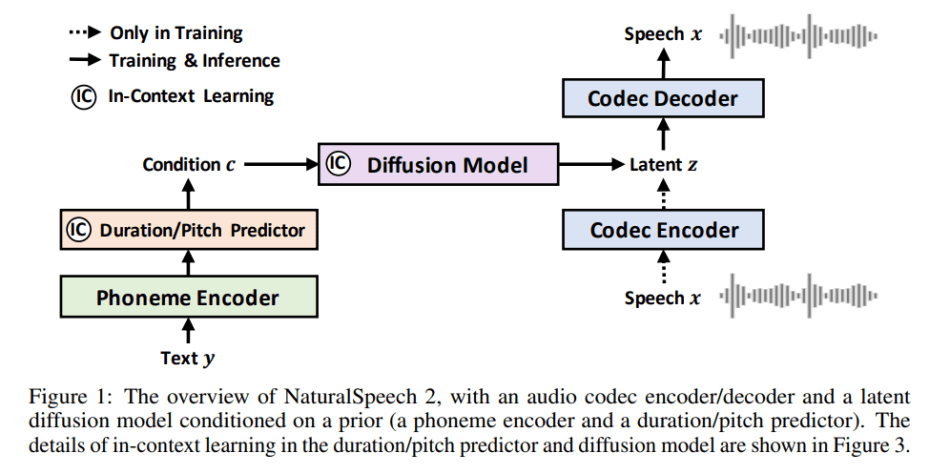
Contemporary text-to-speech (TTS) systems are achieving increasingly impressive humanlike voice generation performance in terms of intelligibility and naturalness. A lack of diverse speech data however makes it challenging to faithfully capture the many different speaker identities, prosodies and styles that can present in human speech. In the new paper NaturalSpeech 2: Latent Diffusion Models are Natural and Zero-Shot Speech and Singing Synthesizers, a Mi
MIT, Harvard & Northeastern U’s Sparse Probing Aims at ‘Finding Neurons in a Haystack’ | Synced

One of the most vexing public concerns regarding powerful AI systems such as large language models (LLMs) is their lack of interpretability: How can people trust a model’s output when they cannot understand how it was formed? In the new paper Finding Neurons in a Haystack: Case Studies with Sparse Probing, a research team from theMassachusetts Institute of Technology, Harvard University and Northeastern University proposes sparse probing, a technique desig
Microsoft’s Automatic Prompt Optimization Improves Prompts to Boost LLM Performance | Synced

The recent rise of powerful large language models (LLMs) has revolutionized the field of natural language processing (NLP). The performance of these generative models is largely dependent on users’ prompts, which are becoming increasingly detailed and complex. A Google Trends search reveals a hundredfold increase in popularity for the term “prompt engineering” over the last six months, and social media is teeming with novel prompting tips and templates. Is
Google & Stanford U’s DoReMi Significantly Speeds Up Language Model Pretraining | Synced

Large language models (LLMs) pretrained on massive data are being used in countless real-world applications. However — as computer scientists have known for decades — not all data is equal, and this is also true with regard to the composition of LLM pretraining data, which is typically sourced from publicly available domains such as Wikipedia, book and web texts, etc. Most current data selection strategies for LLMs determine the mixture of domains (i.e. th
Beyond Next-Token Prediction? Meta’s Novel Architectures Spark Debate on the Future of Large Language Models | Synced
The research from Meta explores the latent space of models, seeking to revolutionize their internal representations and facilitate reasoning processes more aligned with human cognition. This exploration stems from the observation that current LLMs, both open and closed source, lack an explicit hierarchical structure for processing and generating information at an abstract level, independent of specific languages or modalities. The prevailing “next-token pr