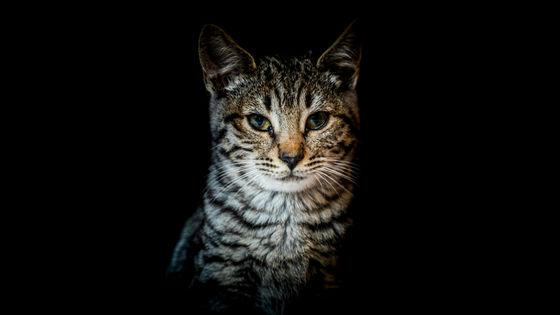
In ancient Egypt, cats were presented to the gods as offerings. Recent research published in the archaeological journal “Journal of Archaeological Science” suggests that even these cats, which became offerings to the gods, were not necessarily well cared for.
Keeping cats for mummification in ancient Egypt: osteological evidence from Beni Hassan - ScienceDirect
https://www.sciencedirect.com/science/article/pii/S0305440326002633?via%3Dihub
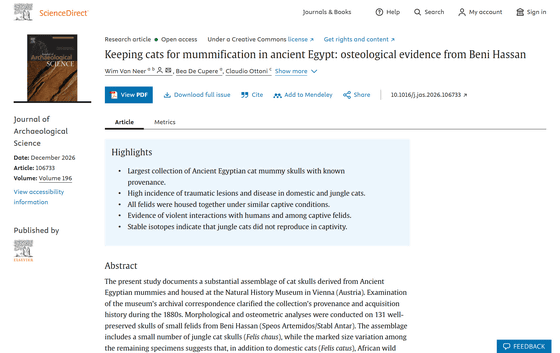
Egyptian cats meant for the gods led harsh lives, extensive museum collection reveals
https://phys.org/news/2026-11-egyptian-cats-meant-gods-harsh.html
Bea de Cupere, a zooarchaeologist at the Royal Belgian Institute of Natural Sciences and a coauthor of the study investigating cats that were offered to the gods in ancient Egypt, said, “The most striking finding was the high proportion of cats showing signs of injury or illness. This suggests that they lived in harsh conditions. It would be unusual for animals destined to be mummified and presented to the gods to show such signs.”
The study examined 131 cat skulls held at the Natural History Museum Vienna. The skulls are said to have been kept since the 19th century with little attention. Old letters found in the archives indicated that the skulls were “likely to have originated from Beni Hassan, a large animal cemetery in the Nile Valley.” According to the research team, this is the largest museum collection of ancient Egyptian cat skulls with recorded provenance.
It remains unclear what became of the bones other than the skulls, but the study reports that many animal mummies in the 19th century were ground into powder for medicine or used as fuel or fertilizer, so these bones may have been treated in the same way. Wim Van Neer, a researcher at the Royal Belgian Institute of Natural Sciences and a professor at KU Leuven, said, “Because scientists in the late 19th century were primarily interested in skulls, the rest of the bodies was most likely simply discarded.”
The research team used modern techniques to examine the interiors of the mummies while leaving the cloth wrappings on whenever possible. It was standard practice to unwrap mummies from the 19th century through the early 20th century, and ancient Egyptian cat mummies excavated from the Beni Hassan site were also studied after their wrappings had been removed.
The research team closely examined the skulls, measured them, and recorded evidence of injury and illness, including cuts, holes, and fractures. Most of the skulls are thought to be from domestic cats, but at least seven are believed to be from jungle cats, which are larger than domestic cats. These jungle cats are thought to have been captured for mummification.
More than half of the skulls examined showed traces of disease or injury. Some had missing teeth, signs of periodontal disease, or small pits on the surface of the bone, while others showed signs believed to be caused by infection. Some skulls had wounds or bite marks thought to have been inflicted during fights between cats.
Fan Nefer said, “If many cats were confined in a narrow space, stress would build up, and they would inevitably have become aggressive and injured. Disease would also have spread more easily.”
Other skulls appeared to have been injured with sharp objects or beaten with blunt, stick-like weapons. Some had wounds that proved fatal, while others showed traces of wounds that were beginning to heal. Fan Nefer commented, “Perhaps the work of catching and killing cats to make mummies did not always proceed as intended.”
When nine skulls were tested using radiocarbon dating, all but one were found to have belonged to cats that died between 380 BCE and 40 BCE. This was the period from the end of the Late Period of ancient Egypt to the beginning of the Ptolemaic dynasty.
The single skull with a different date was much older and dated to Egypt’s Third Intermediate Period. At Beni Hasan, cats may have been mummified much earlier than estimates based on textual sources suggest, but the research team believes that this skull may also have originated from Bubastis, the oldest known cat cemetery in Egypt.
Chemical analysis of the bones also revealed that the domestic cats were likely born and raised close to humans. Jungle cats were believed to have been captured while young and subsequently kept with other cats. The research team noted that the investigation provides insight into the conditions in which cats offered as sacrifices to the gods lived. The cats appear to have lived in overcrowded environments where disease spread easily and fighting was frequent.

