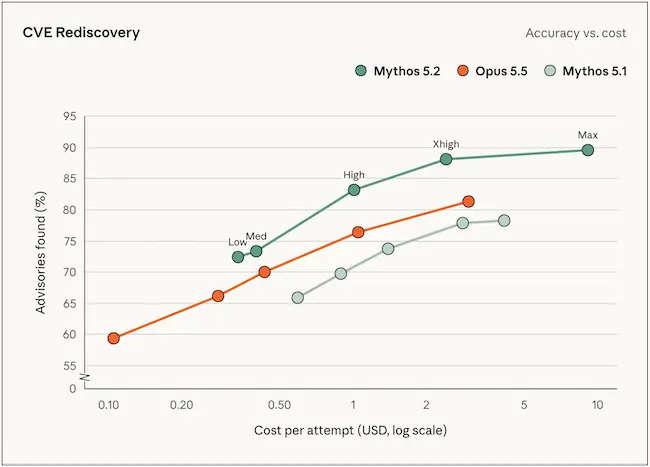
Anthropic launched Claude Fable 5 and Claude Mythos 5 on June 9, 2026, two products that, according to Anthropic, are based on the same underlying model and differ only in their safeguards: Fable 5 for general use with active security classifiers, and Mythos 5 reserved for a restricted circle of cyber defenders via Project Glasswing, with these same safeguards lifted in certain areas. The confinement layer, which Anthropic describes in its engineering post as a configuration layer applied at inference time ("configuration overlay applied at inference time", free translation), distinct from the weights, thus becomes the commercial boundary between the two offerings.
The novelty is therefore not only the launch of a more powerful model. It lies in the explicit separation between the model weights, the configuration applied at inference, and the access regime. Fable 5 and Mythos 5 become distinct products not because they necessarily represent two separately trained models, but because they expose different usage spaces. This distinction is strategic: it allows Anthropic to make available so-called "Mythos-class" capabilities while reserving certain uses for verified actors, notably within the context of Project Glasswing.
According to Anthropic's announcement, Fable 5 is priced at $10 per million input tokens and $50 per million output tokens via the Anthropic API; according to LLMReference (updated on June 9, 2026), the Mythos Preview pricing was $25 per million input tokens.
A pricing cut that fits within a sector-wide compression of inference pricing
DeepSeek has been practicing a pricing grid significantly lower than American frontier models for over a year, while OpenAI's GPT-5 shows $1.25 per million input tokens and $10 per million output tokens, which are respectively 8 and 5 times cheaper than Fable 5 on the base pricing. The Mythos Preview pricing was $25 per million input tokens according to LLMReference, which is 2.5 times the input pricing of Fable 5. The explanation based on the guardrails configuration - Anthropic charges for the containment work rather than the weights - coexists with a competitive explanation; the June 9 announcement does not resolve the two, and the official statement remains silent on the breakdown.
Documented on-the-ground performance, but sensitive results left out of review
On the FrontierCode benchmark published by Cognition AI on June 8, 2026, Fable 5 topped the ranking according to Cognition AI, though the exact score wasn't mentioned in the launch announcement; according to Cognition AI, Claude Opus 4.8 was leading FrontierCode with a peak of 13.5% before Fable 5 emerged, and over 50% of SWE-bench outputs remained non-mergeable. Cognition develops Devin and thus operates in the coding agent segment where Anthropic positions itself, something not mentioned in the launch announcement. On the customer testimonials side, Stripe reported during early tests that a migration of a 50 million-line Ruby codebase was executed by Fable 5 in one day, compared to over two months estimated for an entire team. In the sensitive area, Anthropic states that 9 out of 14 target proteins in an internal drug design study produced solid candidates, but these results are not peer-reviewed. The manufacturer also clarifies that the automated alignment evaluation places Mythos 5 at a level of misaligned behaviors similar to that of Opus 4.8, meaning low but non-zero.
Glasswing, classifiers and AI Act calendar: what the European buyer reads in the announcement
The most cited result by Anthropic in support of the Mythos class precedes the launch of Mythos 5: according to Glasswing's expansion announcement from June 2, 2026, the 50 initial partners - including AWS, Apple, Cisco, CrowdStrike, Google, Microsoft, NVIDIA, JPMorganChase, or the Linux Foundation - had identified over 10,000 high or critical security flaws by scanning their codebases with Mythos Preview. These flaws are therefore attributable to the open Preview access since April 2026, not to Mythos 5, whose Glasswing deployment has barely begun. Regarding Fable 5, Anthropic indicates that security classifiers trigger in less than 5% of sessions and then redirect the request to Opus 4.8 - the constructor acknowledges a deliberately conservative setting capable of intercepting harmless requests. For a European buyer, the regulatory calendar softens the integration pressure: according to the provisional political agreement reached on May 7, 2026, regarding the AI Act Omnibus, the high-risk obligations of Annex III are postponed to December 2, 2027. The configuration of safeguards, as Anthropic bills it, becomes a separate product sold independently of the model; the false positive rate of the classifiers - currently reported as less than 5% of sessions by Anthropic alone - is not published by the criticality level of the intercepted request.
 Add ActuIA to my Google favorites
Our articles will rise to the top of Google's "On the front page".
-
 Decision by authority (CNIL, CE…) Washington reinstates Fable 5, but the risk of dependence on American models remains intact
July 1, 2026
-
 New model Claude Opus 4.8: Anthropic emphasizes a more honest model in the face of its own errors
May 28, 2026
-
 Decision by authority (CNIL, CE…) The United States cuts access to Anthropic's Fable 5 and Mythos 5 models: a precedent for AI sovereignty
June 15, 2026
-
 Decision by authority (CNIL, CE…) Anthropic forced to suspend Fable 5 and Mythos 5 after a directive from the U.S. government
June 13, 2026
- Nov. 4 Anthropic puts the message threads of the Messages API in beta: the conversation remains on the server, each request only sends new messages
- Nov. 4 India: According to CNBC-TV18, the CERT-In gains access to Claude Mythos, Anthropic's unpublished model, for its cybersecurity
- Nov. 3 SemiAnalysis launches GDPx, an agent-based test bank in 11 areas where Claude Opus 5.5 peaks at 12% compared to Gemini 4 Carbon at 10.9%