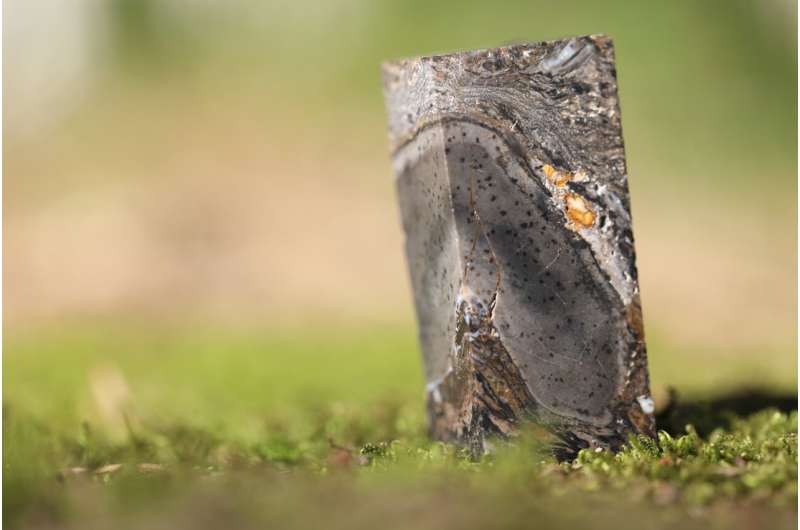
 Fossil specimen of Prototaxites taiti on a mossy surface, resembling the landscape of the Early Devonian. Credit: Laura Cooper, University of Edinburgh.
Prototaxites are something of a prehistoric mystery. They were the first giant organisms on land, towering over ancient landscapes at heights of up to 8 meters. They had smooth trunk-like pillars and no branches, leaves or flowers. And unlike trees, they had no true root system. Instead, they may have been anchored to the ground by a simple bulbous base.
Since their first fossils were discovered in the mid-19th century, scientists have argued over their place in the tree of life. Are they giant fungi, massive algae or some kind of plant? But new evidence has emerged that may help settle the matter once and for all. Or will it just add more fuel to the debate?
According to a new study published in the journal Science Advances, Prototaxites belonged to a previously unknown, now-extinct branch of life.
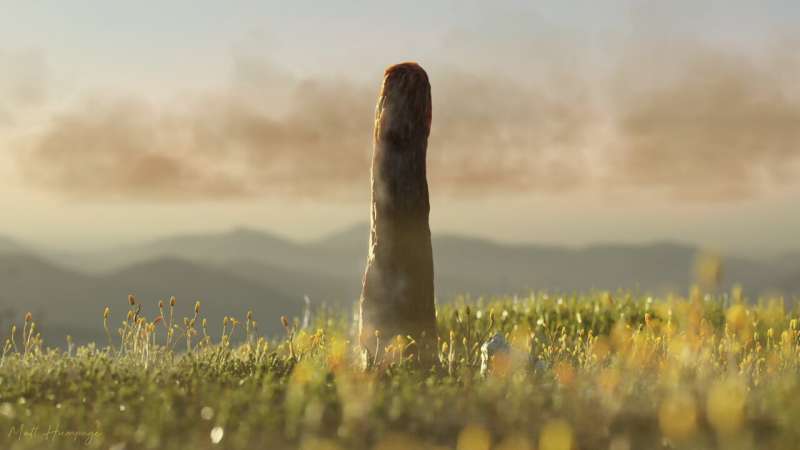 A life reconstruction of Prototaxites taiti growing in the 407-million-year-old Rhynie chert ecosystem. Credit: Matt Humpage, Northern Rogue Studios
Solving an ancient mystery
The researchers studied a specimen of Prototaxites taiti recovered from the Rhynie Chert in northeastern Scotland. This paleontological site is well-known for its exceptionally well-preserved plant, fungal and animal material.
The team used lasers and 3D imaging to look inside the fossils and compared their chemical compositions with those of other fossils found in the same rock. They discovered two significant differences.
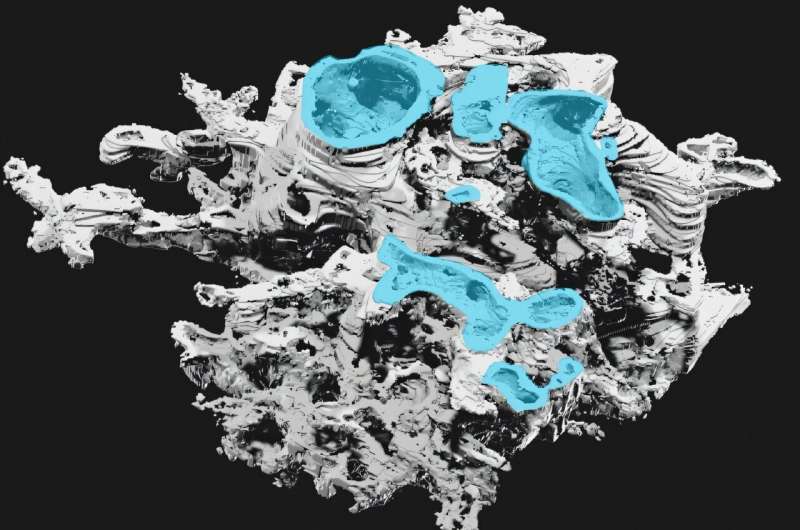 The internal anatomy of Prototaxites taiti was composed of interwoven tubes that joined at highly complex branched regions. The complex 3D structure of these regions was revealed by confocal laser scanning microscopy. Credit: Laura Cooper, University of Edinburgh
While fungi have simple networks of long, tubular structures called hyphae, the Prototaxite specimen had a much more complex internal structure. It comprised three different types of tubes and dense hubs where they branch and connect.
To study its chemical fingerprint (the chemical signature organisms leave behind based on the cells they are made of), the team used artificial intelligence. The polysaccharide chitin is often detected in fossilized fungi and insects, but it was completely missing from the Prototaxites sample. They also used artificial intelligence to see if its chemistry matched that of any living organism. It didn't.
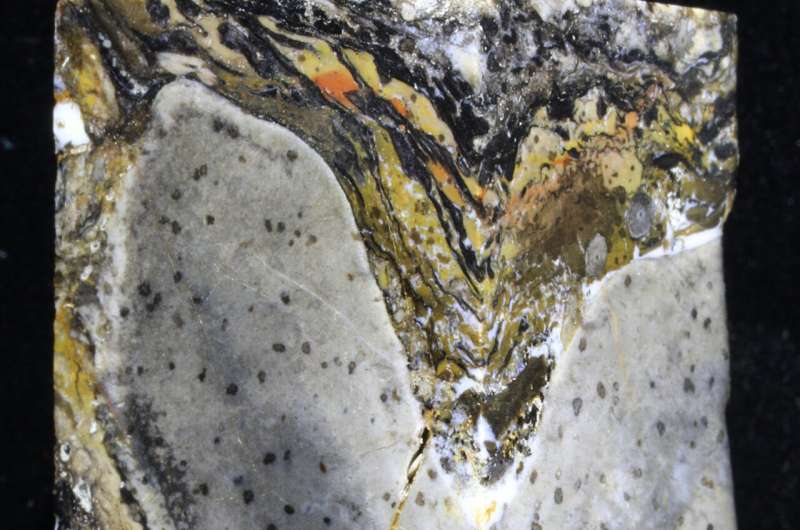 Fossil specimen of Prototaxites taiti showing the spotty internal structure. Credit: Laura Cooper, University of Edinburgh
A lost branch of life
The researchers ruled out the giant fossils being fungi or plants, and instead, they conclude that Prototaxites were members of an extinct lineage of eukaryotes (complex-celled organisms), as they note in their paper: "Our integrative approach... undermines the hypothesis that Prototaxites taiti was an ascomycete specifically, and a crown-group Fungus more generally, and instead supports assignment of Prototaxites to a previously undescribed extinct eukaryotic lineage."
The findings may have finally solved the long-standing mystery about the true nature of Prototaxites. However, further analysis and fossil discoveries may well be needed before the results are considered conclusive.
Written for you by our author Paul Arnold, edited by Lisa Lock, and fact-checked and reviewed by Robert Egan—this article is the result of careful human work. We rely on readers like you to keep independent science journalism alive. If this reporting matters to you, please consider a donation (especially monthly). You'll get an ad-free account as a thank-you.

