An increasing number of companies are bringing generative AI into the modernization of aging core systems. Even when design documentation is unavailable, AI can decipher source code and identify business logic. Cases are also emerging in which analysis on a scale that would have been unrealistic by hand is completed in a matter of months.
Kakuyasu, a liquor wholesaler, is one such company. Its core system, which had operated for 30 years, had fallen into a state where it was “untouchable, unreadable, and unfixable,” and manual analysis was estimated to require an enormous 450 person-months. Generative AI, it turned out, reduced that analysis time to effectively two months. Mr. Ishii, a Special Assignment Officer in the Group Systems Division at parent company Hitomairu in Kita Ward, Tokyo, revealed the story behind the project at “AWS Summit Japan 2026,” held by AWS Japan at Makuhari Messe on June 25–26.
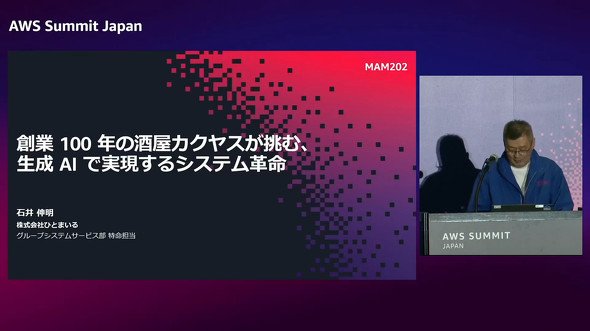 Mr. Ishii of Hitomairu speaking at “AWS Summit Japan 2026” (Source: Hitomairu’s presentation; the same applies below)
The “core system” that had operated for 30 years had become ossified—A last-ditch effort that even included changing the company’s name
Kakuyasu’s core system was built roughly 30 years ago using the then-current “Visual Basic” (now VB.NET) and an Oracle database, and optimized for liquor wholesale operations. However, after years of piecemeal additions, reliance on a maintenance vendor had become routine by 2025, and no one understood how the system worked internally. The contract for “VMware,” the infrastructure software used to run servers efficiently, was also approaching an immovable deadline: it would expire in July 2027.
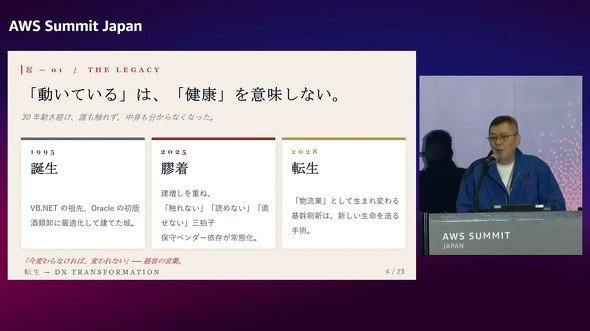 No one understood the internals of the core system that had continued operating for 30 years
The modernization was driven by a transformation of the business model. In July 2025, Hitomairu Group changed the name of its holding company from Kakuyasu Group, declaring a shift from “a company that transports alcohol” to “a company that profits from transportation”—from liquor wholesaling to the logistics business. Mr. Ishii positioned the project as “the first and last heart surgery to give the company itself a new life,” and described the company name change as “the banner of a last-ditch effort in which we advanced ourselves to the point of no return.”
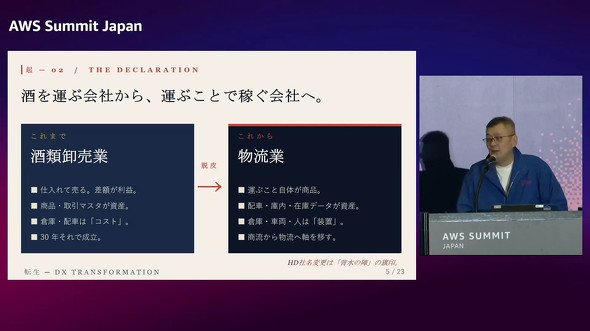 Proclaiming the shift from liquor wholesaling to logistics
No design documentation, and some code missing—An estimated 450 person-months
What Mr. Ishii saw when he joined the project was a system with no design documentation, some of its program code missing, and no environment in which it could be tested in the same state as production. It had 2,200 operating screens and 3,000 tables for storing data, but no one inside the company understood the whole system. Moreover, many of the systems handling core operations, such as calculating selling prices and inventory, were buried deep inside programs whose internals were opaque from the outside, and no one could extract them.
Manual analysis was estimated to require 450 person-months. Mr. Ishii recalled, “After a year, we couldn’t even draw a map, and the deadline was two years away. We were on the verge of sinking.”
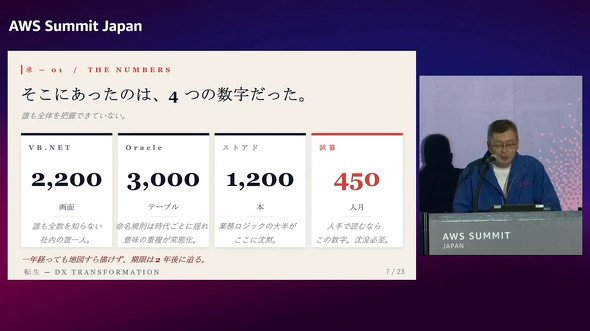 A scale of 2,200 screens, 3,000 tables, and 1,200 stored procedures
AI-Driven and Business-Driven: Breaking Through with “Both Wheels”
The breakthrough came from a two-pronged approach of “AI-driven development” and “business-driven development.” In the AI-driven development effort, Anthropic’s coding-support AI, Claude Code, was run on Amazon Web Services’ (AWS) generative AI platform, Amazon Bedrock, to analyze 1,200 stored procedures. Six business logics were extracted: data movement between tables, inventory valuation calculations, selling price calculations, credit evaluation calculations, inventory allocation, and empty-container collection—a commercial practice unique to the liquor industry. A testing platform was also established that could reproduce the production Oracle environment on AWS, allowing behavior to be compared and verified.
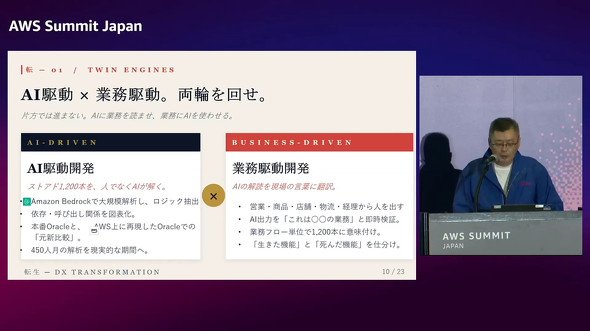 Claude Code on Amazon Bedrock analyzes 1,200 stored procedures
In the other, business-driven development effort, people were brought together from the sales, merchandising, store operations, logistics, and accounting divisions to translate the AI’s analysis results into the language of frontline business. Unused screens and similar but distinct screens were sorted out, condensing 2,200 screens down to approximately 800 screens necessary for the business. Ishii described this as “not a reduction in functionality, but a leaner redesign to enable us to operate as a logistics company,” and said, “Neither AI alone nor the field alone could move us forward. Only when the two wheels meshed together were we able to move ahead.”
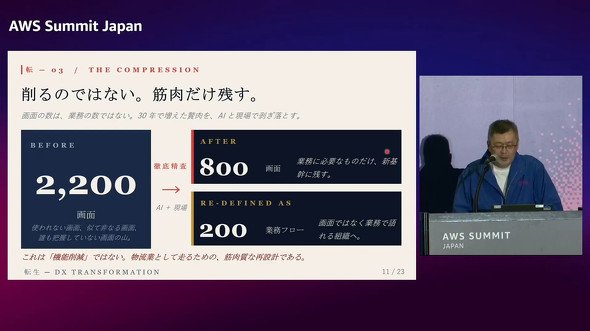 Reduced 2,200 screens to approximately 800