In this article, I will try to understand how pricing works for frontier models, where OpenAI and Anthropic actually make their money, whether subscriptions pay for themselves, and what to expect from prices over the next one to three years.
Framing the Problem and Sources
This article answers five questions:
- How much do tokens cost today—at list prices and in practice? Are these prices economically justified?Are subscriptions profitable for providers?How will prices change in 2027–2029?What do these trends mean for companies and professionals?
primary documents: Anthropic’s IPO prospectus (Form S-1), Gartner press releases, the Ramp corporate spending index, research from Epoch AI and Stanford’s Digital Economy Lab;
original analytical analyses with open calculations: Martin Alderson, Ethan Ding, Chris Zeoli, Tomasz Tunguz, Torsten Slok (Apollo), Matthias Bastian (The Decoder);
OpenAI’s financial metrics as reported by The Information and The Wall Street Journal. The company does not disclose its financial statements, so this data should be treated as estimates.
Source links are provided in the text, and the full list appears at the end of the article.
What do tokens cost now
By the end of 2026, the market had formed a three-tier structure:
super-flagships — Claude Fable 5.1 and GPT-6 Astra;
workhorse flagships — Claude Opus 5.5, GPT-6 Sol, Gemini 3.5 Flash;
mass-market models — GPT-6 Luna, DeepSeek V4.1-Flash, etc.
Prices are shown in dollars per 1 million tokens at the standard rate:
Model | Input | Cache read | Output | Tier |
|---|---|---|---|---|
0,25 | 50,00 | super-flagship | ||
GPT-6 Astra (OpenAI) | 10,00 | 1,00 | 50,00 | super-flagship |
Claude Opus 5.5 (Anthropic) | 4,00 | TAG170@@0,20 | TAG174@@20,00 | TAG177|
| TAG184@@GPT-6 Sol (OpenAI) | TAG187TAG196@@10,00 | TAG199TAG206@@Gemini 3.5 Flash (Google) | TAG210@@1,50 | TAG213TAG222@@flagship | TAG226TAG228@@DeepSeek V4.1-Flash, off-peak tariff | 0,15 | TAG235
| TAG254@@0,10 | TAG257
Sources: [1], [2], [3], [4].
However, the price list does not accurately reflect actual costs. According to Ramp, the weighted average price that U.S. companies actually paid OpenAI and Anthropic in the week ending October 23, 2026, was approximately $0.56 per million tokens [5]. The reason is that, in agentic use cases, most of the volume comes from rereading cached context and using cheaper models.
Martin Alderson showed that the cost of a long agentic session is determined primarily by the cache-read rate, rather than by input and output pricing [1]. If a typical software agent session is calculated using his methodology, the difference between models is very significant.
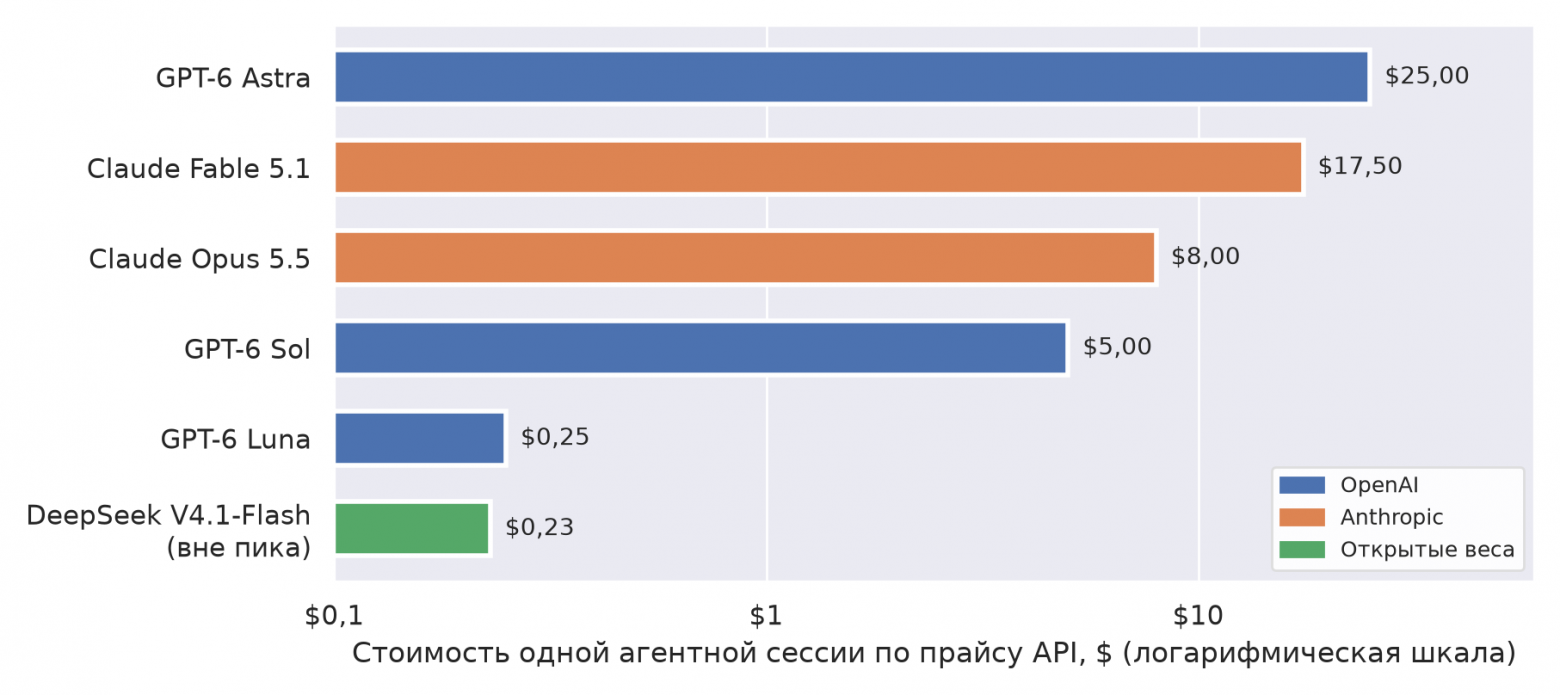
The same work costs anywhere from 23 cents to $25—a difference of two orders of magnitude. Model selection and cache architecture affect the final budget more than any pricing-list changes.
Two price curves
The most widely cited study on this topic is Epoch AI’s report “The plunging price of thought” (September 2026). I was unable to obtain the full text of the report, so the figures are based on detailed, mutually consistent retellings [6], [7].
According to the report, the cost of achieving a fixed level of quality has fallen by roughly a factor of 13 per year since 2023. This is faster than DNA sequencing, computing, and batteries have become cheaper.The pace is highest immediately after a new capability emerges and then gradually slows. A telling example: a result that cost about 30 cents per question in early 2025 became achievable hundreds of times cheaper within a year and a half.
The trend had been described before. In 2024, Guido Appenzeller (a16z) called it “LLMflation” and estimated a tenfold reduction per year [8]. Epoch AI showed that the rate of cost reduction depends strongly on the task level [9]. MIT researchers provided a more conservative estimate and noted that algorithmic progress accounts for only part of the effect [10].
It is important, however, that this is a curve for a fixed capability level. Ethan Ding pointed out a conflation: demand shifts almost entirely to the latest model, whose price remains roughly constant, while the number of tokens per task grows [11]. The data confirms this.
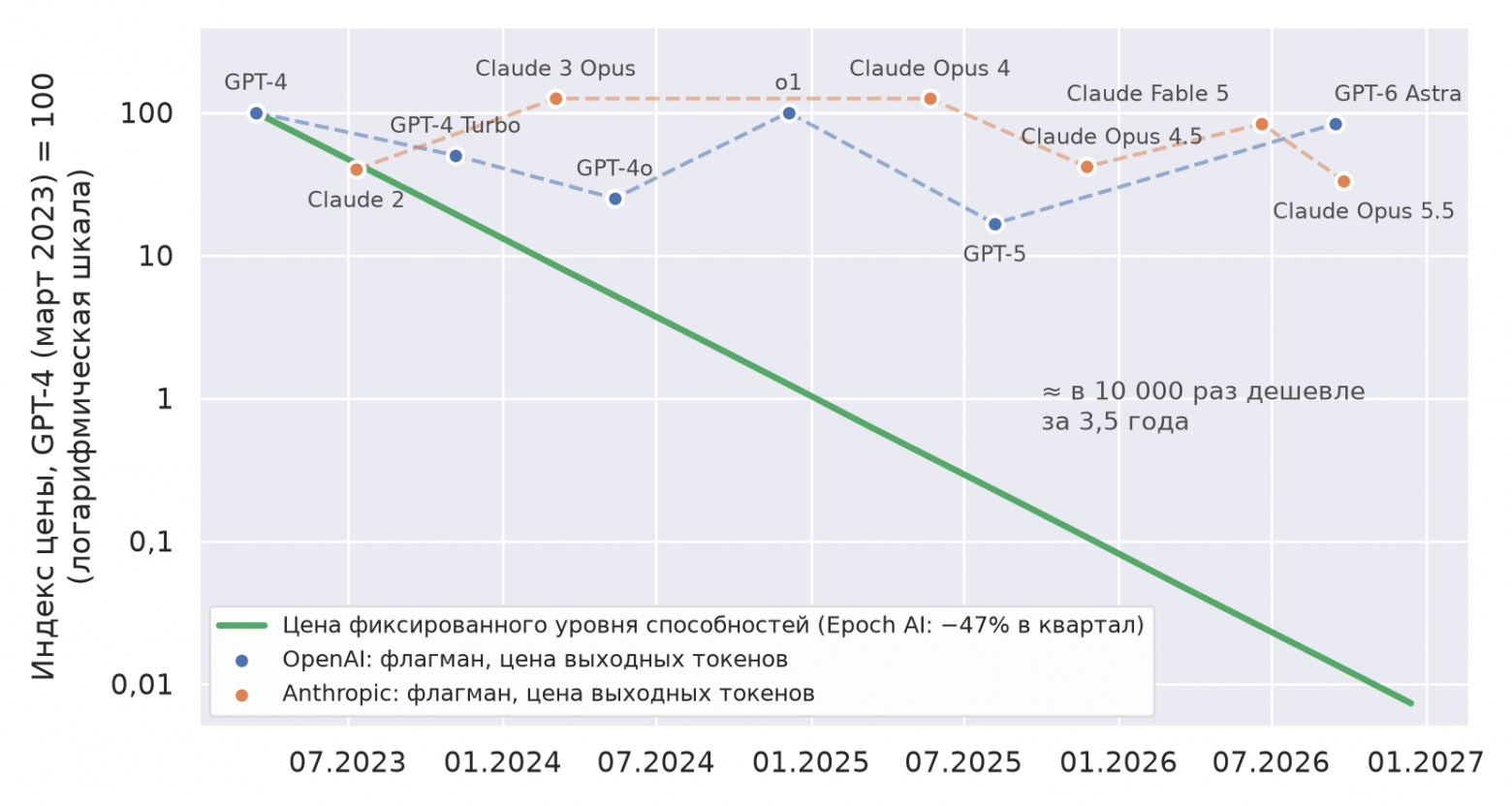
If Epoch’s pace is extrapolated over the period since spring 2023, the price of a fixed capability level has fallen roughly ten-thousandfold (this is my estimate, not a figure from the report). Over the same period, the price of output tokens from OpenAI and Anthropic’s flagship models has remained in the $10–$75 per million range.
In 2026, this was compounded by direct price increases for new models. Matthias Bastian provides several examples: Gemini 3.5 Flash costs several times more per token than its predecessor, while new versions of Claude consume noticeably more tokens for the same task at the same price [12].According to the Ornn index, in September, actual prices for closed-source models rose, while prices for the open-source DeepSeek model fell [13].
Are the prices economically justified?
Cost of revenue: the first verifiable data
Until autumn 2026, discussions of LLM providers’ margins were based on leaks and estimated calculations. Anthropic’s prospectus, published on October 26, provided verifiable financial reporting data for the first time, enabling margins to be calculated [14], [15].
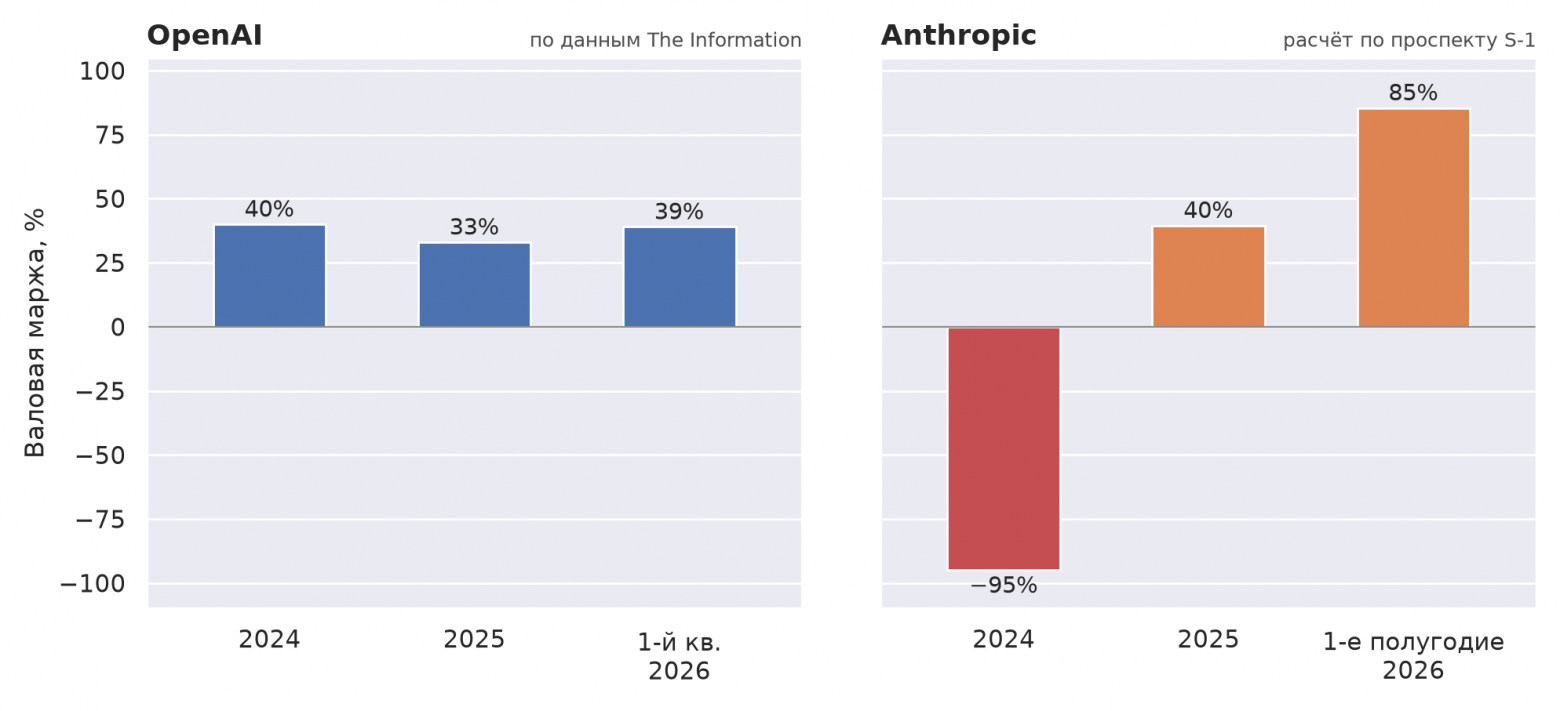
The key calculated metric is a gross margin of approximately 85% in the first half of 2026 (the company itself does not disclose the margin; it is derived from revenue and cost of revenue). In other words, the direct compute costs of serving requests amount to only about 15% of revenue. As recently as 2024, this metric was negative: cost of revenue was nearly twice revenue. About 80% of the company’s revenue comes from token-based payments, with the remaining 20% coming from subscriptions.
One caveat: nearly half of Anthropic’s revenue passes through the AWS and Google Cloud cloud marketplaces, and their commissions are recorded not in cost of revenue but in commercial expenses. Therefore, the “net” serving margin is somewhat lower. However, the order of magnitude remains the same: serving model queries is a high-margin business.
Where does the revenue go? The expense structure is shown in the figure below.
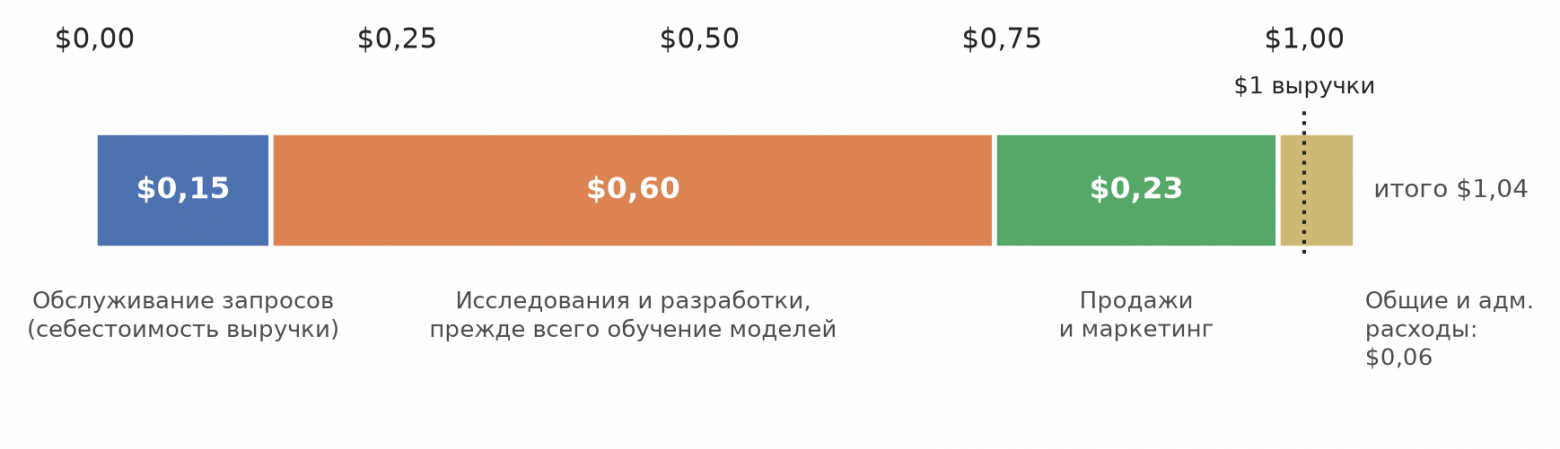
The company spends about 60 cents of every dollar of revenue on research and development, primarily on training the next generation of models. About 23 cents goes toward sales and marketing, around 6 cents toward general and administrative expenses, and only about 15 cents on actually servicing requests. Overall, expenses slightly exceed revenue, although in the second quarter of 2026, Anthropic generated operating profit for the first time across the periods disclosed in the prospectus. The net loss for the half-year is incomparably larger—about $81 billion—but more than $72 billion of that stems from the non-cash revaluation of convertible loans and other instruments that appreciated along with the company’s valuation [15].
OpenAI: a different business structure
OpenAI’s financial position is markedly different. According to data published by The Information and WSJ, with revenue of $5.7 billion and $6.7 billion in the first and second quarters of 2026, respectively, the company posted operating losses of $9.3 billion and $12.3 billion [16], [17].
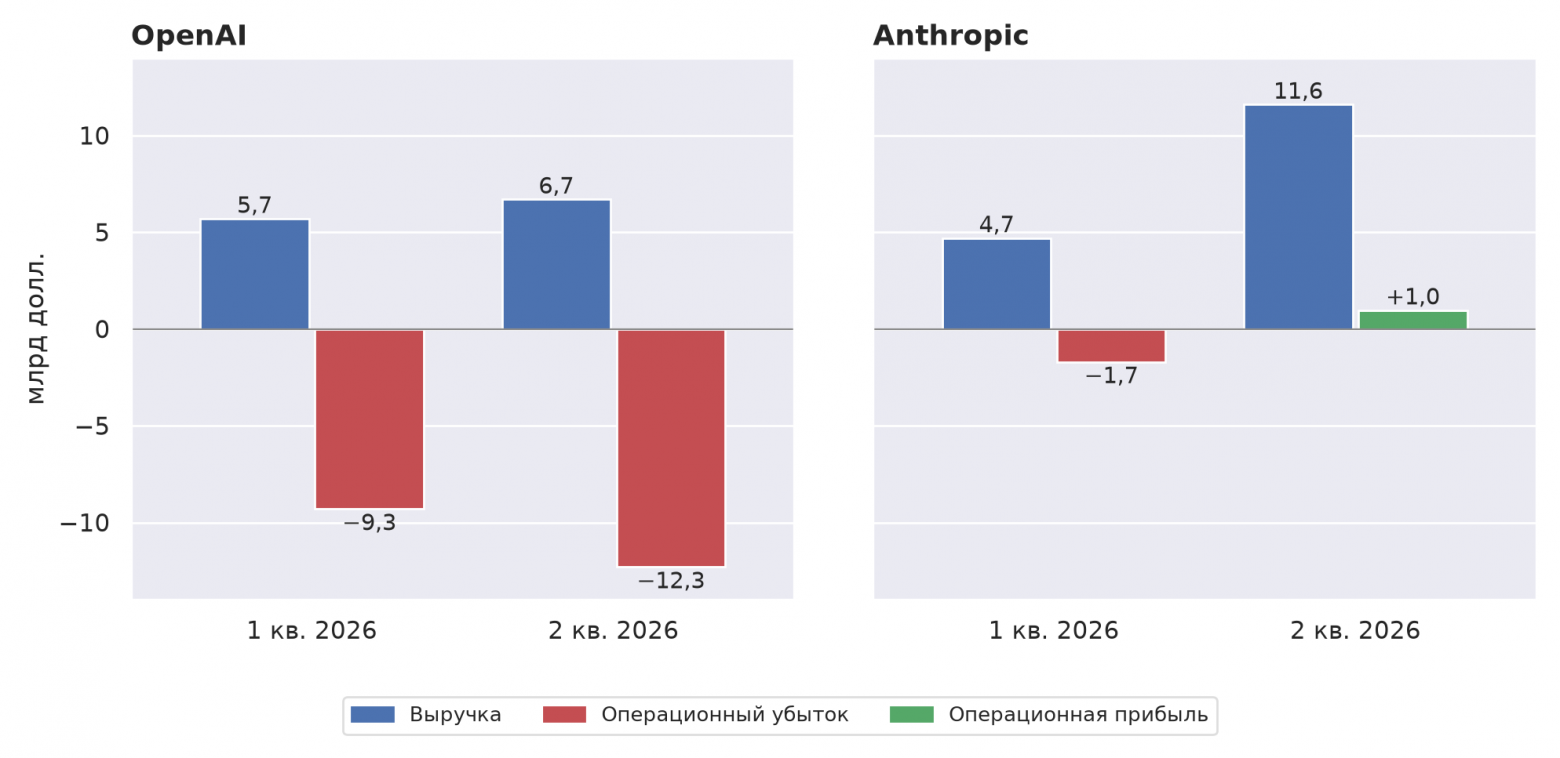
The main reason for the differences is the structure of the user base. A significant portion of ChatGPT users are on free or low-cost plans, the costs of servicing which are included in cost of revenue.Therefore, according to The Information, OpenAI’s gross margin was around 33% in 2025 and 39% in the first quarter of 2026, whereas Anthropic generates most of its revenue from enterprise clients and software access.
Independent cost estimates
Back in 2025, Martin Alderson estimated the cost of inference based on the cost of renting graphics accelerators and the architecture of a DeepSeek R1-class model [18]. His conclusion was that processing input tokens costs the provider almost nothing, the main expenses are associated with generating the response, and the margin on software access is 80–95%.
“The API business is essentially a money printer.” Translation: “Selling API access is essentially a money-printing operation.”
In 2026, Alderson examined the widespread claim that an active Claude Code subscriber paying $200 per month consumes $5,000 worth of computing [19]. According to his estimate, this is the cost at retail prices, not the cost to the provider. Comparable open models from third-party providers cost about one-tenth of the price of Opus, and those providers operate at a positive margin.
What actually determines the priceAnthropic CEO Dario Amodei articulated the industry’s logic [20]: each individual model pays for its training, but the company remains unprofitable because it simultaneously invests an order of magnitude more in training the next generation.“Anthropic is not a profitable company. But inference isn’t why.” Translation: “Anthropic is not a profitable company. But the reason is not inference.”
“Every model is profitable, but the company is unprofitable every year.”“Every model is profitable, but the company is loss-making every year.”
Anthropic’s prospectus discloses commitments to purchase computing capacity totaling over $265 billion (as of June 30, 2026). The company also warns investors about the risks of price pressure and allows for a transition to outcome-based or task-based payment [21].
Thus, the prices of frontier models are economically justified, but not by the cost of a token. Three factors determine them:
the need to recoup the cost of training models with a short life cycle;
- a premium for technological leadership that those for whom the difference in quality converts into money are willing to pay;
the shortage of computing capacity in 2026.
For buyers, the conclusion is simple: paying extra for the most powerful model is justified only where it delivers a measurable effect. The market, apparently, already understands this. According to Ramp, one month after the launch of Claude Fable 5, it accounted for only about 6% of the tokens purchased from Anthropic. Ramp economist Ara Kharazian described this as a sign of the limits of companies’ willingness to pay for quality gains [22].
Subscription economics
Current rates
Plan | Price, dollars.per month | Features |
|---|---|---|
ChatGPT Go | 8 | Luna model, advertisements shown (starting February 2026) |
ChatGPT Plus | 20 | GPT-6 Sol model, agentic programming limits reduced |
ChatGPT Pro | 100 / 200 / 500 | The $500 plan launched in late September 2026 |
Claude Pro | 20 | Limits for the five-hour window and weekly usage |
Claude Max | 100 / 200 | 5 and 20 times the Pro limits; usage beyond the limit is charged at API rates |
What is known about profitability
One of the first to publicly acknowledge the problem was OpenAI CEO Sam Altman. In January 2025, he said the company was losing money on the Pro plan because users were using it much more intensively than expected [23].
The mechanism behind this phenomenon was described by Ethan Ding [11]. When an agent operates autonomously for tens of minutes, token consumption no longer depends on the time a person spends in the app.The user becomes the operator of background processes, while consumption volume becomes practically unlimited.
“There is no flat subscription price that works in this new world.” Translation: “Under the new conditions, there is no fixed subscription price that would work.”
Providers responded not by raising prices, but by managing usage limits. In 2025, Anthropic introduced weekly limits, expanded them in spring 2026 after adding new capacity, and reduced them again in September amid a shortage of accelerators. OpenAI reduced the limits of the Plus plan when transitioning to new models. Chris Zeoli summarizes [13]:
“Instead of raising list prices, they cut usage allowances.” Translation: “Instead of raising list prices, providers reduced usage allowances.”
In the mass-market segment, OpenAI is shifting toward an advertising-supported model: according to The Information, the company expected the number of Plus subscribers to decline, with the shortfall compensated for by the advertising-supported Go plan [24].
Estimate: at what usage level does a subscription become unprofitable
To quantitatively assess subscription economics, I built a simple model. The cost of serving a subscriber is assumed to equal a certain percentage of the cost of the same number of tokens at the API list price. The baseline percentage is taken from Anthropic’s prospectus (about 15%), while a range of 10% to 30% is considered to assess sensitivity.
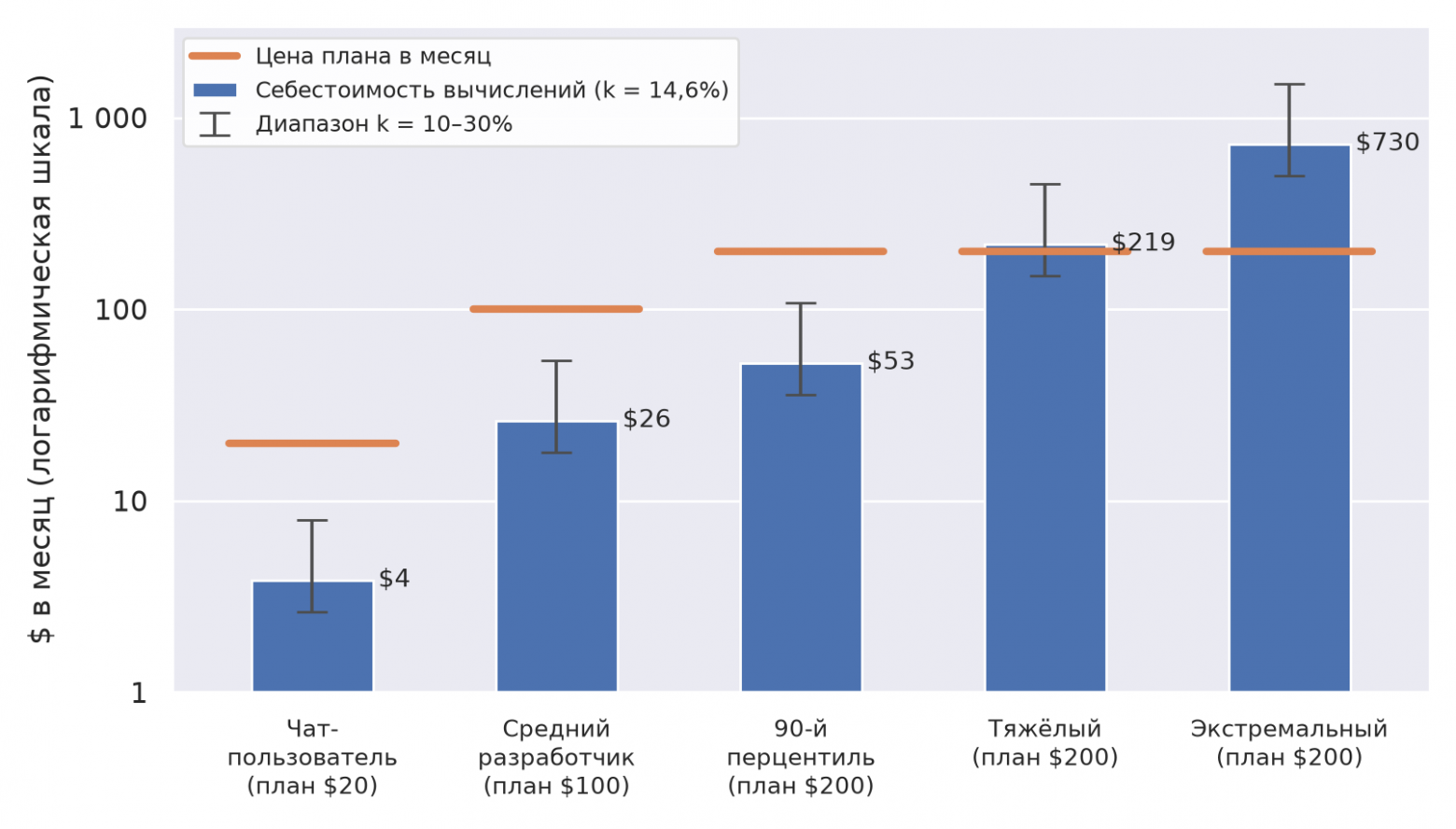
The average developer using Claude Code, and even users in the top 10% by usage, are served at a substantial margin. Only the most intensive users are unprofitable. For a hypothetical portfolio of subscribers on the $200 plan, in which “heavy” and extreme users make up 15%, the margin under the base case is approximately 56%.
Methodology and calculation of subscription unit economicsFormula. Subscriber cost C = A × k, where A is monthly usage at the API rate (API equivalent), and k is the cost-to-price ratio. Margin M = P − C, where P is the plan price. Break-even point: A = P / k.
Assumptions for k: 10% — comparison with open models from third-party providers [19]; 14.6% — cost-to-revenue ratio based on Anthropic’s prospectus; 30% — conservative estimate.
Cost and margin by profile, dollars per month:
Profile | API equivalent | Plan | C at k=10% | C at k=14.6% | C at k=30% | Margin at k=14.6% |
|---|---|---|---|---|---|---|
Chat user (100 thousand tokens per day) | 26.4 | 20 | 2.6 | 3.9 | 7.9 | 16.1 |
180 | 100 | 18 | 26.3 | 54 | 73.7 | |
360 | 200 | 36 | 52.6 | 108 | 147.4 | |
Heavy user (assumption) | 1,500 | 200 | 150 | 219 | 450 | −19 |
Extreme user (Cursor estimate) | 5,000 | 200 | 500 | 730 | 1,500 | −530 |
Pointbreak-even, monthly API equivalent:
Plan | k = 10% | k = 14.6% | k = 30% |
|---|---|---|---|
$20 | $200 | $137 | $67 |
| $1 000 | $685 | $333 | |
$200 | $2 000 | $1 370 | $667 |
$200 plan mix: 60% average users, 25% — 90th-percentile users, 10% intensive users, 5% extreme users. Average API equivalent: 0.6 × 180 + 0.25 × 360 + 0.1 × 1 500 + 0.05 × 5 000 = $598. Margin: (200 − 598 × k) / 200 = 70.1% / 56.3% / 10.3% at k = 10% / 14.6% / 30%.
Replacing every five percentage points of average users with extreme users reduces the margin at the baseline k by approximately 18 percentage points. Therefore, limits, rather than price, are the primary tool for managing subscription economics.
Thus, the subscription operates as an insurance model with limits: moderate users subsidize intensive users. An unlimited plan is economically infeasible for agent use.In the coming years, further fragmentation of the pricing lineup, overage charges beyond API plan limits, separation into peak and off-peak periods, and regular adjustments to limits rather than price changes should be expected.
Forecast for 2027–2029
The short answer to the question about future pricing: the cost per token will continue to decline, but the cost per task on frontier models will not. At the same time, forces pushing the market in different directions are at work.
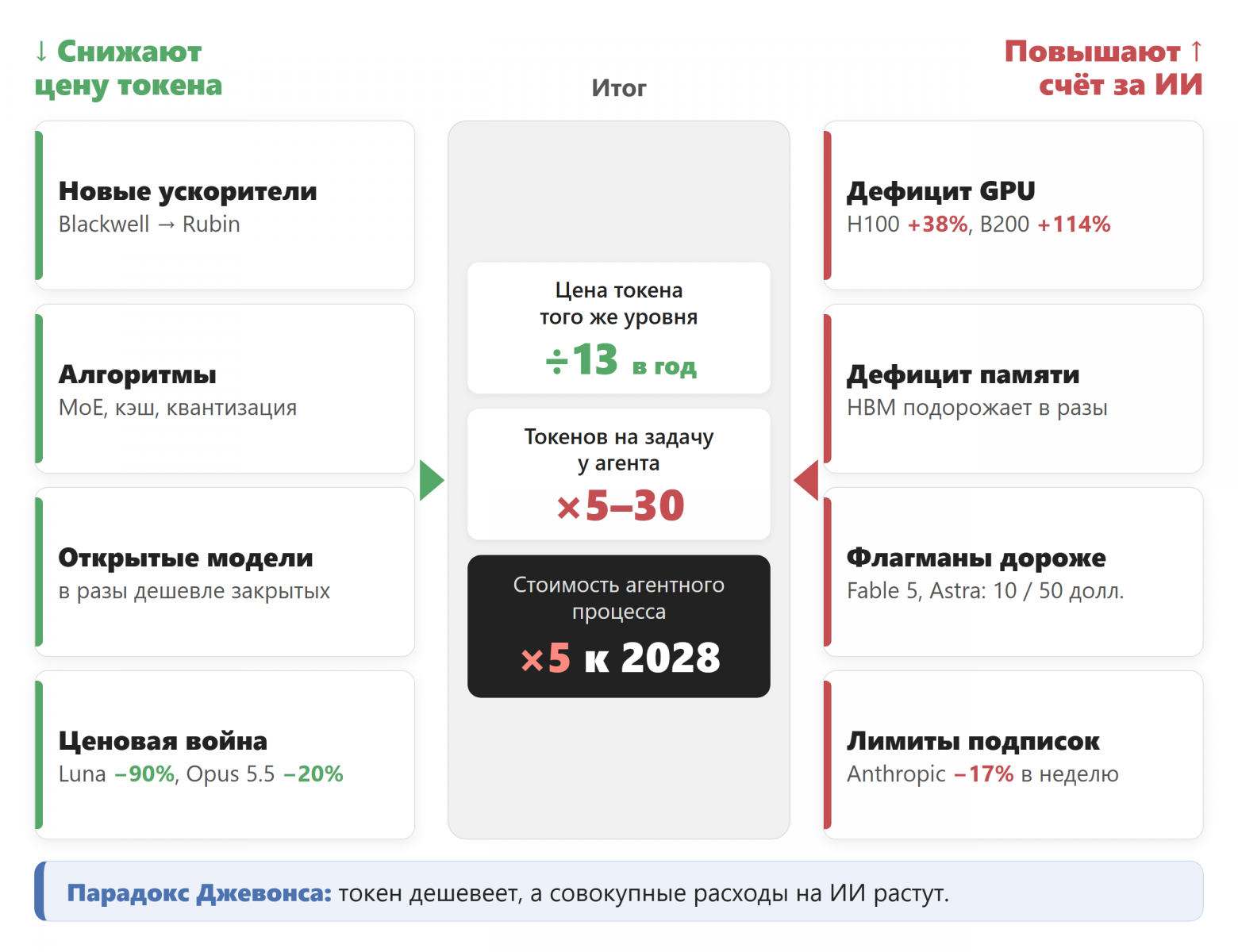
Factors driving down prices
Technological trend. According to Epoch AI, the cost of achieving a fixed level of capability has not yet slowed on average, although for mature tasks the pace of decline is slowing [6].
Inference efficiency. Gartner forecasts that by 2030, inference for a model with one trillion parameters will cost providers more than 90% less than in 2025 [25].At the same time, analysts note that the cost reductions will not be fully passed on to customers, whose total costs will continue to rise.
Price competition. Over two months, OpenAI significantly reduced prices for the Luna and Sol models, while Anthropic cut the price of its flagship model for the first time, particularly for cache reads [1].
Open models with comparable quality are several times cheaper than closed models [13].
Factors keeping prices high or driving them higher
Shortage of computing capacity. According to SemiAnalysis, the annual rental cost of H100 accelerators increased by nearly 40% from October 2025 to March 2026 [28]. Spot prices for the latest B200 accelerators more than doubled in six weeks in spring 2026, rising by 114% [29], and AWS raised prices for reserved GPU capacity by approximately 20% from July 2026.
Memory. According to TrendForce, contract prices for RAM nearly doubled in early 2026. TrendForce expects annual contracts for the high-bandwidth memory (HBM) used in accelerators to become several times more expensive in 2027.
Growth in consumption per task. According to Gartner, an agent requires 5–30 times more tokens than a chatbot to complete a task [25].
Tomasz Tunguz describes the situation as follows [29]:
“Inflationary demand outpaces deflationary algorithmic & chip improvements”.Translation: “Inflationary demand outpaces the deflationary effect of improvements in algorithms and chips.”
Gartner’s overall forecast: by 2028, the cost of a single agentic process will rise more than fivefold, despite continued declines in token prices [26]. Analysts call this the “inference paradox.” Gartner analyst Will Sommer formulates a practical takeaway [27]:
“Product leaders cannot rely on more efficient token economics to rationalize AI costs”. Translation: “Product leaders cannot rely on declining token prices alone to justify AI costs.”
From a product management perspective, this is perhaps the central thesis of the entire review.
Scenarios
To assess the scale of the divergence, I built a simplified scenario model. It compares two quantities. The first is the cost of solving a today’s task on the least expensive suitable model. The second is the cost of an agentic process on a frontier model, taking into account changes in prices and growth in the number of tokens.
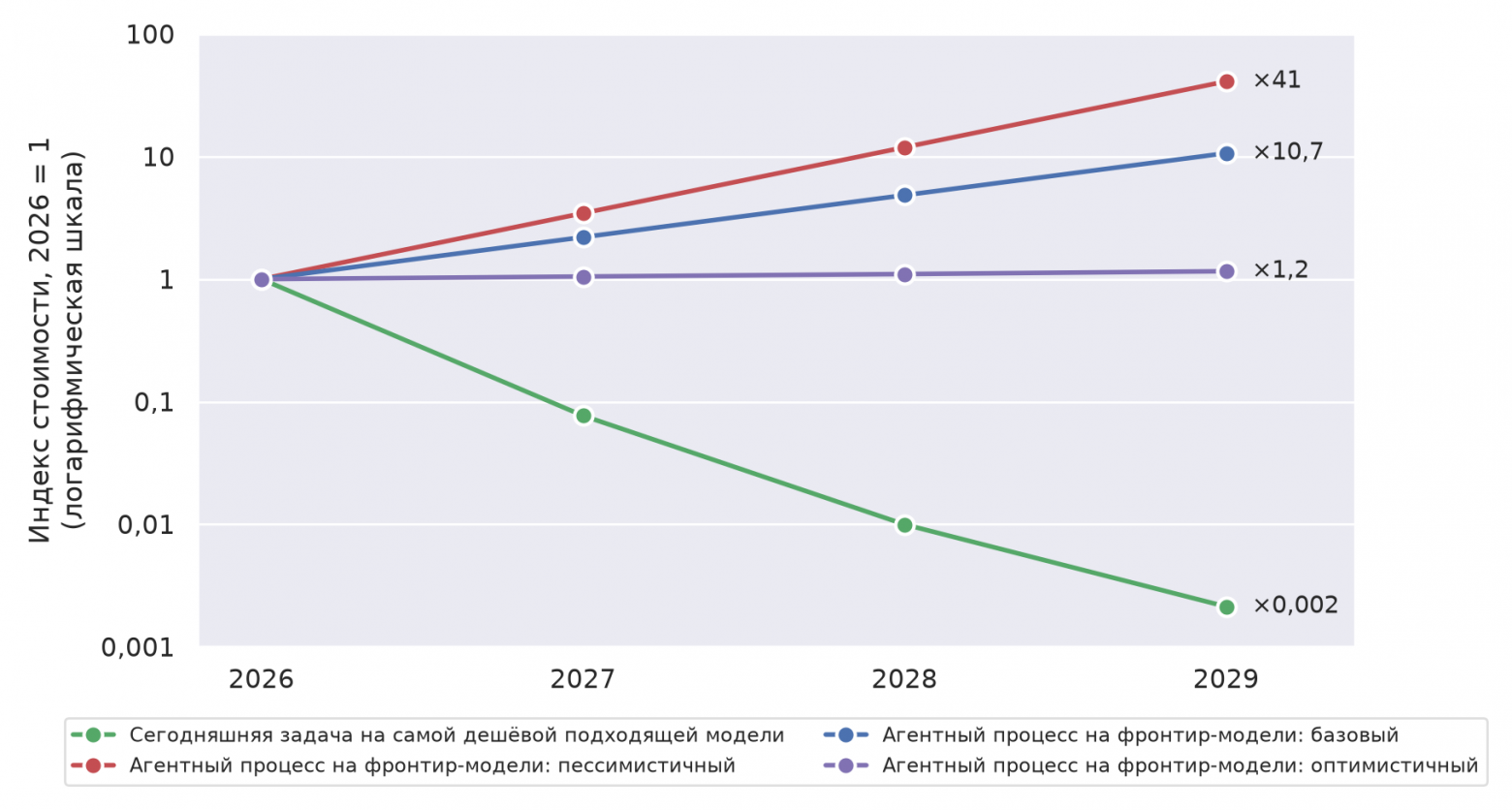
By 2029, the cost of solving today’s task falls by two and a half orders of magnitude. The cost of an agentic process at the frontier grows approximately tenfold in the baseline scenario and fortyfold in the pessimistic one.Only the spread of price competition to the upper segment of the market makes it possible to maintain it at the current level.
Scenario model parametersToday’s task: I(t) = I(t−1) × f(t), where f is the annual cost-reduction factor based on Epoch AI data, with a gradual slowdown: 1/13 in 2027, 1/7.7 in 2028 (assumption), 1/4.7 in 2029 (the rate for mature capabilities).
Agentic process at the frontier: I(t) = I(t−1) × p × g, where p is the annual change in the price of frontier models, and g is the annual growth in the number of tokens per process.
Scenario | p | g | 2027 | 2028 | 2029 | Logic | ||||||
|---|---|---|---|---|---|---|---|---|---|---|---|---|
Optimistic | 0,70 | 1,5 | 1,05 | 1,10 | 1,16 | price competition reaches the upper segment | ||||||
Base | 1,00 | 2,2 | 2,20 | 4,8410,65 | corresponds to the Gartner forecast | Pessimistic | 1,15 | 3,0 | 3,45 | 11,9 | 41,06 | shortage of memory and accelerators, increasing task lengths |
Today's task | — | — TAG1041@@ | 0,077 | 0,010 | 0,002 | Epoch AI's pace with a slowdown |
The model does not account for the redistribution of workloads to cheaper models, volume and batch-processing discounts, or price spikes when new generations are released.Its purpose is to show the scale of the divergence, rather than provide an exact forecast.
Expectations for the market segments can be summarized in a table:
Segment | Price per token | Key factor | Confidence |
|---|---|---|---|
Mass-market models | significant decrease | TAG1100@@competition, open weights, previous-generation accelerators | high |
| TAG1110@@Workhorse flagships | moderate decrease | price competition, cheaper memory | medium |
Super-flagships | no change or growth | capacity constraints, premium for leadership | medium |
Agent process cost | TAG1150@@2–10-fold increase | task length, number of steps and agents | medium | TAG1161
growth | TAG1171highokay |
The pricing models themselves will probably change as well: pay for outcomes (this option is explicitly mentioned in Anthropic’s prospectus), peak and off-peak rates, greater importance of cache pricing, and tiered subscriptions with overage charges.
Implications for companies
The Ramp Index, based on transactions involving more than 85,000 U.S. companies, shows that more than half of them are already paying for AI [5]. The spread in spending is enormous: the median company spends around $16 per employee per month, while companies in the top 1% spend nearly $10,000. The trend is even more striking: over the course of a month, the volume of tokens consumed grew by more than one-third, the effective price of a token fell by roughly one-fifth, and total spending still increased.
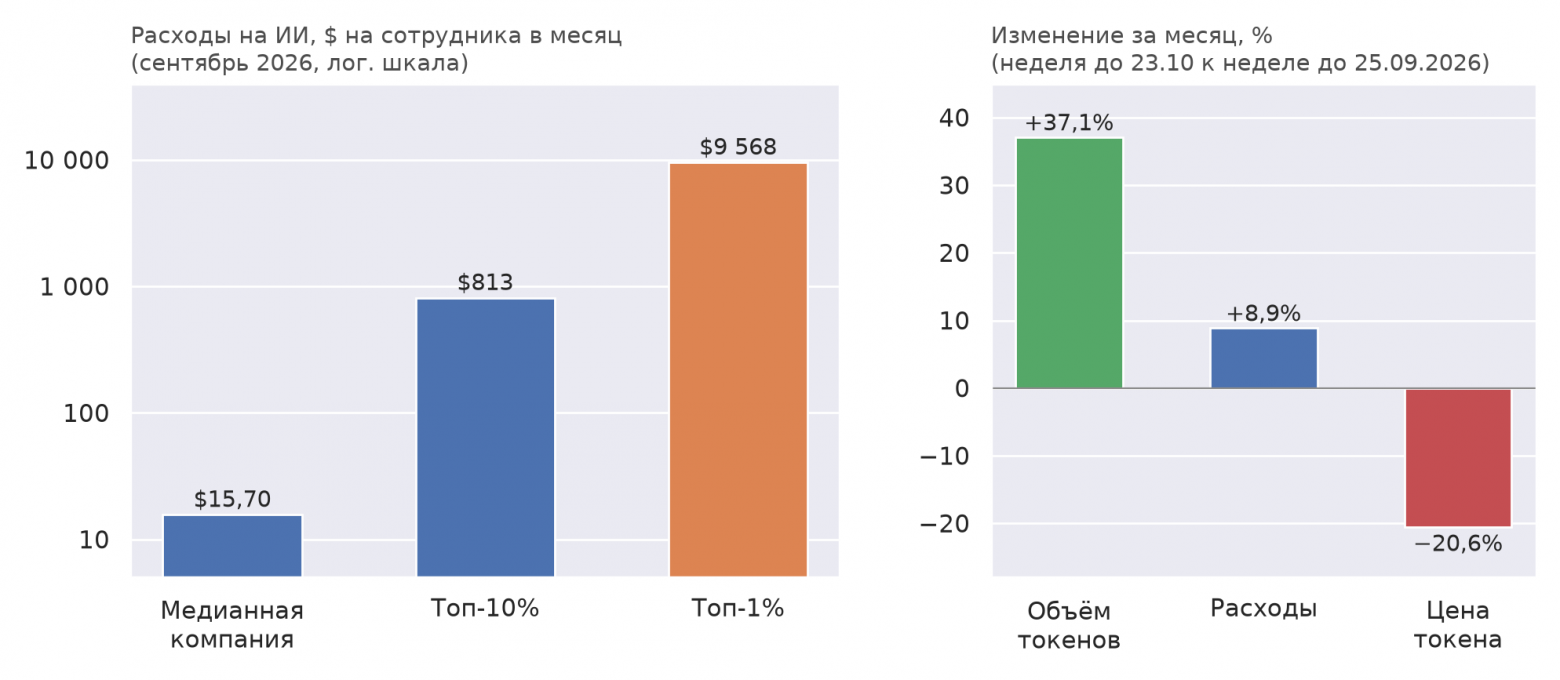
Apollo Chief Economist Torsten Slok observed the same effect at the macro level: aggregate spending on tokens has roughly doubled since the end of 2025, even though the price of an individual token has fallen by more than 90% since 2023 [30]. This is the classic Jevons paradox: making a resource cheaper increases its total consumption.
In October, Slok made another observation [31]. Growth in revenue per employee and profit margins is noticeable among the largest technology companies, but not across the rest of the market. Outside the technology sector, AI spending is increasingly viewed as a cost rather than a source of growth.
“AI may be a great calculator, but in business, intelligence is mostly judgment”.“AI can be an excellent calculator, but in business, intelligence is above all the ability to make decisions.”
Tokens as a per-employee cost
For employers (currently this applies only to developers at IT companies), computing is becoming a separate line item in employee costs. At the NVIDIA GTC conference in March 2026, Jensen Huang proposed allocating engineers a budget for tokens equal to roughly half their base salary on top of it [32], [33]. The head of the accelerator manufacturer’s statement cannot be called impartial, but it accurately reflects the trend. Even according to Ramp, companies with the highest spending currently spend noticeably less per employee. However, the computing budget is already included in the cost of a specialist’s position and over time may account for a substantial share of the payroll.
If an agent is compared directly with a person, the economics of substitution are unambiguous. A month of continuous agent operation on a flagship model costs approximately $1.3 thousand at list price, while on a mass-market model it costs several dozen dollars. For comparison, the full cost to an employer of a month of an engineer’s work in the United States is about $16 thousand: the median software developer salary is $135,980 per year [35], and salary accounts for 70% of the employer’s cost per employee [36].
Calculating the cost of an agent session and comparing it with laborSession A (using the Alderson methodology): 0.5 million input tokens, 10 million cached tokens, and 0.2 million output tokens. Session B: 0.2 million input tokens, 20 million cached tokens, and 0.1 million output tokens. Cache writes are not included.Prices are in dollars per 1 million tokens, and session costs are in dollars.
Model | Input | Cache | Output | Session A | Session B | Agent, full month |
|---|---|---|---|---|---|---|
GPT-6 Luna | 0.10 | 0.010 | 0.50 | 0.25 | 0.27 | 42 |
DeepSeek V4.1-Flash (off-peak) | 0.15 | 0.003 | 0.60 | 0.23 | 0.15 | 38 |
GPT-6 Sol | 2.00 | 0.200 | 10.00 | 5.00 | 5.40 | 840 |
Claude Opus 5.5 | 4.00 | 0.200 | TAG1351@@20,00 | 8,00 | 6,80 | 1 344 |
Claude Fable 5.1 | 10,00 | 0,250 | 50,00 | 17,50 | 12,00 | 2 940 |
GPT-6 Astra | 10,00 | 1,000 | 50,00 | 25,00 | 27,00 | 4 200 |
Metric | Value |
|---|---|
Engineer in the US, full cost to the employer | approximately $93 per hour ($65.4 median salary [35] / 0.70 [36]), $15,700 for 168 hours |
Engineer in Eastern Europe (assumption) | $35 per hour, $5,880over 168 hours |
Agent on Claude Opus 5.5, 168 sessions | $1,344 (about 9% of the cost of an engineer in the US) |
Agent on GPT-6 Astra, 168 sessions | $4,200 (about 27%) |
Agent on GPT-6 Luna, 168 sessions | $42 (less than 1%) |
Token budget under Huang’s proposal | $250,000 per year, around 2,600 sessions per month on Opus 5.5 |
Thus, the limiting factor is not the cost of computation, but the quality of the result and the cost of verifying it.
Recommendations for companies
This leads to practical recommendations for building a corporate LLM architecture, especially for companies in the real economy:
Plan the budget around the process, not around tokens. Lower prices do not guarantee lower costs: when moving from a chatbot to an agent, the cost of a task increases severalfold.
Measure the cost of a successfully completed task, taking into account retries, errors, and human verification of the result.
Route requests by model tier. Perform high-volume operations (classification, data extraction from documents, knowledge-base searches) using local or inexpensive open models.Medium-complexity agentic scenarios — use workhorse flagships. Use superflagships only where errors are costly and the difference in quality is measurable.
Design prompts with caching in mind. Place stable context (data schemas, reference materials, agent instructions) in an immutable initial section of the request.
Use your own infrastructure for non-time-critical workloads, such as batch and overnight processing or reindexing. Previous-generation open models are sufficient for such tasks, and they are getting cheaper faster than any others.
Review model selection quarterly and build into the architecture the ability to replace a model without redesigning processes.
Implement AI cost management: per-user and per-agent budgets and limits, monitoring, and alerts for anomalous usage.
TAG1560@@It is pointless to compete with an agent on price for routine tasks. A month of using an agent based on a flagship model costs the employer an order of magnitude less than a month of an engineer’s work (calculation — in the previous section).Value is shifting toward areas where AI complements work rather than automating it: assigning tasks to agents, reviewing results, and providing domain expertise.
The ability to manage compute costs is becoming a professional skill. Selecting the right model for the task, caching context, and monitoring spending make the difference between an agent session costing 23 cents and one costing $25 (Fig. 2).
Access to compute is becoming part of the terms of employment. If Huang’s idea of a token budget on top of salary takes hold, it will enter the job offer alongside salary and equipment. When choosing an employer, it is worth asking which models will be available and in what quantities.
You should not count on unlimited access through a personal subscription. Under intensive use, subscriptions become unprofitable for providers, and limits are already being reduced.If AI has become a practical tool, it makes sense to understand in advance what API-based work will cost.
TAG1562@@Account for vendor risk in contracts. Providers reserve the right to change model limits and specifications, so prices and limits should be fixed for the contract term.
TAG1566TAG1568@@Set aside a budget reserve for 2027 in case frontier inference becomes more expensive.
TAG1572Implications for employees
Labor market data remain inconclusive.The Stanford Digital Economy Lab study (Brynjolfsson, Chandar, Chen, August 2026) finds no signs of widespread displacement of workers [34]:
“We do not see widespread, economy-wide job displacement associated with AI.” Translation: “We do not observe widespread, economy-wide displacement of jobs associated with AI.”
However, the picture is different for young professionals, although the authors emphasize that this concerns descriptive patterns rather than an estimate of a causal effect. Employment among 22–25-year-old workers in occupations most exposed to AI is approximately one-fifth lower than it would have been if the growth rates characteristic of their peers in other occupations had been sustained. The decline is concentrated where AI automates tasks. Where it complements the work of professionals, employment is stable or growing.
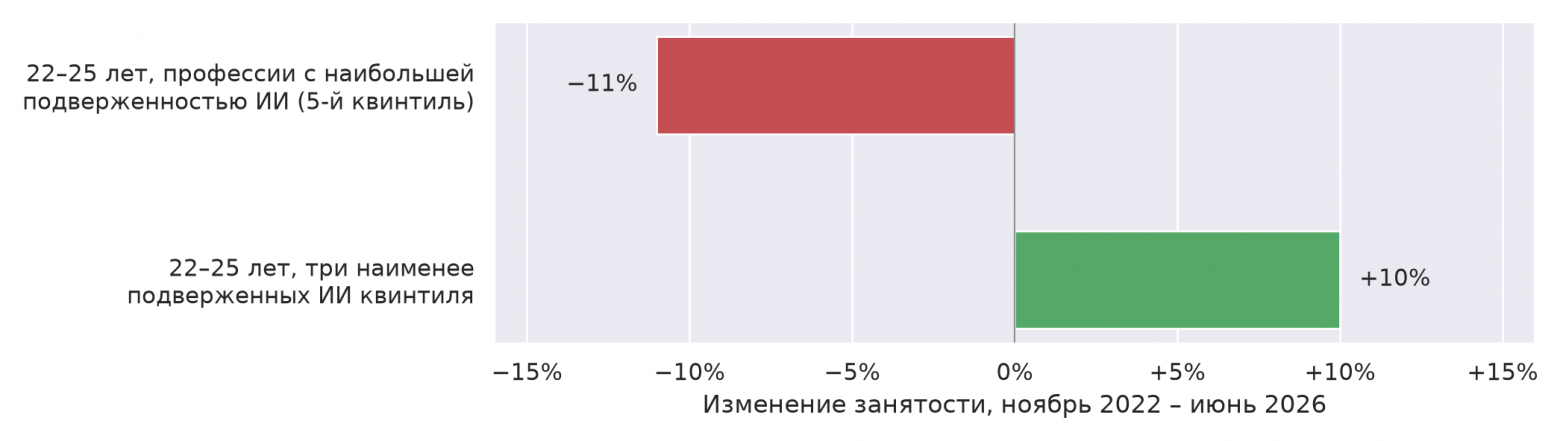
Meanwhile, according to Ramp and Revelio Labs, companies with the largest investments in AI increased their headcount by approximately 10% over two years, including at entry-level positions; companies with low AI-use intensity show no noticeable effect. What does this mean for the individual professional:
Conclusions
The price of frontier models from the market leaders (Antropic and OpenAI) is not determined by the cost per token. The margin on serving requests is high, and most revenue is directed toward training the next generation of models and meeting commitments to purchase computing capacity.
There are two pricing curves. The cost of achieving a fixed level of capability is falling by an order of magnitude per year, while the price of flagship models has remained in the same range since 2023 and even rose in 2026.
The positions of the market leaders differ fundamentally. Anthropic, which focuses on the enterprise segment, reported operating profit in the second quarter of 2026. OpenAI, with its massive free user base, remains deeply unprofitable.
Subscriptions are profitable on average, but an unlimited plan is impossible. Providers manage subscription economics through limits rather than pricing.
Over the next 1–3 years, prices will diverge. Mass-market models will continue to become cheaper, price competition will intensify in the midrange segment, and the cost of using frontier models will likely rise due to a shortage of computing capacity.
Aggregate corporate spending on AI will grow even as the price per token falls.Those who measure the cost of a completed task, switch to cheaper models in a timely manner, and move workloads that are not time-critical to their own infrastructure will benefit.
The limitations of the review must be noted. OpenAI’s financial figures are based on media reports rather than audited financial statements. The Epoch AI report was examined through summaries, and the authors themselves warn that benchmark results are not equivalent to useful work. The share of cost in subscription calculations is an estimate. Ramp data reflects U.S. companies, with a bias toward the technology sector. Finally, prices and limits change practically every month in 2026, and the data provided is current as of early November.
ReferencesAlderson M. The AI margin collapse is gathering pace. 29.09.2026 — https://martinalderson.com/posts/ai-margin-collapse-gathering-pace/
eesel.ai. GPT-6 Astra pricing — https://www.eesel.ai/blog/gpt-6-astra-pricing
LLM Reference. Claude Fable 5.1 — https://www.llmreference.com/provider/anthropic-api/claude-fable-5-1
CloudZero. Gemini pricing 2026 — https://www.cloudzero.com/blog/gemini-pricing/
Kharazian A. (Ramp). Ramp AI Index, September–October 2026 — https://ramp.com/data/ai-index
TechSpot. Summary of the Epoch AI report “The plunging price of thought” (Emberson L., Roodman D., 22.09.2026) — https://www.techspot.com/news/114055-cost-ai-performance-falling-fast-could-reshape-entire.html
FourWeekMBA.Epoch AI: The Cost of AI Performance Falls 13x Every Year — https://fourweekmba.com/ai-epoch-ai-the-cost-of-ai-performance-falls-13x-every-year/
Appenzeller G. (a16z). Welcome to LLMflation. 12.11.2024 — https://a16z.com/llmflation-llm-inference-cost/
Epoch AI. LLM inference prices have fallen rapidly but unequally across tasks. 2025 — https://epoch.ai/data-insights/llm-inference-price-trends
Gundlach H., Lynch J., Mertens M., Thompson N. The Price of Progress. arXiv, 2025 — https://arxiv.org/html/2511.23455v1
Ding E. tokens are getting more expensive. 31.07.2025 — https://ethanding.substack.com/p/ai-subscriptions-get-short-squeezed
Bastian M. (The Decoder). Gemini 3.5 Flash follows Anthropic and OpenAI in making newer AI models significantly pricier. 2026 — https://the-decoder.com/googles-gemini-3-5-flash-follows-anthropic-and-openai-in-making-newer-ai-models-significantly-pricier/
Zeoli C. (Data Gravity). The GPU Depreciation Curve Is Broken. 25.09.2026 — https://www.datagravity.dev/p/the-gpu-depreciation-curve-is-broken
Tunguz T. An Analysis of Anthropic's S-1 Prospectus. 10.2026 — https://tomtunguz.com/anthropics-s1-grew-eleven-fold/
Sheldon E. (Leverage Shares). The Anthropic IPO: 5 Key Numbers from the S-1 Filing. 28.10.2026 — https://leverageshares.com/us/insights/the-anthropic-ipo-5-key-numbers-from-the-s-1-filing/
The Decoder.OpenAI tripled revenue to 5.7 billion in Q1 (according to The Information) — https://the-decoder.com/openai-tripled-revenue-to-5-7-billion-in-q1-but-burned-through-3-7-billion-to-get-there/
Outlook Business. OpenAI trails Anthropic in Q2 revenue (according to WSJ, 18.08.2026) — https://www.outlookbusiness.com/deeptech/openai-trails-anthropic-in-q2-revenue-as-growth-slows-and-losses-deepen
Alderson M. Are OpenAI and Anthropic Really Losing Money on Inference? 27.08.2025 — https://martinalderson.com/posts/are-openai-and-anthropic-really-losing-money-on-inference/
Alderson M. No, it doesn't cost Anthropic 5k per Claude Code user. 09.03.2026 — https://martinalderson.com/posts/no-it-doesnt-cost-anthropic-5k-per-claude-code-user/
The Decoder. Interview with D. Amodei, Big Technology Podcast. 2025 — https://the-decoder.com/?p=25977
BuildMVPFast. Anthropic S-1: 85% Margins, a 265B Compute Bill — https://www.buildmvpfast.com/blog/anthropic-s1-public-filing-claude-builders-2026
Bastian M. (The Decoder). Fable 5's slow adoption suggests corporate willingness to pay for frontier AI has hit a ceiling. 13.08.2026 — https://the-decoder.com/fable-5s-slow-adoption-suggests-corporate-willingness-to-pay-for-frontier-ai-has-hit-a-ceiling/
TechCrunch. OpenAI is losing money on its pricey ChatGPT Pro plan. 05.01.2025 — https://techcrunch.com/2025/01/05/openai-is-losing-money-on-its-pricey-chatgpt-pro-plan-ceo-sam-altman-says/
Zitron E.OpenAI projects ChatGPT Plus subscriptions to drop by 80% (according to The Information) — https://www.wheresyoured.at/openai-projects-chatgpt-plus-subscriptions-to-drop-by-80-from-44-million-in-2025-to-9-million-in-2026-made-up-using-cheaper-subscriptions-somehow/
Gartner. Inference on a 1-trillion-parameter LLM will cost over 90% less by 2030. 25.03.2026 — https://www.gartner.com/en/newsroom/press-releases/2026-03-25-gartner-predicts-that-by-2030-performing-inference-on-an-llm-with-1-trillion-parameters-will-cost-genai-providers-over-90-percent-less-than-in-2025
Gartner. AI inference costs per agentic workflow will increase more than fivefold through 2028. 17.08.2026 — https://www.gartner.com/en/newsroom/press-releases/2026-08-17-gartner-predicts-ai-inference-costs-per-agentic-workflow-will-increase-more-than-fivefold-through-2028
VentureBeat. Gartner says agent costs will rise fivefold by 2028 even as tokens get cheaper — https://venturebeat.com/ai/gartner-says-agent-costs-will-rise-fivefold-by-2028-even-as-tokens-get-cheaper-here-is-how-to-keep-them-in-check
SemiAnalysis. The Great GPU Shortage — H100 1-Year Rental Price Index. 2026 — https://newsletter.semianalysis.com/p/the-great-gpu-shortage-rental-capacity
Tunguz T. GPU Spot Prices Surge 114% in Six Weeks. 27.04.2026 — https://tomtunguz.com/b200-gpu-pricing-spot-market-model-releases/
Slok T. (Apollo). Cheaper Tokens, Bigger Bills.12.06.2026 — https://www.apollo.com/institutional/insights-news/insights/daily-spark/cheaper-tokens-bigger-bills
Slok T. (Apollo). No Signs of AI Payoff Outside the Tech Sector. 24.10.2026 — https://www.apollo.com/wealth/insights-news/insights/daily-spark/no-signs-of-ai-payoff-outside-the-tech-sector
Fortune. Jensen Huang… paying engineers in AI tokens. 17.03.2026 — https://fortune.com/2026/03/17/jensen-huang-ai-infrastructure-buildout-1-trillion-dollars
Trending Topics. Nvidia's Jensen Huang Wants to Pay Engineers in AI Tokens — https://www.trendingtopics.eu/nvidias-jensen-huang-wants-to-pay-engineers-in-ai-tokens/
Brynjolfsson E., Chandar B., Chen R. Canaries in the Coal Mine? Stanford Digital Economy Lab, ed. 12.08.2026 — https://digitaleconomy.stanford.edu/news/canariesaug26/
U.S. Bureau of Labor Statistics. Occupational Outlook Handbook: Software Developers, Quality Assurance Analysts, and Testers (median annual salary, May 2025) — https://www.bls.gov/ooh/computer-and-information-technology/software-developers.htm
U.S. Bureau of Labor Statistics. Employer Costs for Employee Compensation — June 2026 — https://www.bls.gov/news.release/ecec.nr0.htm
Thank you for reading to the end.I would appreciate it if you spend a few seconds on the survey below.