European AI sovereignty, American inference silicon: the RX-1, unveiled by Helsing, a German up-and-comer launched in 2021, exposes in a single technical sheet the two disjointed halves of the European embedded AI stack. This first quadruped robot designed for the battlefield by Helsing was conceived by Area 9, the company's research division, and developed by a team of fifty engineers based in Paris. The company's official website describes the device as a «first European robotics research platform», at the prototype stage at the time of the announcement, without an identified client or communicated operational deployment date. The presentation comes a few weeks after a $1.2 billion raise valuing the group around $18 billion, in May 2026. For a defense decision-maker or public buyer, the consequence is immediate: dependence on Nvidia's inference silicon conditions all sovereign deployment schedules, regardless of the quality of the European embedded AI weights.
Two layers, two geographies
The technical sheet of the RX-1 exposes a two-tier architecture where sovereignty is not distributed uniformly. Hardware, software, and AI models are developed in Paris by Area 9's teams. The model layer is particularly based on the partnership established on February 10, 2025, between Helsing and Mistral AI around VLA (vision-language-action) models, embedded systems that interpret an operational environment in real time to generate appropriate actions. The weights, software orchestration, and training data are handled by European actors here.
The silicon layer follows a different logic. Helsing admits in the Les Echos dispatch that the embedded Nvidia processors are not manufactured on the Old Continent, an explicit concession that nuances the "made in Europe" label claimed by the startup. The performance/consumption profile required for an autonomous quadruped (on the order of 275 TOPS, tera-operations per second, unit of embedded computational power, to 60 watts of the Jetson AGX Orin, according to official Nvidia specifications, which is the standard in military robotics) does not currently find an equivalent embedded solution among European actors: the SiPearl Rhea, with its 80 Arm Neoverse V1 cores, targets high-performance computing for supercomputers, with a thermal envelope incompatible with an embedded quadruped chassis, and the public benchmarks of the Kalray MPPA (low-power manycore processor), designed in France, mainly focus on edge-computing (computing at the edge of the network, closest to the sensors) in industrial and automotive sectors, not on the perception-action loads specific to military robotics.
A industrial gap that the European schedule does not fill
The absence of an embedded European silicon option is not due to a point deficiency, but an industrial trajectory. According to the European Commission, the EU Chips Act mobilizes 43 billion euros to increase the European share of the global semiconductor market to 20% by 2030, against approximately 10% at the time of the text's adoption, a target defended since the initial presentation of the text at the end of 2021. The 2030 horizon remains nonetheless later than the operational deployment windows targeted by current military robotics programs, which are aligned with the NATO member states' programmatic calendars.
The field has already started validating the European software layer without waiting for the silicon deadline. In November 2025, the Haraka Storm exercise conducted in Kenya by ARX Robotics and Helsing with the 2nd Scots Regiment constituted the first pilot unmanned Recce-Strike chain involving British forces - Recce-Strike designating, in NATO terminology, a reconnaissance-strike loop where the same system handles target detection and engagement. This precedent illustrates the dissociation that Helsing's strategy organizes de facto between a sovereignty of weights and models, operationally demonstrable, and a sovereignty of embedded computing that remains, for the coming years, dependent on American supply. The same asymmetry underlies the Helsing/Mistral AI alliance on VLA, established in February 2025.
Three already occupied market positions
Three actors define the coordinates of the segment in which the RX-1 prototype is seeking its place today. According to defense-focused reports (Task & Purpose, U.S. Air Force statements), Ghost Robotics has been deploying its quadruped Vision 60 at the U.S. Air Force base Tyndall AFB since 2022, as per the U.S. Air Force, giving it four years of operational lead over the European presentation. The machine integrates, in its documented configuration, a remote inference model update interface, an operational capability that has become the de facto standard to which Western forces refer.
Beyond just the quadruped, Anduril Industries claims 2.2 billion dollars in revenue for 2025 and a valuation of 61 billion dollars according to its latest funding round in May 2026, centered around its multi-domain orchestration platform Lattice. The declared valuation gap with the Munich-based competitor illustrates, if the figures from the California-based group hold true, an industrialization and order book lead on the American side, not just in R&D.
Outside the Western sphere, Unitree Robotics sells several quadruped models in China, whose commercial availability raises dual-use concerns documented by defense-focused media. Beijing's trajectory also illustrates that reliance on foreign silicon is not a European peculiarity: before U.S. export restrictions, Chinese actors also operated on non-domestic GPUs, a structural constraint affecting all defense autonomous robotics ecosystems outside the United States.
 Add ActuIA to my Google favorites
Our articles will be prioritized in Google's 'Top Stories'.
-
 Dataset / open resource
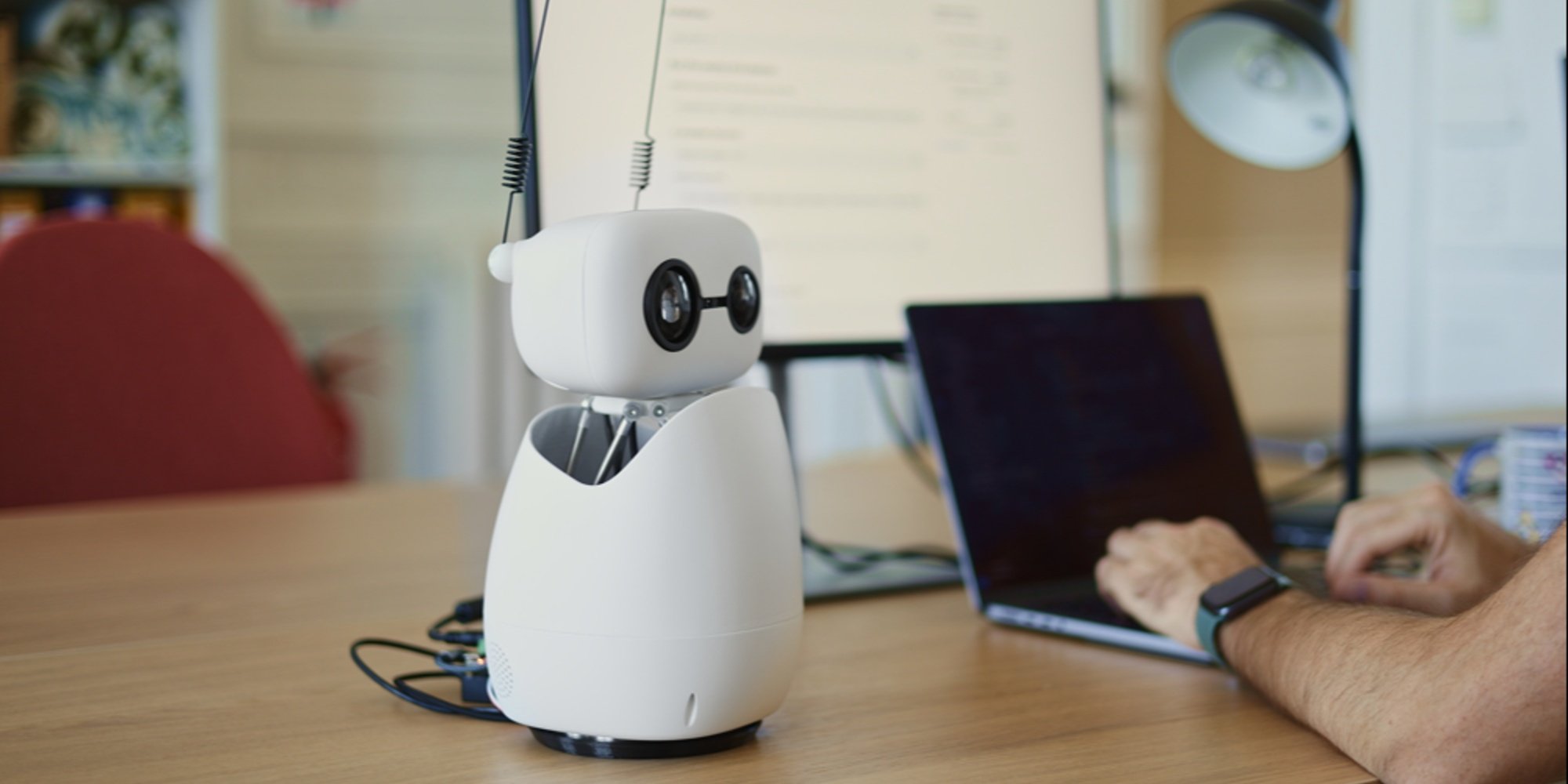
Hugging Face introduces Reachy Mini: a new milestone in the democratization of AI robotics
July 16, 2025
- November 4 Bull and Schwarz Digits sign a Franco-German agreement to build a sovereign AI and cloud infrastructure in Europe
- November 4 NVIDIA expands its urban AI agents to Taiwan, Malaysia, Nigeria, and Morocco: ITMAX aims for 17,000 cameras by 2027
- November 4 According to The Information, Huawei asks customers to find their own HBM for its Ascend chips, supplied through smuggling from South Korea