
▲Image generated by AI
@zhidxcom@zhidxcom
Author | Li Shuiqing
Editor | Xin Yuan
Zhidx.com reported on November 12, 2026, that on November 11, the Beijing Bureau of Industry and Information Technology released the "Action Plan for High-Quality Development of Embodied Intelligent Robotics Industry (2026-2028)" (hereinafter referred to as the "Action Plan").
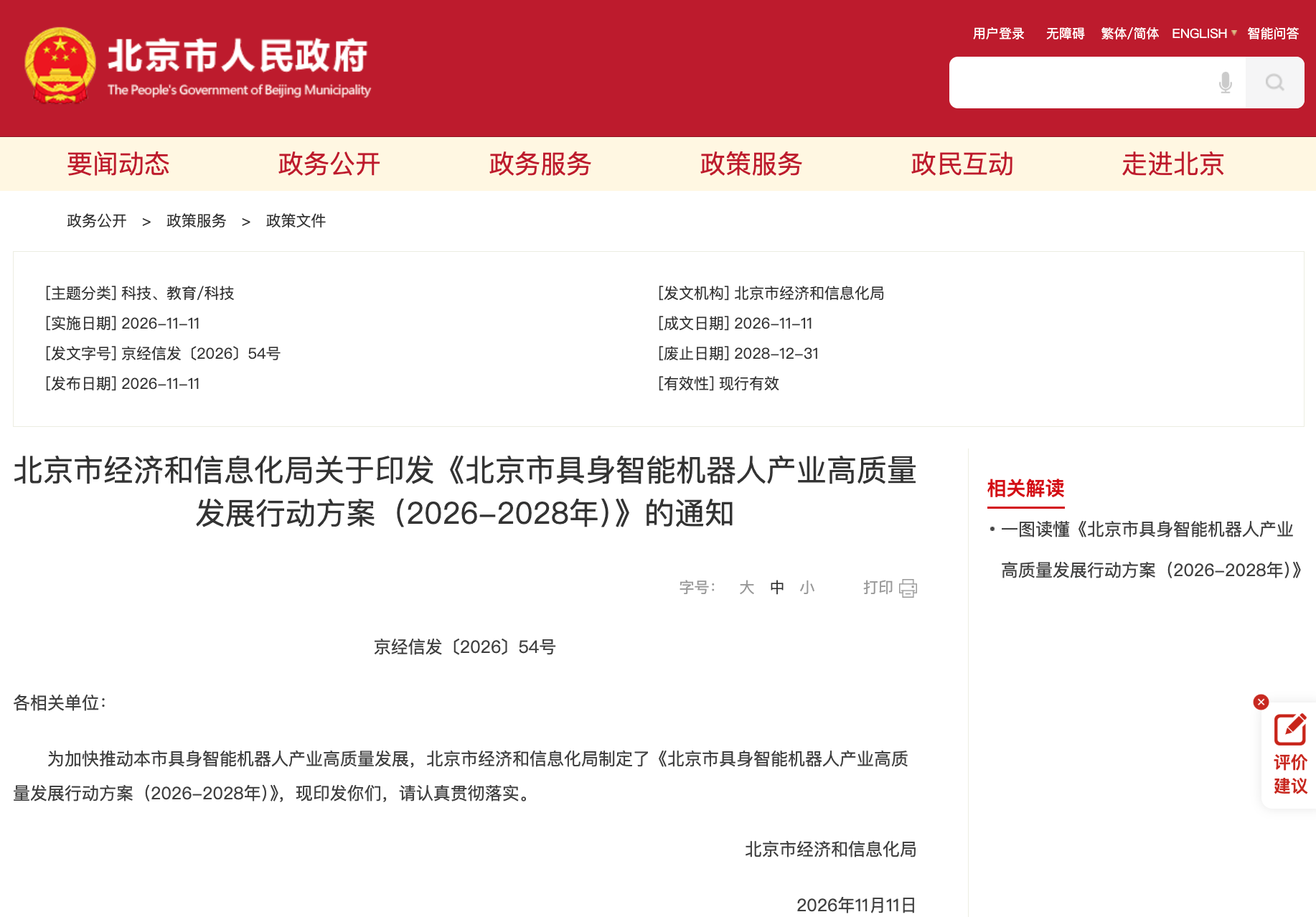 ▲Announcement of the "Action Plan"
The "Action Plan" proposes that by 2028, Beijing aims to cultivate no less than 5 internationally leading, 10 nationally advanced humanoid robot whole-machine enterprises; the whole-machine production capacity in the Beijing-Tianjin-Hebei region will account for no less than 25% of the national total, and the rate of key component supply will exceed 60%; and it also proposes to build a safety governance system, striving for international first-class standards.
The "Action Plan" will focus on implementing six major projects: Embodied Intelligent Leap, Beijing-Tianjin-Hebei Industrial Chain Synergy, Technological Innovation Source, Large-Scale Application Promotion, Industrial Ecosystem Leadership, and Safety Governance Pioneer, covering more specific goals such as "building an embodied intelligent dedicated computing power cluster exceeding 50,000 PFlops", "collecting over 1 million hours of high-quality data in no less than 100 real scenarios", and "appropriately leading in layout, forming a whole-machine production capacity of 200,000 units per year in Beijing".
In addition, the "Action Plan" also mentions that Beijing will formulate special support policies, increase financial support for key technology breakthroughs, innovative product development, intermediate-scale testing capability construction, and typical scenario applications; and strengthen the introduction of high-level talents and teams, providing support for urgently needed and scarce talents in the field of embodied intelligent robotics in aspects such as entry to Beijing, children's education, housing, and medical care.
@zhidxcom@zhidxcom @zhidxcom@zhidxcom
Beijing will regard the embodied intelligent robotics industry as an important field of its high-end, precision, and cutting-edge industries and a key breakthrough for future industries, accelerating the high-quality development of the industry, aiming to cultivate no less than 5 internationally leading and 10 nationally advanced humanoid robot whole-machine enterprises by 2028, with embodied intelligent models, robot bodies, and key technologies all reaching international first-class standards; the whole-machine production capacity in the Beijing-Tianjin-Hebei region will account for no less than 25% of the national total, and the rate of key component supply will exceed 60%; it will be the first to build a safety governance system covering the entire life cycle, involving multi-department collaboration, and being scientifically effective, and will make the city a world-class source of embodied intelligent robotics technology and an innovation hub for the industry.
@zhidxcom@zhidxcom @zhidxcom@zhidxcom
@zhidxcom@zhidxcom@zhidxcom@zhidxcom 1. Significantly enhance the capabilities of embodied intelligent foundational models. Support the layout and development of multiple technical routes such as Visual Language Action Models (VLA), World Models (WM), and Reinforcement Learning, and promote technological integration and development, leading the technological innovation of each main route. Support the development of technologies such as multi-source information fusion, physical space understanding, and human emotion recognition, to promote the leap from "perception" to "cognition", achieving "brain" level cognition that can understand physical laws constraints, actively recognize human actions and expressions, and respond to non-verbal instructions. Support the development of technologies such as real-time reasoning, cross-ontology transfer, and self-learning evolution, significantly enhancing the "cerebellum" capabilities in multi-task generalization, high-reliability execution, fast-paced operations, and ultra-precise manipulation. Support the development of technologies such as group collaboration, long-term memory, localized lightweight deployment, and model interpretability, significantly improving the real-world deployment capability of embodied intelligent models, and making the overall level of embodied intelligent foundational models reach international first-class standards.
2. Enhance the supply level of high-quality embodied data. Support leading innovation in data acquisition hardware and acquisition solutions such as ontology-free data collection and "first-person perspective data collection", accelerating cost reduction and efficiency improvement. Support the development of technologies such as high-fidelity simulation data generation, robot autonomous exploration data collection, human motion mapping, and multi-modal data unified representation, actively exploring the formation of a high-quality data supply model that integrates multi-source data and covers the entire process of model training and application deployment. Build a national-level embodied intelligent robot data infrastructure that covers a variety of real-world scenarios, collecting more than 1 million hours of high-quality data in no fewer than 100 real-world scenarios.
3. Increase the guarantee of dedicated computing resources. Construct a new dedicated computing cluster for embodied intelligence with a total scale exceeding 50,000 PFlops, further enhancing the supply of high-quality embodied intelligent computing resources. Promote the formation of computing resource supply-demand coordination through a "pairing" approach between key embodied intelligent enterprises and key computing node project construction units. Through the "Galaxy Computing Corridor" project, collaborate with computing resource aggregation cities outside Beijing to connect embodied intelligent enterprises with domestic high-quality computing resources.
4. Build an authoritative evaluation system for embodied intelligence. Construct the world's first embodied intelligence model testing field based on real application scenarios and providing diverse ontologies, establish and improve the embodied intelligence model evaluation system of "user units setting questions, testing entities answering", build and operate a neutral, authoritative, and regular evaluation and certification platform with the support of professional institutions and relevant central units, continuously iterating the evaluation standards and indicator systems. Based on the embodied intelligence testing field, organize a real-scenario task challenge competition for global embodied intelligence model development teams, creating a globally renowned embodied intelligence model ranking.
II. Implement the Beijing-Tianjin-Hebei Industrial Chain Synergy Project
5. Build an international first-class ontology platform. Organize collaborative innovation among whole-machine and component enterprises, continuously improving the hardware architecture and system to enhance comprehensive performance. Strive to achieve a rated load capacity of more than 40% of the self-weight, an average time between failures exceeding 2000 hours, a core motion component and end-effector annual failure rate lower than 10%, a whole-machine designed service life exceeding 5 years, and a battery endurance of more than 4 hours in continuous operation scenarios. Build 3 to 5 international first-class whole-machine platforms that meet the requirements for large-scale deployment in diverse scenarios, with series, modular, and software-defined product capabilities.
6. Accelerate the formation of comparative advantages in key components. Focus on high-technical-value-added key components, support the development of high-efficiency and high-reliability motors with torque density of over 60 Nm/kg, high-precision reducers with rated life exceeding 15,000 hours, high-energy-efficiency integrated joint modules with torque density of over 100 Nm/kg and transmission efficiency over 85%, six-dimensional force sensors with full-scale linear error not exceeding 0.1% and dynamic response better than 5kHz, tactile sensors with force resolution ≤ 0.01 N and spatial resolution ≤ 1 mm, high-reliability and high-degree-of-freedom dexterous hands with rated load life of 1 million cycles, fingertip force control resolution of 0.1 N, and single unit cost within 10,000 yuan, high-safety batteries with energy density of 350 Wh/kg and cycle life of 1500 times, and high-human-like imitation faces with interaction response delay below 50 milliseconds and the ability to reproduce over 200 expressions. These key components should reach international first-class standards overall.
7. Solidly advance collaborative innovation in R&D, manufacturing, and application. Promote the empowerment of Beijing's embodied intelligence technology achievements to product innovation in industrial robots, service robots, and special-purpose robots in the Beijing-Tianjin-Hebei region. Supporting a combination of contract manufacturing and self-built production lines, with appropriate forward-looking layout, to form an integrated machine production capacity of 200,000 units per year in Beijing. Build no less than 5 embodied intelligent robot manufacturing service platforms, forming mid-scale testing and verification service capabilities covering aspects such as software and hardware functions, performance, reliability, safety, and environmental adaptability. Relying on the relevant mid-scale testing and verification capabilities of the whole machine, realize an innovation closed-loop of R&D and manufacturing synergy, with the配套 rate in the Beijing-Tianjin-Hebei region exceeding 60%, supporting rapid iteration and upgrading of the core products. Actively introduce cross-industry supply chain enterprises such as intelligent connected vehicles, support the construction of no less than 10 shared processing platforms in the Beijing-Tianjin-Hebei region with fast response service capabilities in areas such as structural component processing, surface treatment and heat treatment, SMT pasting, and wire harness manufacturing, to shorten the sample delivery time after component design changes to 1-2 days. Encourage Beijing embodied intelligent robot enterprises to collaborate with application scenario units in Tianjin and Hebei to carry out application innovation. Focusing on the integration of vehicle and machine, and the integration of mechanical and electrical systems, build a number of R&D and manufacturing parks within the Beijing-Tianjin-Hebei region to promote cluster development of the industry.
III. Implementing the Innovation Source Engineering for Technological Innovation
8. Advance the layout of frontier technologies. Support the research on frontier technologies of embodied intelligent and whole machine, such as the underlying architecture of embodied intelligent models, basic algorithms, and the mechanisms of biomimetic structures and motion control. Support the research on key component frontier technologies such as woven motors based on functional fibers and "weaving manufacturing" processes, integrated joints and dexterous hands based on biomimetic mechanisms, large-area tactile sensing electronic skin, and ultra-low power intelligent computing chips.
9. Concentrate on breaking through key core technologies. Support the breakthrough in core components such as high-end flexible tactile sensors, miniature precision reducers, and miniature hollow cup motors that are at risk of being controlled by others, as well as key chips such as system-level intelligent computing chips based on RISC-V and high dynamic load N-channel MOSFETs, promoting the "full layout" of breakthroughs in key chips and core components. Support whole machine units to adapt and apply the relevant components and chips, promoting the "full adaptation" of related self-reliant and controllable products. Support the breakthrough in fundamental software such as simulation and intelligent training platforms, simulation tool chains, robot operating systems, and middleware compatible with ROS/ROS2, development tool chains, and resource scheduling platforms, continuously improving the self-reliant and controllable software application ecosystem.
IV. Implementing the Scale Application Promotion Engineering
10. Continuously enhance the brand of the "Two Meetings and One Race" for robots. Build an embodied intelligent robot training and competition base, continuously optimize the competition items according to the actual needs of application scenarios, and create an embodied intelligent robot competition and half-marathon that fully reflect and represent the highest level of China's embodied intelligent robot industry development. Leverage international cooperation and exchange platforms such as the World Robot Conference, support close collaboration with organizations such as the China Electronics Society and the World Robot Cooperation Organization, organize high-standard international academic conferences on embodied intelligent robots, and build a global high ground for industry and academic exchanges in the field of robots.
11. Deeply promote breakthroughs in real-scenario training and testing. Actively explore the construction of application innovation platforms in vertical细分 fields to promote real-scenario training and testing in related areas. In the industrial field, focus on scenarios such as advanced manufacturing and logistics warehousing, and make breakthroughs in key capabilities such as human-machine collaboration, tool usage, and precise operation, gradually becoming capable of performing tasks such as moving and transporting, inspection and sorting, connection assembly, and auxiliary processing, forming no less than 20 benchmark application scenarios in the industrial field. In the service field, focus on scenarios such as elderly care, medical health, public services, cultural tourism and education, and commercial superstores, and make breakthroughs in key capabilities such as task planning, safe interaction, and flexible operation, gradually becoming capable of performing tasks such as consultation and guidance, unmanned retail, security patrol inspection, and care assistance, forming no less than 20 benchmark application scenarios in the service field. Specialized fields,focus on scenarios such as production safety, emergency rescue, and urban security, emphasizing breakthroughs in environmental adaptability and safe handling capabilities, gradually becoming capable of performing tasks like inspection and排查, security duty, and rescue operations, forming no less than 10 benchmark application scenarios in specialized fields.
12. Accelerate the formation of solutions to promote large-scale application.Cultivate embodied intelligent robot solution providers and application innovation platforms, distilling no less than 15 scalable solutions in fields such as production operations, commercial services, home life, and elderly care services. Innovatively build a comprehensive evaluation system covering multiple dimensions such as task execution efficiency and return on investment, as well as a real application working condition data collection and feedback mechanism, innovatively utilizing financial instruments such as lease financing and application insurance. Regularly select and release typical products and scenarios of embodied intelligent robots, organizing whole-machine units and solution providers to widely connect with state-owned enterprises, central state-owned enterprises, and universities that have potential for large-scale application scenarios, accelerating the promotion and continuous iteration of solutions.
13. Explore the construction of regional integrated application scenarios.Support the construction of the Robot Innovation Park in the Olympic Center Zone, creating theme restaurants, hotels, and cultural tourism attractions that integrate robots such as catering, service, entertainment performance, and cleaning, which have market operation capabilities and can be scaled up for promotion. Support the iterative expansion of the functions of the Robot World, transforming Beijing Economic-Technological Development Area into a concentrated demonstration zone for the full-domain real-scenario application of embodied intelligent robots.
Five, Implement the Industry Ecosystem Leadership Program
14. Further expand the innovation entities.Establish a "one-on-one" service mechanism for embodied intelligent robot companies to go public, cultivating leading enterprises with advantages. In key areas such as whole-machine units, critical components, embodied intelligent models, and data collection, cultivate no less than 200 science and technology and innovative small and medium-sized enterprises, high-tech enterprises, specialized and refined and unique small and medium-sized enterprises, specialized and refined and unique "little giants" enterprises, and manufacturing single-item champion enterprises. Fully leverage the role of industry organizations such as the Beijing Robot Industry Association, strengthen industry self-regulation,oppose "involution-style" competition, guiding the industry to develop in a healthy and orderly manner.
15. Continuously improve the level of open source and open development.Further enhance the quality level of the physical body, embodied intelligent model open platform, and open data sets of embodied intelligent robots. Build a globally influential open source community for embodied intelligent robots, explore the establishment of new service platforms such as application software stores for embodied intelligent robots. Construct a new business model based on general-purpose software and hardware platforms and open data sets, targeting vertical scenarios for secondary development, forming leading domestic capabilities in software and hardware secondary development. Promote the establishment of 100 robot research teams in universities and research institutions in Beijing, support relevant teams to cooperate with local leading enterprises and innovation platforms, and produce high-quality research results based on the open software and hardware platform of humanoid robots.
16. Actively lead the construction of standard systems.Support organizations such as the National Robot Standardization Technical Committee's Humanoid Robot Sub-Committee (SAC/TC591/SC5), the Humanoid Robot and Embodied Intelligence Standardization Technical Committee (MIIT/TC8), and the Beijing Robot Industry Association in their work. Establish a municipal-level standardization committee related to robots, conduct research on the standard system, and hold standard demand and supply对接 activities around the robot field. Encourage local units to take the lead in and participate in the compilation of no less than 8 international standards, 30 national standards, 70 industry and group standards, with a national standard participation rate of over 90%. Actively recommend local units to carry out national standardization pilot projects related to robots.
17. Support enterprises going global and participating in international exchanges and cooperation.Support local qualified key enterprises in embodied intelligent robots to "go global", encouraging foreign leading enterprises and institutions in embodied intelligent robots to set up research centers and manufacturing bases. Leverage international exchange and cooperation platforms such as the World Robot Conference, support the China Electronics Society to closely cooperate with the United Nations Industrial Development Organization, the World Robot Cooperation Organization, etc., organize high-level international exchanges and academic conferences on embodied intelligent robots, and build a high ground for international exchanges and cooperation in the industry and academic fields.
Six. Implementing the Safety Governance Pioneer Project
18. Advance the layout of safety technology innovation. Focus on the needs of human-machine collaborative production and living scenarios, and lead in laying out research on inherent safety technologies such as hardware overload protection, energy and power distribution safety, and active emergency braking; conduct research on safety technologies for embodied intelligent models, including decision safety auditing and tracing, protection against malicious attacks, handling of sensitive privacy data, and ethical constraints on human-machine interaction; and carry out research on safety governance technologies such as identity recognition, electronic fences, and digital twin tracing.
19. Lead in building a safety governance system. Establish third-party institutions such as the Center for Testing and Certification of Embodied Intelligent Robots and the Center for Quality Inspection and Testing of Embodied Intelligent Robots, and build a comprehensive testing and certification platform covering functions, performance, safety, reliability, and intelligence levels of the entire machine, components, models, and data. Construct a "one machine one code" full-process management system for embodied intelligent robots, and lead in forming safety governance capabilities covering the entire lifecycle from R&D, production, scrapping, to recycling, including identity authentication, trusted tracing, and behavior auditing.
Seven. Guarantee Measures
Improve the working mechanism for promoting the embodied intelligent robot industry, and strengthen the overall coordination among various departments and districts. Formulate special support policies, increase financial support for key technology research, innovative product development, intermediate-scale testing capability construction, and typical application scenarios. Further leverage the leading and catalytic role of government-guided funds to guide market-oriented capital to support the industry development. Encourage more universities to offer related majors in embodied intelligent robots, deepen the talent cultivation model of industry-academia integration, and cultivate a group of urgently needed professional talents for the industry development, such as data collection and secondary development, as well as compound talents with both technical expertise and product understanding. Strengthen the introduction of high-level talents and teams, and provide support for urgently needed and scarce talents in the field of embodied intelligent robots in terms of Beijing household registration, children's education, housing, and medical care.
This plan will take effect from the date of issuance and is valid until December 31, 2028.
@@TAGn@@



