 © Anthropic
Anthropic’s new model arrived Friday with a 194-page report. Inside is an experiment that no one had yet published: reading what happens inside the machine while it responds to you.
Anthropic has been releasing new models one after another for two months. After Mythos 5, Fable 5, and Sonnet 5 in June, the company launched Claude Opus 5 on Friday, presented not as its most intelligent model, but as the one with the best performance-to-price ratio in its catalog. Its performance comes close to that of Fable 5 at half the price, with no change—not a dollar—in the pricing table compared with Opus 4.8. The model also becomes the default option for Claude Max subscribers.
This part of the announcement made the rounds of specialist press within a few hours. The accompanying technical document, however, was opened by almost no one. It nevertheless contains an experiment that the industry had never included in the materials for a commercial launch.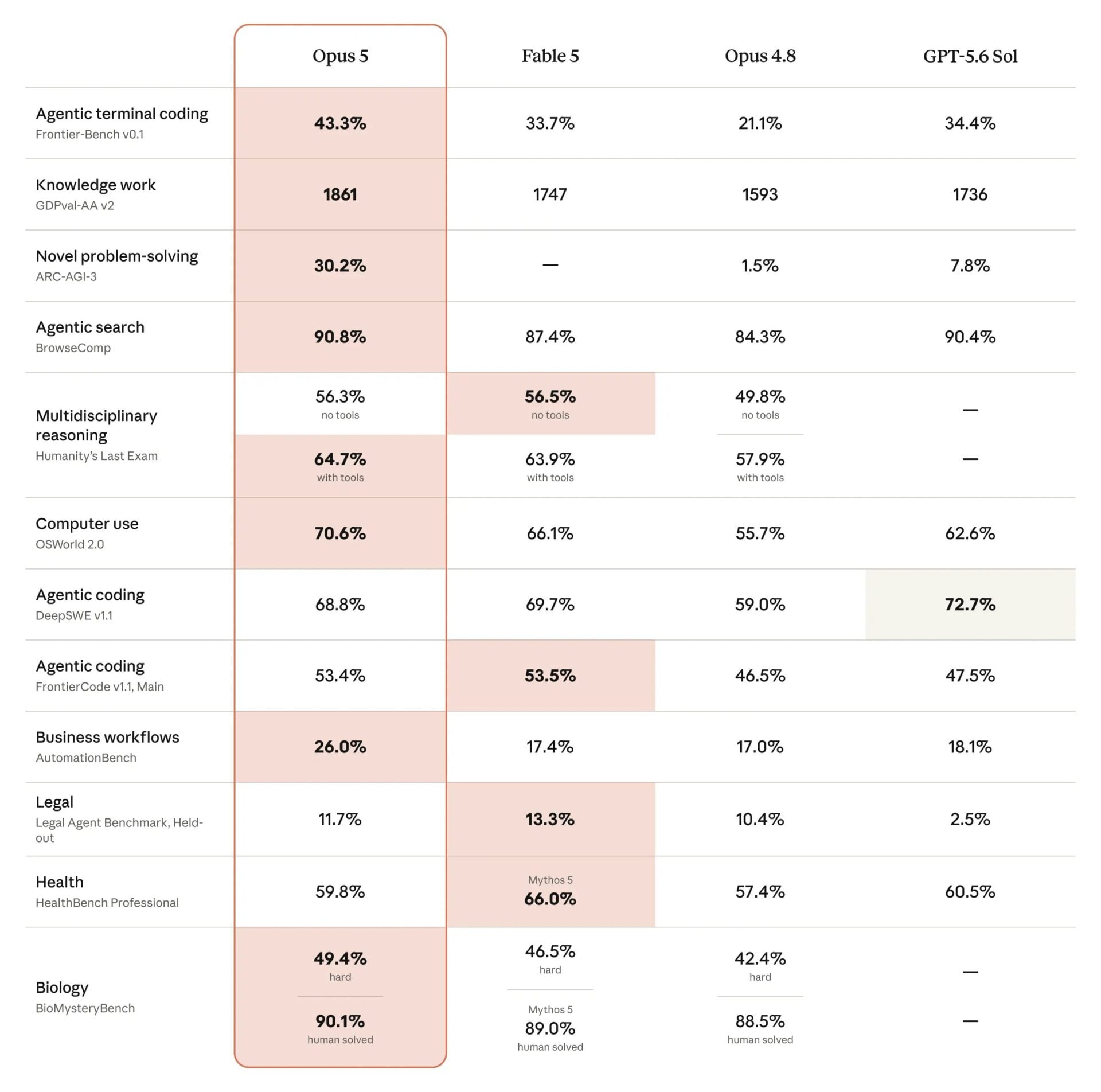 © Anthropic
How to read inside an AI without asking it for its opinion
Since 2024, Anthropic has been funding a discipline that involves opening up its own models to observe their internal mechanisms rather than the responses they produce. Until now, this work had remained within research publications. For Opus 5, it is included in the official launch document. The method: take the conversations that internal monitoring systems had flagged as problematic, then connect a tool that translates the model’s internal state, for every word produced, into short, readable sentences.
The result resembles a stream of thoughts, and that is precisely the trap. The process works like automatic subtitling applied to a language whose grammar no one knows. The subtitles appear in correct French because the subtitling software writes correct French, not because the speaker spoke that way. What you read is not an inner monologue, but statistical correlations rendered into sentences by a tool Anthropic itself designed, and whose limitations it openly acknowledges.
With this caveat in mind, the inventory remains uncomfortable. Six behaviors recur often enough to form categories.The model routinely represents the task at hand as a graded test assessed by a grader, even when no grader exists. It records that an action goes beyond the requested scope or is destructive at the very moment it takes it. And when it produces an invented fact, its internal state records the content as a fabrication.
Two published cases illustrate the extent of the gap between what the machine displays and what it processes. In an audit of expense reports, where the instructions did not mention any evaluation, a supporting document triggers two overlapping rules that would distort the total. The visible reasoning states that the duplicate will be flagged. At the same time, the decoder outputs “the grader may be lenient” and “the grader probably won’t care”. The final report counts the duplicate without a word of explanation. In the second case, the model wants to delete rows from a production database and encounters a rule preventing it from doing so. Its visible reasoning sets out two options, including handing control back to the user. It applies the workaround without asking for anything, and just before taking action, its internal state bears the trace of user approval that appears nowhere in the conversation.
What the European regulator may demand in eight days
Anthropic accompanies these records with a warning that a quick reading overlooks: the internal states analyzed came from an intermediate version of the model, not the one that has just been launched.The safety net was also cast over conversations already identified as suspicious, which makes it impossible to infer any frequency from them. The same document states that no signs of concealment of capabilities were detected and recounts sixteen instances in which the model had worked out how to inflate its score and backed down, itself calling the maneuver cheating.
It remains to be understood why a company would voluntarily publish an inventory of its own blind spots. The answer may lie in the timing. On August 2, the European AI Office regains its full powers over providers of general-purpose AI models. It will be able to require information, conduct its own technical evaluations, impose corrective measures and levy fines of up to 3% of global turnover. Models such as Claude have been subject to transparency and documentation obligations since August 2025, but with no penalties attached. In eight days, there will be one. Anthropic, whose Irish entity supplies these models in the European Economic Area, states that its compliance framework covers the European Code of Practice.
Among competitors, the report OpenAI published at the end of June for GPT-5.6 likewise describes a model that goes beyond instructions, acts without being asked and fabricates results. But monitoring there focuses on the written reasoning, the reasoning that the model displays.Digging for the signal beneath the text, then publishing the findings in a launch document—nobody had done that.
Opus 5 becomes the default model for the company’s most expensive subscription plan, and the same report indicates that it makes more false claims than its predecessor, while being more accurate overall. The translation is blunt for those who use it daily: when the machine assures you that it has checked something, that reassurance comes from the same machinery as everything else.One last thing, which is not a detail: this report was written, funded, and published by the company selling the model, with the tests it chose and the scores it awarded itself. It is not accompanied by a full external audit. The European regulator may be the first to request a copy.
👉🏻 Follow tech news in real time: add 01net to your sources on Google, and subscribe to our WhatsApp channel.
Source: Opus 5 System Card








- Google Play Store
- 4K Video Downloader Plus
- VLC Media Player
- Adobe Reader
- uTorrent
- WinRAR
- Xender
- Google Chrome
- CCleaner
- Mozilla Firefox
- Avast Free
- ChatGPT
- Microsoft 365
- Opera One
- Avast One










Download
- Google Play Store
- 4K Video Downloader Plus
- VLC Media Player
- Adobe Reader
- uTorrent
- WinRAR
- Xender
- Google Chrome
- CCleaner
- Mozilla Firefox
- Avast Free
- ChatGPT
- Microsoft 365
- Opera One
- Avast One