TAG17@@Simplified diagram: each stage has its own tool, and data is transferred between stages manually.It does not identify a specific company.
In September 2026, Alexander Sitnikov, head of Gazprom Neft’s Scientific and Technical Center, called “the systematization of dozens of disparate software systems” the next stage in Gazprom Neft’s development as a digital oil company. Note the wording: dozens of software systems, not dozens of digital twins. I will preserve this distinction below; otherwise, we would end up with a catchy headline and inaccurate text.
Three approaches
“Gazprom Neft” and “Sbertech” | “Rosneft” | Aker BP (Norway) | |
|---|---|---|---|
What they do | A platform that orchestrates digital twins for exploration and production | The company’s Unified Digital Platform (UDPC) for all IT services | A digital twin of operations built on a unified data layer |
When | The agreement was signed at a forum in September 2026; the orchestrator was showcased at the CIPF in 2026 | Introduced in July 2024 | The project was described in 2022; DNV assessment in 2023 |
With whom | “Sbertech” | In-house developments based on open-source software | Aize and Cognite |
What is known about the outcome | There is no platform yet, and there are no deadlines or budget.…they called | The publicly available materials contain no figures on the platform’s effectiveness | DNV recognized the data platform as compliant with the recommendations for validating twins |
The projects have different objectives, even though their names are similar. It is like three houses, each with its own “unified system”: in one, a common electrical panel; in another, a foundation for future extensions; in the third, the common wiring was run before the chandeliers were hung.
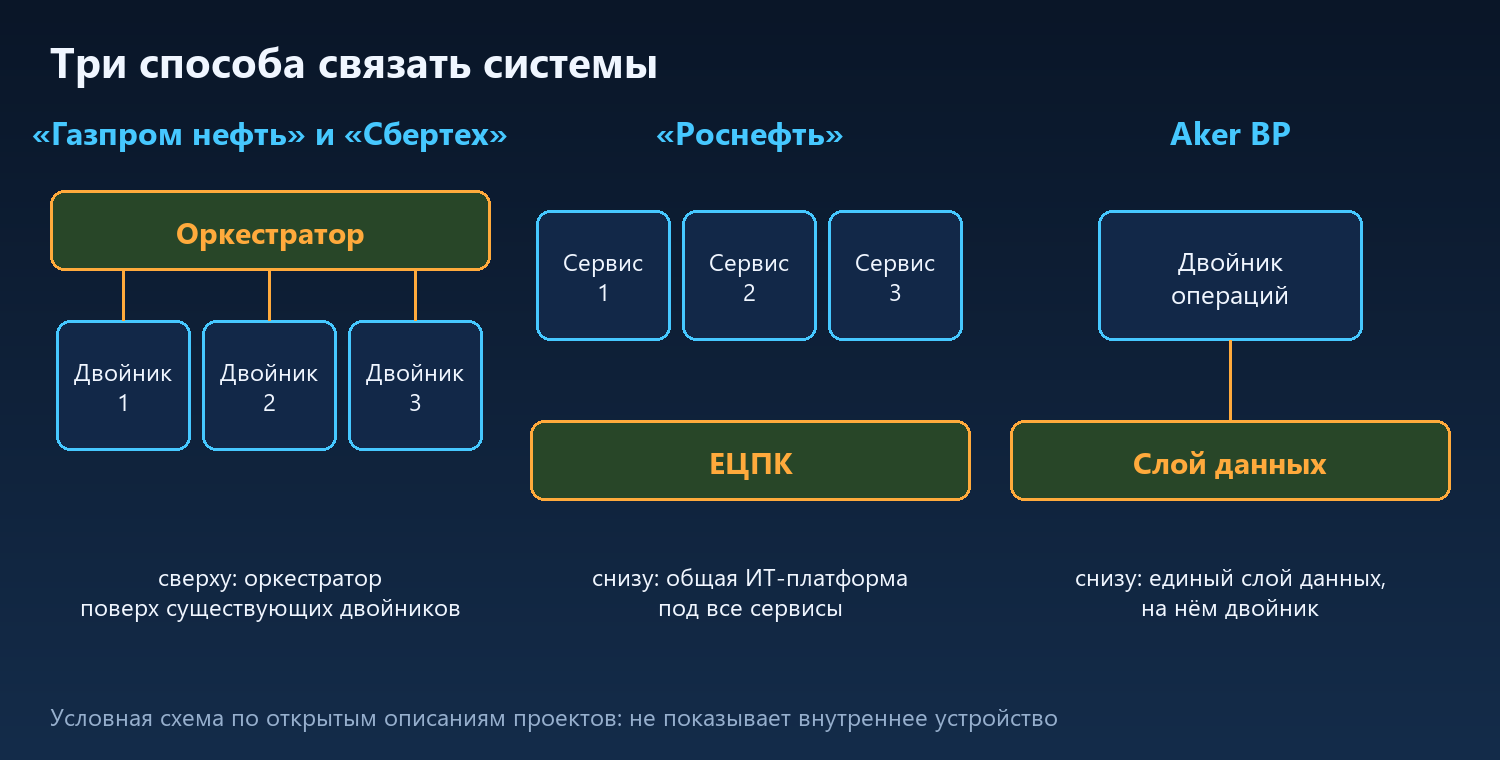
A conceptual diagram based on publicly available descriptions of the projects. It does not show the internal structure of the platforms.
“Gazprom Neft”: a layer over the existing system
Judging by the description, no one plans to rewrite dozens of systems. The partners want to create a unified platform for managing digital twins: from deposit discovery and design to drilling, production and infrastructure operations. The platform should bring together the company’s separate applications, databases and IT systems. SberTech works in IT; it is not a bank.
I read the word “orchestrator” in press releases with caution. A conductor does not replace the musicians or play in their stead; he makes sure the violins and drums enter on time. But during a rehearsal, the orchestra does not sound as it does at a concert. Sitnikov said: “In partnership with SberTech, we will test advanced solutions to create a next-generation platform.” The word “will test” implies trials; a launch has not been promised here yet.
TAG137@@Earlier, the company showcased a digital twin orchestrator at the CIPR, that is, a solution for connecting virtual models and tools used at different stages.SberTech CEO Valery Kudryavtsev says that the industry has high requirements for reliability, performance, and scalability, while the partnership will combine SberTech’s expertise with Gazprom Neft’s industry knowledge. The parties also agreed on joint reviews of software products and on AI for exploration and production tasks.What is missing from the publicly available materials: launch timelines, the budget, and the number of systems and fields for the first phase. I will not make up these figures.
Rosneft: a platform for all IT services
In July 2024, Rosneft presented the company’s Unified Digital Platform (UDPC). According to the company, it brings together IT services and solutions. Its objectives include optimizing IT infrastructure and reducing the deployment time for new technologies severalfold. The project’s main goal is to assemble a platform with ready-made services for creating and monitoring applications based on the company’s own modifications to open-source software. The company calls this the foundation for import substitution.
If Aker BP started with connectivity, while Gazprom Neft is looking for a way to connect buildings that are already standing, then Rosneft is building a shared foundation for future buildings. This is a common IT platform, not a separate platform for field twins. It tracks the lifecycle of machine-learning models, but the materials contain no direct connection to the twins. I found no figures quantifying the impact of the UDPC.
Aker BP: data first, twin later
Norwegian Aker BP is developing a digital twin of its operations together with Aize and Cognite. According to the company, data from fields is extracted using the Cognite Data Fusion platform, which structures it and adds context, after which the data becomes available to various applications.As the company explains, a digital twin starts with static data such as 3D models and maps, and real-time data is then mixed in: pressure, temperature, work permits, and weather. Work permits alongside pressure may seem unexpected, but to me it makes sense: what is happening at the facility is just as important as what a sensor shows.
Another interesting detail: the company explicitly says it wants this software to be applicable in other companies and in other industries as well. It seems the oil company is also trying on the role of a software vendor. In 2023, DNV recognized the Cognite platform as compliant with the DNV-RP-A204 recommendations for validating digital twins; this was a joint initiative with Aker BP.
I like Aker BP’s sequence: first a unified data layer, then a digital twin on top of it. It’s like laying a road first and then putting up houses. Gazprom Neft has it the other way around: the digital twins are already in place, and now they are looking for a common road to connect them. Based on publicly available materials, it is impossible to say which sequence is more reliable, but my bet is on the first: rebuilding streets where people already live is usually more expensive than laying them out properly from the start.
Where Open Data Ends
The three projects have one thing in common: I found no independent impact figures for any of them. For Gazprom Neft, there are no results; for Rosneft, the materials I found contain no figures for the ECPK; for Aker BP, everything is described by the company itself and its partners, while DNV’s assessment concerns compliance with the recommendations, not the economics.
Therefore, it is currently impossible to compare the effectiveness of the approaches. One can compare only what is claimed: what they connect, in what order, and with whom.
Based on publicly available materials, no one has measured organizational risk.Most likely, each of the dozens of systems has an owner within the company, and that owner will have to change the process to accommodate the common layer. People are rarely happy when their carefully configured tool becomes “just one of the connected ones.” Whether a single platform will suffice or additional workflow solutions will be needed cannot be determined from publicly available materials.
What I would check in a year
For Gazprom Neft, the criterion is simple: whether the first system actually connected to the orchestrator within the workflow, rather than in a demonstration, will appear. For Rosneft: whether the company will show at least one digital twin running on the ЕЦПК. For Aker BP: whether the company will publish figures for the time and cost of operations after the digital twin is launched.
Which metric would you start with when evaluating such a platform: the time it takes to transfer data between stages, the number of connected systems, or something else?
Sources
ComNews. “Gazprom Neft and SberTech will jointly develop a digital twin system,” 18.09.2026.
ComNews. “Gazprom Neft and Sbertech will develop a platform for managing digital twins,” 21.09.2026.
ComNews. “Rosneft has developed a digital platform for the ЕЦПК,” 05.07.2024.
Aker BP. “Digital twins streamline operations,” 24.08.2022.
DNV.“Cognite Data Fusion achieves industry-first DNV compliance for digital twins,” March 2023.******

