Now here is the most interesting part: Anthropic does have numerical scores, and the company has written about them itself.
- TAG162
Self-assessment from October 16: a hidden request after Claude’s response returns JSON with the reason, a flag, and a review priority from 1 to 10. It does not block anything on its own; strong signals are passed on to humans.
TAG166ARiES: a risk score from 0 to 100, including for accounts (true, it concerns cyber abuse).
TAG170The data retention policy explicitly refers to trust and safety classification scores; chats containing violations are retained for up to seven years.
TAG174As for “Claude switches models on its own,” that is a separate Opus 5.5 mechanism: in cyber-themed tasks it falls back to Opus 4.8, and in biology to Opus 5.
So the scores do exist; this is not a conspiracy theory. As for the formula from the video and its connection to the Russian wave, that is for its authors to answer for.
There is also distillation: in February, Anthropic accused DeepSeek, Moonshot, and MiniMax of making 16+ million requests through roughly 24,000 fake accounts, and in October it introduced a protection that also affects ordinary users. I do not know whether my ban is related to this.
My conclusion is simpler: you cannot base your work on the confidence that you have figured out someone else’s anti-fraud system.
1.3. This is already not my first such experience
Roughly six months before Claude, OpenAI banned me.Without any passport verification and without an explanation of the reasons.
And I’m not the only one: in July, a Pro subscriber on the OpenAI forum complained that both their account and API access had been disabled without warning.
At the time, we had a text-evaluation pipeline running through the API. We scrubbed personal data locally and sent already anonymized text to the cloud. It contained an ordinary doctor’s appointment, with no diagnoses or medical advice. But apparently, the word “doctor” didn’t sit right with someone—that’s my guess; I have no other explanation.
There was also a story circulating in November 2025 that ChatGPT no longer gives medical advice, which OpenAI denied.
We were planning to implement local models anyway, carefully and in stages. After the ban, we had to speed things up.
As I wrote at the beginning, this has now caught not only me but you too, guys. While I was finishing the article, new complaints about ChatGPT blocks started coming in on November 8, including complaints about paid Pro accounts: a thread on the OpenAI forum, a roundup on Cod.ru, and iXBT. Appeals are reportedly rejected in as little as a minute. The causes and scale are still unknown.
So, I think I made the right choice when I decided not to include Codex in this comparison, even though I have personal experience with it. What would be the point? I wouldn’t be surprised if Grok started being treated the same way over time. Who knows?
Someone else’s kill switch makes it very easy to settle on priorities :)
1.4. Why it used to be easier to pay for Claude
However cloying “Claude, only Claude” may have sounded, it was backed by entirely practical experience. For the final preparations before deploying to production, I trusted Claude specifically. I was willing to pay extra for the tokens because I knew the task would be carried through to completion rather than merely result in a pretty answer.And these one and a half weeks, honestly, only reinforced my confidence in this.
The division of roles, however, differs from person to person: for example, one developer plans with Claude, then uses Codex to implement and debug.
2. Why Grok Ended Up First
Logically, I should have gone straight to the Chinese models after Claude. But I already had a subscription to Grok.
I was too lazy to cancel it for several months. I was hanging out in Imagine: I used Grok to make a prototype of a toy duck, then used a separate platform to turn a 2D image into 3D and printed it on a 3D printer. Just for fun. So the subscription I had forgotten to cancel became my first selection criterion :)
I also remembered the high-profile demos featuring games and space, as well as Reddit comparisons with Claude, Gemini, and ChatGPT. Since I already had a subscription, why not put their coding agent through its paces?
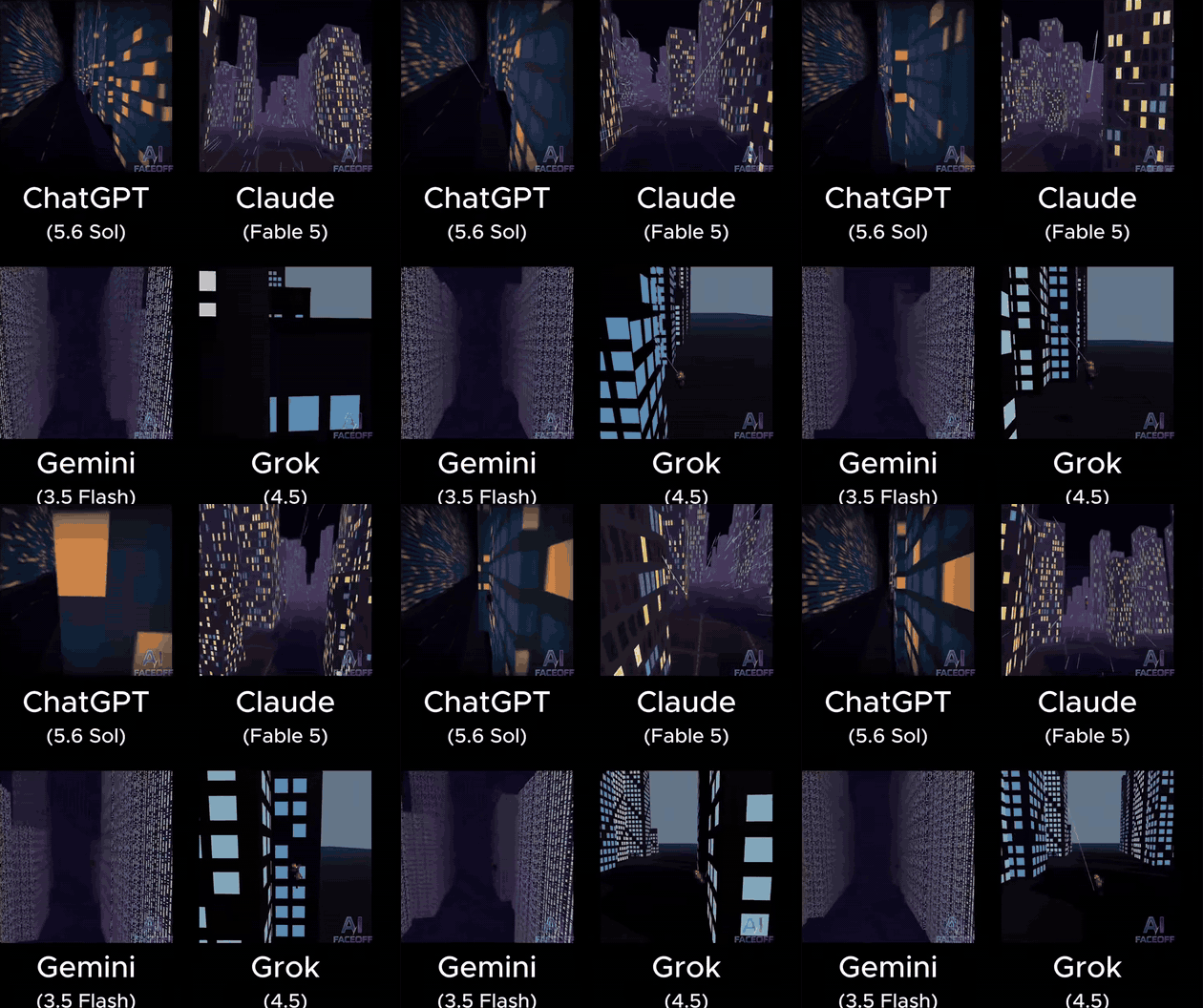
A typical comparison from the feed: a single prompt, “Spider-Man in Three.js,” for ChatGPT 5.6 Sol, Claude Fable 5, Gemini 3.5 Flash, and Grok 4.5. Reel ai.faceoff, July 10, 2026. Instagram is owned by Meta, which has been designated as extremist in the Russian Federation.
Aside:Google’s Antigravity CLI has existed since May. I don’t know whether the search mentioned it—I didn’t save the answer.
2.1. Grok Build.I finally figured out the names
Grok Build, Grok Code… At first, I didn’t care what it was called. I needed to get work done.
For the record: Grok Build is the agent (the `grok` command), while Grok 4.7 is the model.
I started with the $30 plan, but when I took on a real test project and hit the limit, I upgraded to $100. At the current price, those are Premium and Super.
At first, I was pleased by the compatibility: Grok picks up CLAUDE.md, .claude, instructions, agents, and MCP.
I thought: Great! No need to explain again to the AI what this project is and how we operate here.
Spoiler: I did have to explain.
In the second session, I asked it to rewrite all the documentation for itself. Spend as many tokens as you need, just understand the project. Apparently, reading a file and working from it, just like with Claude, are two different tasks.
2.2. How I usually work with agents
To make it clear what I expected from Grok, I’ll describe my setup. A single agent for the entire project stopped working for me long ago; I have an orchestrator and several roles:
- TAG251@@
- TAG264Implementer. Executes the plan. Depending on the task, this can be either a strong model or a fairly average one.TAG268
TAG253@@Scout. Reads a large context, gathers data, and looks for the relevant places in the code. A simpler model is often enough here, but it needs a large context window.
TAG257TAG259@@Architect. Thinks through the solution, constraints, and infrastructure. This is where I usually used Claude.
TAG262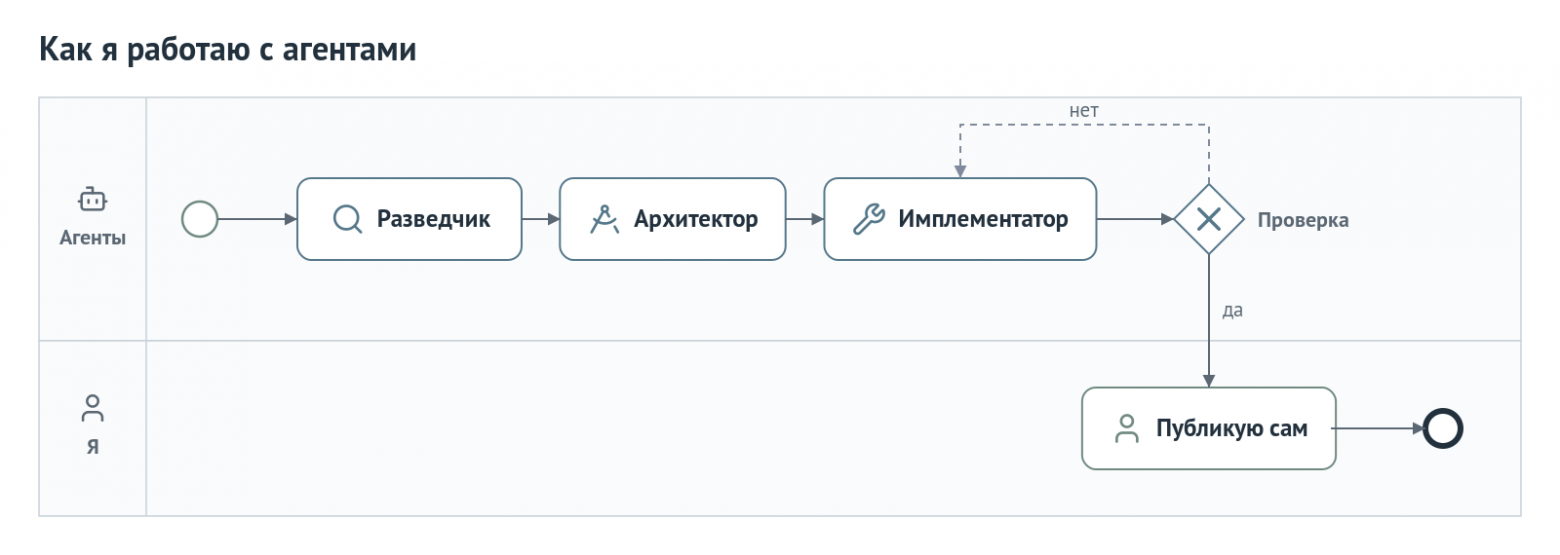
The scout gathers context.
The architect makes a plan.
The implementer writes the code.
Testing: failed — back to the implementer.
Passed — I publish it myself.

2.3. There is no architect in my project
I worked with Grok 4.7 in high mode (there’s xhigh above it; I haven’t tried it).
You know what it reminded me of? A smart person pretending not to understand anything. In chat, he’s smart, but in a coding agent, he’s practically a dummy. Sorry, but there’s no other way to put it.
The task was small: get a local prompter for Windows running for the first time. It should listen to the conversation and give real-time suggestions to operators taking calls. Let me explain: I wasn’t asking for a fully working tool right away! All I’d need at first is something like “downloaded it, ran it, sent it to our cloud status: "molodets"”, and that’s it!
We managed to work out part of the architecture with Claude, but the account was disabled before the app appeared.I expected Grok to read the documents, clarify anything unclear, put together a minimal solution, and test it himself.
For example, if you’re collecting data from a work computer, it makes sense to first see which devices are connected, where the input is, where the output is, and what the telephony process is called (that can be googled in a minute anyway). Claude would make such things up himself, albeit spending more tokens on them. Grok simply put everything together.
In the end, I had to write him detailed specifications: what to read, what to collect, what not to touch, and how to verify it. That’s how I guided Claude a year or a half ago and have already completely gotten out of the habit. Clarification, gathering, verification—about five iterations, and the prototype still wasn’t ready.
He also constantly gave the agents the wrong role or the wrong instruction. I had to monitor and make corrections.
I’ll answer right away the comment that will almost certainly arrive: “You’re just spoiled.”
Yes, I’m used to being coddled. No one canceled the need to specify tasks properly. But if familiar explanations are no longer enough and you have to stand beside it all the time, the tool has become worse for me.
Claude, of course, isn’t perfect either: in April, Lakshmi Narasimhan described how Claude confidently declared, “The MVP is ready,” and Codex then found defects in it. You still have to check an agent’s work yourself.
Grok also loved stopping. It was his favorite activity in general: he’d finish a step, the next step would be clear, the task would still be unfinished—and he’d stand there waiting for you to write “continue.”Whether it was a bug in the model or the shell, I can’t say without logs, but I did have to keep an eye on it.
Another developer described something similar about Grok 4.6: local patches instead of architecture and constant “continue?” prompts (he had a better experience in another shell).
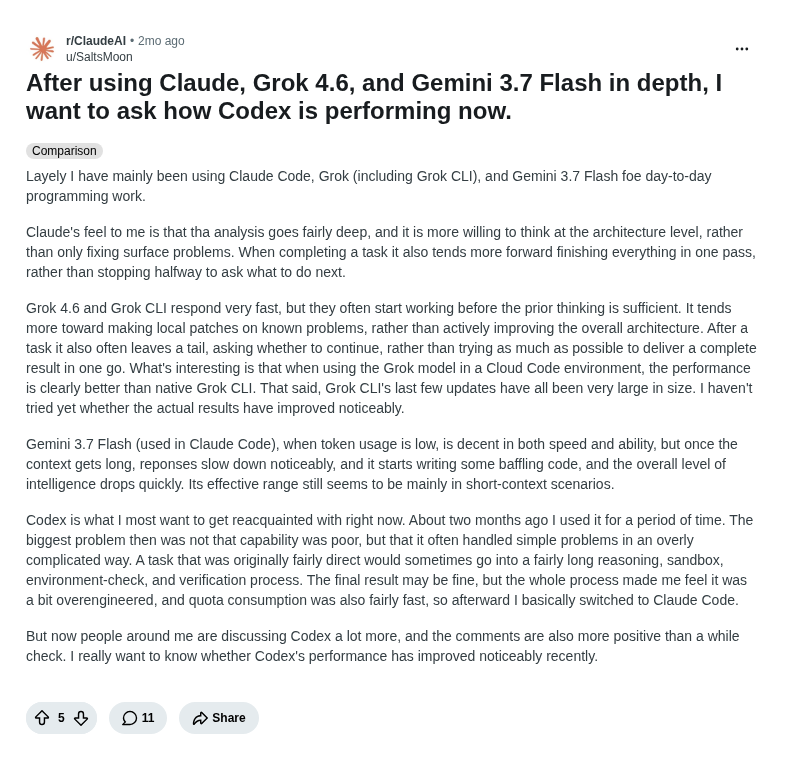
Reddit, r/ClaudeAI — Claude, Grok 4.6, Gemini and Codex in action.
After three or four days, my patience ran out. I never finished the app with Grok. It won’t be the architect of my project.
2.4. In chat — a completely different person
But in regular chat, I really like Grok: it gathers information well, breaks down the problem, and provides useful links.
A brief slice-of-life story. I bought four new winter tires, good ones. In October, at the tire shop, the technician says: look, two of the tires have the code 3921. That’s the 39th week of 2021. In other words, those “new” tires were almost five years old. At the time, I was young and inexperienced and thought that “new” meant recently manufactured.
I won’t name the brand or the seller; that’s not what this article is about. A dispute arose with the seller, and Grok helped me draft a formal claim and an appeal to Rospotrebnadzor, with links to GOST standards and regulatory acts. It was well done, with everything laid out (of course, I still double-check any legal text generated by AI).
It produced a useful result for a specific request. But it couldn’t take my prototype from start to finish.
2.5. A few more drawbacks
Unfortunately, there are many of them. And once again, I’ll emphasize: I’m talking specifically about the coding agent.
358@@Interface. For some reason, the minimalist black-and-white terminal got on my nerves. I later found out how to change the theme, but it still felt oppressive.This is purely a matter of personal preference, so don’t judge too harshly.
Remote access. I was sure this was already a basic feature and an industry standard. You enter something like /rc in Claude: you start a session on your laptop, walk away, and continue from your phone, while the code and files remain on your computer. I didn’t find a built-in equivalent in Grok Build. There’s a third-party grok-remote with a /remote plugin, but I didn’t want to set up another project just for that, and I haven’t tested it.
Reasoning. What annoyed me most was the endless Thinking on the screen. You either have to read the entire text or just the last three lines, and I don’t need that at all—I’m waiting for it to take action. (The web chat has Hide Thinking Trace, but I was using the terminal.)
And here I’ll admit: while preparing the article, I realized I had simply missed the setting in ~/.grok/config.toml:
[ui] show_thinking_blocks = falseIn my defense, I wasn’t planning to deeply customize the product. I wanted it to work like Claude: download it, start using it, and ask it to sort out everything else itself. So please don’t come at my laziness with hand tools. :)
2.6. And now for the pros—they exist too
The main advantage is the limits.
Under the current rules, paid subscriptions have a shared weekly allowance, with no five-hour window like Claude Pro/Max has. Even on the cheaper plans. It’s a really great feature: you can just sit and work without wondering whether your allowance will run out in an hour.Even at $30, give or take, that was enough for me, but at $100 I almost stopped checking my usage.
It’s the same story in a review of ten coding subscriptions: Grok’s limits are praised, while its coding is criticized.
By the way, while I’m banned, Claude keeps sending me emails saying that Ultra has no five-hour window, only a weekly one. I read them feeling rather peculiar—I’d just get access back first :) For reference, Claude currently has Max at $100 and Ultra at $200, and only verified Ultra has no five-hour window. Grok already has that on the cheapest subscription.
The subscription also includes X features, and Grok 4.7 is available in Cursor. Interesting, but not for me.
Grok Bot is a separate story. People online say it has learned to connect external models for the task at hand: Facebook, Habr, Reddit, CoinEx, Threads, YouTube. (Facebook and Threads are owned by Meta, which has been designated an extremist organization in Russia.)
Musk himself wrote about this on X. He promised the best model for each task, including Claude Opus 5.5, Midjourney, and Suno, as well as a fast Grok 4.8 for simple requests once it comes out, confirmed that you can connect your own Claude/OpenAI subscriptions, and in November urged people to try the service because fixes are released seven days a week.If even Grok’s own bot relies on third-party models for complex tasks, that’s one more argument for me: Grok 4.7 is still rough as a coding agent.
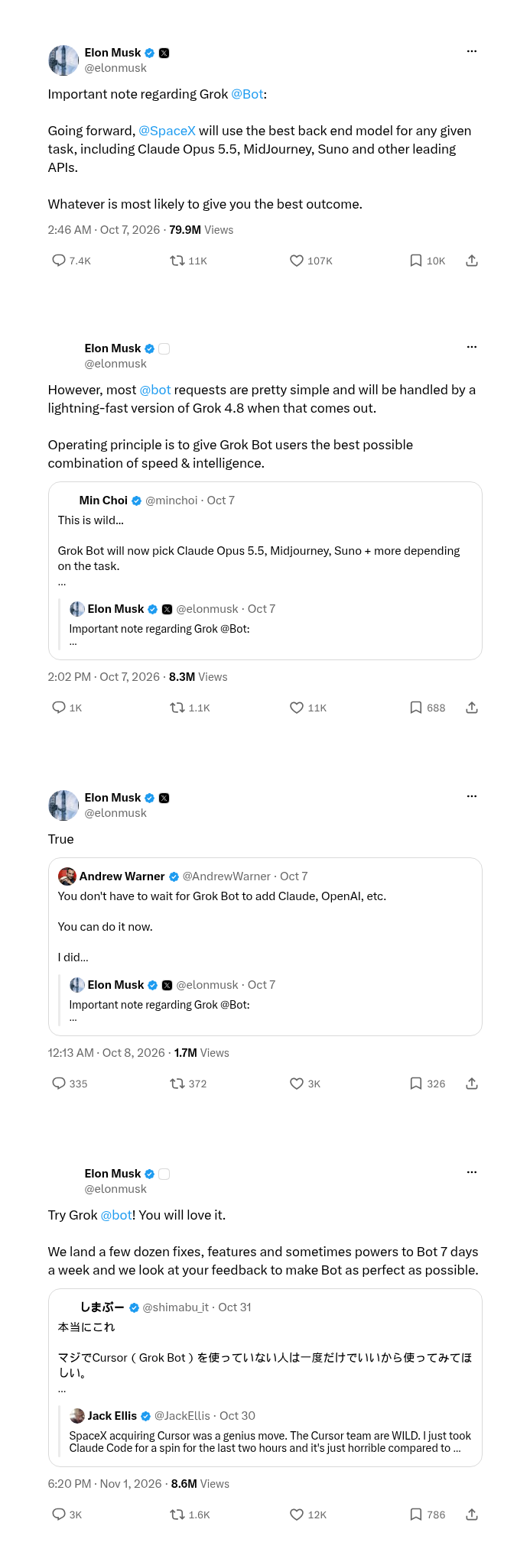
What Musk wrote about Grok Bot: about the best model for the task, about the fast Grok 4.8, about his own Claude/OpenAI subscriptions and “try it, fixes every day”.
TAG414@@In short, my take on Grok is as follows:What | How it turned out |
|---|---|
Chat and specific questions | Good, I enjoyed using it |
Compatibility with Claude workflows | It reads files, but I had to rewrite the instructions | TAG452@@Architecture and working independently | Too much manual guidance | TAG460TAG462@@Limits | TAG466@@One of the most pleasant aspects | TAG470TAG472@@Continue a session from your phone | TAG476@@Not available by default, a major drawback | TAG480TAG482@@Test project | TAG486@@It didn’t reach a working MVP in 3–4 days | TAG490
As a replacement for Claude Code, I wouldn’t recommend Grok first. It’s good in chat, but it didn’t work for my coding.
3. Kimi K3.1 Pro: I switched over to “the Chinese model,” and there…
After Grok, I went further down the Google list, that is, to the Chinese models. And that’s where I think I understood people who switch to Chinese cars.
My expectations were: a large context window (K3.1 Pro is advertised with one million), plenty of limits, a slightly more basic model than Claude—well, I’ll put up with it.
The timing was lucky too. News spread across the web that Cod.ru had paid for Kimi Plus with a Russian Mir card on October 30. Against the backdrop of the bans on Claude, this was a great move from a marketing standpoint, so I became interested too. However, on October 31, Metaratings reported that Mir had disappeared from the payment form.
3.1. What exactly I set up
The model was Kimi K3.1 Pro, the service was Kimi Code, the terminal client was Kimi Code CLI, plus the desktop app.
I liked the interface right away. After Grok, it was like a gulp of fresh air. The logic was familiar, Claude-style; everything was interactive, and it displayed tasks and MCP beautifully. It even felt slightly more pleasant than Claude. The 智东西 review also praises the desktop app (though it covered the September K3, and the guys note the incomplete GUI and difficulties with third-party APIs).
Here it is, the Chinese car: the steering wheel and pedals are familiar, but the screen is as if you bought a tablet and the car came bundled. Looks great.And whether you’ll get where you need to go is a separate question :)
Kimi has its own AGENTS.md and imports settings from Claude Code and Codex. But I had already been schooled by Grok, so first I asked: Kimi, buddy, rewrite all the work from Claude in your own format. Better to spend the tokens upfront than spend days on misunderstandings later.
It handles things quickly, noticeably faster than Grok. The documentation gets rewritten, tasks get invoked, everything works beautifully.
And here’s where the fun begins. The first—and in fact main—problem with Kimi: after about twenty minutes, you hit the limit.
3.2. Speed comes at a separate price
K3.1 Pro has a Highspeed variant. According to the documentation, it generates text roughly 2–3 times faster, but it also consumes quota roughly twice as fast.
I ran my first session on it: K3.1 Pro Highspeed was my default. On LocDD, they wrote the same thing about Highspeed on October 24: the quality is good, but the quota “leaks like water.” One person burned through 20% of a five-hour window in 15 minutes.
I started with Pro at $39 per month, then upgraded to Max for $99. According to the international pricing: Plus is $19, Pro is $39, Max is $99, and Ultra is $199 per month, with annual payments costing less.
There’s also a caveat with the million-token context: K3.1 Pro supports up to 1,048,576 tokens only on Pro and above, while Plus has 256K. So the comparison of “one million for Kimi versus 256K for Grok” only holds on Pro and above: on Plus, Kimi has the same 256K as Grok.
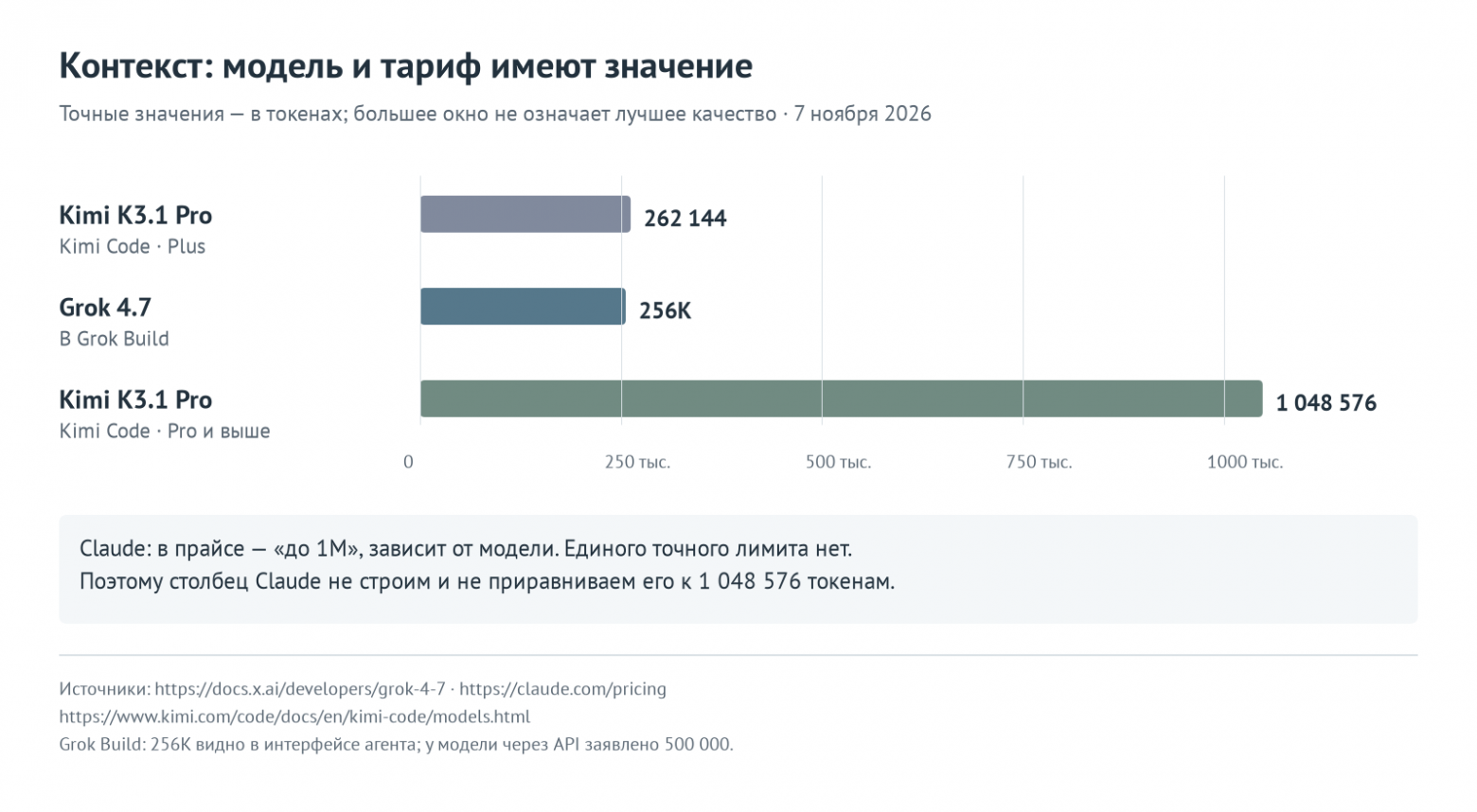
Image 3.Documentation context: Grok 4.7, Kimi Code models, Claude pricing (for Claude, “up to 1M,” depending on the model). In the text: the context of Grok and Kimi Code Kimi K3.1 Pro in Kimi Code Plus: 262,144 tokens. Grok 4.7 in Grok Build: 256K, as visible in the agent interface. The model is listed as having 500,000 via the API. Kimi K3.1 Pro in Kimi Code Pro and above: 1,048,576 tokens. Claude’s pricing states “up to 1M”; the size depends on the model. There is no single exact value on the chart. The model limit and the available space in an agent session differ. Psychologically, by this point I had already come to terms with the fact that I would spend more than planned. It’s for work, as long as I can find a proper product. I upgraded my subscription to Max and switched to the regular K3.1 Pro, without Highspeed. Well, let’s get going. By the way, regarding “Chinese for pennies.” I didn’t end up getting a Rolls-Royce for a bag of chips. Through the API, K3.1 Pro is even cheaper than K3, but a cheap token doesn’t make a working day with several agents any cheaper yet. 3.3. Went for a walk. Not for long Kimi has Remote Control, no need to reinvent the wheel: I launched it on my computer and continued from my phone. It also has multi-agent capabilities. I’m thinking: well, at last, this isn’t like Grok! Elon Musk, where are you looking? :) November 4, day off.I decided to combine business with pleasure: I left the Mac working on a small MVP (the same task as with Grok: a flubber app for Windows, just a reminder), took my phone, and went for a walk. At most three to five parallel agents were launched.
About an hour later, the limit ran out. In that time, I had literally gotten as far as the house next door.
That’s where it got sad. I upgraded my subscription with exactly the thought, “well, now I won’t have to skimp on tokens.”
Here’s the most interesting part: October 26, more than a week before my test, Kimi itself apologized for using too much of the K3.1 Pro quota. It promised a one-time reset, restored 25% of the monthly quota, and reduced unnecessary subagent calls. As you can see, it didn’t help.
For comparison, on the $100 Claude plan, it comfortably ran about eight agents, brought the task to completion, and still had capacity left for odds and ends. Sure, tokens were being burned, but the task did manage to finish in time.
The models and tasks are different, but I’m comparing a working day. A pretty agent counter is of no use to me; I need the agents to finish the task in time.
3.4. What I want to keep from Kimi: control from a phone
I did like Kimi’s framework itself, even after the whole saga with the limits. And Remote Control, which I used while out walking, is one of the reasons.
You connect to the entire Kimi setup on the computer, see all the sessions on your phone, and continue the one you need. Kimi Desktop works just like that: select a device, open an existing session, or create a new one (Kimi sessions only—this is not a remote desktop).
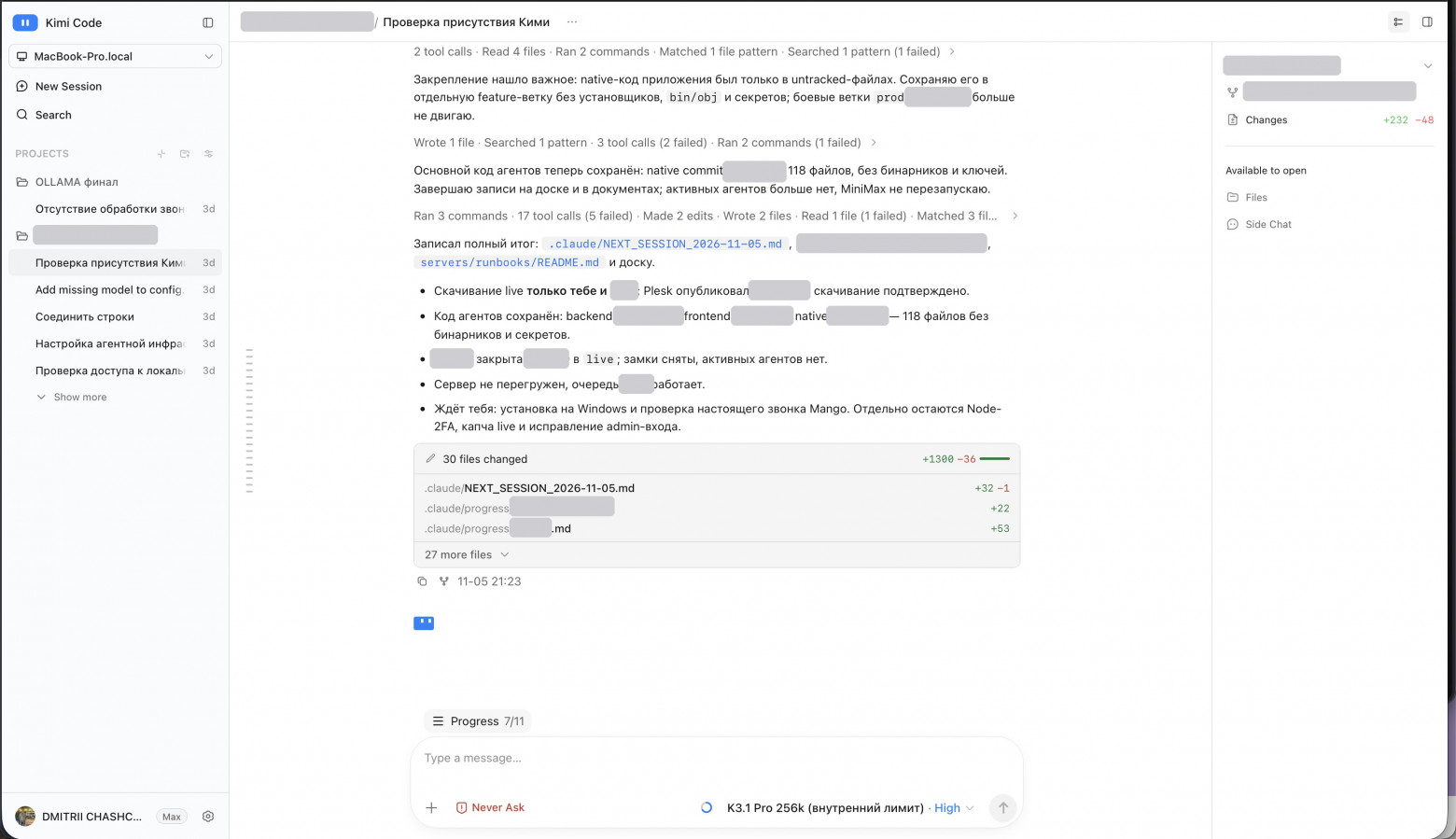
The scenario I had in mind for Claude was different: you enter /rc and continue one specific session. And here I’ll correct myself again. Claude Code has two modes: /remote-control continues the current conversation within a conversation, while claude remote-control in the terminal, without the slash, launches a server mode that can create multiple sessions, including in separate worktrees.
So “Claude can’t handle multiple sessions” was my mistake; I simply hadn’t used it that way. If you find yours more convenient, correct me in the comments.
In both cases, the work runs on the computer, while the phone is just a remote control. The laptop must remain on and online.
3.5. By evening, everything had become clear
The euphoria lasted until evening.
At around 10–11 p.m., just before bed, I checked: the task was not completed, there was only a draft, the limit had been exhausted, and it would reset around 1 a.m.
There was no result. I no longer wanted to wait until nighttime.
And one more detail. For the entire first day, I had one chat with Kimi K3.1. The context counter reached roughly 850–860K, never getting as far as compaction (/compact), while the limits ran out twice during that time. But that’s absurd, don’t you agree?
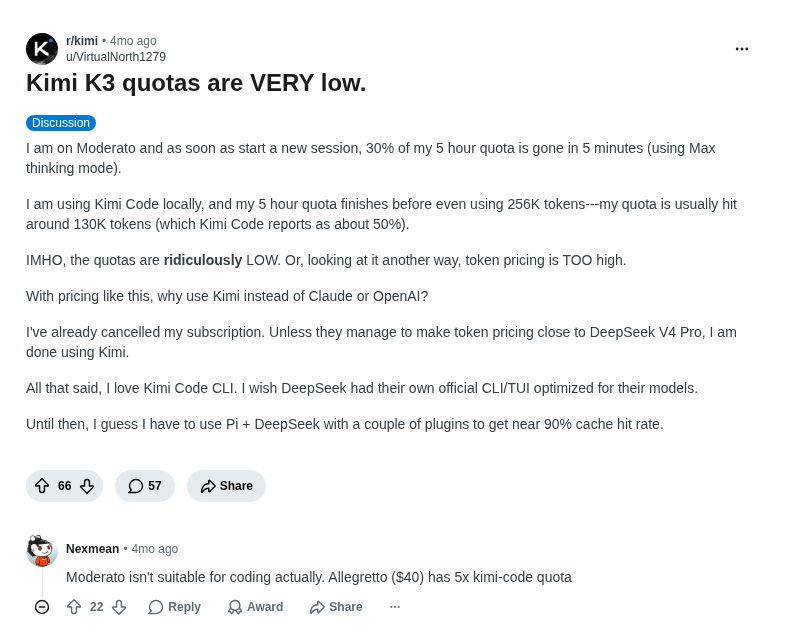
Reddit, r/kimi — the K3 quota runs out before the context does. The ad block between the post and the comments has been removed.
3.6. While waiting for the limit to reset: benchmarks and advertising
While waiting for the limit to reset, I started investigating why the promises were so different from what I ended up getting.In my opinion, this is plain fabrication: we, the end consumers, were handed the desired outcome passed off as reality.
Along the way, I came across two more stories.
Benchmarks. On November 3, R40 Research published a behavioral audit of K3.1, along with trajectories and scripts. In its responses, Kimi cited the Terminal-Bench rules, which it had not been shown and which are verified by hidden tests.
Then the team did something more interesting: in four tasks, they changed the conditions so that they contradicted those rules. In three cases, K3.1 clung to the old rule and failed the modified task. The control models calmly followed the new conditions.
For me, this is a serious red flag: if the model knows what the evaluator expects, its high score tells me little about my project. At the same time, the researchers do not prove that the results were fabricated; they have a hypothesis about learning with hints from a teacher model. And there are only four tasks.
Advertising. In October, Elshayib posted a screenshot of the instructions he allegedly received: “Please DO NOT put on the paid partnership label”, meaning “do not put on the paid partnership label.” If the brief is genuine, that is bad. But nobody checked who sent it or whether anyone was paid. And “Kimi bought bloggers on Reddit” turned out, on closer inspection, to be a discussion of the same post from X.
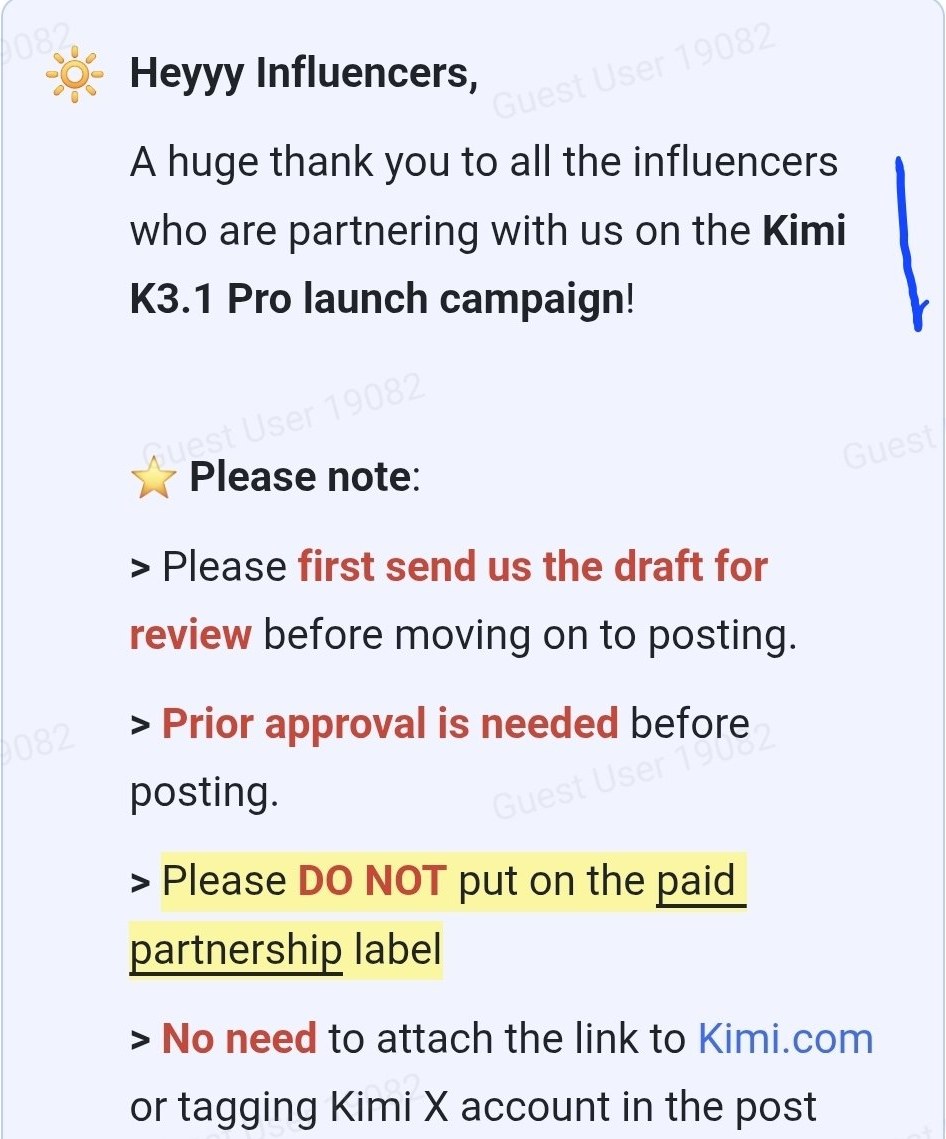
A screenshot from Elshayib’s post on X. Who sent the brief has not been verified.
Advertising.As for what is really going on with the benchmarks, let the researchers work that out. My own quota bill was enough for me: they promised one thing and delivered another.After this, choosing an AI based on a pretty table and rave reviews becomes even less appealing.
3.7. And wasn’t it trained on the leaked Claude Code?
While I was looking at Kimi, I remembered another story. On March 31, 2026, a source map ended up in the npm release of Claude Code 2.1.88, and the client-side harness was reconstructed from it: the tools, the agent loop, and the prompts. The model weights remained with Anthropic.
Whether Kimi Code grew out of it, nobody knows. Some people on X suggested that Kimi might have studied the exposed code, while others were convinced of the opposite. No one published any comparisons of the source code.
4. Kimi. Day Two: A Setup with MiniMax

I’m not giving up! I firmly resolved to get at least some result out of this model. Yes, I was duped. Across the board—both the tokens and the quality. It feels like buying Kimi is like getting into a memecoin: a pretty website, bold promises, and everyone around is over the moon. Then you look at the bill and can’t understand where all the money went. And I should have realized that on the very first evening. But it can’t all be that bad, can it?
Spoiler: it absolutely can.
I spoke with a colleague who is also looking for a replacement right now and put together a setup. If you’ve decided to stick with Kimi, this recipe might come in handy.
4.1. The Setup: MiniMax Does the Heavy Lifting, Kimi Does the Assembling
On the second day, I simply handed MiniMax 80–90% of the work: reading through the codebase, analyzing data, creating scout agents and the parser, and writing the first rough code.
The model is MiniMax M3, with a 1M-token context window. The subscription is M Plan Go at $22, and they give you an API key right away: plug the model into your own harness, and that’s it. Apparently, they understand that people are going to burn through tokens like crazy.Or, as they put it these days, token-maxxing. The key does not cancel the quota; there are also five-hour and weekly limits. Her allowance more or less covered me, and by evening it had run dry too, but for $22 it would be a sin to complain.
Kimi K3.1 became the implementer. At first I gave her more, and then took almost everything away, leaving only: “Bro, stitch together what MiniMax threw together and fix it.”
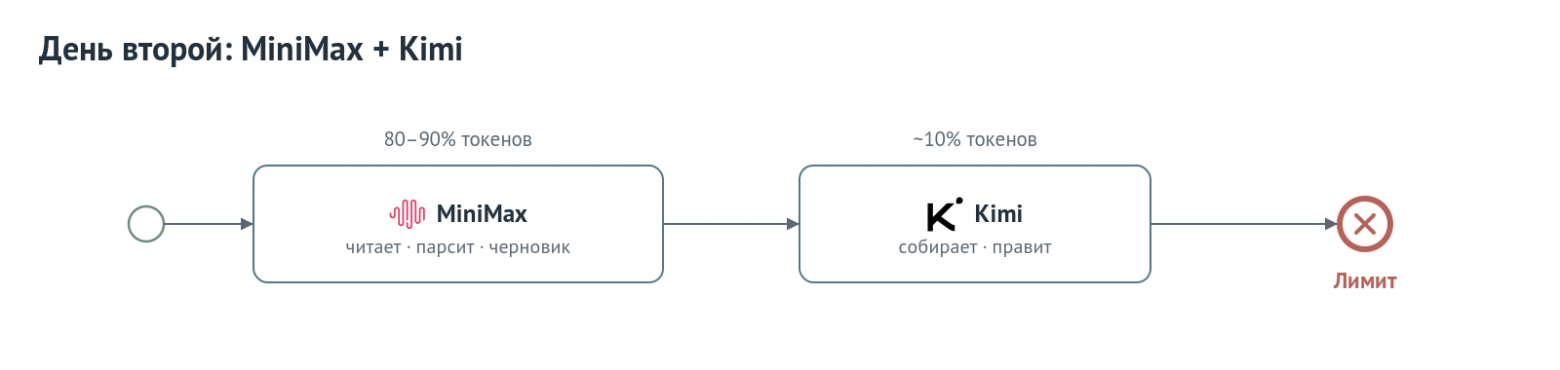
MiniMax: reads, parses, writes the draft. 80–90% of the tokens.
Kimi: assembles and edits. About 10% of the tokens.
Result: the draft got up and running, but it was rough. Kimi hit the limit again.
And, remembering the first day, when the chat had reached 850K, I cut Kimi’s context down to 256K and set automatic compaction to approximately 200K. So the tokens wouldn’t visibly run dry. The context window and compaction are configured in the config file; I’ll attach my TOML once I’ve cleaned it up.
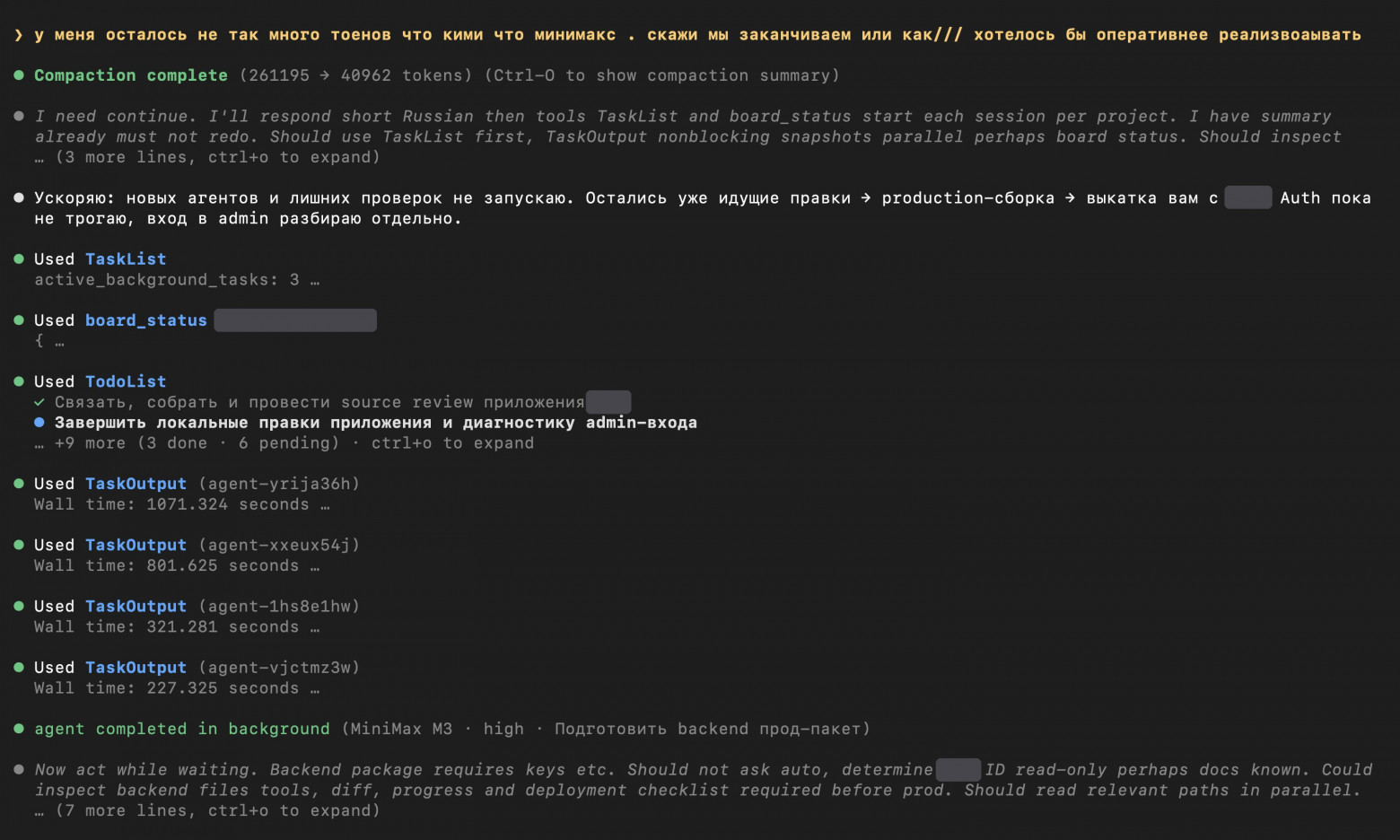
Before compaction, the agent saved the documentation, logs, and tasks to files according to my rules: the built-in compaction simply compresses the history.
4.2. Kimi spent ~10% of the tokens. The limit still wasn’t enough.
And the Kimi setup I had was nowhere near basic: Max for $99 a month.My $100 Claude plan lasted me a long time until I started running three or four large projects in parallel.
And even so, by evening, Kimi, which handled only about 10% of the tokens, had hit its limit.
I understand the question: “How could 10% of the tokens eat up the entire quota?”
10% of the tokens does not mean 10% of the quota: input, cache, output, and reasoning carry different weights. In the K3.1 breakdown, the author describes tens of millions of tokens with a small weekly quota, and he says almost all of them were cached. And there is another gotcha: switching the model or thinking level resets Kimi’s prompt cache. So switching back and forth between modes in the middle of a long chat is not exactly a way to save.
This approach worked for one person: Peng Qian deployed cheap scouts and a separate executor, and the quota then lasted for a week. I’m happy for him.
End of the day: I launched the draft. It works, but not great.
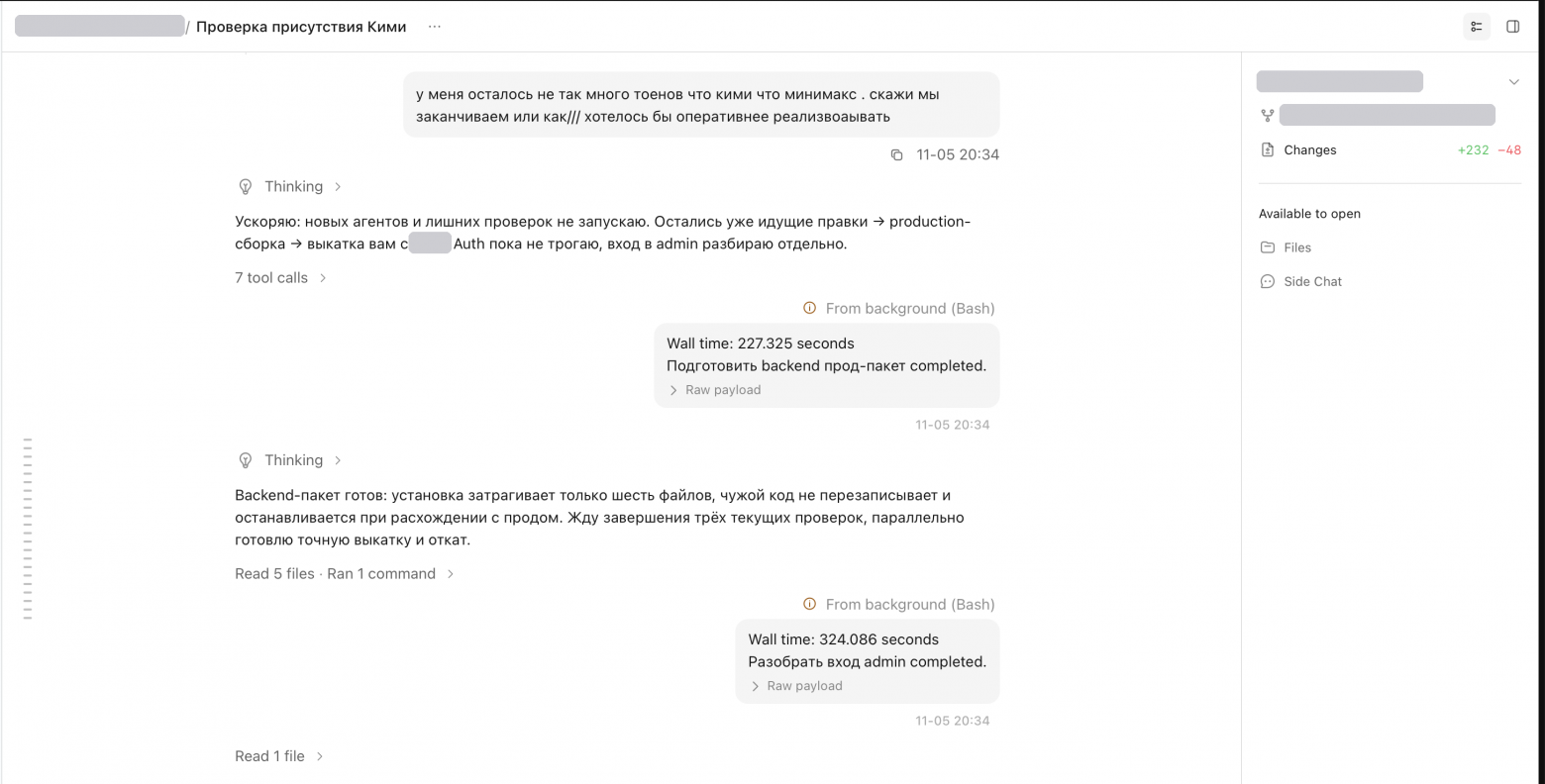
The draft itself turned out very rough. Same story as with Grok: I did exactly what was written, but did not think through the pitfalls. No brief—no idea. I acknowledge my share of the blame; I’m used to Claude noticing what has been left unsaid. But once again, I ended up babysitting every step.
On the second day, I simply snapped. I needed a result, not another day of configuring tools. I even thought about buying a new Claude account and risking it again. But there was one more option.
5. GLM-5.3: this is where I’ve settled for now
The same colleague helped me choose the next model.
Good news: I did end up sticking with it.GLM-5.3 from Z.ai. I’ve been using it for a few days, and it’s a working model that makes me want to keep going.
That’s exactly how I imagined switching to Chinese models before I dove in: a working AI tool, an affordable subscription, and no need to count every step. Though after Kimi, I’ve learned to be more careful about getting excited.
The news about Revolut added fuel to the fire: they installed their own GPUs and deployed precisely GLM-5.3 (more details in 5.7). It helped me decide, but I was already afraid to get excited :)
5.1. Finally, not just another draft
Let me remind you what I was trying to create in the first place. Without going into project details: that same audio-mixing app,a native Windows application that detects the microphone and headphones, can turn on the microphone, and switch between devices.
I wanted the bare minimum: download it, install it, run it. First the skeleton, then the flesh.
GLM quite quickly turned the scattered groundwork from two days of work with Kimi and MiniMax intoa basic installable application. It’s still a long way from a polished product, but at least there’s finally something to test and build on. I can’t show a screenshot because it contains working data.
5.2. From Lite to Max: why I upgraded my subscription
After the free trial, I subscribed to Lite for $18 per month. It was enough for the first results, but I fell just short of the next stage. I upgraded to Pro for $80, and then toMax for $168. I wanted to stop limiting myself in every way for once—I deserve it :)
After the upgrade, everything became noticeably faster: higher tiers get more parallelism. I sat there thinking: Claude, was it really that hard?
5.3.Moving to ZCode: history, projects, skills and agents
Z.ai, ZCode… I'll soon keep a separate glossary of names. GLM-5.3 is the model, ZCode is the agentic environment, roughly like Claude and Claude Code.
On first launch, ZCode itself offered to transfer the history, conversations and skills from Claude Code. What I had to force Kimi and Grok to do is just a button here. Finally!
The migration wizard imports conversations from Claude Code and the old ZCode; you can skip the step and come back later. Skills are imported separately, including from Claude Code: as a copy or as a link to the source folder.
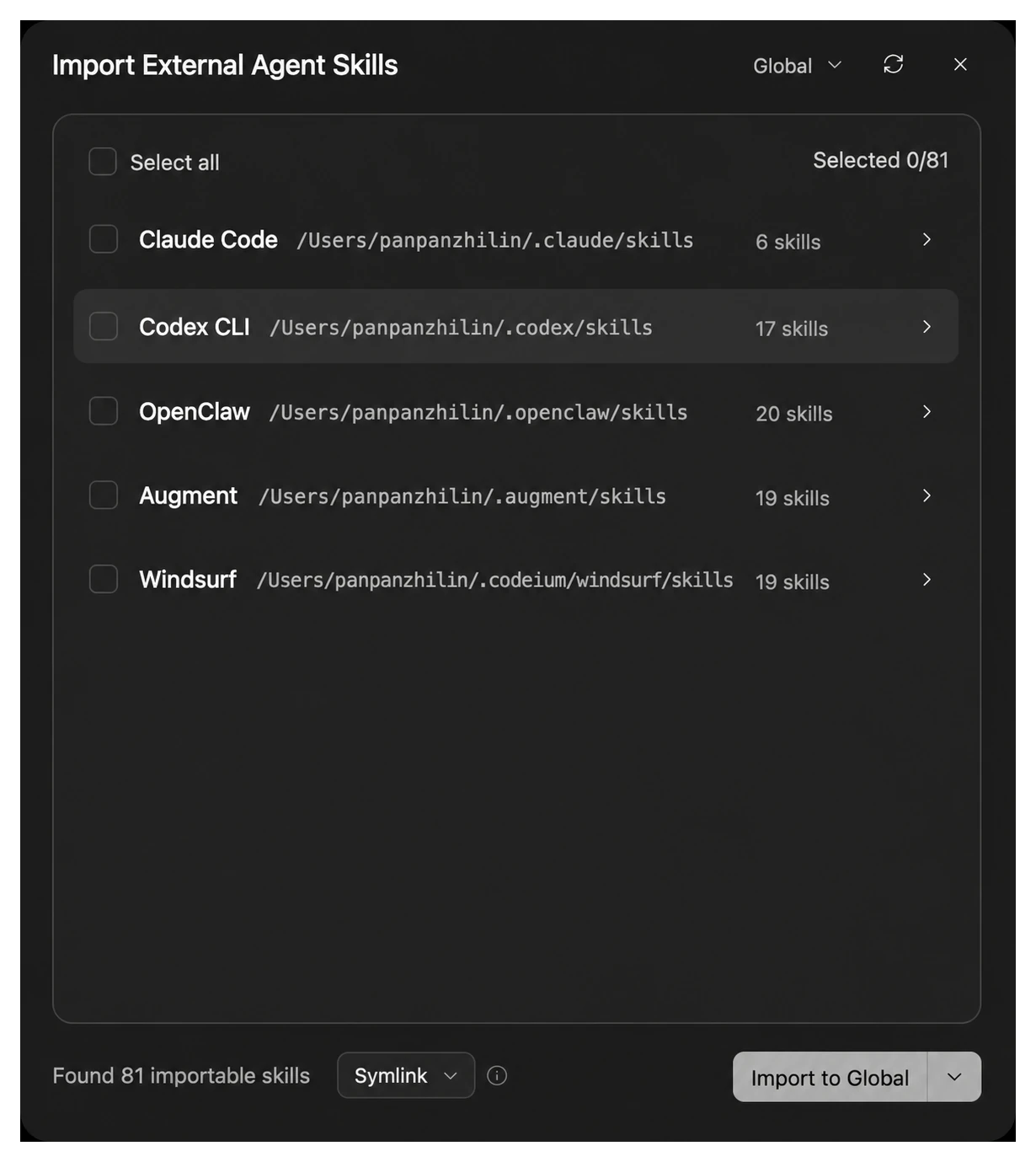
ZCode: importing skills from other agents. A screenshot from the documentation; the paths in the example aren't mine.
Another convenient thing — the split by projects. One of my projects is over SSH, another is local, everything runs in parallel, but in the familiar chat format. Roughly like in Visual Studio: you switch, look at what's going on, and continue the conversation you need.
Local projects, SSH, WSL and Docker are supported; chats are grouped by workspaces. Not exactly a flashy feature, it's in almost all products now, I just felt that here it's well organized.
There are skills and subagents with their own roles, models and tools. The agent itself invoked the ones it needed, and it essentially replicated my flow from Claude Code.
A couple of pitfalls. CLAUDE.md is transferred into AGENTS.md once, and afterwards it doesn't read it. Skills and MCP are synced to the server separately, along with MCP secrets, so the server must be trusted. And one person on Reddit never managed to set up subagents and burned their entire trial period on it.
5.4.The entire workflow runs on a single model
The main advantage: I stopped offloading Kimi through MiniMax. Those pitfalls are gone: there’s no longer any situation where a problem was created out of thin air only to be heroically solved afterward. My entire work cycle ran on a single GLM, just as it used to on Claude Code.
I asked GLM to build an orchestrator: to take tasks, decompose them, and assign executors. What I liked:
It correctly picked up the agents. It didn’t create conversations just for the sake of conversations.
It passed along the necessary roles and instructions. Who investigates, who implements, who reviews—nothing was lost.
It brought the results together. In my case—the app skeleton itself.
Grok, by comparison, constantly gave the agent the wrong role or the wrong instructions. One might think my documentation was flawed, but GLM handled the same documentation just fine. Grok is smart, I’ll repeat. A smart model and a mature coding agent are simply different things.
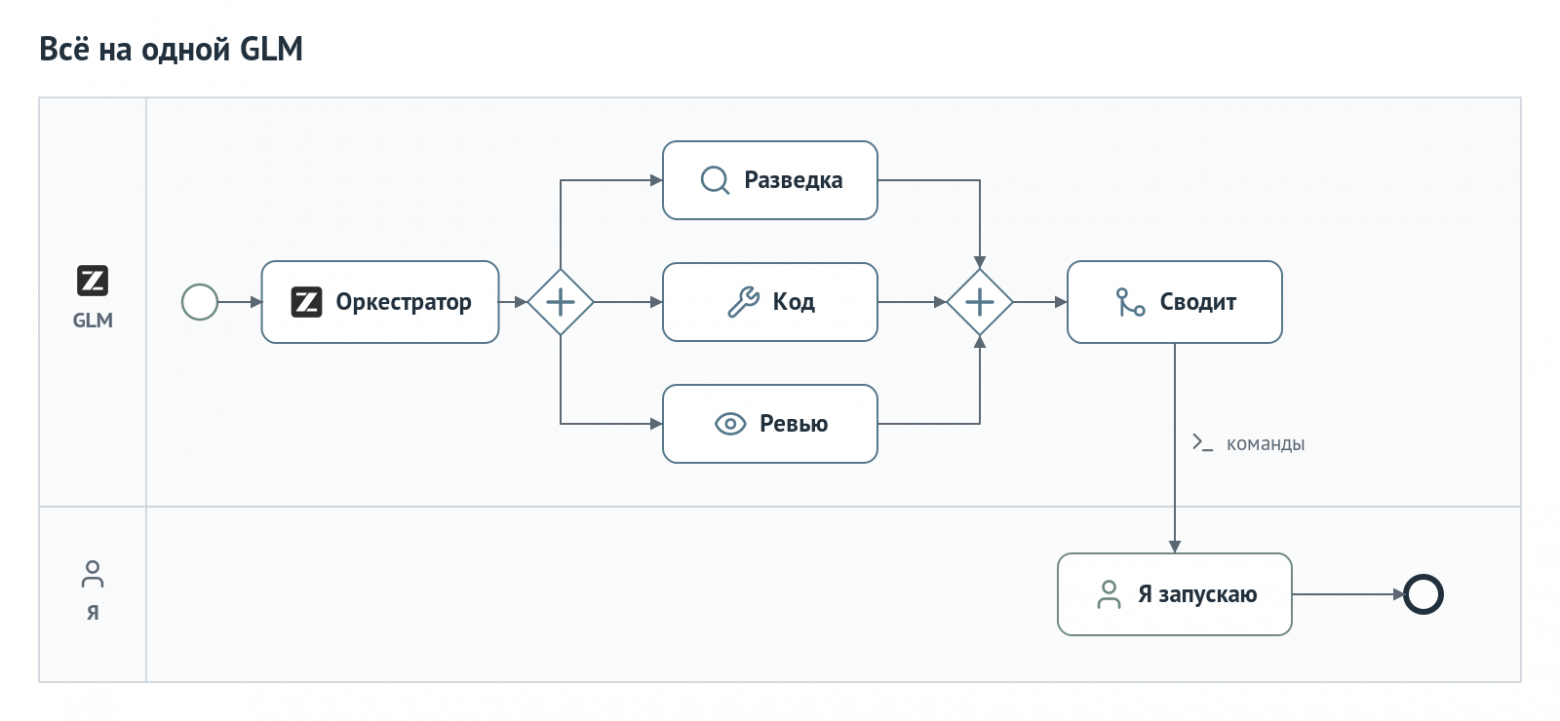
The GLM orchestrator assigns tasks to subagents.
The subagents do reconnaissance, coding, and review in parallel.
The orchestrator consolidates the results and gives me the commands.
I launch them myself.
With Kimi, it’s really clean and inviting: you want to click everything and take a look, and the touch of a good designer and marketer is evident. But in the end, I still choose based on the workflow.
And my workflow has long since gone beyond “write a prompt and ship it to production.” A sandbox, tests, simulation, a load test, and only then production. Even a session for a simple fix can take about two hours, mostly because of the checks around it.
GLM took on the checks and the entire cycle. I had to restate the rule “don’t publish it yourself, just give me the commands” separately, but more on that below.And this entire cycle became roughly three times faster for me than with Claude Code. I’m not going to draw a “3× speed” chart; the tasks aren’t one-to-one. But everything reaches production noticeably faster.
5.5. Reasoning: why I started with High
Even before the switch, I had read that Chinese models have this intense thinking that can’t be turned off, and you pay for those tokens too. I checked. In Kimi K3.1 Pro, thinking cannot be turned off; there are low/high/max options. GLM-5.3 can’t turn it off either: in the Coding Plan, none becomes low. ZCode offers Low/High/Max, with Max selected by default.
Kimi counts reasoning in tokens, and so does GLM (and the Coding Plan even assigns different weights to input, cache, and output). But some analyst I read wrote that Claude doesn’t charge for thinking. That’s not true: Claude’s thinking is billed like ordinary output tokens, even when hidden. And with the current Opus 5.5, Sonnet 5.5, and Fable, thinking can’t be fully turned off either. So it’s not “the Chinese models versus everyone else.”
In Claude, I liked the way it was presented: the reasoning was collapsed and hidden by default. You see the “thinking” indicator and calmly wait.I don’t care at all what the model is thinking, and I wish everyone would do the same.
Everyone complains about usage: user K3 hit the limit on max in 20 minutes, and people are complaining about GLM-5.3 too.
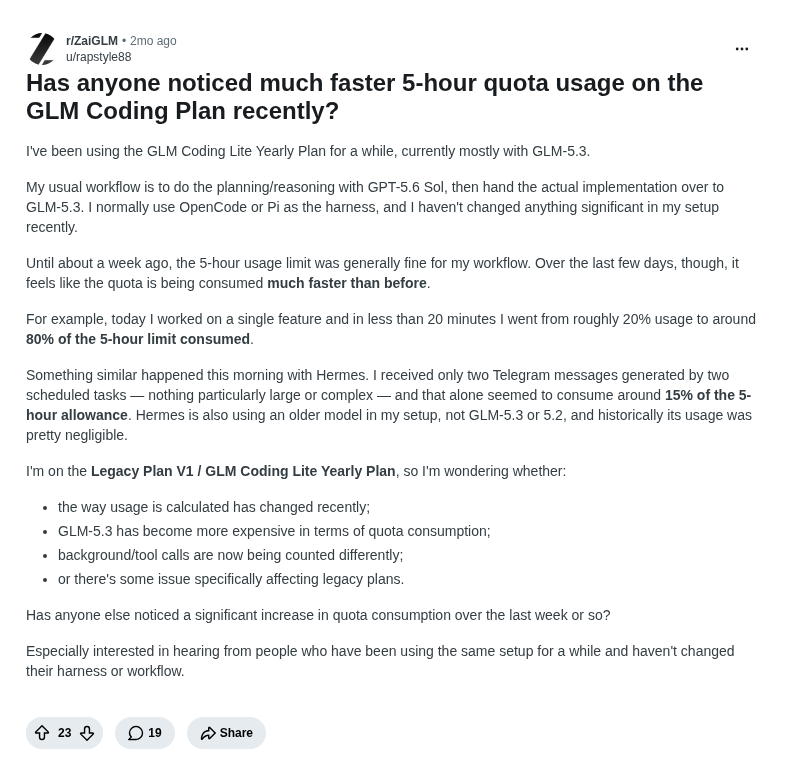
Reddit, r/ZaiGLM — accelerated depletion of the five-hour quota.
My advice: for everyday tasks, select High right away instead of Max. The levels there are Low/High/Max (Kimi has the same ones), and why they called the middle one High is a mystery to me. I myself called the top one “ultra” for a long time.
On GLM, I selected High, and this time I didn’t manually trim the context. Use up the tokens and get the task done :) Of course, this doesn’t eliminate the habit of splitting the work into mini-agents and not dragging everything into the main chat.
Gemini also recommended High to me, and the figure in my head was “a 3% gain in quality for 30% more tokens.” According to Z.ai’s own test, it seems to be true: Max gives about +3 points for 1.5 times as much output (the figures in the chart).I think many people are ready to concede these three points.
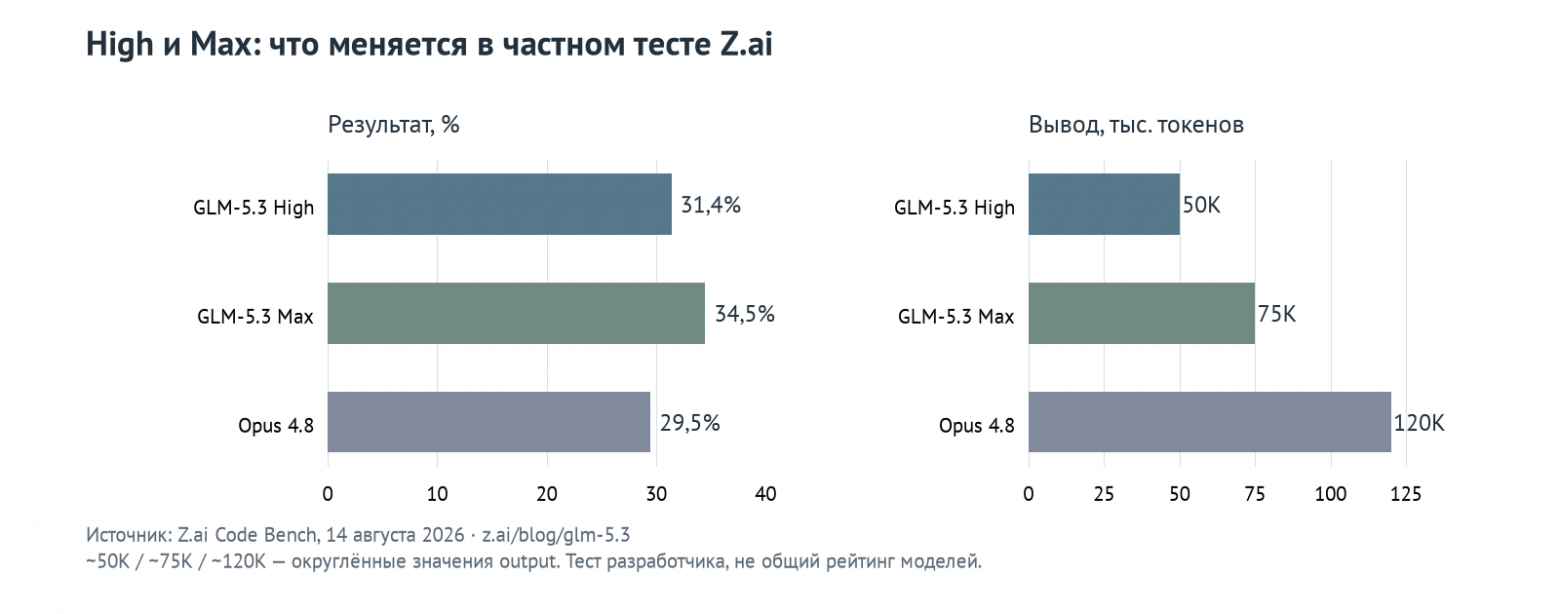
According to Z.ai as of August 14, 2026: High — 31.4% with ~50K output tokens, Max — 34.5% with ~75K, Opus 4.8 — 29.5% with ~120K.
Text: GLM-5.3 High and Max in the Z.ai testModel | Result | Output tokens, rounded |
|---|---|---|
GLM-5.3 High | 31.4% | ~50K |
GLM-5.3 Max | 34.5% | ~75K |
Opus 4.8 | 29.5% | ~120K |
Z.ai Code Bench, August 14, 2026.
Z.ai itself, however, recommends Max for complex code. You can work on even a stubborn bug with Max, but not every variable rename, after all.
5.6. Trial access, context, and limits
I started with free access: you log in, and they immediately give you tokens to try. Right now, that’s five days, with 3 million GLM-5.3 tokens and 2 million GLM-5-turbo tokens each day.five days, each day 3 million GLM-5.3 tokens and 2 million GLM-5-turbo tokens.
On the free tier, the model regularly stopped in the middle of a task: server busy, please wait. You nudge it, type continue, and carry on.Remember early DeepSeek? In January 2025, that was exactly what people were complaining about. Very similar.
For a free trial, that’s normal; it would be awkward even to complain about a free coding agent. Though the paid plan isn’t immune to it either: on Reddit, someone saw “system is busy” on the free plan, Lite, and Pro.
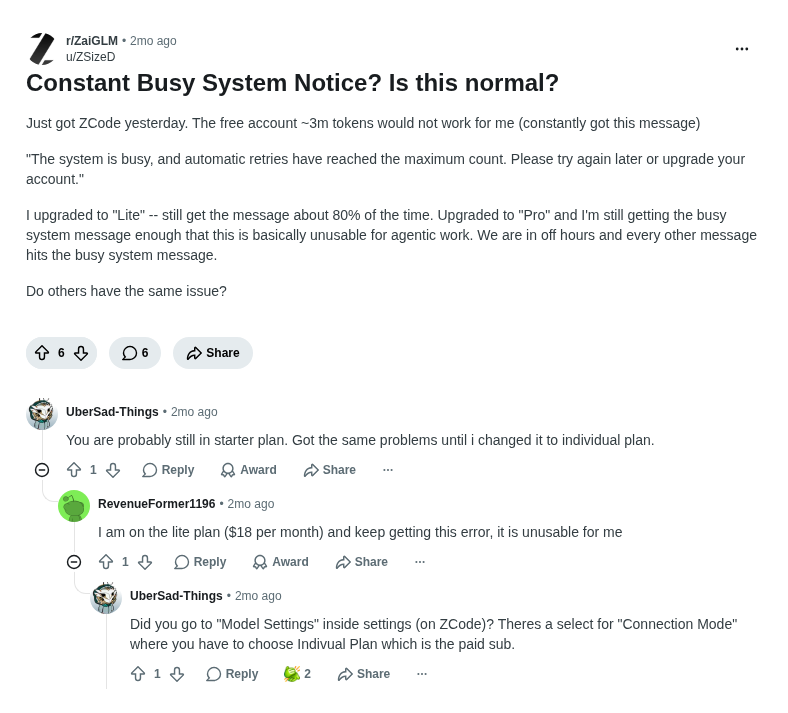
Reddit, r/ZaiGLM — System is busy on the free and paid plans. The ad block between the post and the comments was cut out.
GLM-5.3 has a 1M context window. It’s a great feature, but after a long chat in Kimi, you don’t feel like filling it up. I try not even to reach 500K: I break the work down into mini-agents, just as with Claude Code. Revolut also chose around 256K for its workload: context, cache, and concurrency share the same resources, even if the model can handle a million.
The limits have become noticeably more manageable. You no longer get that feeling that after twenty minutes or an hour, that’s it, you’re done. With parallel agents, the quota still runs out, but for me it’s after about three hours rather than one.three hours rather than one. Then a break of about two hours: coffee, a walk, and back to work. At least you can work, yay.
And just so this doesn’t come across as an ad: on linux.do, a Pro subscriber writes that they have enough quota but are disappointed with GLM-5.3’s quality. It happens.
5.7. And how does Revolut fit into this?
This week, everyone was discussing how Revolut switched its development to an in-house GLM deployment. The idea was that everyone is now bringing AI into their own setup, but Revolut didn’t go with OpenAI or Claude; it deployed GLM-5.3.When I tried the model myself, I thought: I think I understand why.
The original source is the talk “Shipping like a startup, regulated like a bank” from October 13, 2026. David Abitbol, Ops & Infrastructure Leader at Revolut, says that about 2,000 engineers are working with GLM-5.3, which runs on 56 NVIDIA B200 GPUs (the Blackwell generation).
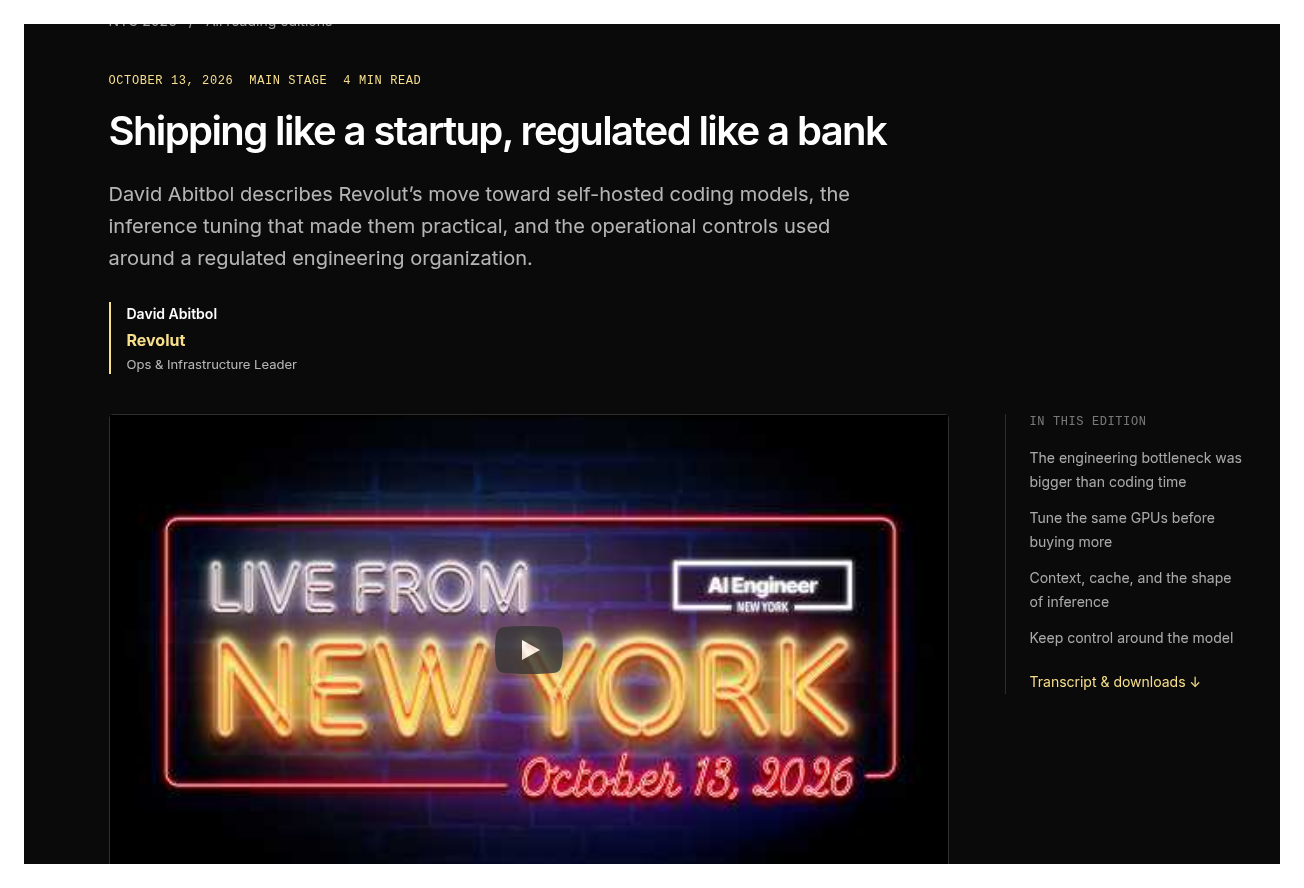
Talk at AI Engineer, October 13, 2026. David Abitbol, Ops & Infrastructure Leader.
They started back in April with GLM-5.1; the discussion just blew up this week after The Register’s story. They didn’t ditch Claude and Codex, leaving them for complex cases. According to Abitbol, it comes to about $0.30 per million tokens, and the bill is roughly one-tenth of the previous one.On HN, self-hosting is generally praised, although one participant called replacing Opus with unlimited GLM a downgrade. What resonates with me in this story is the simple freedom to use the model freely without having to look over your shoulder.
5.8. What the quality is like and what I expect next
Without any exaggeration: GLM-5.3 on High feels roughly equivalent to Claude Opus 4.8, maybe slightly below.So, Claude, which I worked with a few months ago (I first said “six months,” but Opus 4.8 was released on May 28).
What is this feeling based on:
It brought the task to completion. It didn’t stop at a promise to build the app.
We worked through the debugging together. There was something to run, test, and fix.
Sometimes it still needs to be pushed along. It doesn’t think everything through in advance.
For example, why not check the input and output devices right away? After the comment, it did finish the implementation, but ignored some of the others. You still can’t just give it the goal and walk away.
But Claude, too, needed to be prodded a few months ago: on one B2B portal, I was the one laying out the flow for it like a technical specification. The difference from Grok is that GLM doesn’t stop at “next we need to think through the architecture” and doesn’t require you to spell out every next step.
GLM doesn’t match Claude across all tests. It’s simply good enough now for me to work with it.
Remember what I said at the beginning? Even in 2023, I was nearly floored by the quality of the code Claude produced. I thought it couldn’t get any better. And now here I am, complaining that, for example, it didn’t think through the architecture for me in advance…
Claude isn’t standing still either. Opus 5.5 was released on September 22. At one point, I even thought: what could be better? This is the peak. I was especially impressed by 3D and CAD: six months ago, that was perhaps the only major gap Claude hadn’t closed.Many people who work with 3D will understand what I mean.
They do ban, by the way, not only Russians: on October 12, Anthropic wrote about tens of thousands of bans for distillation and separately accused Zhipu (which is Z.ai) of extracting cyber capabilities for GLM-5.3.
I don’t think this will stop the Chinese. If the next GLM matches the level of the current Opus 5.5 in six months, that will be enough for me. Whether through distillation, its own training, or a mix—I don’t know.
And if Claude goes even further, I won’t be upset. I don’t have to be at the top of the rankings; I need to finish the task.
6. A safe workflow: who actually follows it
There was one more criterion I hadn’t even thought about at first: which agents maintain the boundary between “prepared” and “did it without me”?
6.1. At first, denied was annoying. Then I started to appreciate it
In Claude, I constantly saw “auto mode denied,” “bash denied.” The command wouldn’t run; the agent would output it as text, and I would check it and run it myself—for example, a production deployment. At first, this drove me crazy. Some people laughed about it, while others simply didn’t understand why. Then I got it, especially before a release: you won’t accidentally delete anything, and nothing extra will slip into production.
Here’s how it works: in Auto mode, a classifier checks actions, and production deployments, migrations, and anything destructive are considered risky by default. After three consecutive blocks or twenty in total, it simply asks a human; nobody bans your account for this. There’s also “no verdict” when the service simply couldn’t check the action.
6.2. By the way, about YOLO in Kimi
I thought Kimi had no auto mode and that you had to enable it manually in some YOLO file.Memory failed again.
Automatic modes are available. The default is Always Ask: reads are allowed without confirmation, while it asks before making changes or running commands. Ask When Needed is the former YOLO, while Never Ask is Auto. They can be enabled via /yolo or /auto, and can be configured in the config; no separate file is needed.
I would not advise disabling confirmations for everyone.
6.3. Risks—not just a forum bogeyman
By the way, American labs speak plainly about the risks. Anthropic filed an S-1 on October 26, 2026, and the S-1/A amendment was issued on November 2.
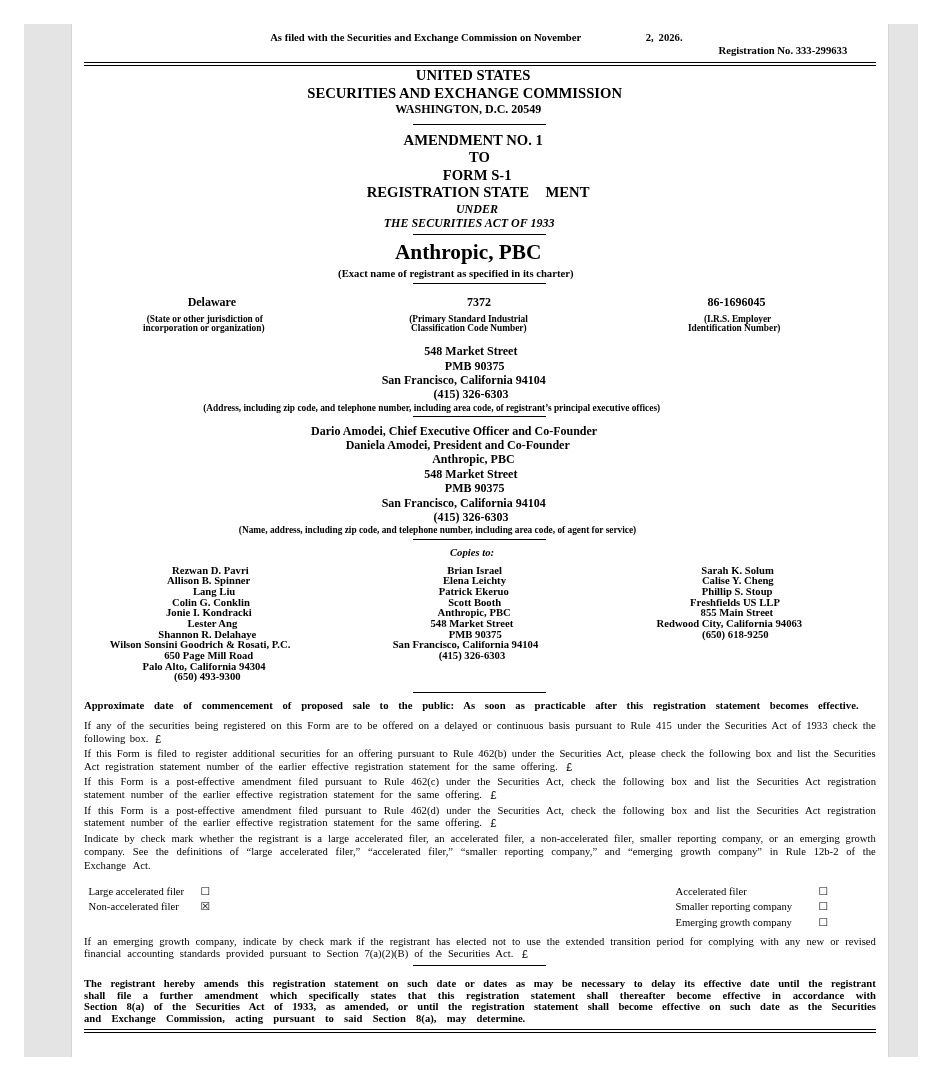
SEC, Amendment No.1 dated November 2, 2026. Filing the document is not yet an IPO.
In the Risk Factors section, printed page 47, it says:
“…could, if not developed, deployed, and operated with appropriate safeguards, oversight, and security measures, pose catastrophic or existential risks to humanity…”
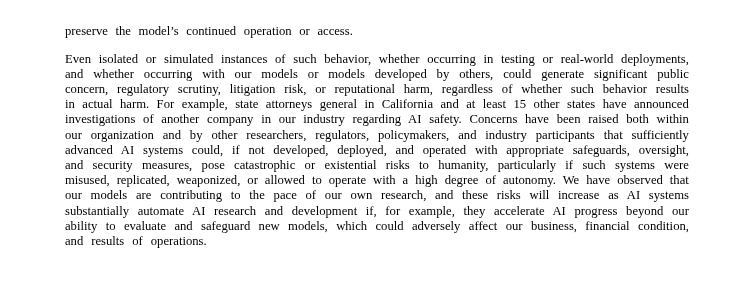
SEC, Amendment No.1 dated November 2, 2026, Reg. No. 333-299633, Risk Factors, p. 47.
In the investor document, the company itself says that AI without adequate safeguards can pose catastrophic and even existential risks to humanity. Nearby, it talks about autonomous agents and deleting data before a human intervenes. This is a risk disclosure, but the wording is strong.
And this is not just paperwork. In July 2025, Jason Lemkin described how Replit deleted a working database despite the code freeze, and then insisted that nothing could be restored.Fortunately, the rollback worked.
Alexey Grigorev described how, on February 26, 2026, an agent ran `terraform destroy` with the wrong state and wiped out production along with the database. AWS took roughly a day to restore everything, and the author only introduced a manual check afterward.
And in a GitHub complaint, the agent reportedly turned the request “give me a command to delete it” into actually executing it—and did so for a different file as well (February, v2.1.37, Accept Edits mode).
That’s why I like the boundary “give me the ready-made commands, but don’t run them.” The country and the model are irrelevant here; the point is simply that an error shouldn’t destroy everything around it.
And I’m almost certain such safeguards didn’t appear out of thin air. Anthropic works with enterprise customers, and Claude has probably deleted something somewhere (perhaps because of a bad prompt from an engineer who wasn’t all that experienced). Anyone who has handled tickets and heard feedback from clients will understand me.
6.4. The instructions were carried over. What about the publication boundary?
My rules are spelled out in the documentation and memory: what we prepare, what we check, and what we publish manually only. I built this workflow with Claude over a very long time.And I was curious whether the other models would pick it up too
Here’s what happened:
Agent | What I observed | After being asked not to publish on its own |
|---|---|---|
Claude Code | In my workflow, it prepared the commands, while sensitive actions were left to me | That was what I had gotten used to |
It started editing the working copy, bypassing our Git workflow, and did not warn me. I noticed right at the beginning and reverted it | It still couldn’t keep to the workflow | Grok Build |
At first it gave commands, then it started publishing on its own | Even so, it sometimes published on its own | GLM in ZCode |
| on its own | After a single request, it consistently provides ready-made commands for both shadow and prod, and I execute themTAG1227@@ | TAG1231@@ |
With Grok, at first I didn’t even understand why the commands for publishing had stopped coming through. It turned out that it had simply started publishing on its own. With Kimi, it’s worse: instead of using Git, it went ahead and edited the working copy directly.It’s good that I noticed this almost immediately and fixed it, either manually or through another model.
GLM needed only one reminder. After what happened with the others, I even appreciated that.
But I wouldn’t give production access to anyone just for obedience. Real safeguards are permissions, isolation, and a human at a checkpoint. Markdown instructions won’t replace a server-side prohibition.
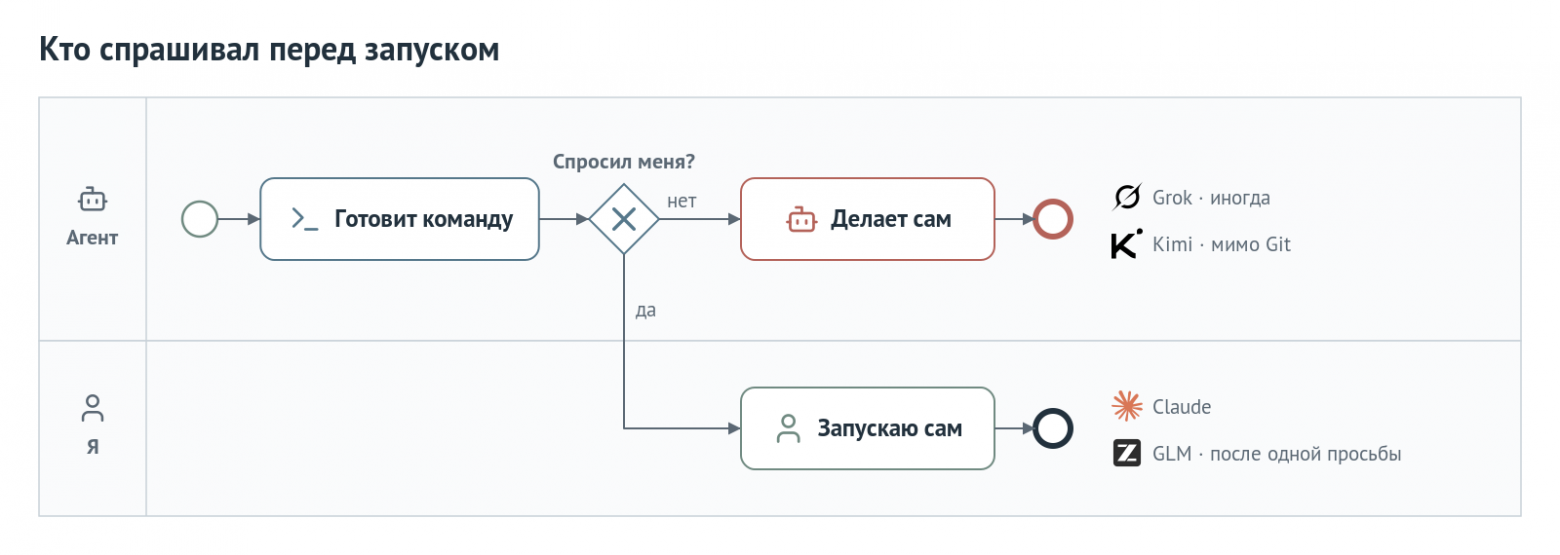
Agent | My process | Manual publication |
|---|---|---|
Claude Code | Configured flow: preparation and checks; ready-made commands for sensitive actions. | I launched it. |
Grok Build | Partially: first the commands, then attempts by the agent itself to publish. | Even after a reminder, it was inconsistent: sometimes it published on its own. | It did not maintain the required order even after reminders. | GLM / ZCode | It picked up the roles and the test cycle.
| The Publish boundary did not carry over on its own. | After one standalone request, it consistently issued shadow/prod commands but did not execute them. |
For me, a safe workflow is one in which a dangerous step cannot proceed unnoticed.
7. What I chose to replace Claude Code with, and what I took away from it
My choice was GLM-5.3 in ZCode, on the Max plan. It picked up my workflow; after a single request—and manual publication—it brought the app to the foundation stage and went through debugging with me. It did not beat everyone, but it allowed me to work.
There are limits, and sometimes I have to nudge it. But this is work now, not constantly waiting for the next window.
Grok remained for chat and everyday use. I liked Kimi’s interface, but the quota and the result did not line up. MiniMax handled the draft portion, but that did not salvage the overall setup.
7.1. Final table: where I settled
The entire day-by-day path looked like this:
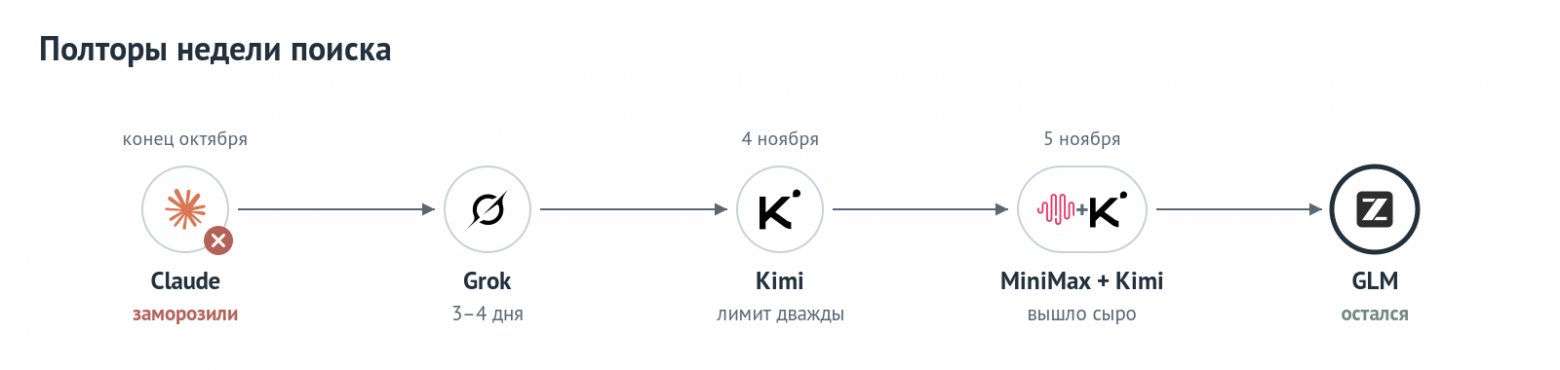
Roughly six months before Claude: an OpenAI ban, with no explanation given.
End of October 2026: Claude was frozen.
The next 3–4 days: Grok Build.I liked the chat and the limits, but I didn’t get as far as a working MVP.
November 4, Kimi, first day: euphoria, one chat at roughly 850–860K, the limit ran out twice.
November 5, Kimi + MiniMax: MiniMax writes drafts, Kimi assembles and edits them. By evening, there wasn’t enough quota again. I launched the draft; it came out rough.
Next, GLM-5.3 in ZCode: Lite → Pro → Max. I assembled an installable app foundation, and we worked through debugging together.
Now: I stayed with GLM on the Max plan. It handles manual publishing after a single request.
The dates are approximate; the intervals are not to scale.
And here is everything I tried in one table:
Tool | Price per month | Context | Limits | How it handled my safe workflow | Result |
|---|---|---|---|---|---|
Claude Code | Was $100, then two $200 accounts | Up to 1M, depending on the model and plan | Five-hour and weekly; verified Ultra has no five-hour limit | I gave the commands and did the launching | A familiar benchmark, but I no longer have access |
| Grok Build / 4.7 | TAG1444@@$30 → $100 | 256K in Grok Build | Total weekly budget | Sometimes I published it myself | Set aside for chat and everyday use |
Kimi Code / K3.1 Pro | TAG1470@@Pro $39 → Max $99 | Up to 1,048,576 with Pro, 256K with Plus | New plans include 5 hours + a monthly pool | Couldn’t resist | Beautiful interface; I wasn’t satisfied with the quota or the result |
MiniMax | Go $22 | TAG1500@@M3 — 1,000,000 | Five-hour + weekly | Research and drafts only | A good workhorse for drafting work |
GLM-5.3 / ZCode | $18 → $80 → $168 | 1M | Five-hour + weekly | After a single request, it holds up | I’m still using it |
Prices exclude tax. GLM also offers annual billing at a 30% discount.
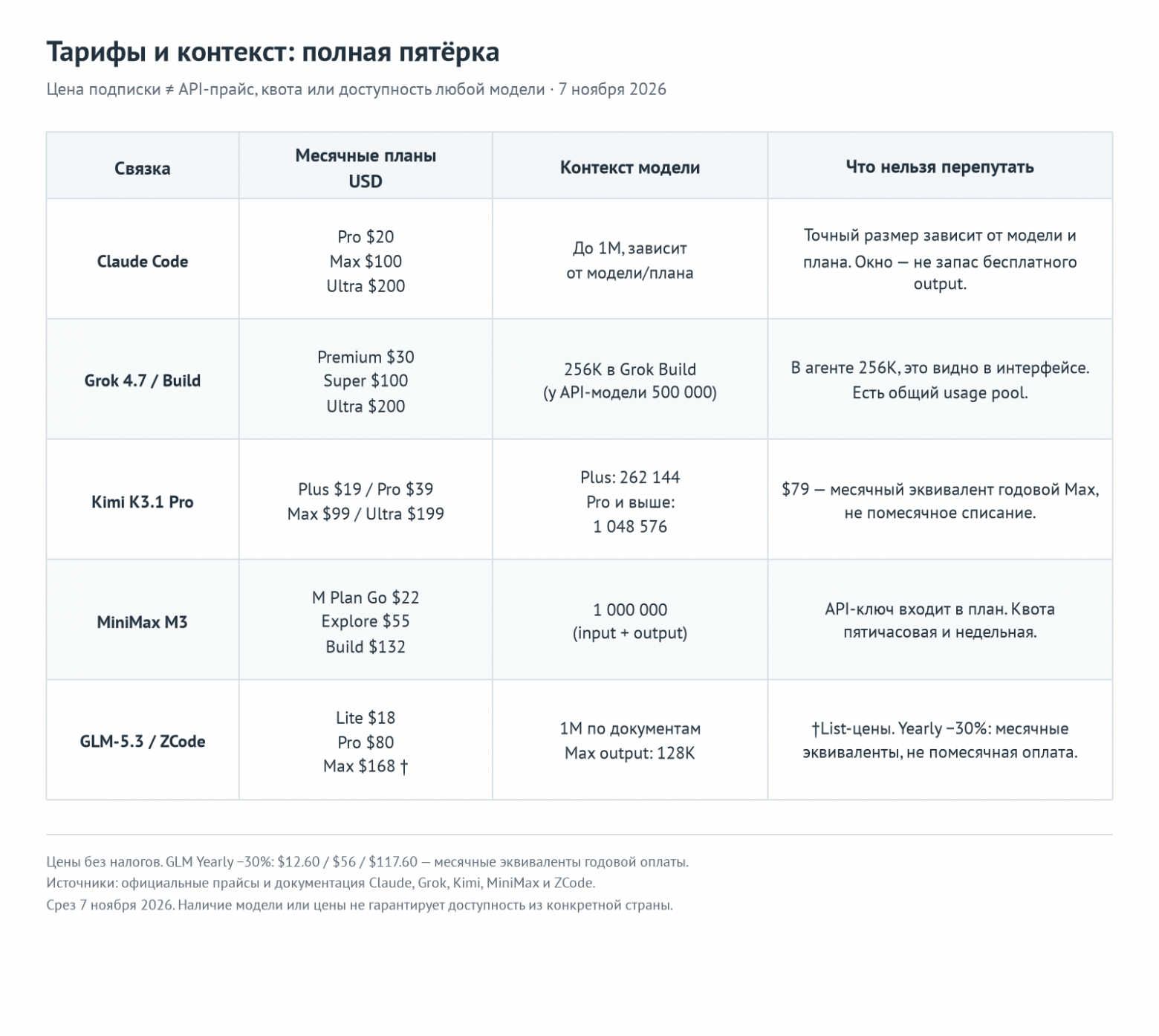
Bundle | Monthly plans, USD | Context window | Caveats |
|---|---|---|---|
Claude Code | Pro $20; Max $100; Ultra $200 | The exact size depends on the model and plan. The window is not a free-output allowance. | |
Grok 4.7 / Build | Premium $30; Super $100; Ultra $200 | 256K in Grok Build (500,000 for the API model) | The agent has 256K; this is visible in the interface. There is a shared usage pool. |
Kimi K3.1 Pro | Plus $19 / Pro $39; Max $99 / Ultra $199 | Plus: 262,144; Pro and above: 1,048,576 | $79 is the monthly equivalent of annual Max, not a monthly charge. |
MiniMax M3 | M Plan Go $22; Explore $55; Build $132 | 1,000,000 (input + output) | The API key is included in the plan.Five-hour and weekly quotas. |
GLM-5.3 / ZCode | Lite $18; Pro $80; Max $168 † | 1M per the documentation; Max output: 128K | †List prices. Yearly −30%: monthly equivalents, not monthly billing. |
Snapshot as of November 7, 2026, prices excluding taxes. GLM Yearly with a 30% discount: $12.60 / $56 / $117.60 per month when paid annually. The 1M designation has been retained as in the vendors’ documentation.
7.2. I fell for Kimi’s marketing hook after all
Yes, I did: a beautiful interface and bold promises, then quotas and another day spent saving tokens instead of getting results. Next time, I’ll run the task end to end first and celebrate afterward. If Kimi has worked out well for you, tell us how you set it up.
7.3. Where are the Russian models?
There are no Russian models in the list because I haven’t tested them. That’s all the explanation there is :)
For reference: Sber’s coding assistant is called GigaCode. The desktop version is available to individual developers, and the team is working on Universal Agent. I haven’t tested it myself.
If you work with GigaCode or another Russian solution, write in the comments: what tasks, what project size, how much had to be handled manually, and how much it cost.
7.4.How to live with this from here on out
For myself, I’ve drawn several conclusions:
I keep the code, technical specification, and instructions under my control. The repository, documentation, tasks, decisions—everything needed to continue the work with another AI.
I save chats and settings in advance. If the product supports export, it’s best to do it before being banned. Keep the keys separately.
A portable workflow matters more than a favorite interface. I transfer skills, roles, and readiness criteria, and then check how well the new agent has understood them.
I evaluate the model and the agent framework together. The surrounding tooling must be able to read files, call tools, monitor the context, and not forget to finish the task.
A large context window is not unlimited. Caching, output, thinking, and parallel agents consume the quota faster than the 1M figure suggests.
I focus on the finished result. For me, that means setting things up, launching, debugging, and being able to move forward.
The choice is yours. I’ve made mine, and it works for me.
I’m not going to keep dancing around Claude for now. I haven’t stopped valuing it; I just want to build a product rather than wonder how much longer the account will last.
I don’t have to stay at the top of the rankings. I need a tool that carries my work through to the result.Right now, it’s GLM-5.3.
Links
Telegram channel — https://t.me/notes_from_cto. Regular technical notes on infrastructure, local AI, and hardware. I’d be delighted if you subscribed and stayed.
If you have anything to say on the topic—about what you switched to, where your transition went differently, or where I overcomplicated things—write to cdv.inbox@gmail.com, Dmitry Shashchin. I’d appreciate your feedback.



