Cats may sometimes appear aloof toward their human owners, but they occasionally meow as if trying to communicate. An experiment targeting 38 cats and their owners suggested that cats might meow to resolve their own dissatisfaction.
The social use of meow in the interaction between cats and humans - ScienceDirect
https://www.sciencedirect.com/science/article/abs/pii/S0003347226002940
Science Has Finally Shown That Your Cat Meows to Demand That You Fix Their World : ScienceAlert
https://www.sciencealert.com/science-has-finally-shown-that-your-cat-meows-to-demand-that-you-fix-their-world
For people who love cats, the sound of a meow is something that feels irresistibly cute. It has been known for decades that cats meow more frequently and loudly in front of humans than in front of other cats. Moreover, stray cats meow less often than domesticated cats, suggesting that the frequency of meowing might be related to the distance between cats and humans.
However, it was not well understood why cats meow. To address this, a research team led by Naira Fukumoto, who studies cats at the University of São Paulo, conducted an experiment involving 38 cats and their owners.
The cats participating in the study had all been reported to meow frequently when food was involved. Therefore, the research team prepared a small plastic box with many holes and filled it with treats that cats like, then observed the cats' meowing frequency and behavior under different conditions.
Since the plastic box had holes, cats could recognize that there were treats inside before opening it. However, because opening the box required human assistance, the cats were unable to open it on their own.
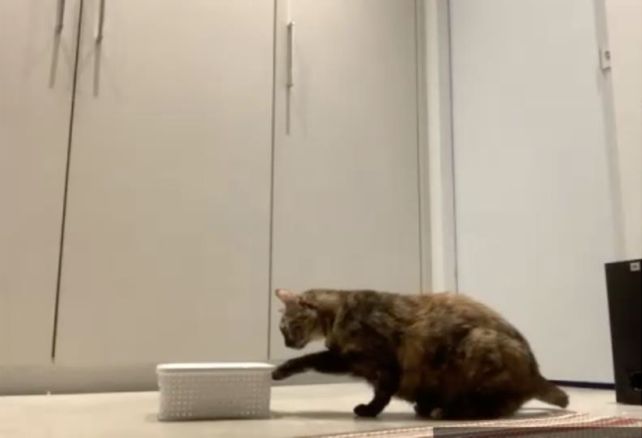
The research team observed the cats for one minute in two scenarios: when a human was present in the same room and when the human was absent. If cats meow to communicate with humans, they would meow more when a human is present.
Here's how the experiment went.
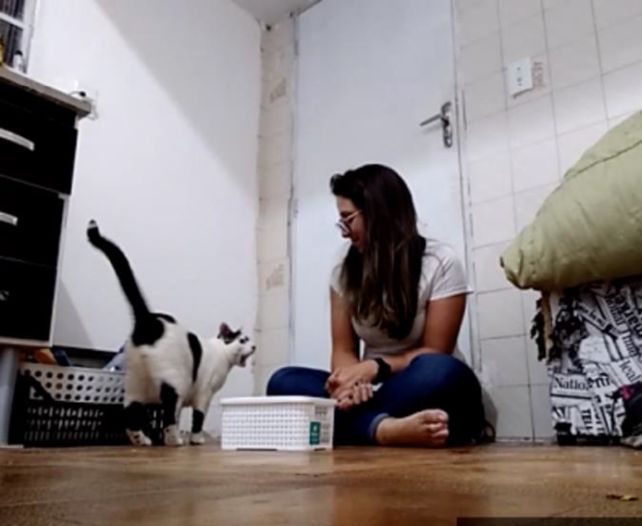
The results of the experiment showed that cats meow significantly more often when a human is present in the room. When humans were absent, cats meowed a total of 20 times, but when humans were present, they meowed 86 times in total.
Additionally, when cats meowed, they often looked directly at humans or alternated their gaze between humans and the plastic box. Furthermore, when humans were absent, it was reported that cats spent more time staring at the door of the room.
These results do not necessarily assert that the cats understood "humans can solve this problem" or that they meowed with the intention of seeking a solution. Nevertheless, they suggest the possibility that the cats were not simply meowing out of frustration about not being able to eat, but were calling out to humans who might be able to resolve the situation.
The research team stated, "Since most of the meows recorded in this study were directed at someone, it suggests that cats are not merely meowing at their surroundings, but are targeting specific audiences."
Note that this study was small-scale, and the selected cats were originally reported to meow frequently when food-related issues arose. Therefore, different results may occur with cats of different natures. Future research is expected to clarify whether cats use meows differently according to their intentions by comparing meows in various situations.

