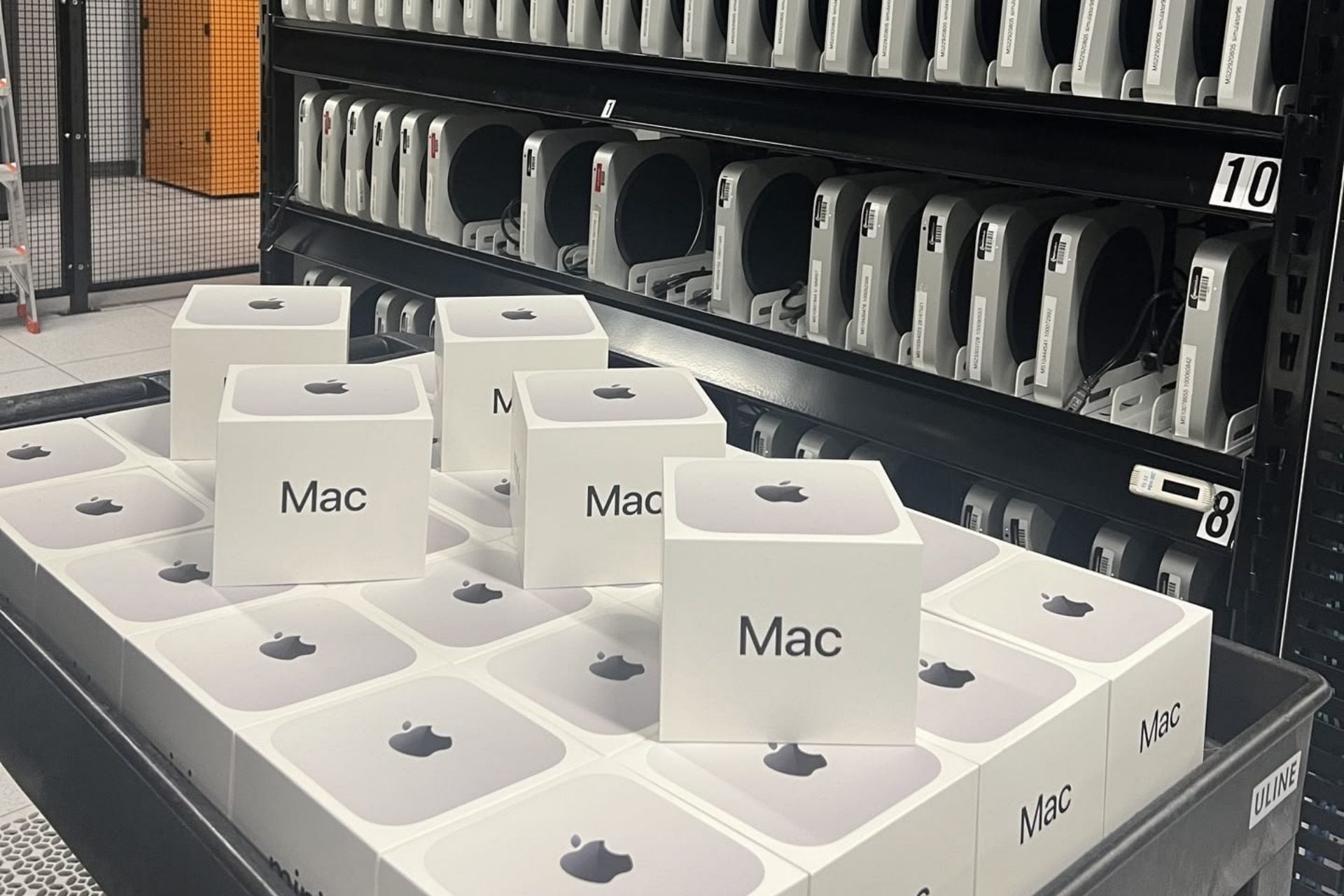
 © MacStadium
Tens of thousands of Mac minis would have ended up in OpenAI’s labs. At Nvidia, the first RTX Spark PCs are reserved before they even exist. Meanwhile, consumers are seeing lead times stretch and prices rise.

Apple Mac Studio
You’ve already felt the shortage of RAM in PC prices this year. Now computers themselves are becoming scarce, at least those capable of running AI without struggling. OpenAI reportedly bought tens of thousands of Mac mini and Mac Studio computers over the past few months. At Nvidia, distributors have already divided up the first batch of RTX Spark PCs, before a single machine has even been delivered.
Why is OpenAI buying Macs by the pallet?
To understand what an AI lab can possibly do with a Mac mini when its attention should be focused on datacenters, you have to look at what it is currently training: agents that use a computer in your stead, mouse and keyboard included. These agents are trained through reinforcement learning, a method in which the model tries, makes mistakes, starts over and receives a score with each attempt (much like an intern you would let click everywhere for weeks, except this one never takes offense).Every digital intern needs its own desk, with a proper system and real applications, hence the value of owning complete machines by the thousand, in addition to graphics cards rented by the hour.
Read also: Mac mini M6 vs. Mac mini M4 – everything that changes between the two generations of Apple computers
It remains to be explained what a Mac offers over an ordinary PC. Apple’s chips share a single memory pool (the famous unified memory) between the processor, graphics chip, and Neural Engine: one large shared desk instead of three separate cabinets. For an agent moving from screenshots to clicks to reasoning, this shared desk matters more than raw computing power. Apple has also added to macOS 26.2 a direct connection between machines via Thunderbolt 5 (RDMA, for those in the know). It bypasses the network stack and reduces latency between Macs from 300 to under 50 microseconds. As for the purchases themselves, neither Apple nor OpenAI has confirmed anything, to put it plainly.
This demand is reflected in delivery times: for configurations with increased memory, the wait for a Mac Studio reportedly went from around fifteen days to nearly two months. Apple ultimately released its new models on August 25, with nothing more than a press release and two weeks before its iPhone conference—an unusual schedule that the labs’ appetite would have hastened. The Mac mini is moving to M6 and M5 Pro chips, while the Mac Studio is moving to M5 Max and M5 Ultra chips, with preorders open and deliveries scheduled for September 22.In France, the Mac mini M6 starts at €1,049, the M5 Pro at €1,999, the Mac Studio M5 Max at €2,999, and the M5 Ultra at €6,599. Both Mac minis come down by €100.
Apple supplies the shovels of the gold rush, without having planned to
In a gold rush, the safest fortunes are made by selling shovels, and Nvidia has occupied that role for three years with a consistency that borders on the brazen. Apple, which was not really expected to play this role, finds itself selling shovels without having sought to. The Mac mini was designed as the least expensive entry point to its chips, a small box for office work and weekend video editing. It has now been promoted to a data-center building block.
The phenomenon has a very recent precedent in RAM. AI data centers have absorbed such a large share of it that prices for RAM, and then PCs, have soared since last year. With Macs, the logic changes scale: labs now buy whole computers, chassis included. Nvidia is living the same scenario with its RTX Spark chip, designed with MediaTek for laptops and compact desktop PCs running Windows on Arm. On paper, it offers a 20-core Grace processor, a Blackwell graphics chip, and up to 128 GB of unified memory. In short, a Mac mini as Nvidia sees it, with CUDA as a bonus.
The first machines are expected to arrive this autumn from Asus, Dell, HP, Lenovo, Microsoft Surface, and MSI.Asus has already told its shareholders that “the market responded well beyond our expectations”: the initial quantities were fully preordered by its distributors. Wholesale orders, in other words—not customers yet. MSI would be in the same situation, and both brands would already be asking Nvidia for more units. All of this without an official price, with estimates ranging from $2,899 to $3,400, depending on the source.
In the middle of this scrum, the ordinary buyer finds themselves behind far better-resourced customers. A Mac Studio M5 Ultra at €6,599 or an RTX Spark laptop costing around $3,000 target the same clientele as Nvidia’s DGX Spark. This small golden box, launched at $3,999, has been selling for $4,699 since February, with the memory shortage forcing the price up. AI machines now sell like concert tickets: the first batch sells out before the doors open, and the rest is negotiated at a premium.
If a Mac mini M6 was on your back-to-school shopping list, delivery is promised for September 22. Click before the labs place their next order: no one at Apple seems in a hurry to say no.
👉🏻 Follow the latest tech news in real time: add 01net to your feeds on Google, and subscribe to our WhatsApp channel.
Source: The Information







- Google Play Store
- 4K Video Downloader Plus
- VLC Media Player
- Adobe Reader
- uTorrent
- WinRAR
- Xender
- Google Chrome
- CCleaner
- Mozilla Firefox
- Avast Free
- ChatGPT
- Microsoft 365
- Opera One
- Avast One









Download
- Google Play Store
- 4K Video Downloader Plus
- VLC Media Player
- Adobe Reader
- uTorrent
- WinRAR
- Xender
- Google Chrome
- CCleaner
- Mozilla Firefox
- Avast Free
- ChatGPT
- Microsoft 365
- Opera One
- Avast One




