
By Paulo Silveira, co-founder and Chief Vision Officer (CVO) at Alura
Over the past few years, following the evolution of artificial intelligence has meant following a technological race. With every launch, new comparisons, new benchmark charts, and new predictions emerged about which company would be closest to leading the next major digital transformation. At times, the entire debate seemed to boil down to a single question: what is the best model available today?
After a recent immersion in Silicon Valley, I came back with the sense that this is still a relevant question. However, looking at what I heard and saw throughout the trip, it no longer seems to be the central question.
Part of this perception has to do with the experience itself of revisiting Silicon Valley nearly ten years after my first time passing through the region. There is something intriguing about placing ourselves within an ecosystem that brings together some of the world’s most influential companies, investors, and universities. Just as when we travel anywhere with a very strong culture, we end up absorbing some of the references and behaviors of that environment.
When someone goes to Japan, they begin paying closer attention to the habits that are part of the local routine. In France, they observe how people relate to the city, the culture, and the gastronomy. In the United States, especially in California, it is inevitable to be affected by the pace of product launches, by technology consumption, and by the constant feeling that the future is being built there.
Something similar happens with Silicon Valley. There is a natural tendency to look at the topics that dominate conversations in the region and see them as a faithful representation of what will happen in the coming years. Often this makes sense. After all, various relevant technological transformations of recent decades passed through there before reaching the rest of the world.
But there is also a risk that accompanies any highly connected environment: the risk of mistaking consensus for certainty.
It was precisely this that caught my attention most during the trip.
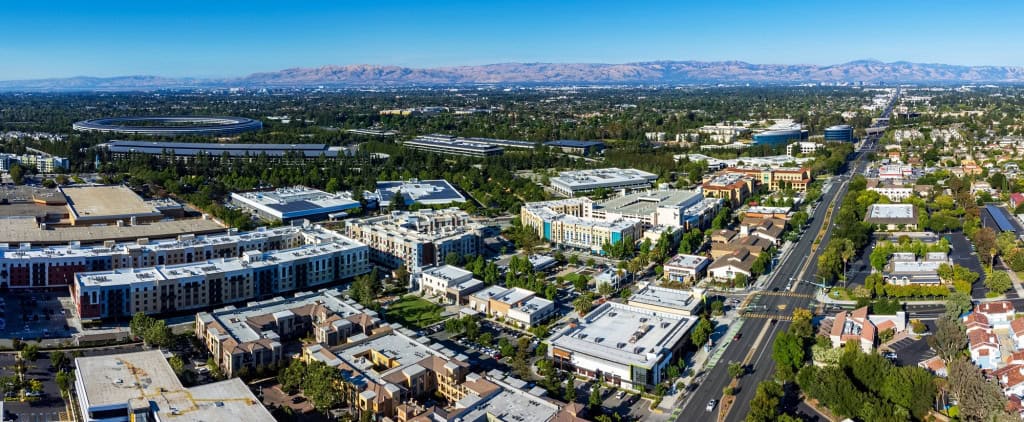 Aerial view of an area of Silicon Valley, in the United States, an important hub for technology companies – Image: Michael Vi / Shutterstock
Contrary to what is seen in much of the public debate on artificial intelligence, few conversations centered on the rivalry between models or the pursuit of the next technological leap capable of redefining the market. The recurring theme was something else.Companies, investors, and specialists seemed much more interested in understanding how artificial intelligence is being incorporated into organizations’ products, processes, and operations than in discussing which laboratory has the most advanced system at the moment.
This shift in focus emerged in different ways throughout the week.
In conversations with executives from Snowflake and Elementum, for example, the topic was not which model leads the rankings or which company will release the next big thing. The discussion focused on the transformation of enterprise software. The shared perception was that we are entering a phase in which intelligent agents begin interacting directly with large volumes of data, carrying out tasks that today require navigating systems, analyzing reports, and making a series of operational decisions manually.
For decades, much of corporate software was designed to organize information and facilitate human work. Now, an expectation is beginning to emerge that these systems will not only present information but also act on it.
This may be one of the most significant changes brought about by artificial intelligence. The impact is not only on the technology itself, but also on the way companies operate.For the first time in many years, the discussion seems less related to the tool being used and more to the ability to turn data into action quickly, seamlessly, and efficiently.
At the same time, some visits showed that not everyone is moving in exactly the same direction.
At Liquid AI, for example, a perspective has emerged that contrasts with many of the sector’s most popular narratives. While a significant portion of the industry continues to bet on ever-larger models and increasingly robust infrastructure, the company is developing more compact systems designed to run locally on devices such as mobile phones, vehicles, and embedded equipment.
The interesting aspect of this approach is not just the technology. It reminds us that innovation does not happen in only one direction. There is a natural tendency to associate technological progress with more computing power, more investment, and ever-larger models. Yet in many cases, the challenge lies precisely in the opposite direction: creating more efficient, more accessible solutions that are easier to integrate into the daily lives of people and businesses.
Perhaps this was one of the main lessons from the journey. When we observe the artificial intelligence market from a distance, it seems as though only one race is underway. When we look closer, we realize that several different races are taking place at the same time.
There are the large general-purpose models. There are specialized systems. There are multimodal applications that combine text, images, audio, and video. There are enterprise solutions designed to address highly specific problems.And there are companies betting precisely on making all of this lighter and more distributed.
Therefore, the idea that the market will move toward a single dominant technology increasingly seems unlikely. The emerging scenario is one of the coexistence of different approaches, each suited to specific contexts, constraints, and needs.
This change also alters how organizations need to think about their technology adoption strategies.
For a long time, the logic was relatively simple: identify the best available tool and implement it. With artificial intelligence, the equation now involves a range of other variables. Issues such as integration, governance, privacy, implementation speed, operating cost, and business fit become just as important as the sophistication of the technology chosen.
In practice, a company may generate far more value from a simple solution that is well integrated into its processes than by using an extremely advanced technology in isolation.
Perhaps that is precisely why the discussion of implementation is beginning to take up more space than the discussion of capabilities.
Another aspect that drew attention was the frequency with which conversations about technology ended up becoming conversations about people.
This perception became particularly evident during the visit to Stanford.Although it is embedded in one of the world’s most advanced artificial intelligence ecosystems, a significant portion of the discussions continues to focus on topics such as education, talent development, building an organizational culture, and developing leaders.
It does not seem to be a coincidence. The history of Silicon Valley has never been merely a story about technology. It has always been deeply connected to the ability to transform knowledge into innovation. Tools change. Platforms change. Companies emerge and disappear. But developing people capable of learning, adapting, and building continues to be a constant element.
This point becomes even more relevant as artificial intelligence becomes accessible to an increasing number of organizations. Access to technology naturally tends to become democratized. Knowledge about how to use it strategically, on the other hand, continues to be a differentiator that is difficult to replicate.
Implementing artificial intelligence consistently requires far more than purchasing a platform or making new features available to teams.It requires rethinking processes, developing competencies, reviewing workflows, creating oversight mechanisms, and preparing people to operate in an environment in which some analyses, decisions, and execution activities are now supported by intelligent systems.
Therefore, the main conclusion I have drawn from this experience is not about which company will lead the artificial intelligence race or which model will become the benchmark in the coming years.
The feeling is that we are moving beyond the phase in which technology itself was the focus of discussion and entering a stage much more focused on practical application. The next phase of artificial intelligence will not be defined by a single revolutionary model replacing all the others. It will be built through the combination of different technologies, the ability to integrate them into existing processes, and, above all, organizations’ ability to turn these capabilities into concrete results.
Ultimately, artificial intelligence remains a technological topic. But after hearing so many conversations throughout the journey, it is difficult not to conclude that it is increasingly becoming a discussion about strategy, execution, and organizational adaptation.
Perhaps this is precisely why the most important question is no longer who has the most advanced AI. Another question seems to be gaining relevance: who will be able to use it better.

Ana Figueiredo is Olhar Digital’s technology editor.She graduated with a degree in Journalism from the Federal University of Uberlândia (UFU).


