Robot Outlook (public account: robot_pro)
Author | Zhong Chen and Zhou Jiaqi
Editor | Moying
Robot Outlook reported on November 12 that today, the top conference in the field of robot learning, CoRL 2026 officially announced its list of award winners.
This year's CoRL submissions reached a record high. According to official figures, CoRL 2026 received 2,094 valid submissions, an increase of approximately 184.1% over the 737 received last year. Of these, 687 papers were accepted, for an acceptance rate of 32.8%. Ultimately, six papers from this year's conference made it onto the final shortlist.
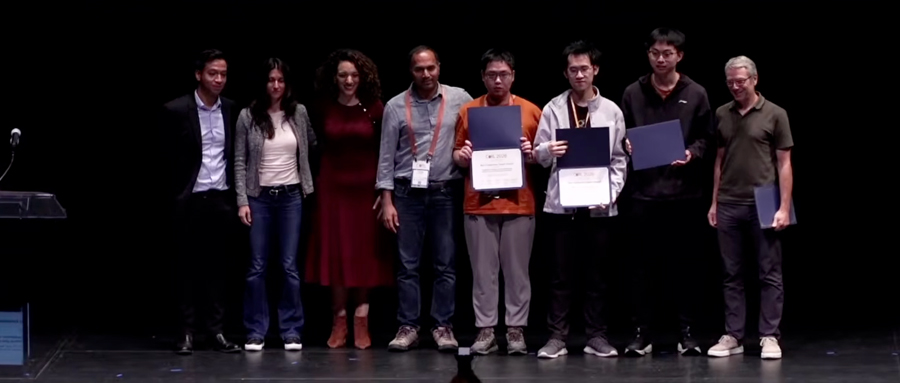
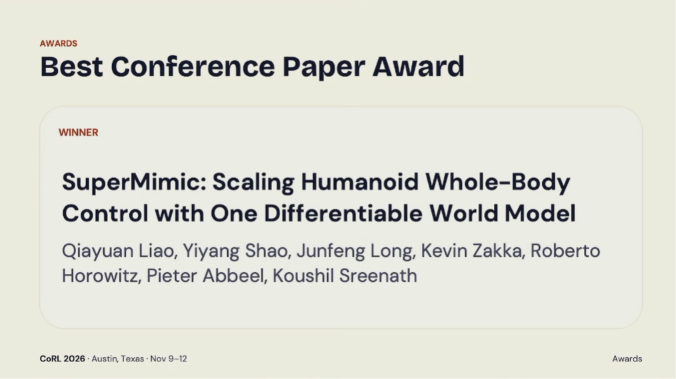
Research fromUC Berkeley on humanoid robot locomotion learning won the Best Conference Paper Award.
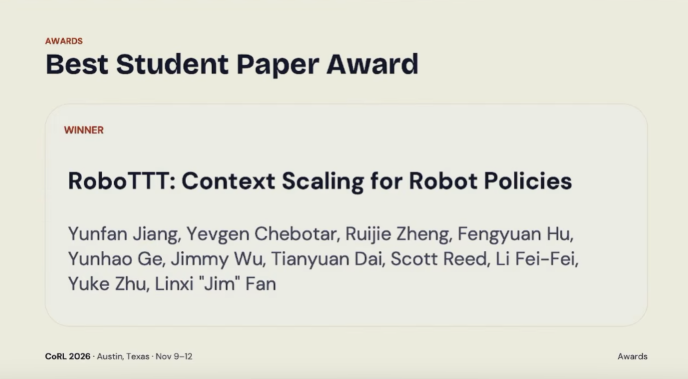
Research fromNVIDIA, Stanford, and other institutions on long-context policy learning for robots won the Best Student Paper Award.
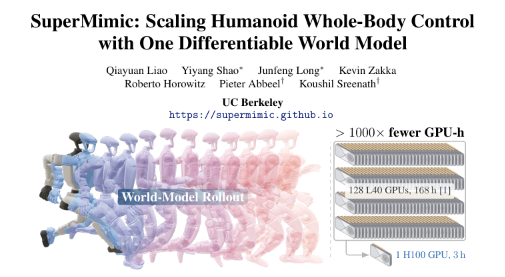
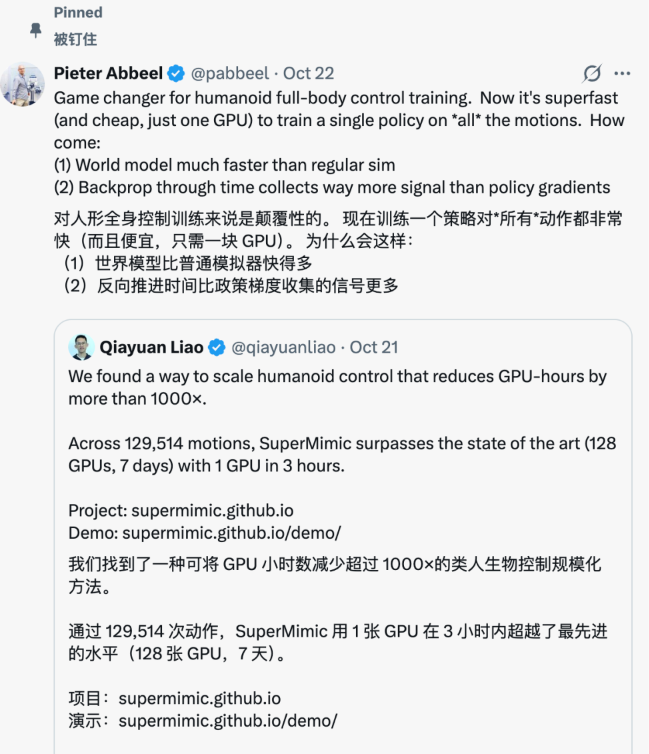
The SuperMimic research from UC Berkeley is a humanoid robot whole-body control policy trained using a differentiable world model and can reduce GPU computation time by over 1,000-fold. With just one GPU and three hours of training, the method surpassed a baseline model trained for seven days using 128 GPUs, and has been validated on an actual Unitree G1 robot.
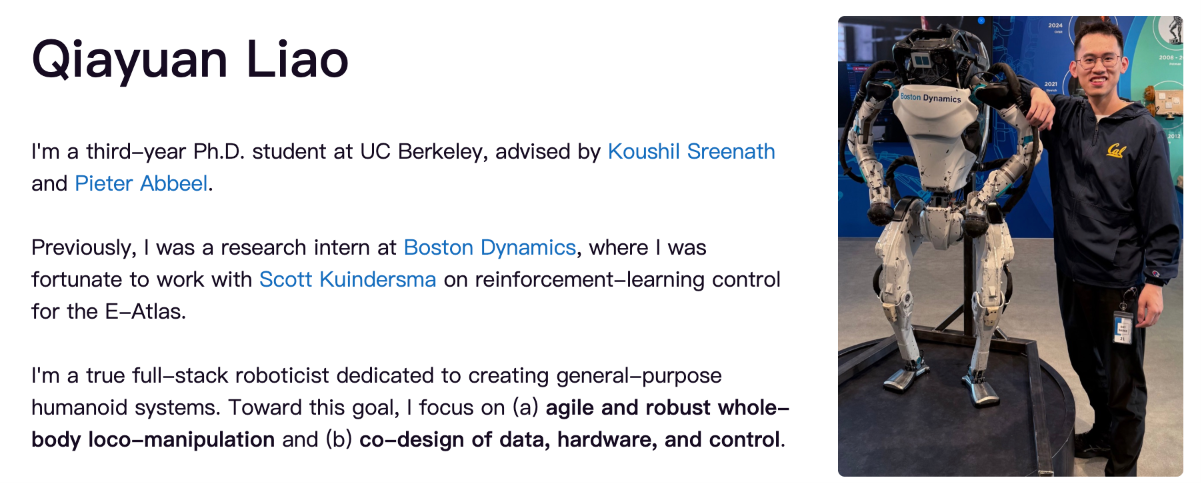
The paper's first author is Qiayuan Liao, a doctoral student at UC Berkeley. According to the School of Mechanical and Electrical Engineering at Guangdong University of Technology, he attended that university as an undergraduate, majoring in mechanical and electronic engineering, before receiving a full scholarship to pursue a PhD at UC Berkeley.
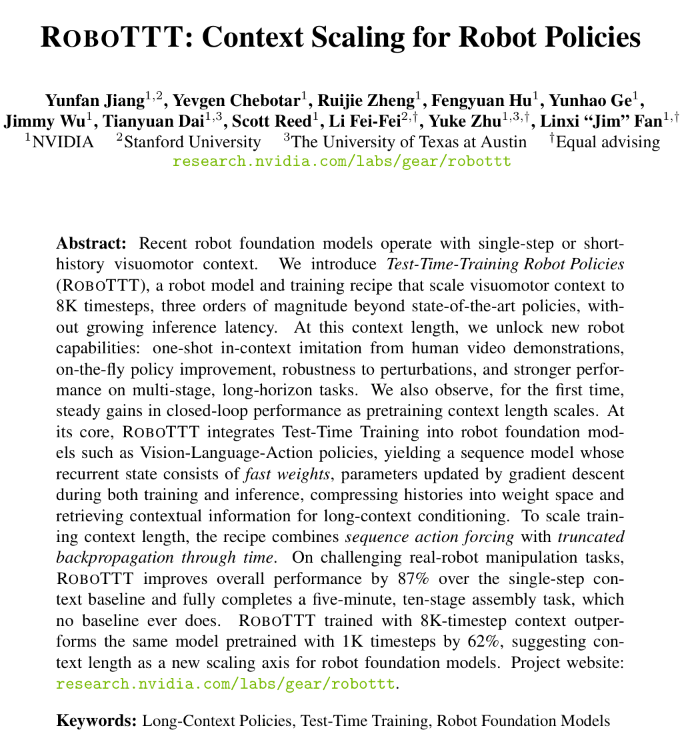
Another study to receive the Best Student Paper Award was RoboTTT. The paper proposed a robot policy learning method based on test-time training that expanded the context window to 8,000 time steps, enabling robots to use longer historical information to complete complex manipulation tasks.
Yunfan Jiang, the paper's first author, is a doctoral student in computer science at Stanford University. Other authors also includeStanford professor Fei-Fei Li, Jim Fan, head of NVIDIA's GEAR team, and Yuke Zhu, among others.
I. Robot training compute reduced by over 1,000-fold; Berkeley team wins Best Paper Award
The paper from UC Berkeley,“SuperMimic: Scaling Humanoid Whole-Body Control with One Differentiable World Model,”won the Best Conference Paper Award.
The method proposed in the paper can reduce the computational resources required to train humanoid robot whole-body control by over 1,000-fold.
On a benchmark of 129,514 human motion segments, SuperMimic surpassed the previously strongest method, SONIC, which had been trained on 128 GPUs for seven days, using just one GPU for three hours of training.
More importantly, the trained policy can be deployed directly on the Unitree G1 robot. SuperMimic has also released relevant demonstration videos showing the Unitree G1 performing difficult maneuvers such as backflips, crawling, and dancing, all with smooth execution. It can also imitate human motions through a tracker, with relatively low response latency. Although it occasionally stumbles, the differences between the imitated motions and the human motions are not pronounced.
The paper’s authors said that this work“removed the compute bottleneck for scaling whole-body control in humanoid robots”.
Currently, the mainstream approach to enabling humanoid robots to master a large variety of human motions is to use reinforcement learning in a physics simulator, repeatedly learning through trial and error while tracking massive amounts of motion-capture data. However, this approach is extremely costly: every increase in the size of the motion library brings a corresponding linear increase in computational cost.
SuperMimic was motivated by a simple observation: although the human reference motions for a humanoid robot differ from one another, they all share the same hybrid rigid-body dynamics.
The research team therefore used the state-transition data recorded by a rigid-body simulation environment (standard rigid-body simulator) to fit a differentiable model of the world (differentiable world model) shared by all motions, allowing the world model and the tracking policy to be trained jointly in the same loop.
The policy performs 32-step imagination rollouts
(imagined rollouts) within the world model, and then directly obtains policy gradients analytically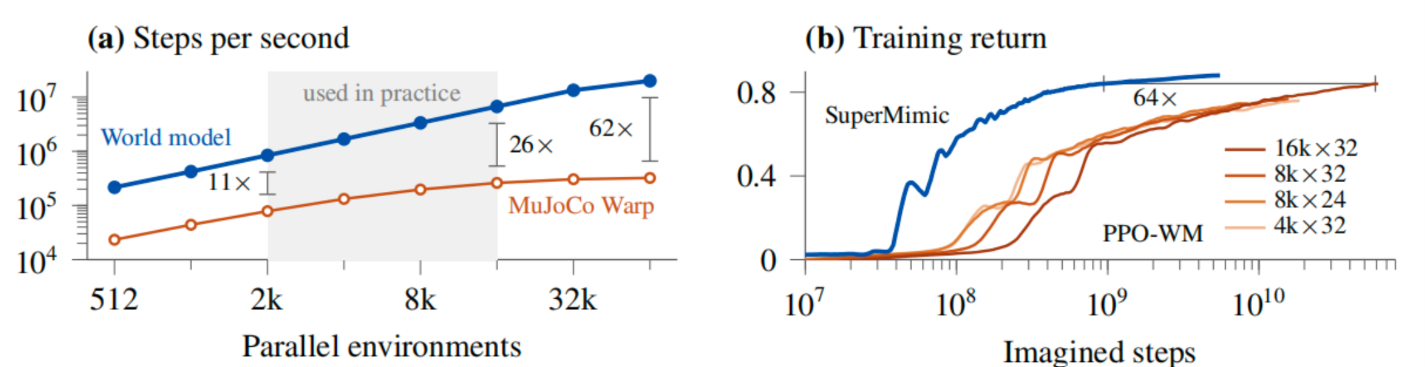 (analytic policy gradients)
This design yields two efficiency gains: at the batch scales used in practical applications
(over the batch sizes used in practice), the world model’s imagined rollouts are more than 10 times faster than running the simulation directly, with the gap widening to 62 times when the number of parallel environments is maxed out at 64k; analytic gradients, meanwhile, allow the policy to require approximately 64 times fewer imagined steps than PPO to achieve the same training return.
In terms of results, after running for three hours on a single GPU, SuperMimic failed on only 25 of the 129,514 motions in the benchmark, compared with 179 failures for SONIC. After 9.8 hours of training on two GPUs, the number of failures dropped to zero.
Worth mentioning is that SuperMimic’s success did not come from simply piling on data. It used only 264.56 hours of motion data for training—about 56.7% less than SONIC’s 611 hours.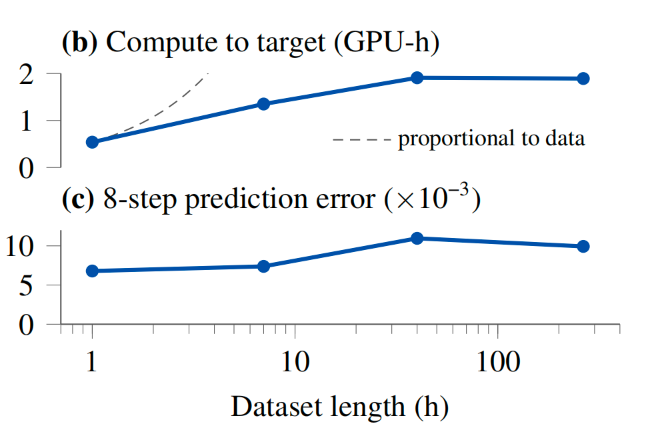
(target return)
did not grow substantially, and the world model’s eight-step prediction error consistently remained between 0.007 and 0.011.The team even stated that measuring “scaling laws for motion tracking” is now inexpensive enough to be handled by a single GPU.
SuperMimic has seven authors, all from UC Berkeley.The first author is Liao Qiaoyuan (Qiayuan Liao), a doctoral student at the university. He previously worked as a research intern at Boston Dynamics, collaborating with Scott Kuindersma on reinforcement-learning control research for the E-Atlas robot. He has also led or participated in projects such as Workhorse and BeyondMimic. MuJoCo Playground, the open-source robot learning framework he helped develop, received the RSS 2025 Best Demonstration Paper Award.
In addition, one of the supervising authors, Pieter Abbeel, is a leading authority in deep reinforcement learning. He serves as director of the Berkeley Robot Learning Lab, co-director of the Berkeley Artificial Intelligence Research (BAIR) Lab, and co-founder of Covariant.
When reposting the paper, he stated bluntly:“The rules of the game for humanoid whole-body locomotion control training have changed.”
2. Robots Learn to Use Long-Term Memory, as the NVIDIA and Stanford Research Team Wins the Best Student Paper Award
The paper that won this year’s CoRL Best Student Paper Award came from a joint research team from NVIDIA, Stanford University, and the University of Texas at Austin. The paper is titled“RoboTTT: Context Scaling for Robot Policies (RoboTTT: Context Scaling for Robot Policies)” and was first made public on July 16 of this year.
At present, most robot policy models can only use a single time step or a short history of information to make decisions, making it difficult to fully leverage prior operational experience. This limitation is particularly evident when performing long-duration, multi-stage tasks.
To address this issue, RoboTTT continuously compresses historical interaction information into model parameters by updating internal fast weights during model inference, without requiring additional cached historical data.
RoboTTT can handle visuomotor contexts of up to 8,000 time steps, equivalent to 4.5 minutes of interaction history at a control frequency of 30 Hz. Its context length is roughly three orders of magnitude greater than that of existing robot policy models.
Meanwhile, the research team usedsequence action forcing (Sequence Action Forcing)to stabilize the training process andtruncatedbackpropagation through time (TBPTT)to control memory usage.
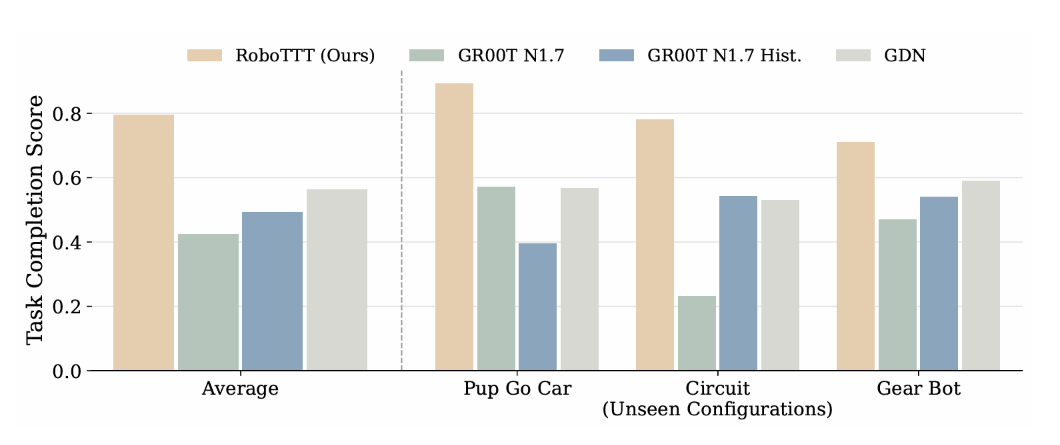
In real-robot tests, the team set up three long-duration, dexterous assembly tasks, including model vehicle assembly, remote-controlled robot assembly, and circuit assembly. They compared RoboTTT with three baseline models: GR00T N1.7, GR00T N1.7 Hist., and GDN.
The results showed that RoboTTT achievedan average completion rate of 79% across the three tasks, higher than the 42%, 49%, and 56% of the other models, and posted the highest task completion rate on every task.
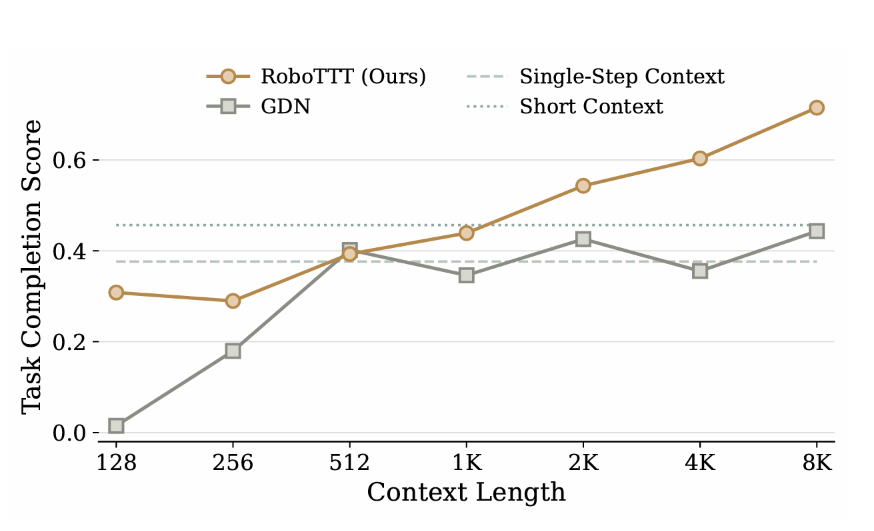
In addition, the research team tested the impact of different context lengths on model performance. As the pretraining context length was expanded from 128 time steps to 8,000 time steps, RoboTTT’s task completion raterose from 30.8% to 71.5%, with no clear signs of performance saturation.
The paper’s first author,Yunfan Jiang, is a doctoral student in computer science at Stanford University, advised by Fei-Fei Li. He also conducts robotics research on NVIDIA’s GEAR team. He earned his bachelor’s degree from the University of Edinburgh and later obtained his master’s degree from Stanford University. His main research areas include robot learning, reinforcement learning, and related fields.

▲ Yunfan Jiang (Image source: NVIDIA)
Previously, research in which Yunfan Jiang participated received the NeurIPS 2022 Outstanding Datasets and Benchmarks Papers Award (Outstanding Datasets and Benchmarks Papers) and the ICRA 2024 Best Paper Award.
Conclusion: One Saves Compute, One Expands Memory—CoRL Recognizes “Efficiency”
Submission volume for this year’s CoRL surged by 184%, as robot learning becomes another “hot commodity” in the AI industry. Over the past few years, the niche field of embodied intelligence has also largely followed the AI industry’s basic consensus: the more data, the greater the computing power, and the stronger the model.
But this year’s award-winning papers offer a somewhat different answer.
SuperMimic compresses training from 128 GPUs over seven days into three hours on a single GPU by leveraging the prior that all motions share the same dynamics and using a differentiable world model to amortize learning costs across the entire motion library. RoboTTT expands the context window to 8,000 timesteps not by enlarging the cache, but by compressing historical information into the model parameters through test-time training.
Amid widespread anxiety over computing power and data, the wins of these two papers demonstrate at least that, beyond scaling up training, there is another path worth pursuing:squeezing out efficiency through algorithm design and the laws of physics.


