Which search engine powers ChatGPT, Claude, Alice AI, GigaChat, and Perplexity
Claude uses Brave’s results, ChatGPT relies on Bing, though not exclusively, and Alice AI uses Yandex Search. Perplexity has its own index—that is, its own database of pages that the service builds itself. The source of GigaChat’s results has not been confirmed.
Service | Whose search results it uses | How it is confirmed | Where to check the site’s rankings |
|---|---|---|---|
ChatGPT | Bing and other undisclosed sources; in HIPAA-covered workspaces, OpenAI’s own index | the Bing Webmaster Blog names ChatGPT among the AI tools on Bing; TechCrunch reports on OpenAI’s partnership with Bing; OpenAI’s HIPAA documentation | Bing Webmaster Tools |
| Claude | Brave | Anthropic Trust Center (according to Peec), Anthropic’s list of subprocessors (TechCrunch), measurements by Peec and Profound | Brave Search API |
Alice AI | Yandex Search | Yandex Webmaster documentation | Yandex Webmaster |
GigaChat | not confirmed | not confirmed | not confirmed |
Perplexity | its own index and its own crawler, PerplexityBot | Perplexity blog | not confirmed |
Alice AI is the clearest in this lineup. According to Yandex Webmaster’s documentation, it breaks the question into subquestions, sends them to Search, and relies on highly ranked sources. For it, rankings in Yandex remain the foundation. According to the company’s blog, Perplexity has its own index of more than 200 billion page URLs and its own crawler, PerplexityBot, a bot that crawls websites.
How do we know that Claude searches via Brave Search
What Claude searches for through Brave is known from Anthropic’s documents and two independent measurements. Peec writes that Anthropic’s Trust Center names Brave as a search provider. In March 2025, TechCrunch noted that Anthropic had added Brave Search to its list of subprocessors, meaning vendors that process data.
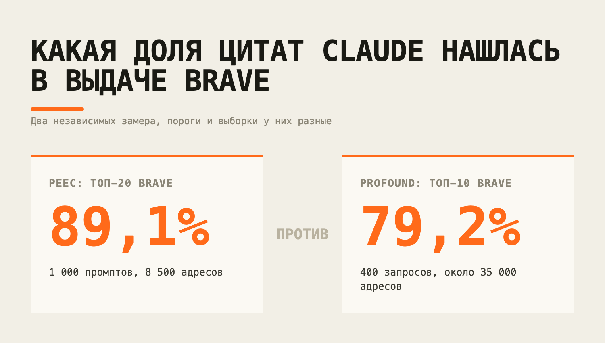
Peec took 1,000 prompts and compared the 8,500 URLs Claude returned for its subqueries with Brave’s results for the same subqueries. The measurement was conducted through the Claude API, providing programmatic access to the model and bypassing the chat interface. Of the 100 pages cited by Claude, 89 were in Brave’s top 20. Profound calculated separately: across 400 queries and approximately 35,000 URLs, 79.2% of the pages cited by Claude were in Brave’s top 10. The measurements have different thresholds and samples, so the figures cannot be combined.Profound cautions that such an overlap does not yet prove that Claude selects sources because of their positions on Brave.
Where ChatGPT searches: Bing and sources OpenAI does not disclose
ChatGPT Search is powered by Bing, though not exclusively. Bing itself lists ChatGPT among the AI tools that run on it in its blog for webmasters. TechCrunch reports that OpenAI has a partnership with Bing, but ChatGPT’s search also uses other undisclosed sources. In HIPAA-compliant workspaces, governed by the U.S. medical data law, queries do not go to Bing, according to OpenAI: search uses OpenAI’s own index. ChatGPT and Bing can be equated only with caveats.
Yandex’s top results offer no guarantees for ChatGPT: Bing is a different search engine with its own rankings. There is no definitive answer to how far down Bing’s results ChatGPT looks. For Claude, there is a benchmark: nearly nine out of ten cited pages are among Brave’s top 20 results. The sources cited by the two neural networks have little overlap: according to Profound’s measurement across more than 600 queries, Claude and ChatGPT share an average of just 8% of source domains.
Where to start checking a site’s visibility in neural network responses: compare rankings in Bing, Brave, and Yandex
You should start checking visibility in AI model responses with a site’s rankings in Bing and Brave, not by editing texts.There is no unified visibility across AI services: each service has its own search provider, and a website absent from Bing or Brave’s results barely exists for ChatGPT or Claude, regardless of its rankings in Yandex.
Bing Webmaster Tools. You can sign in with a Microsoft or Google account; verified sites are imported from Google Search Console. Average position is shown there only for standard Bing Search; there is no position data for Chat. The AI Performance report shows grounding queries, meaning the queries the AI sends to search to substantiate its answers: which of them result in the site appearing in responses and which pages are cited. As of October 13, 2026, the report includes the beta Topics Portfolio, which groups these queries by topic, although smaller websites may not have this section.
Brave Search API. This provides programmatic access to Brave’s search results: a query is sent from a script, and a list of links is returned. According to Brave’s documentation, a single query returns up to 20 results, while country and search_lang specify the region and language. Peec measured at exactly this depth. The command is run in the terminal; curl and jq are required, and the Brave Search API key is inserted in place of $BRAVE_KEY:
Replace ВАШ_ДОМЕН with your own domain.The line number in the grep output is the page’s position among the first 20 results; if the command completes without errors, empty output means the site is not there. The key is created in the Brave Search API account: it is accessed via the same documentation link as above. The API has no separate free plan: it includes $5 in credits per month, around 1,000 requests, and requires a bank card. Brave’s index is noticeably smaller than Google’s and Bing’s, so Peec recommends manually submitting important pages to Brave.
Queries to check.It is worth checking using the subqueries that the neural network generates itself. According to Profound, Claude adds the year to 94% of subqueries, and ChatGPT does so in 17%. The AI Performance report from the first item shows the subqueries that the AI sends to Bing. For Claude, an approximate approach is to rewrite the client’s question as a short search query with the year and check that specifically in Brave.
Yandex Webmaster.For Alice AI, the familiar position reports are suitable: according to Yandex’s documentation, it relies on sources that rank highly in Search.
The reconciliation works the same way as in Peec: take the subqueries, retrieve the search engine’s results for them, and find the pages that the neural network later cited. I have logs of AI model response measurements with a list of cited sources (the sources_cited field), and this is the easiest list to reconcile against. However, the Brave results used for such a reconciliation must be approved by support: Brave prohibits storing data obtained through the API.
What is inaccurate about these figures. The findings from both the Claude and Brave measurements cannot be extrapolated to ChatGPT and Alice AI.Profound explicitly notes that a match with Brave’s results does not prove that Claude selects sources based on them. And Claude does not always search: on 63.4% of prompts in Profound’s benchmark, it went without search, and Brave’s rankings are irrelevant there.
It would be interesting to know whether anyone has managed to compare ChatGPT’s citations with Bing’s results for Russian-language queries and obtain a number comparable to Claude’s 89%.