Saturday afternoon (Nov. 16) at Supercomputing 2019, Intel launched a new programming model called oneAPI. Intel describes the necessity of tightly coupling middleware and frameworks directly to specific hardware as one of the largest pain points of AI/Machine Learning development. The oneAPI model is intended to abstract that tight coupling away, allowing developers to focus on their actual project and re-use the same code when the underlying hardware changes.
This sort of “write once, run anywhere” mantra is reminiscent of Sun’s early pitches for the Java language. However, Bill Savage, general manager of compute performance for Intel, told Ars that’s not an accurate characterization. Although each approach addresses the same basic problem—tight coupling to machine hardware making developers’ lives more difficult and getting in the way of code re-use—the approaches are very different.
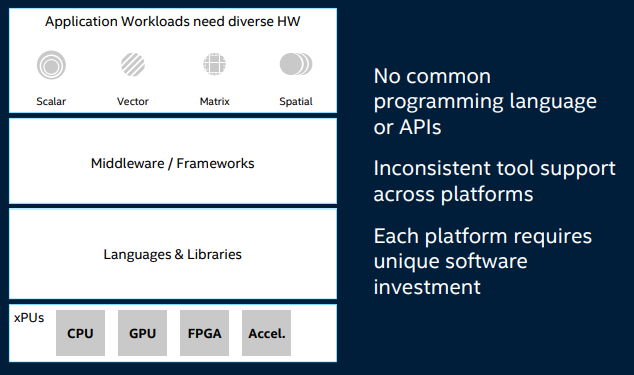
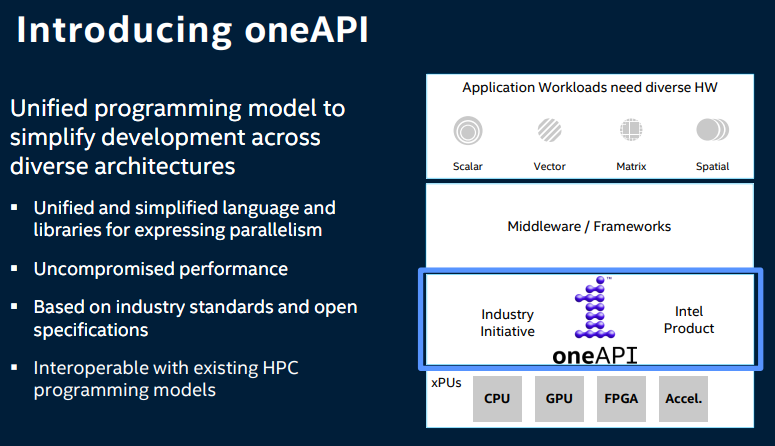
In this simplified block diagram of AI/ML development, Intel wants to isolate “Languages & Libraries” as the biggest pain point.
Intel Corporation
In this simplified block diagram of AI/ML development, Intel wants to isolate “Languages & Libraries” as the biggest pain point.
Intel Corporation

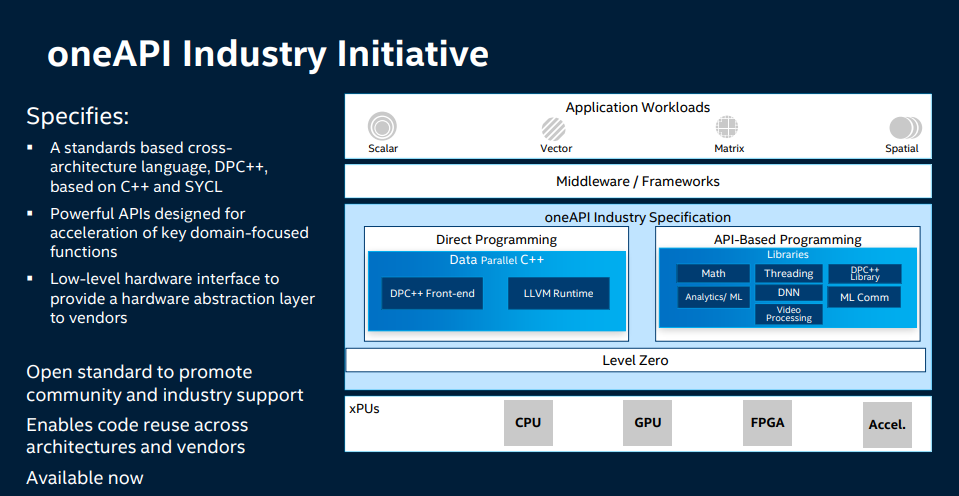
oneAPI aims to uncouple the middleware and frameworks from the gritty details of the underlying hardware they target, making code more re-usable.
Intel Corporation
oneAPI aims to uncouple the middleware and frameworks from the gritty details of the underlying hardware they target, making code more re-usable.
Intel Corporation
In this simplified block diagram of AI/ML development, Intel wants to isolate “Languages & Libraries” as the biggest pain point.
Intel Corporation
oneAPI aims to uncouple the middleware and frameworks from the gritty details of the underlying hardware they target, making code more re-usable.
Intel Corporation

It’s tempting, but inaccurate, to hear oneAPI’s write once run anywhere promises and think “oh, it’s Java for AI.” oneAPI doesn’t produce bytecode, it abstracts optimized, low-level hardware targeting without replacing it.
Intel Corporation
It’s tempting, but inaccurate, to hear oneAPI’s write once run anywhere promises and think “oh, it’s Java for AI.” oneAPI doesn’t produce bytecode, it abstracts optimized, low-level hardware targeting without replacing it.
Intel Corporation

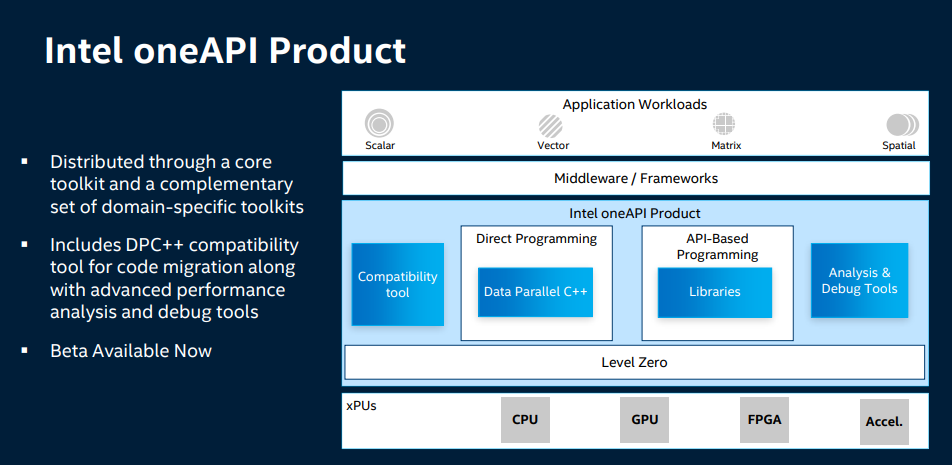
In addition to low-level programming in the new Data Parallel C++ language and higher-level use of API calls, Intel is making compatibility, debug, and analysis tools available in the oneAPI layer.
Intel Corporation
In addition to low-level programming in the new Data Parallel C++ language and higher-level use of API calls, Intel is making compatibility, debug, and analysis tools available in the oneAPI layer.
Intel Corporation
It’s tempting, but inaccurate, to hear oneAPI’s write once run anywhere promises and think “oh, it’s Java for AI.” oneAPI doesn’t produce bytecode, it abstracts optimized, low-level hardware targeting without replacing it.
Intel Corporation
In addition to low-level programming in the new Data Parallel C++ language and higher-level use of API calls, Intel is making compatibility, debug, and analysis tools available in the oneAPI layer.
Intel Corporation
When a developer writes Java code, the source is compiled to bytecode, and a Java Virtual Machine tailored to the local hardware executes that bytecode. Although many optimizations have improved Java’s performance in the 20+ years since it was introduced, it’s still significantly slower than C++ code in most applications—typically, anywhere from half to one-tenth as fast. By contrast, oneAPI is intended to produce direct object code with no or negligible performance penalties.
When we questioned Savage about oneAPI’s design and performance expectations, he distanced it firmly from Java, pointing out that there is no bytecode involved. Instead, oneAPI is a set of libraries that tie hardware-agnostic API calls directly to heavily optimized, low-level code that drives the actual hardware available in the local environment. So instead of “Java for Artificial Intelligence,” the high-level takeaway is more along the lines of “OpenGL/DirectX for Artificial Intelligence.”