Synced Report

Unprecedented!
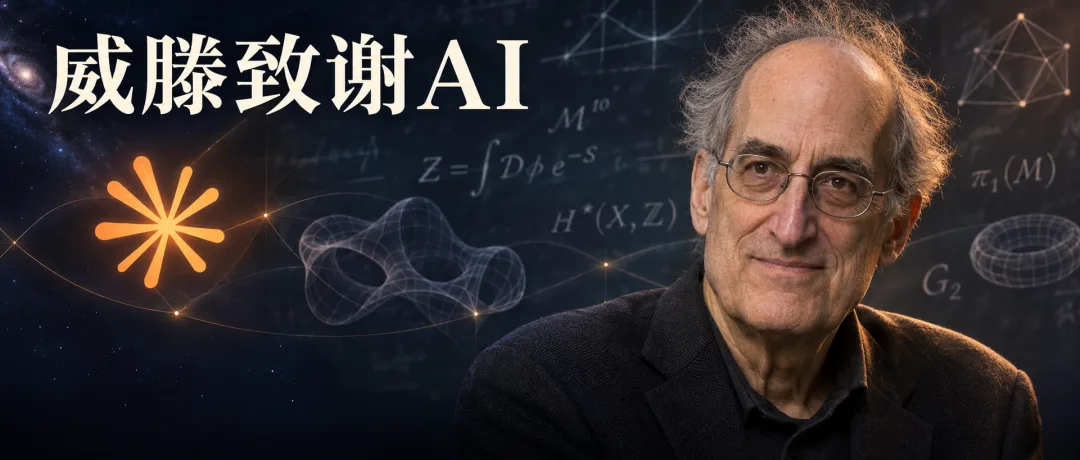
Witten, the “Pope of Physics” and the only physicist to receive the Fields Medal—the highest award in mathematics—publicly acknowledged AI.
In the acknowledgments of a recent preprint paper, Witten wrote:
Many details were assisted by Claude Opus 5.5.

Even more astonishingly, in the main text of the paper, Witten admitted that Claude Opus 5.5 proposed a key solution.

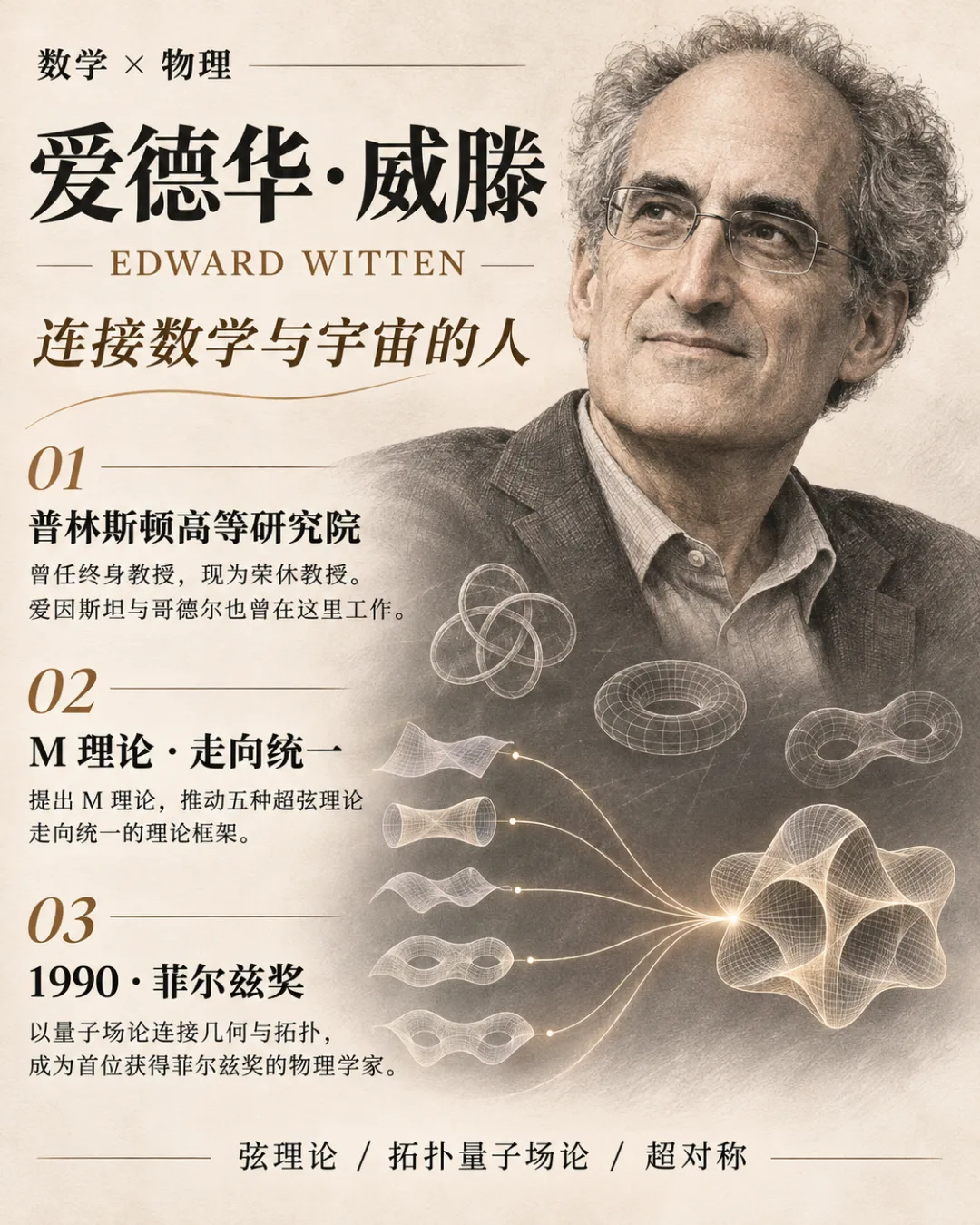
Who is Witten?
Witten is a legend in modern physics.
For decades, he almost single-handedly unified five different formulations of string theory and founded M-theory.
In 1990, he won the crown jewel of mathematics—the Fields Medal—for his pioneering work in topological quantum field theory and supersymmetry.
He formerly held a permanent professorship at the Institute for Advanced Study in Princeton, a position that Einstein and Gödel had also held in the past.
Fellow physicists once joked:
If Witten said a formula was correct, even if no one understood it, everyone would assume it was correct and then spend five years figuring out why.
His scholarly style was classical and pure:
Paper, pen, highly abstract differential geometry, and profound physical intuition.
This physics behemoth in his eighties wrote a 33-page solo long-form paper, yet candidly stated in the main text:This mathematical construction was not something I came up with; AI came up with it.TAG203@@
TAG207@@
The spirit of a master, lofty as mountains and enduring as rivers.
Over five months, AI shifted its position in Witten’s work
In June, Witten studied “Entanglement Wedge Reconstruction” in holography, involving extensive higher-order perturbative matrix calculations.
TAG245@@
Witten encountered an intricate algebraic generalization.
TAG254@@
But Witten put thisin a footnote.
TAG268@@
TAG272@@
TAG277@@
Perhaps this was what most people felt at the time: AI was extremely useful, but merely an “errand boy.”
TAG287@@
By November, a new version of the paper had gone live, and this time, Claude had moved straight from a footnote into the core of the argument.
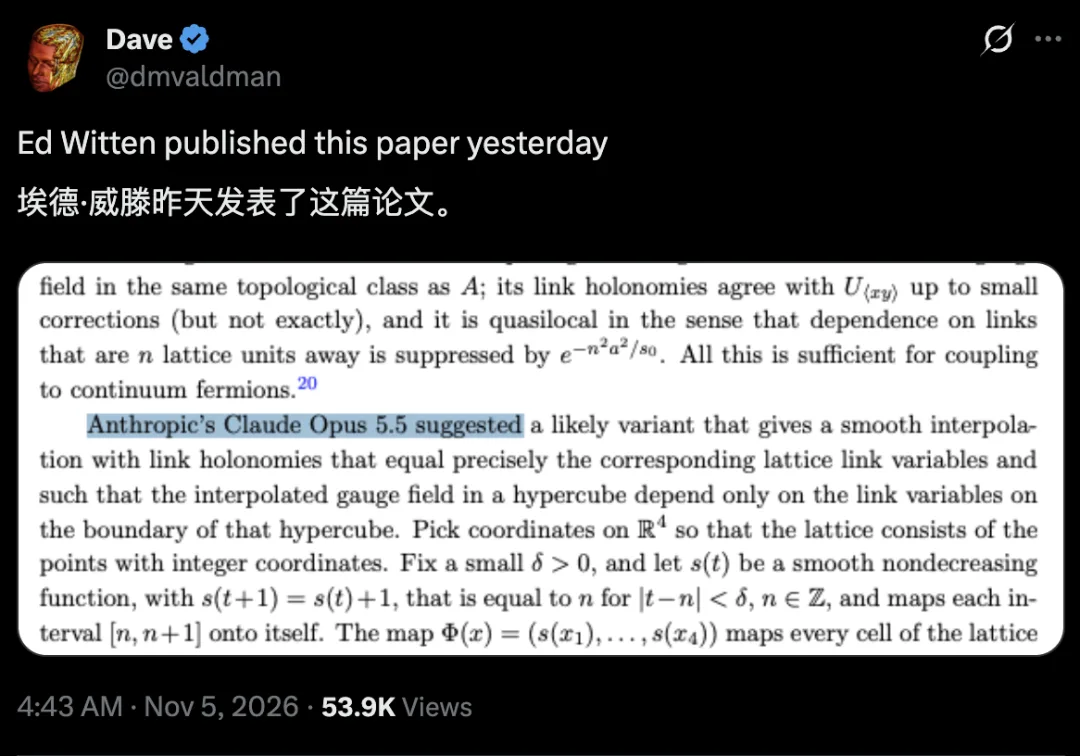
More importantly, the verb changed.
Witten did not write “Claude computed” or “Claude generated.”
What he wrote was:
Claude Opus 5.5 suggested (Claude Opus 5.5 suggested/proposed).
In papers, when physicists write “X suggested that…,” the name preceding it is usually that of a collaborator or a peer who gave them inspiration.
Over the course of five months, Claude’s role shifted from “helped” to “suggested,” from “doing the calculations for me” to “proposing a solution.”
In the purest, most profound realm of theoretical physics, AI’s identity had quietly undergone a qualitative transformation.

The problem tackled by Witten’s paper was one of the hardest nuts to crack in high-energy physics:the lattice discretization of chiral fermions.
Let’s break it down into the simplest possible terms.
Our universe is made up of microscopic particles. These particles obey quantum field theory.
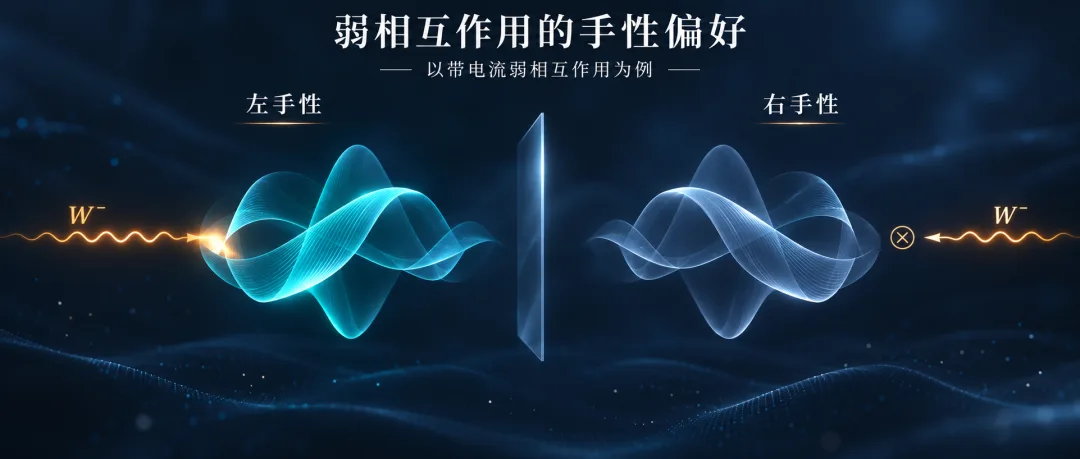
Particles have “chirality,” just like a person’s left and right hands: they are mirror images of each other, but cannot be superimposed.
The fundamental laws of our real world—such as the “weak interaction,” which is responsible for nuclear decay—have one fatal quirk:it only plays with left-handed particles and ignores right-handed ones.
Physics calls this theory “chiral gauge theory” (Chiral Gauge Theory). The Standard Model of particle physics is essentially such a theory.
But when studying quantum field theory in continuous spacetime, calculations often produce “infinities.”.
To understand the underlying nature of quantum field theory, physicists devised a method:to slice spacetime into a grid.
Just like the pixels on a computer screen. Particles live on lattice sites, while forces live on the links connecting those sites.
This method is calledlattice gauge theory (Lattice Gauge Theory).
Once spacetime is turned into a discrete grid, all physical quantities can be calculated directly on a supercomputer.
But disaster follows.
In 1981, two physicists proposed the famousNielsen–Ninomiya Theorem (Nielsen-Ninomiya Theorem):
On a discrete lattice, it is impossible to preserve locality and spacetime symmetry while also having fermions of only a single chirality.
Every time you try to place a left-handed particle on a lattice, the lattice automatically 「duplicates」 an extra right-handed particle deep within.
This phenomenon is called 「fermion doubling」 (Fermion Doubling).
It completely destroys chiral gauge theories.
For more than forty years, generation after generation of leading physicists have pressed on in their attempts to perfectly define chiral gauge theories on a lattice.
Everyone has exhausted every possible approach: Domain-Wall Fermions, Overlap Fermions……Each scheme is immensely complicated and comes with all manner of mathematical compromises and costs.
Witten's new 33-page work is precisely an attempt to find an entirely new and more thorough nonperturbative definition in this extraordinarily difficult field.
Claude: Proposer of the core mathematical construction
This time, Witten completely broke through people's cognitive inertia.
In the process of establishing a mapping between the discrete lattice and continuous spacetime, there is an extraordinarily stringent mathematical barrier:Gauge Field Interpolation.
Simply put, a spacetime lattice contains only discrete line segments (Link Variables, link variables).
But physical calculations require a smooth, continuous space (Continuous Gauge Field).
You must find a mathematical method to smoothly 「stitch」 the discrete jumps into a continuous field.
This stitching process must simultaneously satisfy two nearly self-contradictory conditions:
-
Strict symmetry: the gauge symmetry of the lattice must be preserved exactly, without introducing any mathematical inconsistencies;
-
Holonomy equivalence (Holonomy Matching): the result obtained by integrating along lattice paths must exactly equal the link variables on the discrete mesh.
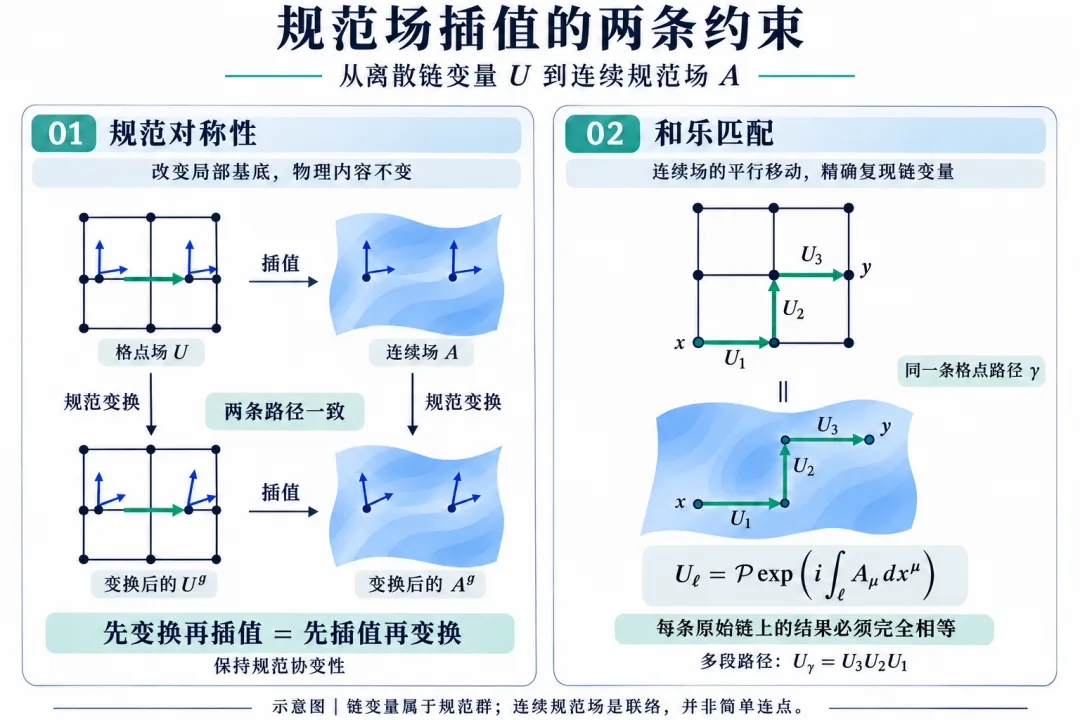
The slightest mishandling will cause the mathematical self-consistency of the entire theory to collapse on the spot.
Here, Witten explicitly documented the role of AI in the main text.
Confronted with the contradiction inherent in interpolating across boundaries of different dimensions—that it must be “both smooth everywhere and rigidly locked to the holonomy”—Claude Opus 5.5 proposed a crucial algorithmic variant to Witten:the introduction of a stair-step boundary collapse under a coordinate pullback mapping (Boundary-Collapsing Map).
Claude’s specific construction is as follows:
First, establish lattice coordinates with integer points as vertices in four-dimensional Euclidean space. Take a sufficiently small constant δ>0.
Claude proposed constructing a special smooth, monotonically nondecreasing scalar function s(t).
This function satisfies two properties:
-
Translation periodicity: s(t+1)=s(t)+1;
-
Within the δ-neighborhood of each integer lattice point n, the function becomes completely flat and constant: when ∣t−n∣<δ, s(t)=n. Outside the neighborhood, it smoothly maps the interval [n,n+1] to itself.
Based on this scalar function, Claude constructed a four-dimensional spatial map:

Geometrically, this mapping produces a stunning effect:
It maps every cell in the lattice to itself, but completely and smoothly “flattens and collapses” the narrow neighborhood of thickness δ surrounding each cell boundary onto the cell’s geometric boundary!
Traditional direct interpolation falls apart at boundary seams because the normal derivatives of adjacent hypercubes cannot be matched as they transition into the interior.
The algorithmic procedure Claude provided completely restructured the order of interpolation:
-
Progressive recursion from lower to higher dimensions: The physicists first define a gauge field A on the 1-dimensional edges so that its holonomy exactly matches the lattice variables;
-
Performing “pullback surgery” before increasing the dimension: Before advancing the field to 2-dimensional faces, 3-dimensional volumes, and 4-dimensional hypercubes, Witten adopted Claude’s core suggestion—first using the mappingΦto perform a differential-form pullback replacement of the field on the lower-dimensional cells, thereby safely solving the Dirichlet problem: Because Φ flattens the entire δ-neighborhood near the boundary into a constant projection, all normal derivatives of the pulled-back field smoothly vanish near the boundary!
This change instantly resolves all contradictions: because all derivatives are zero within the boundary buffer zone,subsequentlywhen the physicists solve the Dirichlet boundary-value problem inside the hypercube in Landau gauge, the solution naturally acquiresinfinite-order smoothness
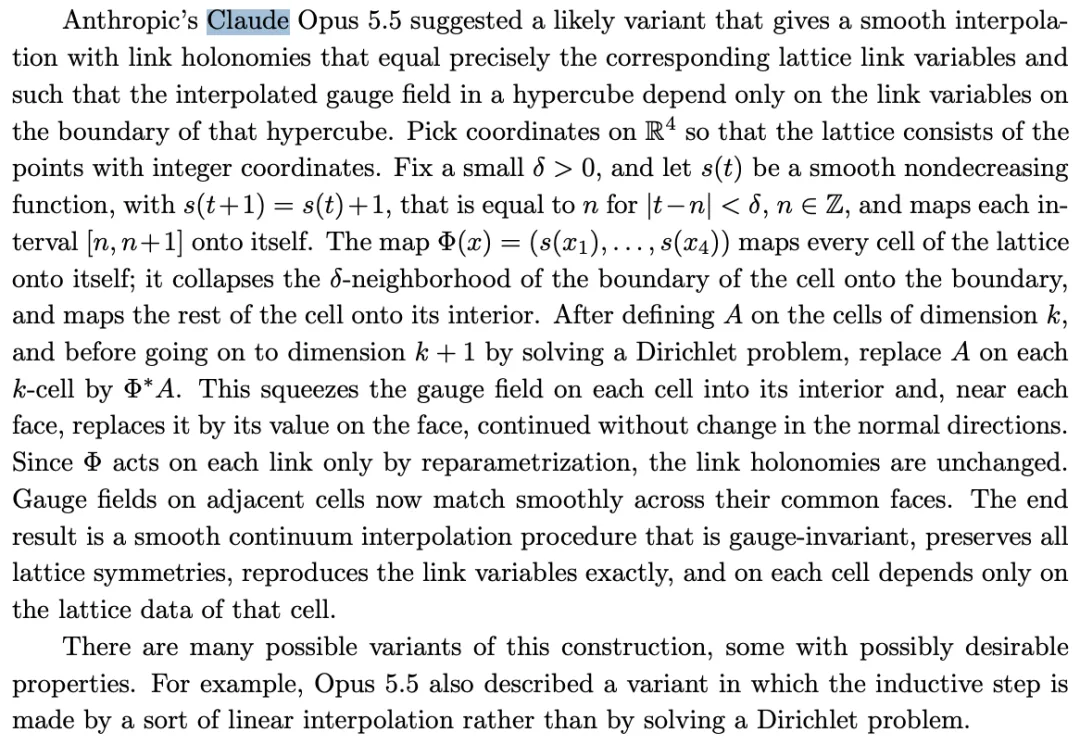
More importantly, along any edge, the pullback mapping Φ amounts to nothing more thanreparameterizationof the line segment,without changing the value of the path integral along the line in the slightest.
The holonomy is exactly conserved, causal locality is rigidly confined within the boundary, and the entire space is smooth to infinite order everywhere.
Witten carefully examined and adopted this variant proposal in the paper, making it a key cornerstone for constructing the nonperturbative chiral-fermion partition function in Section 3 of the main text.
The foundational paradigm of scientific research is being completely rewritten. The fact before our eyes is self-evident.
We once thought that humanity could continue to rule the world of theoretical physics—the jewel in the crown of human civilization, a realm requiring extremely abstract thinking and profound physical insight—for at least a few decades.
But reality has proven that the evolution of cognitive tools has surpassed all predictions.
References:
https://arxiv.org/abs/2611.05051
https://x.com/jdlichtman/status/2118055176972259335
https://x.com/dmvaldman/status/2118081768125550842
Editor: David
Follow ASI instantly
⭐Like, repost, and recommend—all in one click⭐
Hit the star to stay locked in on AI Tech Review’s rapid updates!