Post-2000-born doctoral student at Zhejiang University delivers again! Packs more than a dozen physical factors into a single world model | Native to Huawei Ascend
The Chinese version of Cosmos delivers another result
henry sent from Aofeisi
QbitAI | Official WeChat account QbitAI
Three and a half months after his company’s valuation surged from RMB 4 billion to nearly RMB 10 billion and he vowed to build a “Chinese version of Cosmos,” Chen Tianrun, a post-2000-born doctoral student at Zhejiang University, has delivered another result.
On November 4, at the World Internet Conference in Wuzhen, the company he founded, Moxin Technology, unveiled a new-generation general-purpose 4D world model—
MoWorld 2.0.
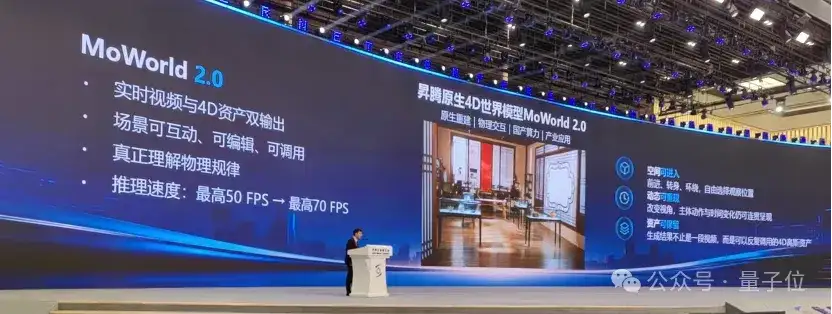
Building on the previous generation’s spatial generation and real-time interaction capabilities, MoWorld 2.0 further strengthens its ability to model physical laws.
It integrates more than ten physical factors—including gravity, elasticity, buoyancy, lighting, soft bodies, fluids, rigid bodies, deformable objects, and thermodynamics—into a single model.
According to the team, by learning these physical factors and their interactions, the world model can more accurately simulate object motion, collisions, and environmental changes, while supporting downstream tasks such as physical simulation.
For example, in the example below, MoWorld 2.0 can not only generate footage of a bookmark falling, but also simulate how the bookmark contacts other objects, the forces acting on it, and ultimately how it falls and bounces.
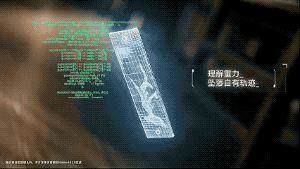
When dealing with a fluid such as water, it can also reproduce, in finer detail, the changes in its motion under external forces.

Compared with earlier world models that primarily predicted what would happen next in an environment based on image and text instructions, MoWorld 2.0 goes a step further—
it allows an object’s material properties, the external forces acting on it, and interactions between objects to jointly determine how the world changes next.
At the same time, to enable the world model to achieve real-time interaction in real-world scenarios, the team further improved the model’s runtime efficiency on Huawei Ascend NPUs, raising real-time video inference speed from a peak of 50 FPS in the previous generation to 70 FPS.
It appears that this strikes a balance between simulation accuracy and cost. How did the team achieve it?
Integrating multiple physical factors into a single model
Start with something as simple as turning a page.
The direction from which the wind blows and its strength affect where the page lifts and how it turns.
The flexibility of the paper itself determines how it bends and deforms when subjected to forces.
Together, these factors produce the page-turning process we ultimately see.

If we want a world model to reproduce this process, it must simultaneously handle different physical elements and the interactions between objects and their environment.
This integrated understanding and simulation of multiple physical variables is at the core of MoWorld 2.0.
According to the team, during training, the model must learn how individual physical elements—such as gravity, elasticity, soft bodies, and fluids—work, as well as how their combined effects influence an object's motion and deformation.
In terms of implementation, the team focused on two main areas.
First, it built a physics Gaussian renderer that supports interactions among different physical elements and their rendering;
Second, it used multi-expert prediction to predict three types of information: physical, pixel, and Gaussian data.
These designs enable the model to simulate more granularly how objects change under different conditions and support downstream tasks such as physics simulation.
In addition to physical realism, MoWorld 2.0 has another noteworthy capability:
Generated scenes can be exported as 3D/4D Gaussian assets, saved, and then further edited, rendered, and reused.
【A video cannot be inserted here, unfortunately… You can view it on the QbitAI WeChat account~】
Gaussian assets may sound somewhat abstract, but simply put, they can be understood as spatial data representing a scene.
Within this data, large numbers of three-dimensional “little blobs,” each containing information about position, shape, and appearance, jointly represent objects and their environment.
Software can use this data to re-render a scene from different viewpoints; 4D assets build on this by additionally recording information about how the spatial content changes over time.
As a result, the spatial content generated by the model is no longer merely a one-off video. It becomes an asset that can be further edited, rendered, and reused, and can enter game engines, film and television production systems, and robot simulation training platforms.
For example, in the official demonstration, MoWorld 2.0 generated an ancient street market that users could walk into based on an ancient painting.
The shops, streets, pedestrians, carts, and boats in the painting became editable, interactive scene content. Users could explore the streets or adjust their viewpoint to observe how the people and objects moved.
For film and game teams, the same scene can be viewed from different camera angles or modified with different weather and object arrangements for storyboard previsualization and content production.
For robot and autonomous-driving teams, it is possible to change obstacles, roads, and weather conditions within the same environment and repeatedly test how agents respond.
Rain, snow, potholed roads, and unexpected obstacles—conditions that are difficult to reproduce frequently in the real world—can therefore become part of a virtual training environment.
However, for these application scenarios to support real-time interaction and repeated training, the model's runtime speed and cost must also be considered.
The Chip-Model Collaboration Behind 70 FPS
The 70 FPS mentioned earlier refers to the speed at which the model generates new frames in real time.
It directly affects whether the visuals can keep up when users move the camera or change the scene, much like the frame rate in a video game.
Before MoWorld 2.0 was released, Moxin and the Huawei team had already spent nearly a year optimizing training and inference around a domestically developed NPU, achieving real-time video inference of up to approximately 50 FPS on MoWorld 1.0.
After this upgrade, the speed increased to approximately 70 FPS, an improvement of about 40% over the previous generation.
In an interview, the team told QbitAI that the key to this speedup was separating different computational tasks and then having multiple NPUs process them in parallel.
Specifically, Moxin uses Ascend’s open low-level operators and parallel scheduling toolchain to break down tasks such as scene decoding and backbone generation across multiple NPUs; it also optimizes coordinated scheduling across multiple accelerator cards, reducing redundant data transfers in device memory and unnecessary computation.
In addition, the team optimized the sparse attention mechanism and employed techniques such as mixed-precision quantization and generation operator fusion to further improve training and inference efficiency.
Beyond speed, cost was also addressed in this round of optimization.
According to the team, its inference costs can be as low as 30% of those of a GPU-based solution of comparable scale.
For teams that need to continuously generate training environments, this means the same budget can support more scenario variations and training attempts.
In practical applications, MoWorld 2.0 has already been deployed on edge devices such as smartphones.
“Mo Xiao Chong,” an on-device application built on MoWorld 2.0, made its debut at Huawei’s new smartphone launch event in October this year.
Users can upload a few photos of their pets to generate a 4D digital twin, view it from different angles, and interact with it.
This experience is reportedly delivered jointly by the cloud and the smartphone: high-quality 4D assets are generated in the cloud; an on-device model with approximately 600 million parameters is trained on the Ascend platform and then deployed on smartphones equipped with Kirin chips for inference; and the smartphone handles rendering and interaction.
In addition, we further learned in an interview that the rendering frame rate for 3D/4D Gaussian assets can reach 500 FPS, while related on-device rendering tests reach approximately 100 FPS.
Overall, from model training on the Ascend platform to on-device inference on the Kirin platform and rendering and interaction on smartphones, domestic computing power is already running through MoWorld 2.0’s complete product chain, bringing “chip–model collaboration” into practical application.
Across the broader industry, world models are gradually evolving from a buzzword frequently discussed at the beginning of the year into a new class of foundation models alongside large language models.
Following this trend, Moxin has gradually established its own main line of technological iteration: building on domestic computing power while improving both physical modeling capabilities and model deployment efficiency.
From a 3D Printer to the “Chinese Cosmos”
Finally, let us return to Moxin Technology, the company behind MoWorld.
The company was founded in 2021. At the time he founded it, Chen Tianrun was in his third year at Zhejiang University, and the team’s first product was a 3D printer.
The turning point from printers to world models came in late 2024.
According to public reports, the team discovered at the time that the network under test could generate not only objects but also spaces; as the volume of data increased, the accuracy and consistency of spatial reconstruction continued to improve.
Chen Tianrun subsequently transferred this modeling framework to the world model project, and the company’s focus shifted to spatial intelligence.
After the transition, the team retained its 3D printer business while validating the model’s capabilities through film, television, and cultural tourism projects, and generating cash flow.
This entrepreneurial experience in consumer electronics also made him accustomed to considering R&D, cost, quality, and delivery schedules together.
Following this path, Moxin unveiled the KOKONI-World prototype in December 2025, released MoWorld 1.0 in July this year, and iterated the model to version 2.0 by November.
Meanwhile, according to a report from September this year, Moxin expanded from 50 or 60 employees to more than 200 over the preceding six months or so.
In bringing in industry partners, the team also valued computing power, endpoint products, sales channels, and customer use cases, not just capital.
In terms of funding, Moxin has completed five consecutive funding rounds this year, totaling RMB 2 billion, and has reached a valuation of nearly RMB 10 billion, joining the ranks of unicorns.
As for the “Chinese Cosmos” mentioned at the beginning, Chen Tianrun had previously discussed target customers such as Chinese automakers in an interview and summarized Moxin’s advantages in three points: adaptation to domestic computing power, on-device deployment, and engineering experience in consumer electronics.
His vision is for MoXin, like NVIDIA Cosmos, to become a foundation model for the physical world and genuinely integrate into the practical business workflows of automakers and other manufacturers.
This time, the entities jointly releasing MoWorld 2.0 with MoXin are three national AI application pilot bases in the fields of embodied intelligence, cultural tourism, and spatiotemporal geographic information.
According to the plan announced this time, subsequent collaboration will focus, respectively, on interactive simulation and robot training, cultural digital assets and immersive experiences, and 3D data production and large-scale scene reconstruction.
And finally, on the occasion of the release of MoWorld 2.0, let us ask a rather philosophical question:
If an AI has seen enough instances of objects landing, can it predict how a previously unseen bookmark will move in the next second—
Then what it has learned from the data is merely correlation in a statistical sense, or are they physical laws that can be transferred to new scenarios and used to extrapolate outcomes?
Or, an even more ultimate question: Is the world we live in perhaps inherently just a set of mathematical equations jointly determined by the interactions of countless variables?
—End—
@QbitAI · Tracking the latest developments in AI technology and products
If this resonated deeply with you, please give a like, follow, and share—all three in one վ’ᴗ’ ի ❤