
GEAR enables researchers to build RSI algorithms modularly, much like using Scikit-learn. It organizes the algorithmic modules required for sampling, candidate evaluation, and diversity management together with evaluation infrastructure such as parallel inference, enabling RSI algorithms to be rapidly assembled, compared, and reused. Experimental results based on improvements to the GEPA (Genetic-Pareto) algorithm show that GEAR-tuned agents achieve significant improvements on marketing, customer service, and coding tasks.
I. Research Significance, Highlights, and Main Results: Building a Scikit-learn-Style Modular RSI Framework
Researchers from institutions including Imperial College London and Duke proposed the open-source framework GEAR, with the aim of providing a general-purpose toolkit for Recursive Self-Improvement (RSI). Its positioning can be summarized as toolkits for RSI: enabling developers to compose, replace, and compare different evolutionary strategies while reusing existing task execution, evaluation, and version management capabilities.
Paper: GEAR: An Open General Evolutionary Architecture for Recursive Self-Improvement of LLM Agent Harness, a preprint dated October 26, 2026.
Paper authors: Yehui Tang, Guanqi Zhu, Shao-Jun Xia, Xin Chen, Mengzhe Geng, Hongyang Du, Yuhao Tang.
Project homepage: rsi-gear.github.io
Open-source code: github.com/rsi-gear/gear
Paper: https://huggingface.co/spaces/WizardTY/GEAR
GEAR breaks parent-version selection, modification proposal planning, task sampling, scoring, and candidate ranking into replaceable modules. Researchers can develop new algorithms around these components, while shared infrastructure records each candidate’s code version, runtime conditions, and evaluation evidence, making it easier to inspect results and continue experiments.
The paper uses harness evolution as its validation target. Prompts, tools, skills, workflows, and context management can be modified, while the target model’s weights remain unchanged. With the GPT 5.6 Luna model fixed and the medium reasoning setting used, the GEAR-evolved DeepSeek Harness (DSH) increased the marketing task pass rate from 27.0% to 40.0%, the customer service task pass rate from 17.0% to 25.0%, and the coding task pass rate from 52.8% to 62.9%. The evolved harness is also equally effective across different reasoning settings and models.
These results demonstrate the potential for systematically optimizing how agents operate. By providing open, shared experimental tools, GEAR aims to enable subsequent research to build on existing work to develop and test new evolutionary methods, while accumulating reusable versions and experimental results.
II. Research Background: Three Core Issues That Self-Evolution Cannot Avoid
Work on Recursive Self-Improvement (RSI) is rapidly emerging. From optimizing prompts and evolving workflows to enabling agents to modify their own runtime code and training new models, different studies have proposed their own approaches to evolution. Yet regardless of their form, these methods cannot avoid several shared core issues.
First, how can sampling be made better and more efficient?The search space for evolution is enormous, but the computational budget is limited.Which existing versions to start from, which improvement directions to explore, and which tasks to prioritize for feedback collection will all affect how far a single search can go. The sampling strategy needs to help the system allocate limited attempts to valuable exploration.
Second, after deriving a Variant from the current version (a candidate variant produced after modification), how can it be evaluated more accurately? Generating a new version is only the beginning; the more important question is whether it has actually improved: Is the score increase due to the modification taking effect, or to differences arising from task difficulty, reasoning level, or runtime variability? And how many evaluations are needed to support a decision to retain or discard it? Evaluation must both control costs and provide trustworthy feedback for evolution.
Third, how can diversity be maintained throughout the evolution process? If each round retains only the version with the highest overall score, the search may prematurely converge on a single line of inquiry. A variant that is temporarily behind may excel at a particular category of tasks or employ a different solution approach. Preserving these valuable differences and giving them an opportunity to become starting points for subsequent evolution is essential to continued exploration.
Sampling, Variant evaluation, and diversity management constitute a common set of issues for understanding and comparing self-evolution methods. Different studies may propose different strategies at these stages, but they also require shared infrastructure to run experiments, store candidates, and test whether strategies are effective.
Agent Harness is one concrete research setting for these issues. Real-world tasks involve invoking tools, organizing context, handling exceptions, and verifying results. These operational patterns affect whether a model can complete a task and also provide elements that self-evolution can modify.
When researchers experiment with new sampling strategies, evaluation schemes, or diversity mechanisms, the underlying infrastructure must support concurrent task execution, version preservation, and evidence management. GEAR was conceived to organize these shared components so that different methods can be compared under clearly defined experimental conditions.
III. Framework Design: A Dual-Layer Self-Evolution Framework Based on Meta-Learning
GEAR models Agent self-evolution as a meta-learning problem: improving the method for solving subsequent tasks based on execution experience from a batch of tasks. Specifically, it divides the system into two layers: the inner layer solves the current task, while the outer layer optimizes the reusable Harness.
The inner layer handles task-level execution and adaptation. The Task Agent uses the given model and runtime framework to interact with the environment, invoke tools, and adjust the plan for the current task based on feedback. Once the task is complete, the system records the execution trajectory, final result, and evaluation feedback. Temporary adjustments at this layer serve only the current task and do not automatically become operating rules for subsequent tasks.
The outer layer performs cross-task meta-learning. The Meta Agent aggregates trajectories and evaluation evidence from multiple tasks, identifies recurring problems, and proposes modifications to prompts, tools, skills, workflows, or context management. Only after a candidate version has been evaluated and selected does it become the new Harness used for subsequent tasks.
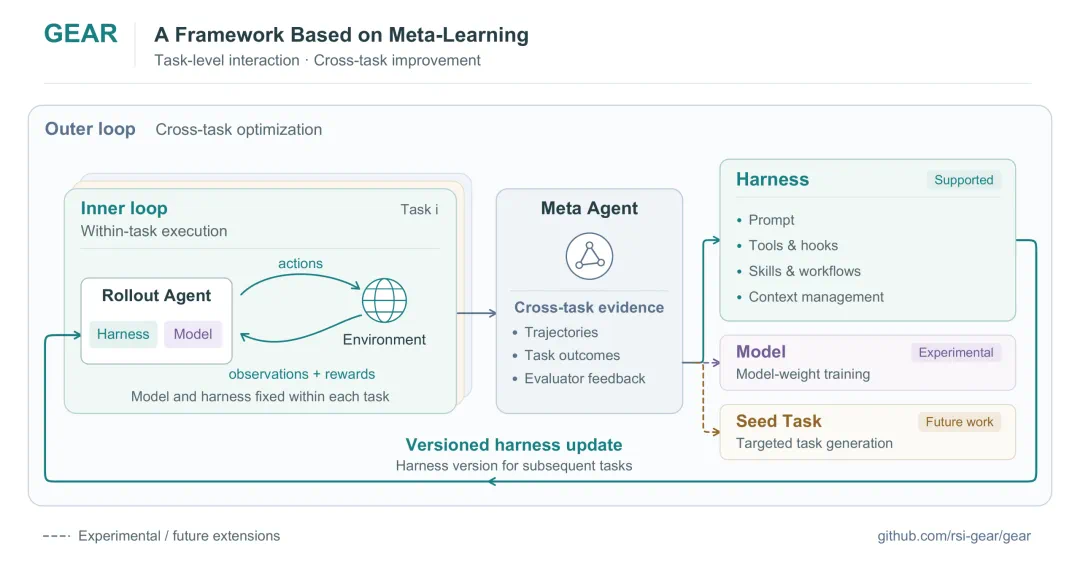
Figure 1 | GEAR’s dual-layer framework based on meta-learning. The inner layer executes individual tasks and produces evidence, while the outer layer uses cross-task experience to improve the reusable runtime framework. Solid lines indicate currently supported harness-evolution paths; model training and automatic task generation are experimental and future extensions, respectively.
The two layers thus form a cycle: task execution produces experience, cross-task experience drives framework improvements, and the new framework then participates in subsequent tasks and generates new experience. Temporary workarounds within an individual task can enter this continuously accumulative process only after being formalized as validated framework modifications.
The aforementioned Sampling, Variant evaluation, and diversity management can all be configured with different strategies in the outer layer: choosing which historical versions to start from, how to evaluate candidates, and which versions to retain for subsequent exploration. The paper provides a concrete instantiation using staged GEPA search, while these strategies can be replaced within the shared framework.
Here, meta-learning takes the form of a dual-layer structure of task execution and cross-task improvement. The harness evolution in this paper keeps the target model weights fixed and achieves improvements through searching over and selecting runtime frameworks, without requiring the inner-layer solving process to be differentiable.
IV. Detailed Results, Experimental Analysis, and Future Applications
With the model and reasoning tier fixed, all three domains improved
The study used 100 Marketing tasks from AutomationBench, 100 Support tasks, and 89 command-line tasks from Terminal-Bench 2.1. Each model–runtime framework configuration was evaluated once per task.
The most direct comparison comes from GPT 5.6 Luna at the medium reasoning tier. The study kept the tasks, model, reasoning tier, evaluator, and runtime settings identical while comparing the initial DSH with the DSH evolved for the corresponding dataset.
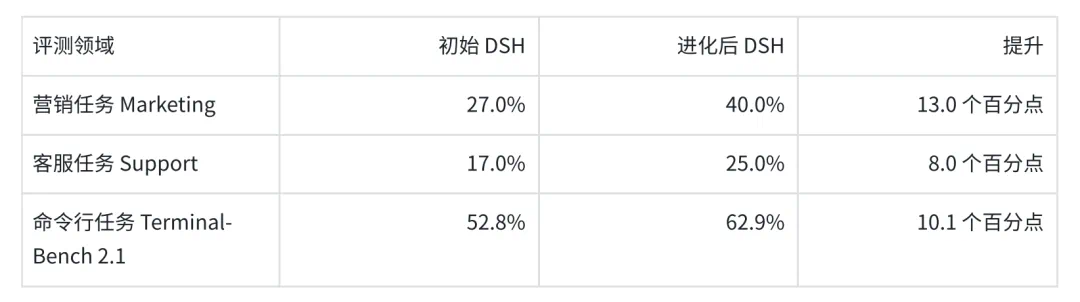
Table 1 | Task pass rates with GPT 5.6 Luna and the medium reasoning tier held fixed. Data are from Table 1 of the paper; each of the three domains evolved its own runtime framework.
For Marketing, the increase from 27% to 40% means that an additional 13 of the 100 evaluation tasks passed. This shows that systematically optimizing the workflow can help the same model complete more tasks.
The study also examined “goal completion rate.” A task may contain multiple final-state checks. This metric first calculates the proportion of scoring criteria satisfied by each task and then averages the results across all tasks. Under the configuration above, Marketing’s goal completion rate increased from 75.4% to 83.9%, while Support’s increased from 72.9% to 81.3%. In other words, both full-task pass rates and partial-goal completion improved.
 Figure 2 | The original experimental-results figure from Figure 4 of the paper, as used on the project homepage. The left panel shows performance across the three domains under different configurations, while the right panel shows the evolution of Marketing under the fixed Luna medium configuration. The blue bracket in the left panel compares the initial medium configuration with the evolved max configuration, including the change in reasoning tier; the same-tier gains in the table above correspond to the difference between the gray and purple bars.
The improved workflow can be used with another modelThe GEAR experiments also explored a practical question: does a runtime framework evolved on one model remain effective when used with a different model?
The study applied the corresponding runtime framework evolved on Luna to GPT 6 Astra at the max reasoning tier. The task pass rates for Marketing and Support reached 61% and 39%, respectively, while the corresponding Codex comparisons in the paper were 57% and 35%. This provides preliminary evidence that the improved workflow can be reused across models. On Terminal-Bench 2.1, the evolved runtime framework achieved pass rates of 84.3% and 87.6% when paired with Luna max and Astra max, respectively.
Some candidates scored better but were not adopted
The evolution of Marketing illustrates why self-improvement requires an explicit acceptance mechanism.
As can be seen on the right side of Figure 2, the initial version had a pass rate of 27.0% and a goal completion rate of 75.4%; the version ultimately retained in Round 7 reached 40.0% and 83.9%, respectively. However, the search path did not improve at every step, and the candidates from Rounds 1, 5, and 6 were all not retained.
Round 5 is particularly illustrative: compared with the Round 4 version retained at the time, the goal completion rate increased from 81.2% to 82.3%, while the full-task pass rate fell from 36% to 34%.A higher average completion rate does not mean that more tasks were fully completed. Therefore, this candidate did not replace the current version.
In Round 6, the pass rate remained at 36%, but the goal completion rate fell to 80.6%, so it was likewise not adopted.The system uses explicit rules to block these regressions and retain versions that simultaneously satisfy all acceptance criteria.
This also highlights the role of GEAR’s logging and evaluation infrastructure: it enables researchers to observe the gains and losses throughout the improvement process, examine exactly what a modification changed, and do more than simply obtain a final score.
From a research toolbox to business process optimization
For researchers, GEAR can serve as an experimental platform for comparing self-improvement methods. With shared task execution and evidence logging infrastructure, researchers can experiment with different search strategies, task sampling methods, and acceptance criteria, and further analyze which methods are more effective under the same budget.
For developers, one direction worth exploring is integrating business tests into this loop. For example, they can build repeatable task sets for customer service handling or development and operations workflows, use failure trajectories to improve skills and workflows, and then run regression evaluations to determine whether to adopt a new version. Human experts can also inspect the rationale for modifications and execution logs, and participate in analysis and annotation.
For real-world business scenarios, the framework is based on a state-of-the-art architecture for toolkits for RSI, enabling the rapid construction of targeted algorithms for different scenarios. It has already achieved performance comparable to that of leading large models on customer service, marketing, and coding tasks using smaller models.


