
Pope Leo XIV defended that artificial intelligence systems be “disarmed” and called for decisions about human life to remain under human supervision. The pontiff also encouraged UN member states to advance toward a ban on lethal autonomous weapons.
At a meeting on AI, the leader of the Catholic Church warned of the risks of delegating human decisions to machines and defended international rules to guide the development of the technology.
 The pope cited lists of military targets and border control databases as examples of decisions that require human supervision. – Image: AI-generated
Machines are tools, not people
In remarks to participants at the meeting “The Future of AI: A Dialogue between the Vatican and the Scientific World on the Advances and Applications of Intelligent Technologies,” Leo XIV presented five principles to guide the development of artificial intelligence. The meeting was organized by the Pontifical Academy for Life and the Future of Life Institute.
The pontiff affirmed that the future of technology depends on human choices. Therefore, it is up to people to guide, modify and, when necessary, reject its applications.
This responsibility, he said, cannot be transferred to the machines themselves. Leo XIV criticized the possibility of granting rights or legal personality to AI systems.They have no experiences, bodies, feelings, or relationships and do not understand concepts such as love, work, and responsibility. Granting them legal status, he warned, could conceal human responsibility and leave victims of any harm facing an entity without a face.
The position is aligned with the principles presented in his encyclical *Magnifica Humanitas*, dedicated to the protection of the human person in the era of artificial intelligence.
Pope calls for a ban on lethal autonomous weapons
The defense of human oversight becomes especially important when AI is used in decisions that directly affect people’s lives and freedom. Leo XIV cited as examples the inclusion of individuals on military target lists or in border-control databases, situations in which they may be reduced to mere data points.
“Decisions that affect human life, freedom, and the use of force must always remain subject to effective, informed, and responsible human oversight,” he said.
On the basis of this understanding, the pope encouraged the countries that will meet in Geneva in November to take concrete measures to prohibit lethal autonomous weapons.
This concern also marked the speech of his predecessor, Francis, during the 2024 G7 meeting. On that occasion, he described artificial intelligence as an exciting and frightening tool and said that no machine should have the power to decide to take a person’s life.
Leo XIV also linked his choice of papal name to the need to confront technological advances.The reference is to Pope Leo XIII, whose pontificate took place during a period marked by the Industrial Revolution.
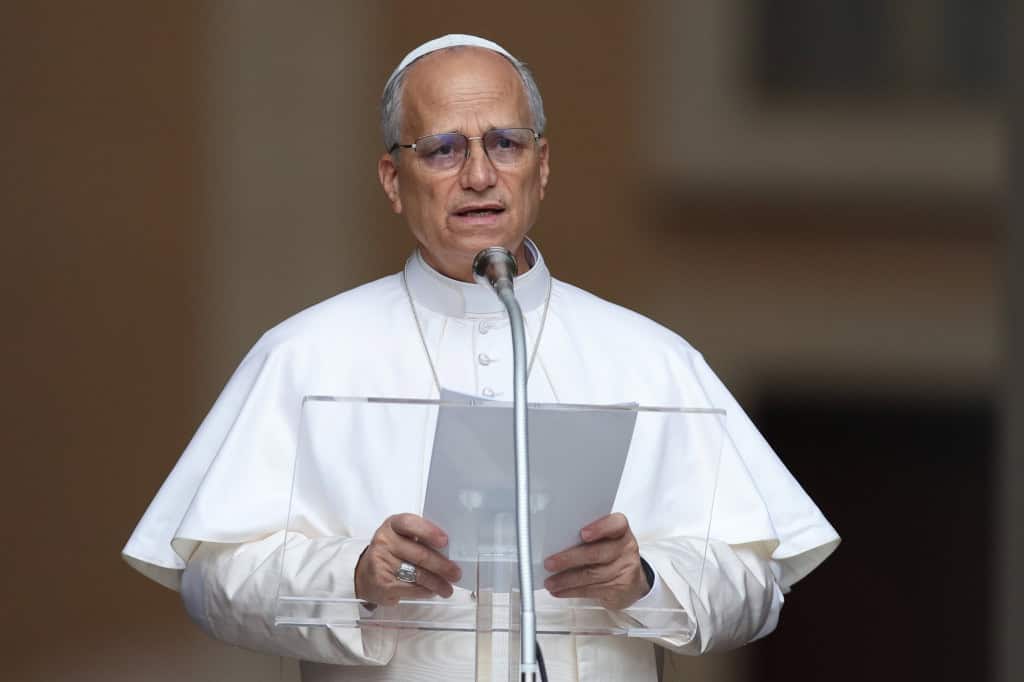 Leo XIV’s stance reinforces the statements made by Pope Francis at the G7 in 2024 about the dangers of machine autonomy. – Image: Marco Iacobucci Epp/Shutterstock
Technology must serve the common good
Another principle advocated by Leo XIV is that artificial intelligence should serve society, rather than cater solely to the interests of privileged groups. According to him, the development of these technologies should foster solidarity and allow the benefits of progress to be shared more broadly.
The pontiff also drew attention to the need for institutions capable of turning ethical principles into concrete measures. To this end, he advocated three fundamental mechanisms:
- Internationally shared standards to guide the development of AI;
- Independent oversight of technologies and their applications;
- Mechanisms for accountability, the ability to challenge decisions, and compensation for harm.
Leo XIV concluded his speech by thanking the participants for their contributions to the debate and encouraging the continuation of international cooperation on the responsible development of artificial intelligence.

Valdir Antonelli is a journalist specializing in digital marketing and consumer behavior.

