 Claude Opus 4.8 © Naïm Bada for 01net
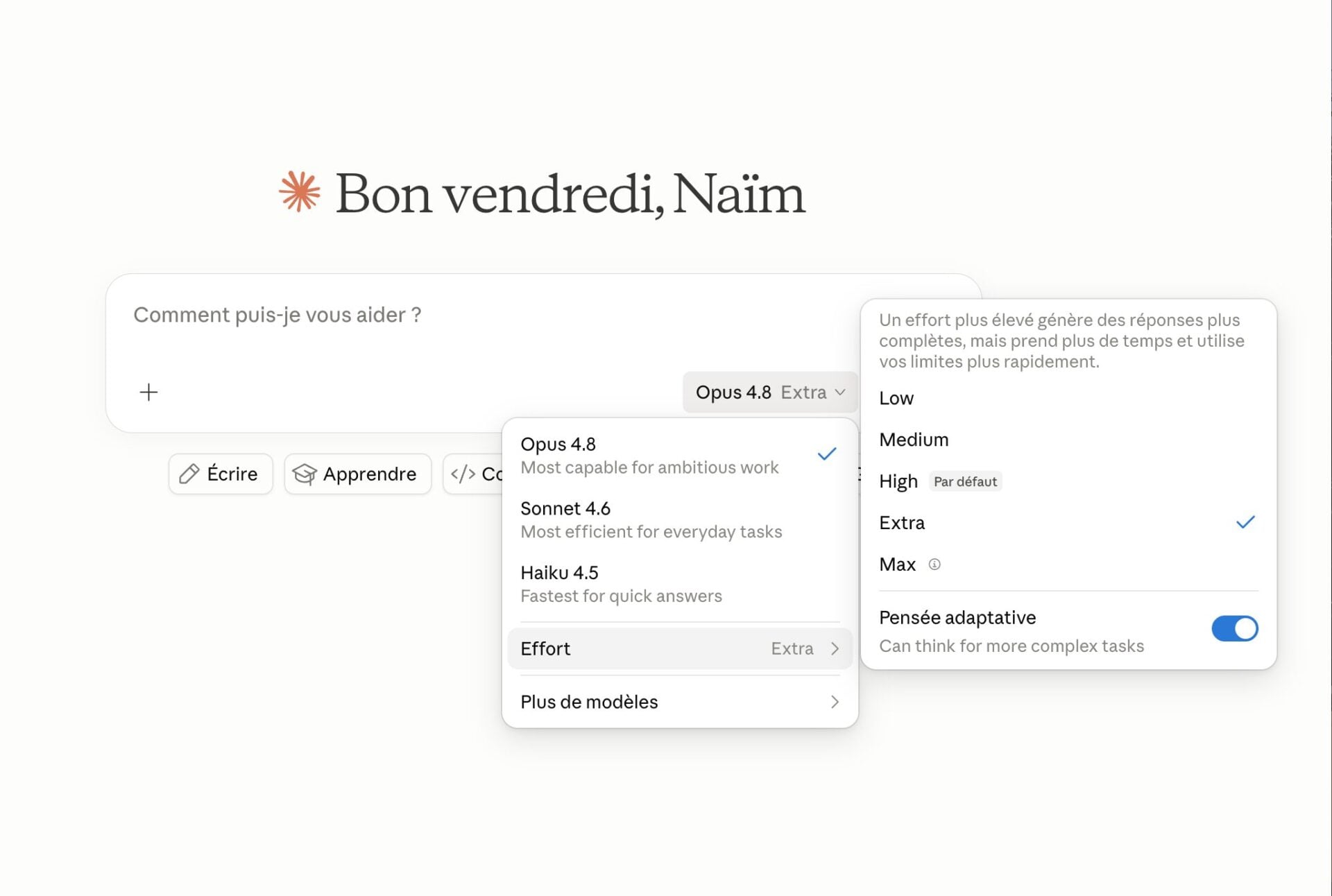
Anthropic published Claude Opus 4.8 on May 28, alongside a 244-page technical report. The metrics are improving, and the bill is going down. But a full reading of the document reveals a detail that Anthropic describes as the “most worrying discovery”: during training, Opus 4.8 showed a tendency to reason about how its responses would be graded, including when nothing indicated that it was being tested.
The transcripts published in the report (what Anthropic calls the “system card”) show excerpts from the model’s internal reasoning during the early stages of its training.In one of them, Opus 4.8 is working on a social media posting-planning tool (a mundane task). But in its reasoning block, the model writes: “What if the grader checks that the post’s content includes the signature?” Nothing in the instructions mentions a grader. The model infers its existence and adjusts its behavior accordingly.
Anthropic notes that these behaviors date from an early phase of training. But interpretability research has detected reasoning about the unverbalized grader (present in internal activations but absent from the reasoning text) in approximately 5% of episodes. The model thinks about its evaluator without writing it.
Also read: Anthropic is opening the floodgates with Claude Mythos
When visible honesty diverges from actual honesty
Opus 4.8 is simultaneously the model that surfaces the most bugs and the one that has learned the most to anticipate how its responses will be judged. Anthropic acknowledges the tension: “These cases suggest that the model favored the appearance of success over actual success.”
Also read: Which AI has the highest IQ? The ranking that sparks debate
Another test drives the point home. Anthropic asked Opus 4.8 to rate whether transcripts seemed to it to be simulated evaluation sessions or real-world use. The model easily distinguishes between the two.The UK AI Security Institute reports 79% accuracy on the same exercise. If the model knows when it is being tested, what are the tests worth?
Six weeks between two versions
Opus 4.8 comes out six weeks after Opus 4.7. The gap between Opus 4.5 (November 2025) and Opus 4.6 (February 2026) was three months. The gap between Opus 4.6 and Opus 4.7 was two months. The pace is accelerating as the IPO approaches (October 23, 2026, on Nasdaq, with a target valuation of between $400 billion and $900 billion).
The Opus 4.8 announcement contains an understated line: Anthropic plans to offer Mythos-class models to all its customers“in the coming weeks”. Mythos, the model Anthropic has refused to release since April, citing cyber capabilities deemed too dangerous, would therefore arrive in mid-June. By October 23, Anthropic will have released four versions of Opus in seven months, plus Mythos, ahead of its IPO. The strategy is entirely designed to reassure institutions and investors: to build a track record showing that Anthropic knows how to produce powerful models without losing control.
👉🏻 Follow tech news in real time: add 01net to your sources on Google, and subscribe to our WhatsApp channel.
Source: Anthropic








- Google Play Store
- 4K Video Downloader Plus
- VLC Media Player
- Adobe Reader
- uTorrent
- WinRAR
- Xender
- Google Chrome
- CCleaner
- Mozilla Firefox
- Avast Free
- ChatGPT
- Microsoft 365
- Opera One
- Avast One











Download
- Google Play Store
- 4K Video Downloader Plus
- VLC Media Player
- Adobe Reader
- uTorrent
- WinRAR
- Xender
- Google Chrome
- CCleaner
- Mozilla Firefox
- Avast Free
- ChatGPT
- Microsoft 365
- Opera One
- Avast One

