 © Anthropic
The creator of Claude modeled the American economy of 2030: in every scenario, the country grows wealthier. For graduates sitting behind a screen, it’s a different story. And its own CEO’s predictions fare poorly in the process.
The studies promising the end of work—you’ve probably come across one a week for the past two years. This one has a peculiarity: it comes from Anthropic, the company that sells precisely the automation it models. Its very young Anthropic Institute published this week “Scenarios for our Economic Future,” three quantified scenarios for the American economy by 2030.The whole comes with a technical report reviewed by 18 economists and a simulator in which everyone can adjust their own assumptions.
Three scenarios, from the mundane to the dizzying
The method involves breaking each occupation down into a stack of tasks, much like a job description turned into a shopping list (AI strikes some out, speeds up others, and sometimes adds new ones). Aggregating everything on a nationwide scale, the model developed with economists Anton Korinek and Chad Jones yields three possible trajectories.
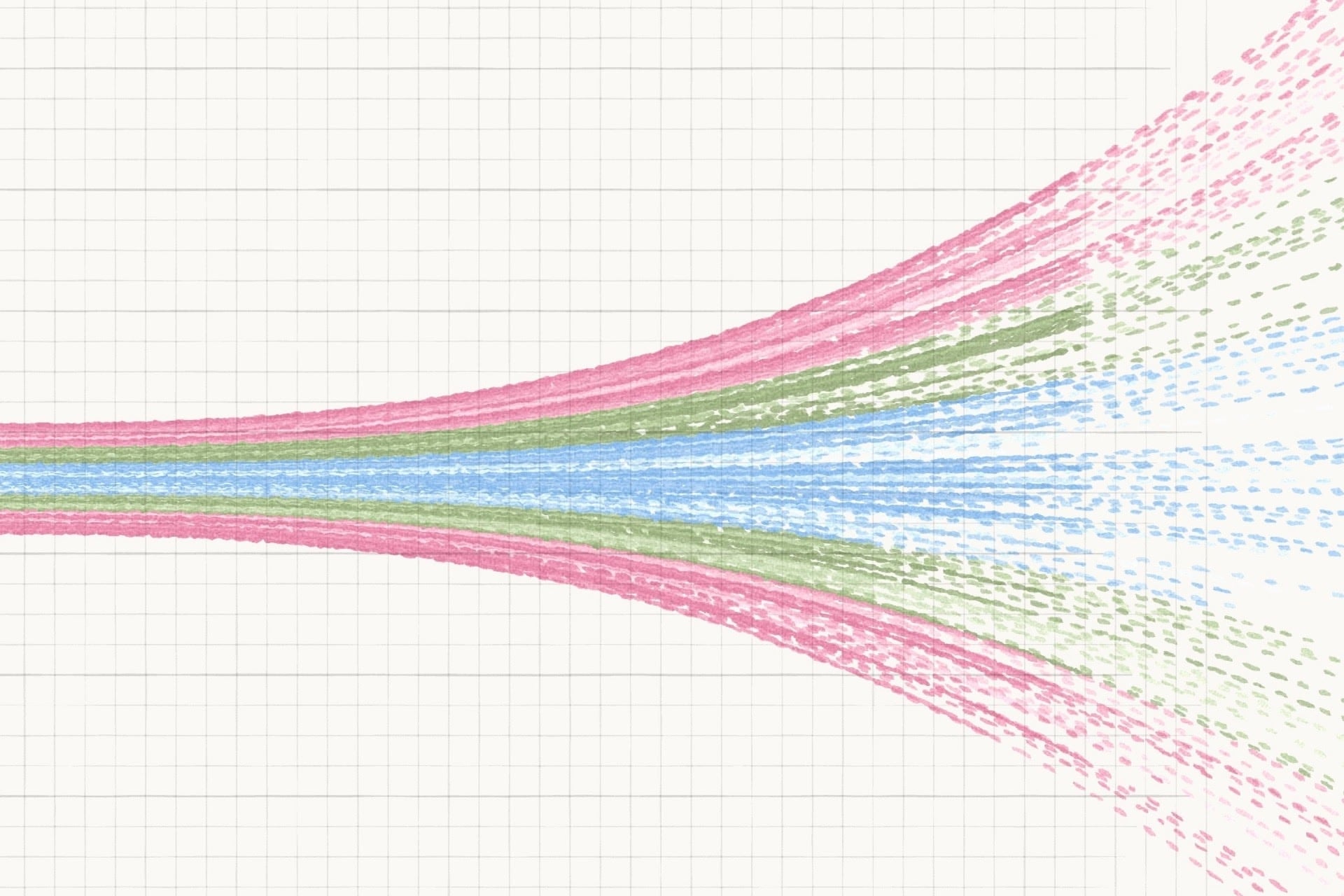
In the modest scenario, AI performs roughly as well as the internet did in its day: adding 1.6% to GDP by 2030, with unemployment within normal bounds and wages rising gradually. The intermediate scenario entrusts the machine with half the country’s intellectual tasks: annual growth doubles and unemployment climbs to around 5%. Nearly four in ten white-collar workers then change jobs, while their wages stagnate.
Then there is the extreme scenario, in which AIs capable of improving themselves outperform humans on the vast majority of intellectual tasks. US GDP would soar by 32% to reach $44.4 trillion, driven by 15% annual growth (the economy would double every four and a half years, something never seen before). The social cost follows the same trajectory: nearly one in five intellectual workers unemployed and cognitive wages running 11.5% below their trajectory without AI.The share of labor in national wealth would fall from 60% to 45% (capital, as often, does very well).
What about the plumbers in all this? The model predicts the opposite for manual trades: electricians, welders, and artisans see demand and wages increase in the most aggressive scenarios, with AI still not laying pipes (not yet, anyway). A survey conducted at the same time among more than 10,000 Americans shows that the typical respondent bets on the middle scenario; only one in ten believes the extreme version.
Anthropic’s CEO, reframed by his own model
This overview takes on a particular significance when one remembers Dario Amodei’s statements. In May 2025, the head of Anthropic predicted in Axios the possible disappearance of half of entry-level office jobs and unemployment of 10 to 20% within five years. Enough to give HR departments a few cold sweats at the time. These figures correspond very precisely to the in-house model’s extreme scenario, the one that one respondent in ten gives credence to and that the report takes care to characterize as an illustrative exercise.
Anthropic acknowledges this and states plainly that “the scenarios are not predictions.” The company had 18 economists review its copy, including Daron Acemoglu and David Autor (two leading authorities in labor economics, not exactly known for their enthusiasm for automation), while making clear that none of them endorsed the conclusions.The study nevertheless calls on public authorities to share the gains more widely rather than slow down technology (the opposite was hardly expected).
Read also: Bill Gates wants to reserve certain jobs for humans and tax machines
The finding itself is nothing new: as early as January 2024, the IMF estimated that 60% of jobs in advanced economies were exposed to AI, and Goldman Sachs counted 300 million jobs concerned. The novelty lies in the signatory, with no automation vendor having yet published the employment outlook for its own clients. Moreover, the model covers only the United States, and there is no obligation for the European labor market, which is more tightly regulated and often slower to adopt new technologies, to follow the same path.
👉🏻 Follow the latest tech news in real time: add 01net to your Google feed and subscribe to our WhatsApp channel.
Source: Anthropic








- Google Play Store
- 4K Video Downloader Plus
- VLC Media Player
- Adobe Reader
- uTorrent
- WinRAR
- Xender
- Google Chrome
- CCleaner
- Mozilla Firefox
- Avast Free
- ChatGPT
- Microsoft 365
- Opera One
- Avast One









Download
- Google Play Store
- 4K Video Downloader Plus
- VLC Media Player
- Adobe Reader
- uTorrent
- WinRAR
- Xender
- Google Chrome
- CCleaner
- Mozilla Firefox
- Avast Free
- ChatGPT
- Microsoft 365
- Opera One
- Avast One