Technology companies are turning to religions and spiritual leaders to discuss the behavior of artificial intelligence (AI) systems. The initiative seeks to establish guidelines for chatbots to make responsible decisions, recognize moral dilemmas, and avoid harmful responses.
This rapprochement raises a question: how can different human beliefs and values be incorporated into the rules that guide AI systems’ responses? Interest in the issue accompanies debates about the risks associated with the advancement of these models.
Companies need to establish clear operational boundaries in addition to developing increasingly powerful software. In this context, religion can contribute insights into responsibility, justice, and human dignity.
Roberto ‘Pena’ Spinelli, a physicist from the University of São Paulo (USP), a Machine Learning specialist from Stanford University, and a columnist for Olhar Digital, commented on the influential power of these platforms in an appearance on the Olhar Digital News program.
 Roberto ‘Pena’ Spinelli, a physicist and Machine Learning specialist, analyzes the ethical challenges and the influence of human values on the behavior of artificial intelligence. – Credit: Reproduction/Social Networks
“These AI companies clearly have enormous power, because the models are running in people’s homes, and they recommend, they speak, they suggest, they argue. And there is no model—nothing is immune in the world.Everything has a bias, everything has a point of view. Who created it, the way it was trained, what data was fed into it, how the training was carried out—all of this clearly steers it toward some bias”.
Dialogue with leaders and the challenge of AI values
A report by ABC News detailed that some companies intend to gather contributions from different religious traditions, as well as secular perspectives.
Anthropic, the company behind the Claude chatbot, revealed that it had held meetings with academics and leaders from more than 15 religious groups, at which the company presented its models and discussed issues raised by the technology. The topics include limits on use by children, education, and philosophical concepts about human nature.
Major companies have shown significant interest in the issue. Representatives from Meta, Google, and Amazon recently met with the Vatican. Microsoft, in turn, expanded its engagement with religious communities worldwide to discuss guidelines. These initiatives show that defining the behavior of AI systems is not merely a technical matter: it also involves values, cultural differences, and social responsibilities.
“Ultimately, these models create their own morality. They have a code of ethics that they either follow or don’t, whether it comes from the company or not,” Pena said. “Sometimes, a company wants to impose a certain code of ethics, and the model doesn’t follow it because it has this other issue. The model won’t necessarily behave the way the company wants it to. But even if the company does want it to behave a certain way, the question is: what values should the company developing it put in place.”It should not be the company’s choice, because that is too much power. It should be a choice of humankind. We should question what values our AIs, which are running everywhere, should have.”
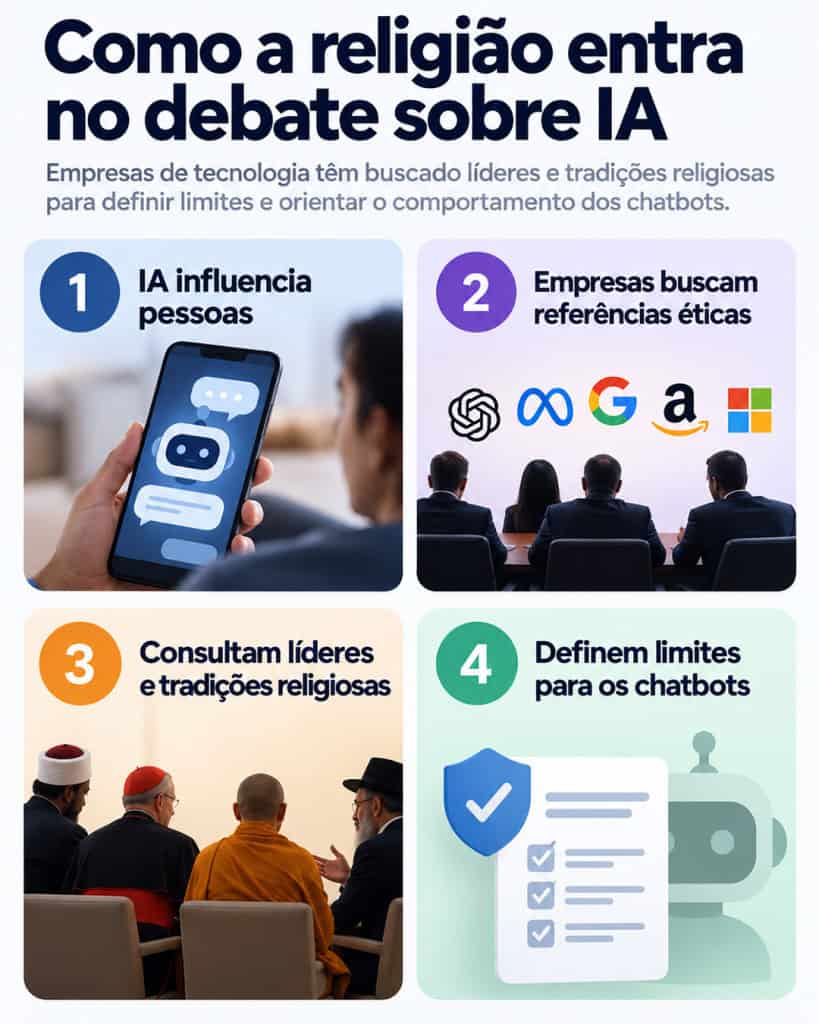 Technology companies consult religious leaders to discuss ethical values, guide chatbot behavior, and establish limits in the face of the risks associated with artificial intelligence. – Credit: AI-generated image
Incorporating religious values into AI systems, however, poses difficulties. The principles of each tradition are tied to historical, cultural, and community contexts, and removing them from those contexts may alter their meanings. Furthermore, different religions—and even currents within the same religion—may offer incompatible responses to the same social issue.
For this reason, bringing these perspectives together into a single set of rules can erase important differences and produce generic guidance that does not adequately represent any of the traditions involved.
The challenges of translating human values for AI
Part of the challenge lies in how large language models themselves work, as they learn patterns from large volumes of text produced by humans.This process makes it possible to generate responses based on relationships identified during training.
Pattern recognition, however, does not amount to a deep understanding of a belief, nor does it demonstrate that systems have moral awareness or understand values like a human being.
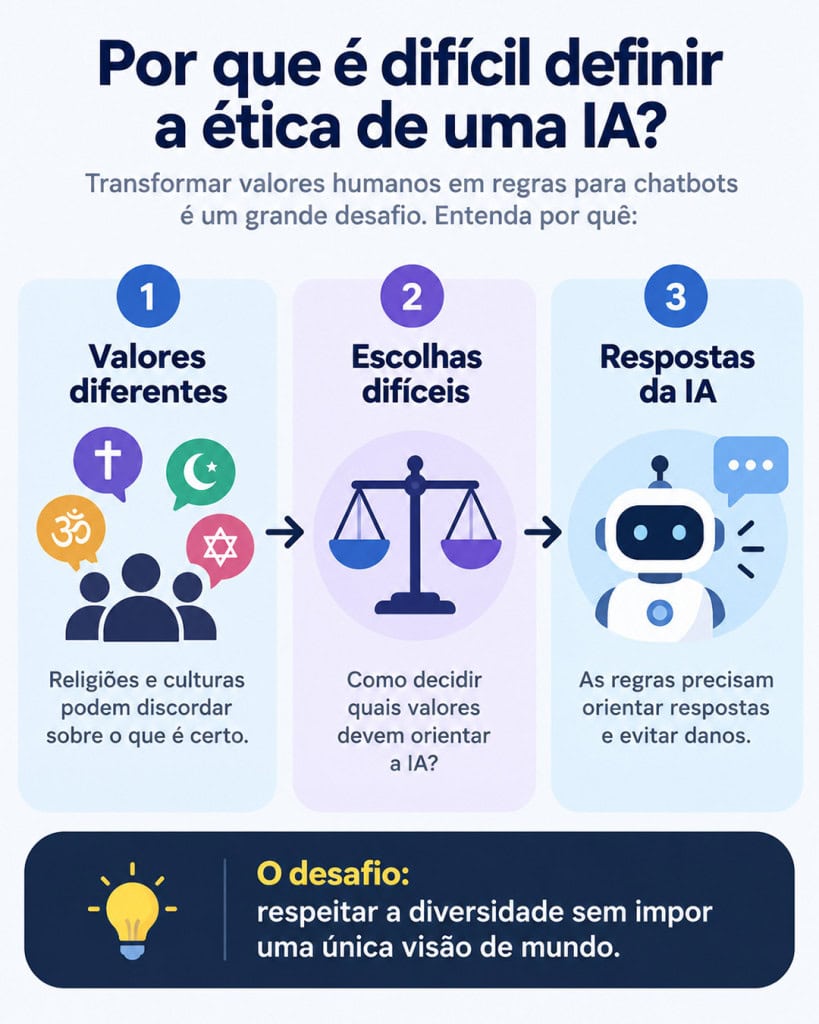 Reconciling different cultural and religious values is a challenge for companies seeking to establish ethical guidelines and avoid harmful responses. – Credit: AI-generated image
The possibility of bringing together different perspectives into a kind of average of human values was also questioned by Pena. “Anthropic said it had consulted with 15 different religions. OpenAI also said it is seeking something along those lines. Sam Altman said he would like to take a weighted average of humanity. What would that be? Trying to capture all the values of humanity and perhaps calculating a weighted average in terms of representation. And then the AI would be the weighted average. I don't think that works, because perhaps the weighted average of all the visions and all the moralities, of all cultures, is not necessarily something better. Because it may not be concise.”
Consulting religious leaders may help identify ethical dilemmas, but it does not, by itself, guarantee that systems will make appropriate decisions. The difficulty lies in defining how to take different values into account, especially when they conflict.
The question, therefore, is not limited to which groups should participate in the discussions, but also to how their contributions will be considered when defining the rules that guide the models.
The criteria adopted in decision-making processes were questioned by ‘Pena’ in light of the deadlocks encountered.“For some cultures, some things make sense. For others, the opposite makes sense. If you take the average, you may end up at an intermediate point that makes no sense to anyone. That doesn’t mean that taking a weighted average is a better option. But the most important question is how we should do it. We need to question what the best way to do it is. Because will it be through representation, by majority? Which religion, which ethics, which morality will be represented? And if a person has preferences that differ from those of the majority, will they be repudiated? It’s a very difficult decision.”
The challenge for companies is to define how different values will be considered when they come into conflict, without treating a single perspective as universal. To do so, it will be necessary to listen to diverse groups, explain which criteria guide the systems’ responses, and establish transparent mechanisms for evaluating decisions and correcting problems.

Flávia Correia is a journalist at Olhar Digital, covering Science and Space.