If one AI-enabled specialist can do the work of ten, what will the other nine do?
(c) John Maynard Keynes
Imagine an ordinary Monday at a company. A developer builds in an hour a prototype of a feature they previously budgeted a week for. By lunchtime, a marketer has twenty advertising campaign options. An analyst builds a report in a few minutes and explains why sales have fallen. A manager first celebrates the productivity boost and then opens the staffing schedule. But there is no need to imagine—something similar already exists somewhere.
 Vlad Lukashenko
Head of SEO & Web Analytics at Tensor (developer of saby.ru), author of the Telegram channel “VladPRO”
For more than 10 years, I have worked in analytics, SEO, and team management in digital marketing. And on my Telegram channel and on mywebsite, I write even more about all sorts of things in real-world marketing. I advise on web project analytics and marketing tool configuration, and help conduct technical interviews with specialists across different traffic types.
So, the conversation about AI is no longer a conversation about the future. The machine does not have to write error-free code, create brilliant advertising, or understand business better than a human. It only needs to produce an acceptable result cheaply enough that the client no longer wants to pay for the same number of human hours as before.
This arithmetic leaves out the second half of the equation. When a service becomes cheaper, those who could not previously afford it start buying it. When production speeds up, products emerge that previously did not cover their costs.And around a new product emerge implementation, oversight, servicing, and entirely unexpected ways to earn money.
Therefore, the question is not: “Will AI take away the jobs of programmers, marketers, or doctors?” For certain individuals and entire professions—yes, it will. The question is different: will new demand create more human work than automation will destroy?
History offers no ready-made answer, but it reveals a mechanism. I have decided to divide this essay into two parts because it is too long. In the first, historical part, we will examine why machine looms, electricity, computers, and the internet did not bring employment to an end. In the second, futurological part, we will examine where the same mechanism might come into play in the AI era—and where the analogy with past revolutions may mislead us.
Why work still has not disappeared
The historical data in this part are predominantly American: they make it easy to see long time series and specific mechanisms, but they do not guarantee the same result in every country.
The loom reduces employment. Cheap fabric creates demand
A mechanical loom really does eliminate jobs. If a factory needs to produce the same amount of fabric and one weaver now produces several times as much, some workers become redundant. The Luddites were not wrong to believe that a machine could destroy jobs. They would have been wrong to think that this was where the story ended.
The loom lowered the cost of fabric. Buyers who had previously economized on clothing and household textiles could afford more. Factories expanded production; they needed raw materials, transportation, equipment maintenance, management, and sales.James Bessen traced this cycle over two centuries of data on the American textile, steel, and automobile industries: productivity growth was accompanied for a long time by employment growth until markets neared saturation. After that, further automation could reduce the number of workers. Bessen, Automation and Jobs: When Technology Boosts Employment.
This was the first important boundary. Technology creates jobs as long as falling prices bring enough new buyers.
Railroads had a different mechanism. They both made an existing service cheaper and created infrastructure that had not existed before. During the construction of the first transcontinental line in the United States, more than eight thousand European immigrants worked for the Union Pacific, and more than ten thousand Chinese workers worked for the Central Pacific. Private business was in no hurry to shoulder all the risk, so the government provided land and financing. National Archives, Pacific Railway Act.
Here are two new sources of employment: expanding the production of things that had become cheaper and building things that had become technically possible.
The automobile creates jobs far beyond the factory gates
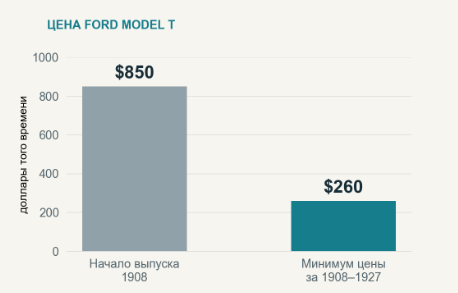
From 1908 to 1927, Ford produced more than fifteen million Model T cars. The minimum price of a car during this period fell from an initial $850 to $260. The assembly line reduced the amount of labor required for each car—and at the same time helped turn the automobile from an expensive toy into a mass-market product. The Henry Ford, Henry Ford and the Assembly Line.
If you look only at the assembly operation, people lost out to the machine. If you step back a few paces, a different picture emerges.Millions of cars had to be sold, insured, fueled, and repaired. Roads, motels, and service stations were built for them. The automobile changed the geography of trade and made new forms of transportation possible. Jobs were created not because the assembly line was “worker-friendly,” but because a new system of consumption had grown around the inexpensive automobile.
Even this effect was distributed unevenly. A study of the electrification of American industry from 1890 to 1940 showed that, in industry groups within counties where firms were initially small, electrification was accompanied by growth in output and employment. Among groups with large enterprises, productivity could rise without a noticeable expansion of employment. Fiszbein et al., Powering Up Productivity.
It is therefore insufficient to evaluate technology solely by the number of employees at a single automated enterprise. Nor can overall market growth be extrapolated to each individual company: one firm will expand output, while another, using the same equipment, will cut a shift.
The ATM did not make the teller obsolete. It changed the economics of the branch
The history of ATMs has become an almost mandatory argument in the debate over automation—and, despite being repeated constantly, it remains instructive. In the United States, the number of ATMs grew from approximately 100,000 in 1995 to 400,000 in 2010. It seemed that all that was left for the bank teller was to disappear. Yet the number of tellers increased from approximately 500,000 in 1980 to 550,000 in 2010. David Autor, Why Are There Still So Many Jobs?.
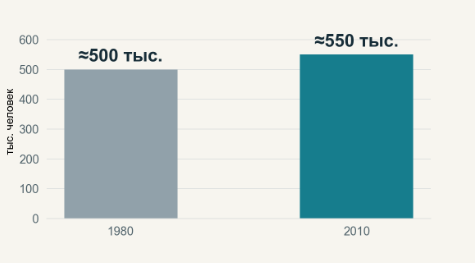
The ATM took over cash dispensing, but at the same time reduced the cost of branch operations.Banks were able to open more locations, while employees shifted to sales and customer service. Automating a single transaction changed the economics of the entire service.
Now this story is repeating itself: online banking and further automation are already reducing demand for tellers, as reflected in the forecast of the U.S. Bureau of Labor Statistics. BLS, Tellers.
At the same time, computers were creating specializations that could not be seen from behind a bank branch counter. U.S. occupational classifications came to include computer applications engineers, electronic circuit designers, and, later, cybersecurity analysts. Researchers New Frontiers estimated that roughly 60% of U.S. employment in 2018 was accounted for by occupational titles added to the classifications after 1940. This does not mean that all of them arose thanks to computers; incomes, medicine, culture, and demand for services were changing. But the range of human work truly had not remained frozen in place. Autor et al., New Frontiers, 2024.
At the same time, new specializations were emerging. They were difficult to predict from the disappearing transaction: servicing an ATM does not capture the new economics of computers.
The Internet destroyed the familiar retail landscape—and built another
The Internet clearly shows why the “created or destroyed” debate is almost always framed too crudely. It hit catalog companies, travel agencies, print advertisements, and many intermediaries.At the same time, he needed warehouses, couriers, developers, and specialists in payment systems, search optimization, cybersecurity, and buyer behavior analysis.
From December 1997 to December 2016, employment in the U.S. e-commerce and mail-order category grew from 212,600 to 380,100 people—almost 80%. There were downturns after the dot-com bubble and the 2008 crisis, rather than a smooth line of technological triumph. BLS, Employment Growth and Wages in E-commerce.
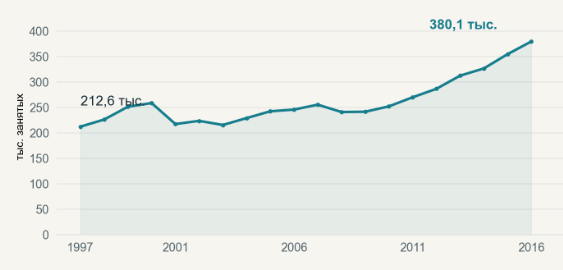
The future economy is clearly not limited to today's list of professions. But a new job appears only when someone is willing to pay for its output.
The Main Formula of the Technological Revolution
All four stories can be reduced to simple arithmetic. Suppose an order used to take ten hours and took five after automation. If there were still 100 orders, the amount of human labor fell from 1,000 to 500 hours. For there to be more work, the number of orders would have to more than double.
Where does this growth come from? Sometimes existing customers order more because the price has fallen. Sometimes new customers come along. Sometimes a product comes into existence that did not exist before. And sometimes a long chain of physical, organizational, and intellectual work grows around the automated core.
TAG118@@Productivity does not create jobs on its own. It lowers the cost of the opportunity. Then demand settles everything.TAG120This is why history does not promise us a happy ending. It gives us something more useful: a criterion by which to test predictions. Merely calling a profession “AI-enhanced” is not enough.We need to show the new service, the new customer, and the reason why the savings from one operation will not translate entirely into staff reductions.
What the first part showed
The lessons from previous technological revolutions can be reduced to four conclusions:
automation really does eliminate individual tasks, jobs, and sometimes entire professions;
- TAG133@@employment grows only when lower prices bring enough new buyers or create a market that did not previously exist;
- TAG137@@new jobs more often arise outside the automated task—in infrastructure, implementation, maintenance, oversight, and related services;
- TAG141@@this growth is unevenly distributed and does not last forever: an industry can expand while a particular company cuts staff, and market saturation can reverse the effect of technology.
TAG144Productivity alone does not guarantee anything. To understand the implications of AI, we need to look not only at how many hours it saves, but also at which services will become available as a result, who will start buying them, and how much human labor will remain around the outcome.
In the second part, I’ll reflect on what, exactly—not professions, but entire fields—AI will open up for us.I will base my reasoning specifically on these four conclusions, so don’t expect futurological predictions in the vein of 20th-century science-fiction writers.
By the way, if anyone is interested in my reflections on AI, you can read my previous ramblings; there still seems to be an active discussion in the comments.
The machine uprising is called off: why intelligence without goals of its own has not yet become reason




