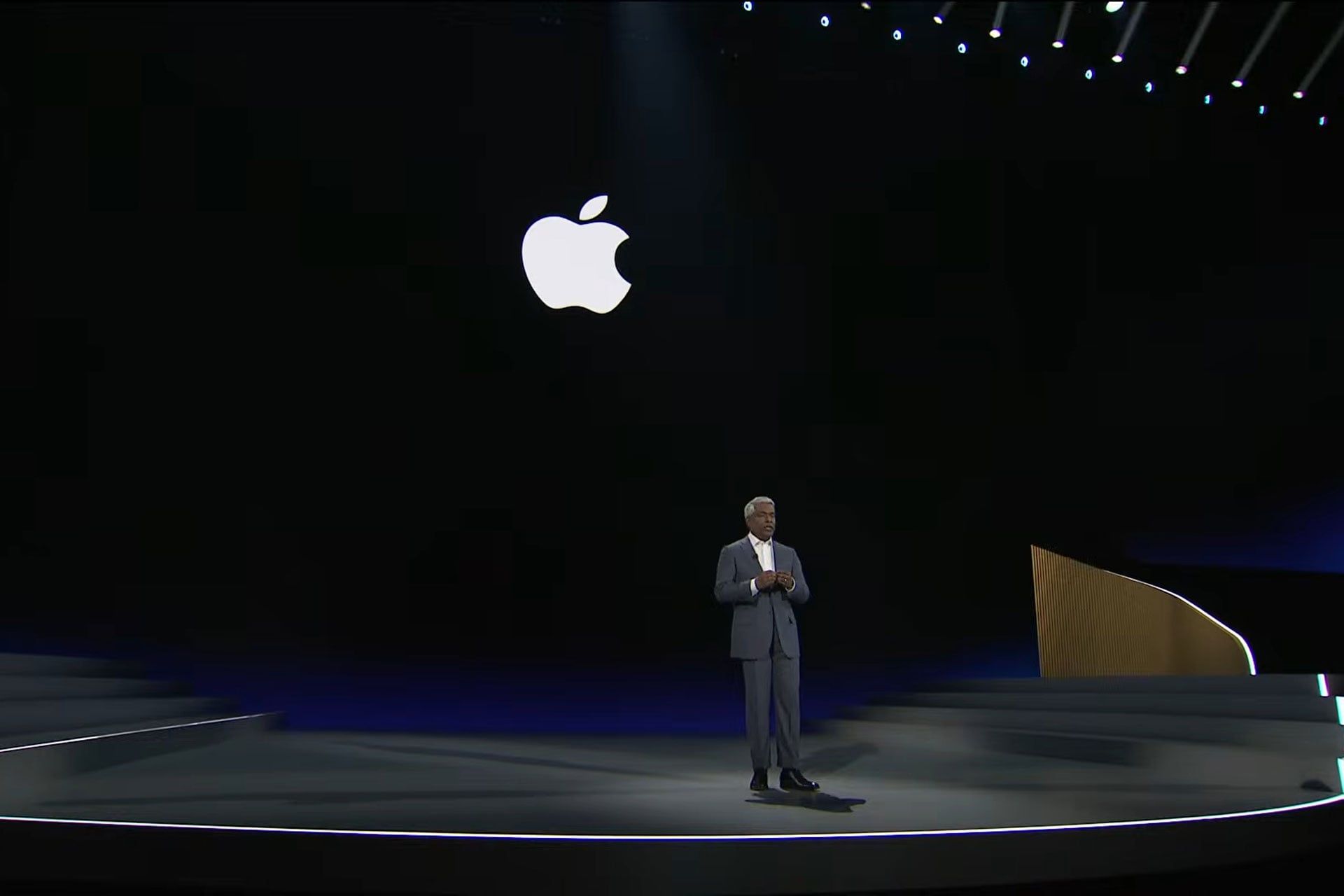
 At its Cloud Next 2026 event, Google boasted of being Apple's “preferred cloud partner” with the redesign of Siri © Screenshot 01net.com / Google
To save Siri, Apple obtained full access to Google's Gemini models. The goal: to compress them so that they work offline on the iPhone.
Apple, which has built its brand around privacy (“what happens on your iPhone stays on your iPhone”), will build the new intelligence of its devices using models from its archrival Google.The partnership, made official in January 2026, is taking an unexpected turn: Apple will “distill” Gemini to make it fit inside your iPhone’s chip.
Distillation, or how to fit an elephant in a shoebox
The technique at play is called knowledge distillation. The principle is simple on paper: a huge “teacher” model (here, a custom-built Gemini with approximately 1.2 trillion parameters) is used to train a much smaller “student” model, on the order of 3 billion parameters, capable of running locally on an iPhone without an internet connection.
Google has granted Apple full access to Gemini in its data centers. This is no small thing: Apple’s engineers can observe the model’s internal calculations, reasoning, and thought processes, and use them to train their own miniature version. The result would be a small model far more effective than simply imitating the final answers.
Privacy, really?
Apple insists that distilled models will run directly on the device, without an internet connection, to handle sensitive personal context (calendar, notes, messages). Personal data would never leave the iPhone for the majority of everyday tasks. For complex requests requiring broader knowledge, the system would switch to the cloud via Apple’s Private Cloud Compute architecture.
The problem is that Tim Cook and Sundar Pichai gave contradictory accounts of the partnership during their latest quarterly earnings calls. Google positions itself as Apple’s “preferred cloud provider,” suggesting that the data does indeed pass through its servers at some point. Both companies refuse to disclose the details of the agreement. Under these circumstances, it is difficult to take the privacy promises at face value.
An admission of weakness
Before this shift, Apple relied on its own in-house models: about 3 billion parameters on-device, along with a more powerful server-side model. But these models were considered behind GPT, Gemini, and Claude. The “new Siri,” originally promised at WWDC 2024, was postponed several times. Distillation of Gemini is Apple’s means of obtaining frontier-level intelligence without possessing the massive infrastructure required to train it.
The estimated cost of the operation is close to $1 billion a year. Apple already receives about $20 billion a year from Google to remain the default search engine in Safari. Google has thus become one of Apple’s largest suppliers and financial partners. Daniel Ives, an analyst at Wedbush Securities, sees this as “pragmatic recognition that Apple cannot win the AI race on its own.” The WWDC on June 8 will reveal whether the promise of an offline, intelligent Siri holds up, or whether Apple has simply found an elegant way to outsource the work of making up for its delay.
👉🏻 Follow the latest tech news in real time: add 01net to your sources on Google and subscribe to our WhatsApp channel.

Source: The Information







- Google Play Store
- 4K Video Downloader Plus
- VLC Media Player
- Adobe Reader
- uTorrent
- WinRAR
- Xender
- Google Chrome
- CCleaner
- Mozilla Firefox
- Avast Free
- ChatGPT
- Microsoft 365
- Opera One
- Avast One









Download
- Google Play Store
- 4K Video Downloader Plus
- VLC Media Player
- Adobe Reader
- uTorrent
- WinRAR
- Xender
- Google Chrome
- CCleaner
- Mozilla Firefox
- Avast Free
- ChatGPT
- Microsoft 365
- Opera One
- Avast One




