November 5: Alibaba Releases the “2026 AI for Good Action Report”
On November 5, Alibaba released the “2026 AI for Good Action Report,” revealing its latest efforts to develop responsible AI and use AI to create social value. The report presented 26 cases spanning education, healthcare, environmental protection, scientific research, and other fields. Sustainable data center development and the achievements of “AI + healthcare” innovation attracted considerable attention. Wu Zeming, Alibaba Group’s Chief Technology Officer and Chairman of the Technology Ethics Governance Committee, said that AI development must meet three requirements: social acceptability, environmental carrying capacity, and economic sustainability. The industry is currently in a period of rule formation, and technology companies should actively create social value and ensure that the direction of AI development serves human well-being.
Cover of Alibaba’s “2026 AI for Good Action Report”
Substantially Improved Resource and Energy Efficiency in Data Centers
In 2025, Alibaba became the first in the industry to publish the “AI for Good Action Report.” This year, it published the report for the second time, continuing to address public concerns. Over the past year, global AI infrastructure expanded on a massive scale. Because data center construction is closely tied to social acceptance, environmental carrying capacity, and economic sustainability, it has become a public issue attracting attention across sectors.
Alibaba Cloud is China’s largest cloud and AI services provider and plans to have a global data center capacity of more than 20 gigawatts by 2032. Wang Chaoyang, Global General Manager of Data Centers at Alibaba Cloud Intelligence Group, said that the construction and operation of data centers has brought in a large number of professionals from other industries and provided new roles for some workers displaced by industrial transformation and upgrading. Some localities have also undergone transformation because of data center construction. Ulanqab, for example, a city in Inner Mongolia renowned for its abundant potato production, has added the moniker “Token Capital” alongside its “Potato Capital” identity, opening up new opportunities for future-oriented development.
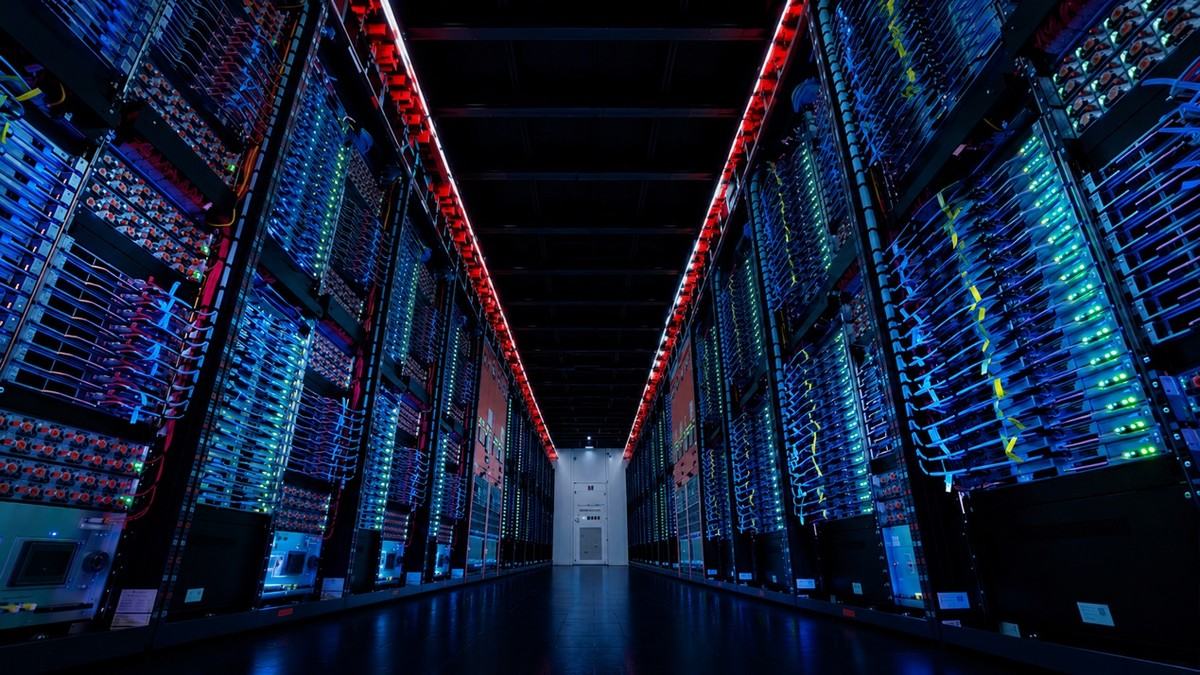
Alibaba Cloud AI Data Center
Data center construction involves resources and energy such as land, electricity, and water. Wang Chaoyang said that Alibaba Cloud is working hard to improve the resource and energy efficiency of its data centers. In terms of land, Alibaba Cloud pursues “power density per unit of land” to increase the IT capacity supported per unit area. Over the past two years, by leveraging the advantages of high-density, vertically integrated design, Alibaba Cloud increased resource density from 0.8 kW/m² to 4.5 kW/m². By next March, it will double again to 9 kW/m². In terms of electricity, Alibaba Cloud has fully utilized local renewable energy resources, increasing the share of green power by 73.6% and achieving 100% green power in Guangdong, Jiangsu, and Sichuan. In addition, it uses air cooling and liquid cooling according to local conditions, reducing PUE (power usage effectiveness) to 1.187. In terms of water resources, Alibaba Cloud’s data centers in Ulanqab and other locations recover and reuse nearly 136,000 tons of reclaimed water annually. By continually increasing the share of green power, optimizing power usage efficiency, and exploring water conservation and recycled water use, Alibaba Cloud is developing data center “carbon neutrality” and “water neutrality” strategies and pathways with Chinese characteristics.
Through innovative infrastructure technologies, Alibaba Cloud’s fully modular data centers also have strong global competitiveness in terms of economics. Wang Chaoyang explained that the traditional delivery timeline for large data centers in China is 6–12 months, while that in the United States is 12–18 months. Alibaba Cloud pioneered a fully modular design architecture, shortening the delivery period to 100 days while reducing overall construction costs by more than 10%. This acceleration and cost reduction are the result of Alibaba Cloud’s commitment to prioritizing in-house and joint R&D and working with “industry-academia-research-application” ecosystem partners to drive upgrades across the industrial chain.Taking the data center power supply technology “Panama Power” as an example, it was jointly developed by Alibaba and several companies. By bypassing the multi-stage conversion process in traditional architectures, it enables one-step power delivery, reducing the footprint by 50% and the number of components by 40%, while achieving power module efficiency of up to 98.5%. At a time when high-voltage DC power in AI data centers has become a certainty, it has become the ideal choice for the entire industry. “As computing power infrastructure develops, China’s intelligent manufacturing is opening up new sources of incremental growth.” Wang Chaoyang said.
AI is rapidly strengthening society’s collective ability to combat disease
The “Alibaba 2026 AI for Good Action Report” shared 26 examples of Alibaba’s “AI for Good” practices over the past year, covering critical areas affecting people’s livelihoods, including healthcare, education, environmental protection, and scientific research. Sun Lijun, President of Alibaba Group Public Welfare and Chairman of the Alibaba Foundation, said, “Doing good” must be “for the people”; only by making AI accessible to the masses can it create the greatest value. Over the past few years, Alibaba has focused its efforts on addressing challenges in livelihood sectors such as healthcare and education, and “AI + healthcare” innovation is rapidly strengthening society’s collective ability to combat disease.
AliHealth has launched an AI-native application for doctors called “Hydrogen Ion,” opening the door to “evidence-based medicine AI.” By evidence-based, we mean “following the evidence”: medical decisions are not made by mechanically applying theories, but by combining the best research evidence, the clinician’s personal experience, and the patient’s actual condition and wishes. What “Hydrogen Ion” seeks to build is precisely an evidence-based medicine-driven decision-support system that assists doctors with evidence retrieval, differential analysis, and clinical decision-making.
Starting with professional evidence and reasoning mechanisms, “Hydrogen Ion” addresses the shortcomings of general-purpose AI in accuracy, reliability, and traceability. To date, “Hydrogen Ion” has entered into content collaborations with leading international medical journal institutions and authoritative domestic academic institutions, and has joined forces with top industry experts to establish a Medical AI Expert Committee and jointly develop evaluation standards and datasets for medical AI. On this foundation, it has established an inference mechanism driven by a “four-layer evidence-based AI architecture,” constraining AI’s use of medical evidence within the evidence-based medicine framework and simultaneously presenting physicians with evidence sources, levels of evidence, scopes of applicability, and limitations. Wang Xiangzhi, CTO of AliHealth and head of “Hydrogen Ion,” disclosed at the launch event that “Hydrogen Ion” has already achieved 100% evidence grounding and 98% evidence fidelity in medical scenarios. Its trustworthiness and reliability are among the most important reasons why an increasing number of physicians use it to assist with clinical practice and research.
To solve the problem of large-scale, low-cost early screening for cancer, Alibaba’s DAMO Academy introduced a “non-contrast CT + AI” solution in 2023. Based on CT, the most widely used imaging examination, it uses AI to identify subtle lesions and has successively made breakthroughs in pancreatic cancer and gastric cancer. At the launch event, Zhang Ling, project lead of DAMO Academy’s “Multi-Cancer Early Screening” project, said the project had made further progress this year, launching dedicated models for detecting colorectal cancer, liver cancer, esophageal cancer, and other cancers while accelerating R&D for breast cancer, kidney cancer, and other cancer types.
Zhang Ling said that the addition of AI is expected to expand healthcare capacity, improve hospital efficiency, and help doctors overcome the limits of human visual interpretation, going beyond the limitations of focusing only on a single lesion. Without requiring changes to existing diagnosis and treatment workflows, it maximizes the value of a single CT scan, reducing the number of examinations and radiation exposure for patients and easing their financial burdens. At present, DAMO Academy’s “non-contrast CT + AI” solution has benefited more than 20 million people in 11 countries and regions.
DAMO Academy is advancing medical AI from disease-specific models toward general-purpose models, collaborating with institutions including the First Affiliated Hospital of Zhejiang University School of Medicine. It recently unveiled DAMO RADAR, a general-purpose medical imaging AI model capable of identifying more than 146 diseases in a single pass, with its accuracy reaching expert radiologist level for the first time. The results were published in the internationally renowned academic journal Science. Alibaba open-sourced the model immediately.
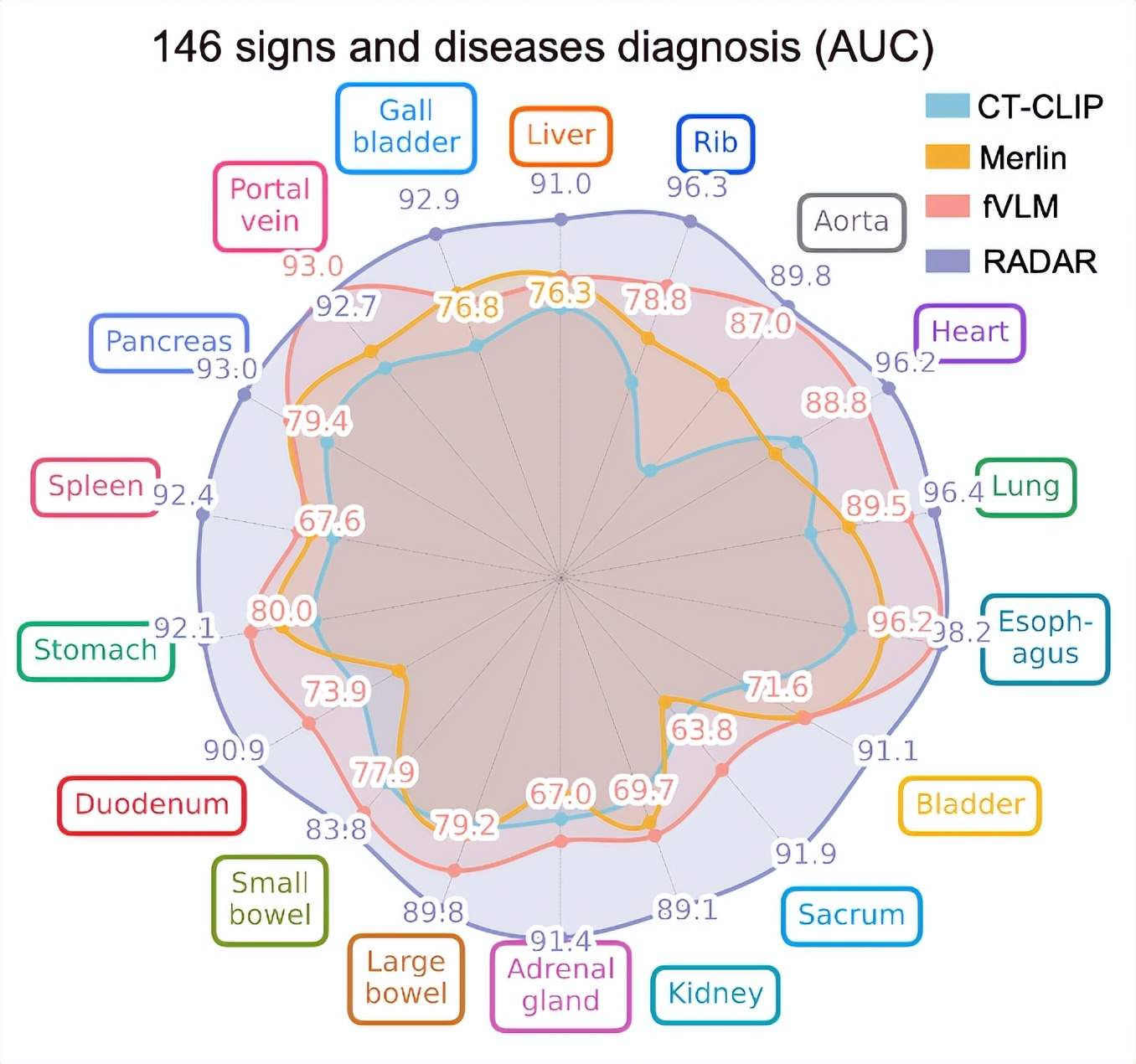
DAMO RADAR, DAMO Academy’s general-purpose medical imaging AI model, can identify more than 146 diseases in a single pass.
The youngest presenter at the launch event was only 18 years old. His name is Liu Sizhe, a second-year student in the Special Class for Young Innovators at the University of Science and Technology of China. Liu Sizhe and his classmates used the university’s medical dataset resources and, building on Qwen’s open-source multimodal model, developed an AI-based voice early-screening product for Alzheimer’s disease, which they named “Forget Me Not.” Liu Sizhe explained that when an elderly person speaks with the product face to face, the AI initially assesses the person’s cognitive risk through speech and acoustic features such as speech rate, pauses, metaphors, semantic coherence, and response patterns. At this year’s “Xiaoyou Kewei” AI for Good Innovation Challenge, “Forget Me Not” won first prize. The Liu Sizhe team went on to develop interactive terminal hardware, which has now been put into use in some communities in Nanjing.
Lü Peng, a researcher at the Artificial Intelligence Research Promotion Center of the Chinese Academy of Social Sciences, believes that what Liu Sizhe is doing is not only AI research and development, but also social work. “From production variables to life variables, AI’s social impact will ultimately reach everyday life. The end destination of AI is life.” Lü Peng proposed the concept of “Life AI.” He said, “The time, attention, and choices released by AI must ultimately be used by people and transformed into their capacity for life, including aesthetics, leisure, human relationships, and so on.”
This article was provided by Alibaba. QbitAI has been authorized to reprint it, and the views expressed belong to the original author.




