Smartphones have become thoroughly widespread even among older people. In January, the NTT DOCOMO Mobile Society Research Institute surveyed 1,300 people aged 60 to 84, finding that smartphone ownership was 95 percent among those in their sixties, 86 percent among those in their seventies, and 69 percent even among those aged 80 to 84. Smartphone apps are convenient, but people may forget passwords they have set, and leaving passwords stored on their phones these days also raises concerns about unauthorized use.
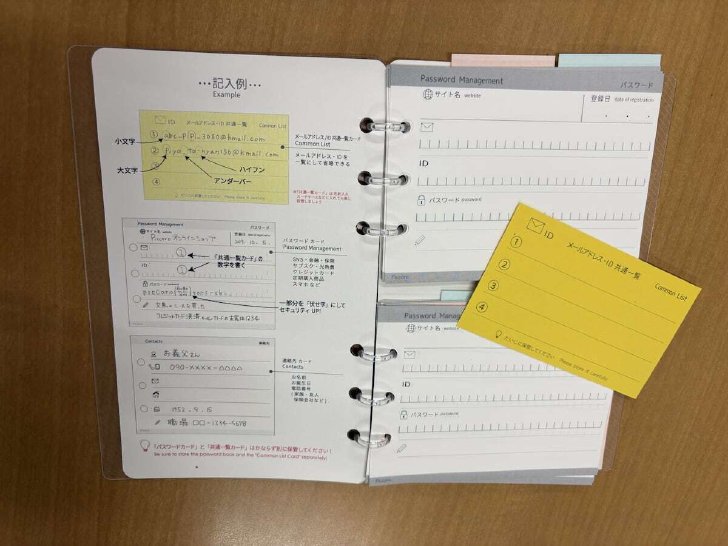 “Pasurakucho,” which manages email addresses and IDs on a yellow card separately from passwords (photographed by Maki Tanaka)
Piccolo, a general-goods shop in Hongo, Tokyo, therefore created “Pasurakucho,” a dedicated password-management notebook that, despite being an analog approach, makes information easy to protect. Small cards on which to write the names of apps (services) being used, registered passwords, and other information are bound into a binder that opens and closes, making it easy to manage information, including replacing and updating it.
The cards bound into the binder are used only for service names and passwords. The major feature is that email addresses and IDs, which are commonly used across all services, are written and managed on a card separate from the notebook. This reduces the risk of unauthorized use even if one or the other is lost or seen by someone else.
Makiko Imai of the same shop encourages people to incorporate “coded writing,” such as using numbers for a grandchild’s birthday and letters for a pet’s name.
As part of end-of-life preparations, Yusuke Furuta of the Digital Legacy Study Group recommends writing the password used to unlock a smartphone screen on paper. The method is simply to write it on thick paper the size of a business card and then cover it with multiple layers of correction tape. The tape can be peeled off with a coin or similar object.
Furuta, however, also strongly insists that instead of writing the password itself, it should be “encrypted” by incorporating information that only family members can understand. (Maki Tanaka)

