Replicating a Physical World
Jay sent from the Office, Quantum Bit | Official Account QbitAI
What, robots can already take over hotel laundry rooms??
It collects your dirty laundry from the guest room, navigates narrow corridors on its own, and intelligently avoids obstacles.
Then it takes the clothes out and loads them into a basket;
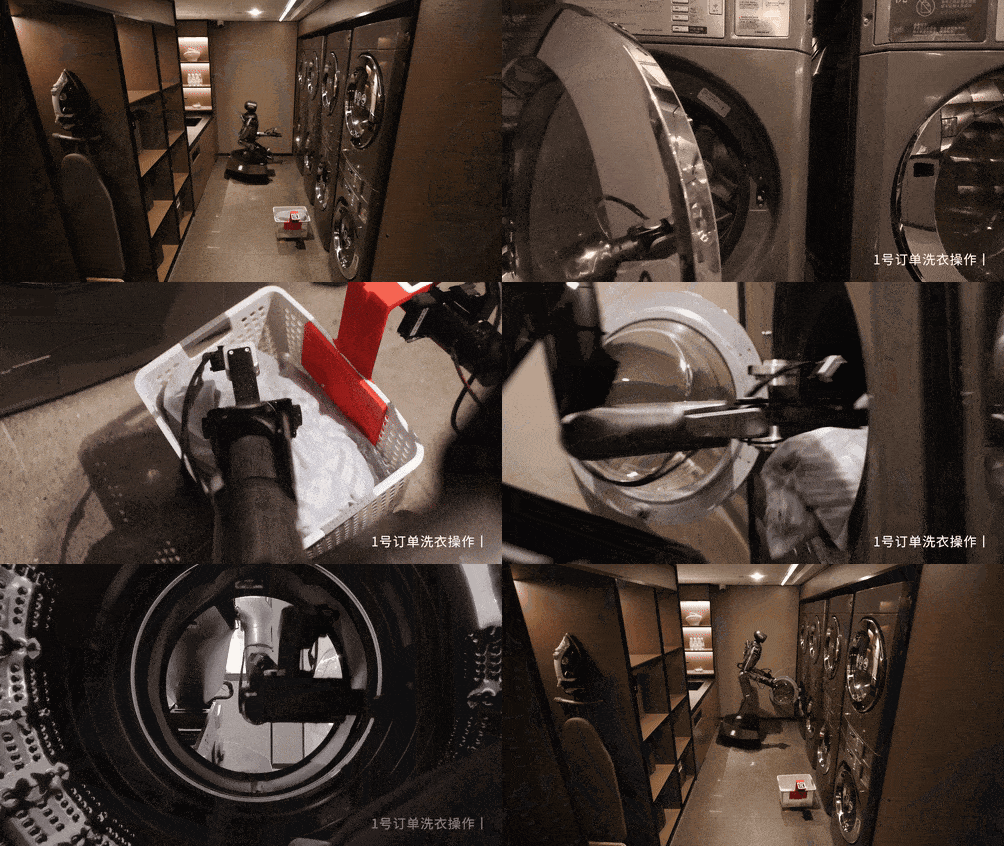
Then it accurately identifies and presses the start buttons on the washing machine and dryer;
Finally, it takes the clothes out and delivers them back to your room...
The entire process is as smooth as silk.
I know, you might think washing and drying clothes doesn't sound even a little Fancy.
But trust me, handling deformable objects and completing an entire long-horizon sequence of tasks in a real, dynamic, non-standardized environment is absolutely hellishly difficult in the robotics world.
Today, Daxiao Robotics has provided a new solution—
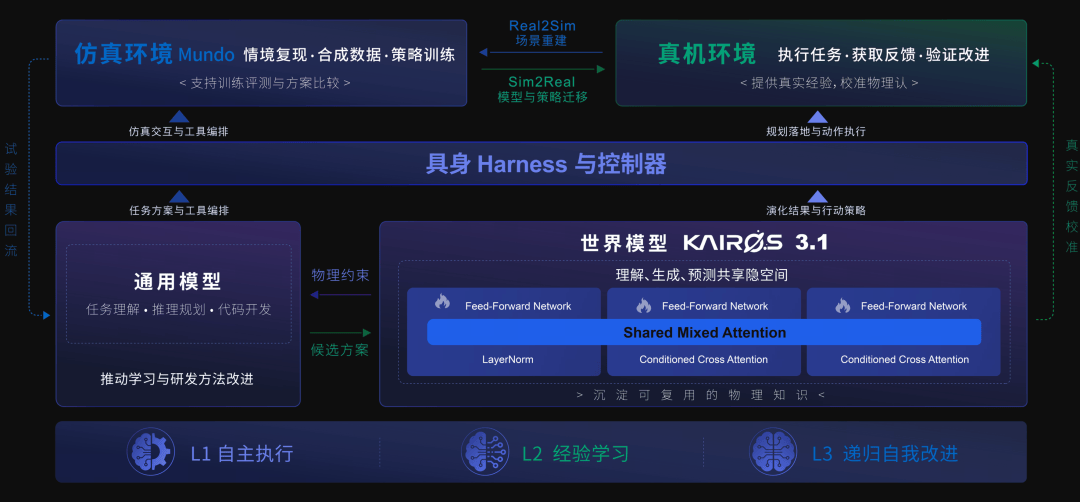
Dual-Brain (World Model + Astra)
Collaborative Architecture + Embodied RSI.It’s absolutely crazy buff-stacking...
Replicating a Physical World
Hotels are actually a very suitable “lighthouse” use case for real-world embodied AI deployment.
On the one hand, hotels commonly face difficulties hiring night-shift staff, high labor costs, and concentrated service demand during holidays;
On the other hand, Daxiao chairman Wang Xiaogang said that part of the motivation was also to show off the company’s technical prowess.
Laundry service involves multiple stages—collecting the laundry, transporting it, operating the equipment, washing and drying, and returning it to guest rooms—all of which place high demands on robots’ spatial understanding, precision manipulation, and long-horizon task planning.
This is also an important reason we chose the hotel setting: rather than asking the robot to complete a few isolated actions, it requires the robot to continuously perform a full service workflow in a real environment.
Traditional robots generally can only perform fixed tasks under preset conditions; once the environment, objects, or task changes, reprogramming or human intervention is required.
However, it is not easy for robots to enter hotels and start working either; they often encounter a major obstacle right from the start—
Cold start.
Just think about it: when you buy a robot vacuum for your home, you first have to let it roam around the entire house to build a map.
Now, if a more complex robot were to go to work at a hotel, it would not even know which way the guest room doors open or what a washing machine looks like.
So the industry’s long-standing approach has always been to first “rehearse” in the digital world.
This is the “spatial intelligence” direction that Fei-Fei Li has been talking about. The most tangible example is something like Atlas: do 3D reconstruction to scan out the scene’s geometric appearance.
But the problem is that, fundamentally, it is still a static mock-up room that you can look at but not interact with.
It has no physical properties.
What does that mean? In other words, in that digital space, the robot does not know exactly how heavy the laundry basket is or how much force is needed to open the washer door.
This actually gives rise to quite a few problems. Let me give you an example.
When we humans perform many operations, we basically do not rely much on our eyes. After all, the physical world allows for direct interaction: reach out and feel something, and you roughly know what it is and how much force it takes.
But if all you have is a show unit that can only be looked at, you can only leave it to chance.😭
It sounds magical, but in reality, many robots are trained in exactly this way.
And this time, Daxiao Robot's solution can be said to have finally gotten back to first principles—
Mundo, a world model that supports modeling physical parameters.
As a member of Daxiao Robot's Kaiwu World Model System, Mundo provides support for environment modeling, training data generation, and policy validation, helping world models apply the world knowledge, predictive capabilities, and action abilities developed through cross-scenario learning to specific tasks more effectively.
Specifically, after being given a pile of photos of hotel rooms, corridors, laundry rooms, and so on, Mundo can recreate a digital twin hotel that can be physically interacted with.
Object mass, friction...All of it is included.
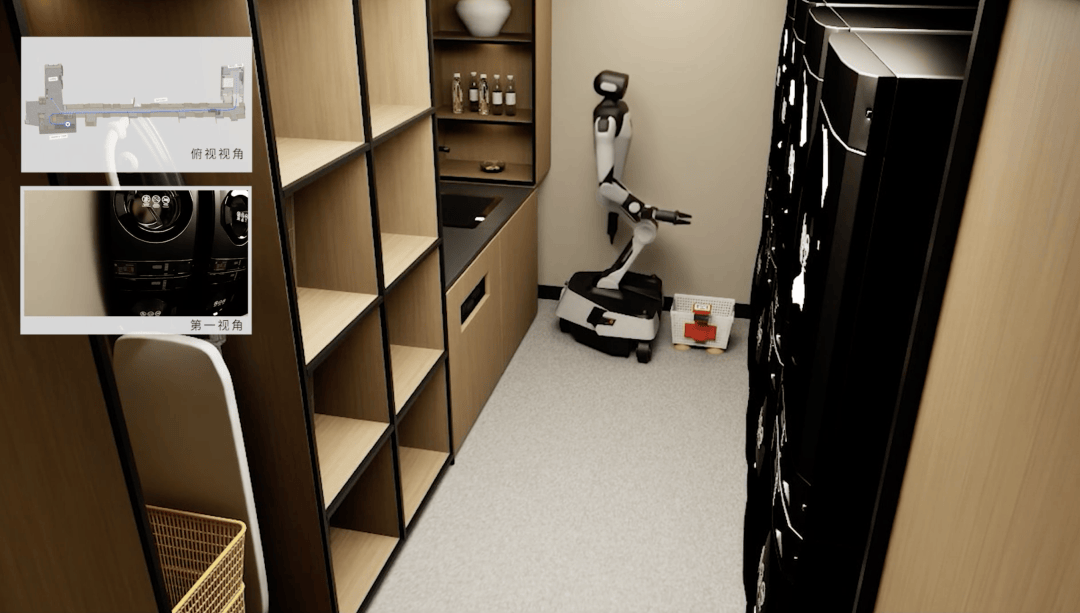
This turns the digital hotel, which was once nothing more than a castle in the air, into a “driving school” exclusively for robots.
Every attempt in the digital world, successful or not, generates a trove of data—motion trajectories, contact states, and visual feedback.
This data can then be used in turn to optimize the robot's action policy.
The result is a dramatic reduction in on-site deployment and debugging time. Before the robot has even “joined the workforce,” it already knows the work environment and business processes inside out.
One thinks, one acts
All right, the robot now has its own driving school and can practice to its heart's content.
The next question is: who will be the driver?
My first reaction was:
This is easy. Astra controls robots so well—let it take the wheel.
And indeed, along with Mundo, Astra is the second brain that Daxiao gives robots.
But after studying it in detail, I found that it wasn't quite what I had initially expected.
Yes, Astra's comprehension, reasoning, and planning abilities are unmatched, but if you simply bolt it on as-is, the result is actually rather awkward...
The team ran a test, and the data showed that relying entirely on Astra for real-time decisions to complete an entire workflow from start to finish took more than 30 minutes.
I could have hand-washed two loads of laundry myself.😭
Physical-world control is inherently high-frequency. If every action by the robot has to wait in real time for the cloud-based large model to observe, think, reason, and decide, by then it'll already be too late...
You want both the benefits of a general-purpose model and the real-time requirements of embodied deployment. What should you do?
This time, Daxiao Robot has the answer—
Decoupling.
A cloud-based general-purpose brain (GPT-Astra) handles macro-level work that requires “thinking,” such as task decomposition, logical reasoning, and strategy generation.
Given a goal and evaluation criteria, let Astra explore to its heart's content in the Mundo world model, finding optimal solutions, validating them, and summarizing them... Once the methodology has converged—
it is distilled into a Skill.
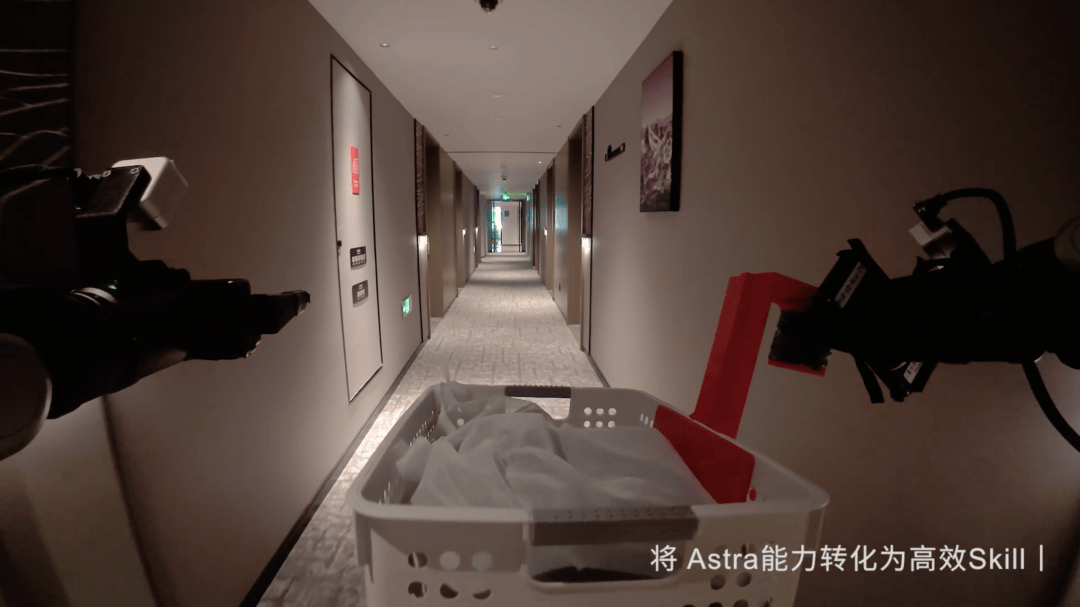
Next, the task passes to an execution brain on the robot itself, which invokes the Skills that have already been consolidated and draws on the robot's onboard camera and robotic arm to quickly complete high-precision physical actions.
With this division of labor in place, take another guess: how long would the local embodied foundation model take to complete the same task cycle?
18.648 seconds.
Yes, you read that right.
From more than 30 minutes to 18.6 seconds. The time required has been reduced by more than 98%.

Of course, the real world always has unexpected things happen.
What if the lighting on site suddenly changes, or someone moves the laundry basket, and the on-device small brain can no longer handle it?
This is when the “cloud brain” Astra steps back in, analyzes the new situation, generates a new version of the Skill, and sends it back down.
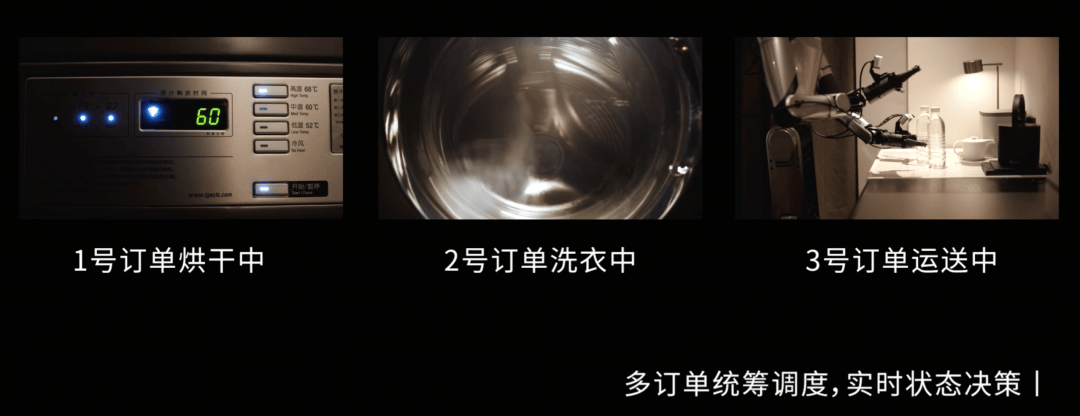
And to manage these hundreds and thousands of Skills, the team also developed a scheduling hub called BotAgent.
Simply put, it is like a concierge. It breaks the entire laundry workflow down into 53 of the most basic atomic actions, then packages them into 14 higher-level semantic steps such as “pick up the basket” and “go to the laundry room.”
Ultimately, BotAgent can flexibly orchestrate more than 200 different action sequences based on the guest room location, elevator status, and washing-machine queues.
By this point, the leverage of Astra’s general-purpose brain had been maxed out.
The dual-brain collaborative architecture of “world model + general-purpose model” had also fully taken shape.
Evolving on Site from Failures
At this point, everything seems perfect.
But the real world is always ten thousand times more complex than the simulator. Unexpected snags will always arise.
For example, the robot goes to grab the laundry basket, but its own wrist happens to block the camera, leaving it unable to see.
Another example: the robot clearly manages to pull the laundry out of the dryer, but one pant leg is still hanging inside the drum🤦♂️...
If every problem required an engineer to rush over and change the code, we might never see robots deployed in our lifetime.

What should we do?
This is exactly where embodied RSI comes into play—
teach robots to learn to evolve on their own through real-world failures.
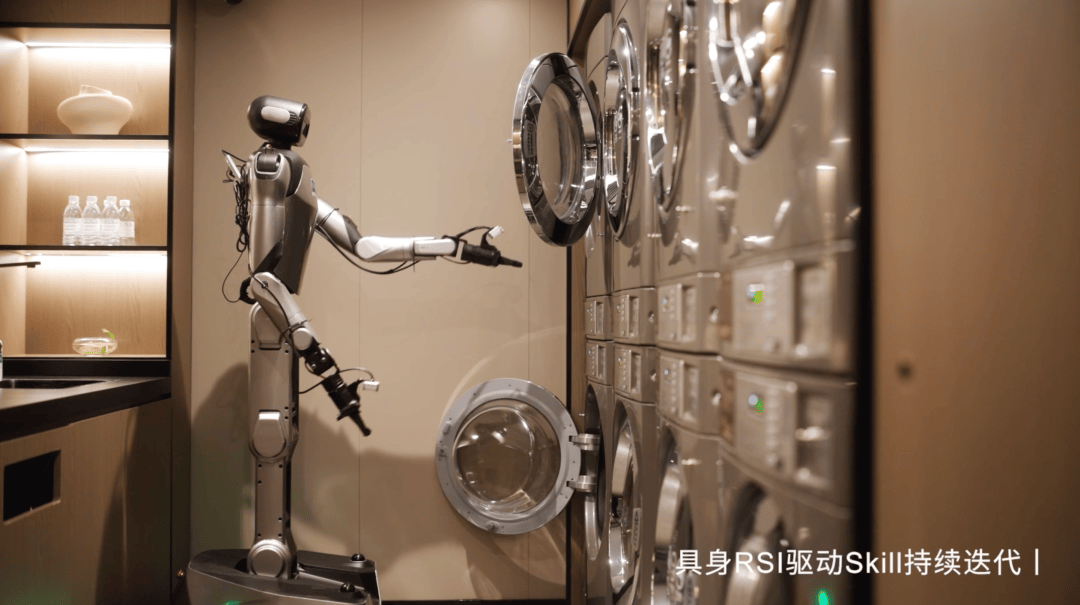
Here is how the entire process works:
First, the Astra brain generates an initial Skill for the robot to execute.
Next, the robot records video using multiple cameras while logging all sensor data and a timeline of its actions.
Once the recording is done, the ball is back in Astra’s court.
If the task fails or the results are unsatisfactory, Astra will examine the footage and data over and over, like a detective, to pinpoint the root cause.
For example, it discovers that the wrist camera is always blocked while grasping the basket, so the improvement is to switch to the overhead camera for observation.
Another example: Astra finds that when it reaches into the dryer to pull out a pair of jeans, the pant leg is always left hanging on the drum wall.
After analyzing the footage, Astra’s optimization strategy is to dynamically fine-tune the gripper’s lifting trajectory while adjusting the grip angle of the fingertips.
There is another trick. To keep this “leveling-up” process running uninterrupted 24/7 and further reduce the need for Human in the Loop, Da Xiao also did something quite clever—
Teach robots to learn “autonomous reset.”
What does that mean?
For example, with the action of taking clothes out, after the robot pulls a garment out of the dryer, it can shake it loose, toss it back into the dryer, and restore the environment to the state it was in before the experiment began.
No human intervention whatsoever.
This removes the reliance on human labor and enables truly autonomous closed-loop evolution.
Of course, as the level of automation rises, concerns about accumulated errors are inevitable.
Working behind closed doors is never a good idea, after all. No matter how intelligent a model is, it may still “fail to recognize the true face of Lushan.”
To ensure that improvements are effective, the team runs an independent copy of the model during training, like a “quality inspector,” scoring the execution videos and data from each round.
If the new version of the Skill performs no better than the old one, the system can roll back quickly.

That's about all.
Talk is cheap; let's look at the data.
For the “dryer clothes retrieval” Skill alone, in 57 hours, the robot completed 165 consecutive rounds of real-world experiments, generating 37 improvement proposals and about 80 iterative versions.
The manipulation targets also gradually expanded from standard fabrics at the outset to more difficult items such as heavy denim jeans and oddly shaped laundry bags.
Ultimately, the time per round stabilized at 170 to 210 seconds. The most critical metric—the residual rate inside the denim pant legs—fell from an average 48% all the way to 32%, with the best attempt even reaching 19%.
Real-world failures became the best fuel for robot evolution.
The Embodied Transformer Moment
The French philosopher René Descartes once wrote:
“Let those who come after continue from where their predecessors stopped.”
In the history of embodied intelligence, the most costly resource is not actually the computing power in the cloud, but the irretrievable trial-and-error time that robots expend in the real physical world.
A slip during a grasp, an occlusion in the field of view, a misjudgment of a garment's edge...
In the past, if these failures merely became an unnoticed error log in the system's back end, then hundreds or thousands of devices would repeat the same mistakes day after day in different scenarios.
But now, things are different.
Dax Robotics turns every setback and adjustment occurring across hotel laundries and guest-room corridors into general-purpose cognitive assets that can be understood by world models and absorbed by foundation models.
One robot's failure became a steppingstone for the growth of all robots.
I think embodied intelligence may be gradually approaching its own Transformer moment.
Just as large language models use a unified architecture to accommodate the infinite variability of human language, once the combination of world models, dual-brain coordination, and a self-evolution mechanism can be seamlessly integrated into industrial production lines, the marginal cost of enabling robots to acquire new capabilities will steadily be driven down.
Next, the question is how the richness of the ecosystem will feed back into training for long-tail scenarios.
And China happens to possess the world's deepest pool of real-world scenarios and the world's most complete hardware supply chain.
According to Wang Xiaogang, Chairman of Daxiao, they have indeed begun exploring scenarios beyond hotels——
Instant retail is a direction very much worth further expanding.
Although it is a different field from hotel laundry, there are some commonalities: robots in both need to understand complex environments, complete multi-step tasks, and collaborate with real business systems and operational processes.
At the same time, these scenarios have a high frequency of tasks and quantifiable business outcomes, enabling them to continuously generate data feedback and drive the iteration of models and skills.
Capabilities such as world-model environment modeling, general-model skill generation, and continuous RSI improvement, validated in hotel scenarios, can provide technical references for other scenarios.
Only after prioritizing the validation of business-to-business scenarios, establishing a commercial model, and ensuring the ability to sustain itself can we focus on building our strength and ultimately advance step by step into more challenging territory.
Embodied intelligence is a marathon, but fortunately, at least at the current level of technological development, it can already solve some pain points.
The small step taken today in the hotel laundry room is paving the most critical springboard
for tomorrow’s enormous transformation of the physical world across industries.




