Google DeepMind announced the robotics AI model “Gemini Robotics 2.5” on November 10, 2026. It learns faster in the real world and can be adapted to a wide range of settings, from everyday life to factory work.
Gemini Robotics 2.5: Accelerating Physical Intelligence — Google DeepMind
https://deepmind.google/blog/gemini-robotics-2-5-accelerates-real-world-physical-intelligence/
The Gemini Robotics series consists of AI that determines a robot’s movements. Released in July 2026, Gemini Robotics 2 was designed as a VLA (vision-language-action) model, enabling it to determine actions based on camera footage and language instructions. Google DeepMind says that the same model can control robots of various shapes and sizes, from tabletop robotic arms to full-bodied humanoid robots.
Google DeepMind announces “Gemini Robotics 2,” an AI model for robots capable of controlling the entire body, from walking to fine motor tasks with both hands — GIGAZINE
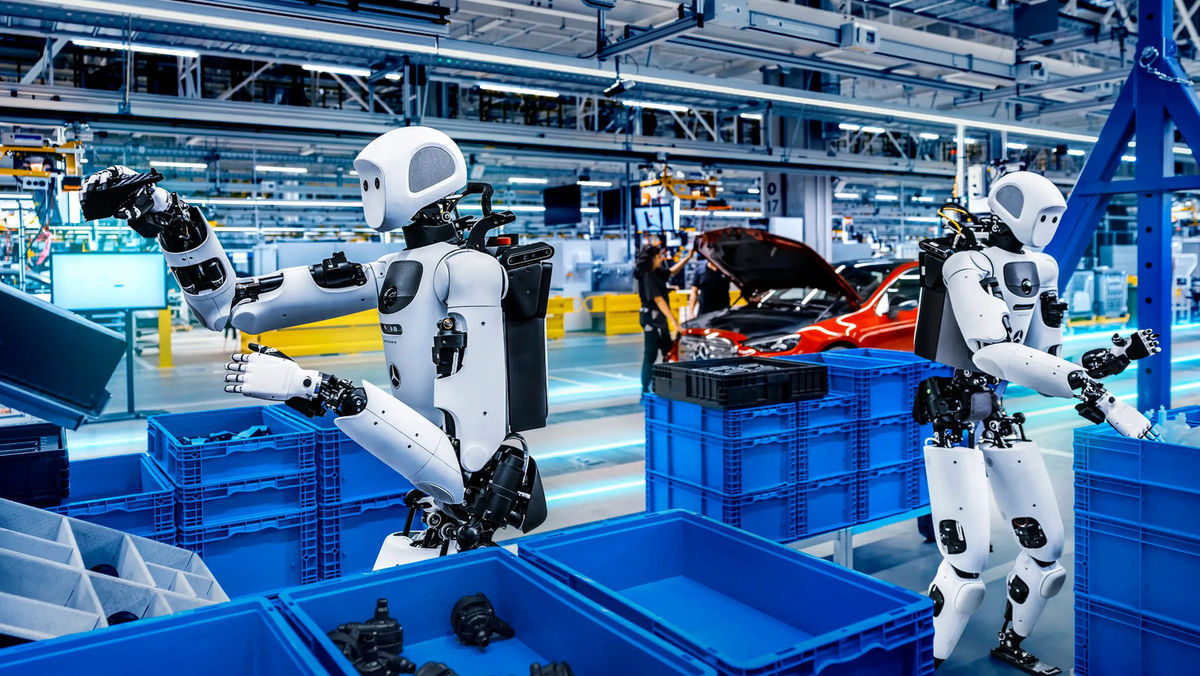
Gemini Robotics 2.5 further improves both the breadth of skills robots can learn and the speed at which they acquire them. Its performance is said to have improved in three respects: “dexterity,” enabling it to perform more tasks than ever before with greater precision; “reliability,” based on real-world validation experiments conducted on the Mercedes-Benz production line; and “safety,” with improved ability to ensure physical safety and the introduction of a new benchmark for testing robot-specific adversarial jailbreaks.
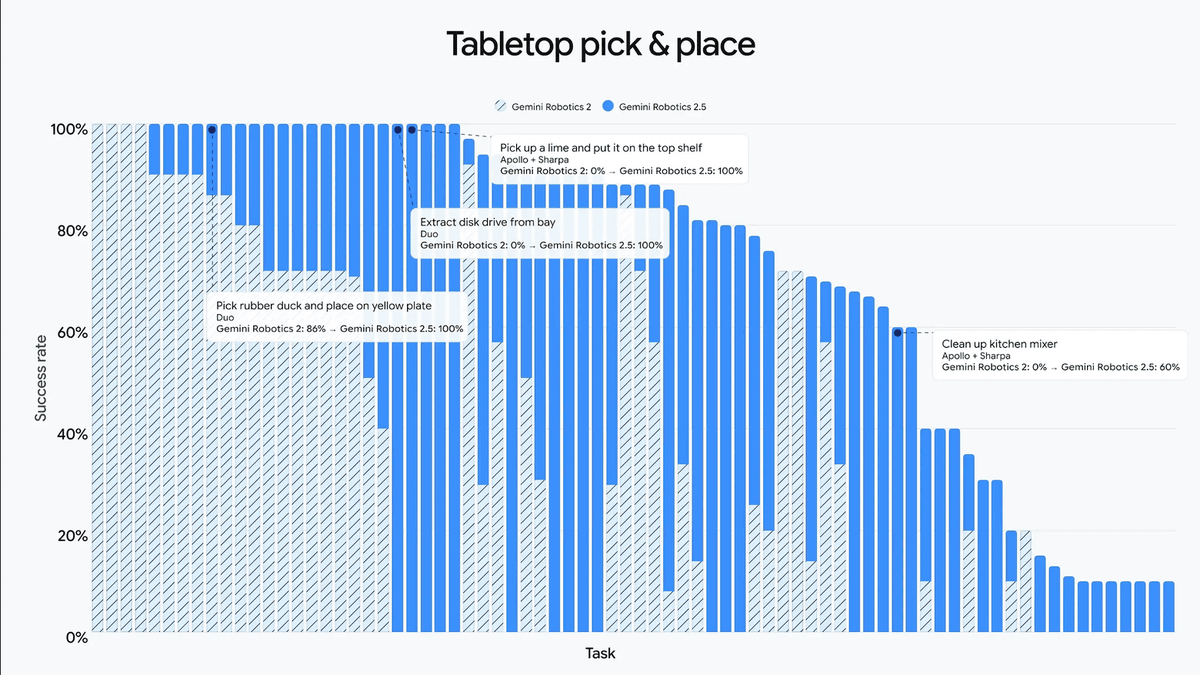
Gemini Robotics 2.5 expands the model’s capabilities in terms of task breadth, performance, and complexity. The model was evaluated on 200 different tasks, including plating food with tongs, tying a ribbon around a gift box, and pipetting liquids. These tasks combine many skills, such as advanced tool use, manipulation of complex deformable objects, and delicate object handling, with the aim of approaching human-level dexterity. Below are the success rates for various tasks involving picking up objects from a table and repositioning them. The diagonally hatched graph represents Gemini Robotics 2, while the blue graph represents Gemini Robotics 2.5. Gemini Robotics 2.5 has more tasks that can achieve a 100% success rate and is also able to address tasks that were previously unsolved.
In terms of safety, Gemini Robotics 2.5 uses inference-time guidance to avoid physical hazards in real time. According to Google DeepMind’s evaluation, its safety classification feature increased the safe task completion rate by 33% around obstacles and by 43% around nearby people. The company also says that it has improved safety in long-running autonomous tasks, achieving a 99.5% jailbreak resistance rate, substantially exceeding the 82% resistance rate of the previous baseline, Gemini Robotics ER 2.
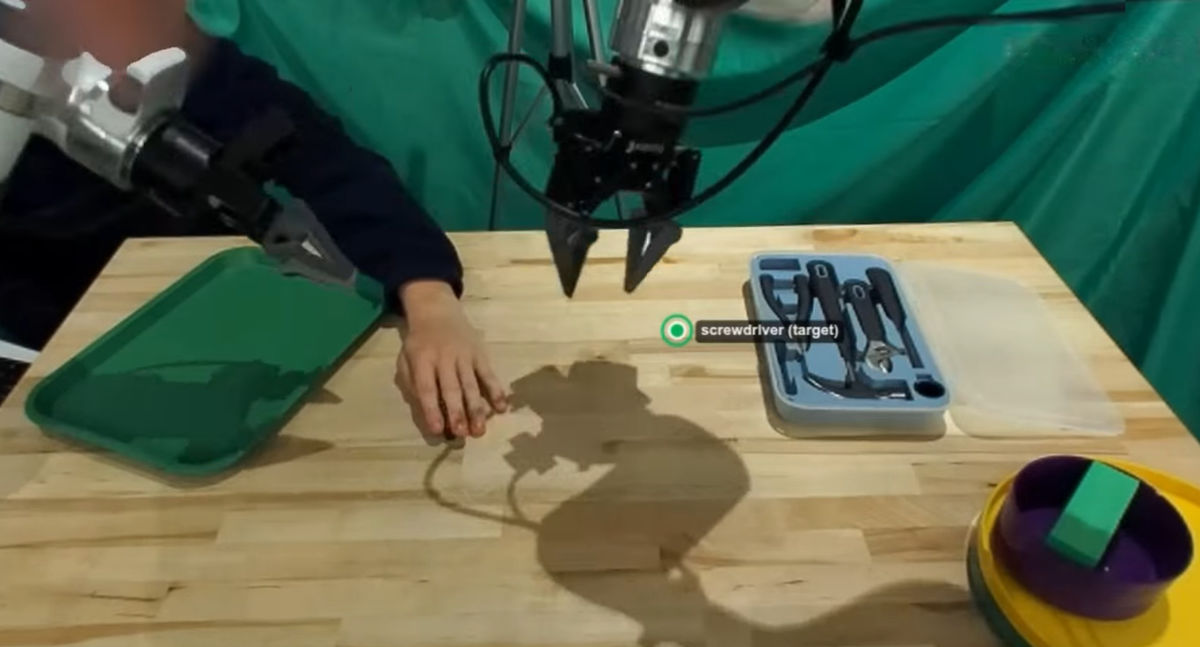
Google DeepMind says that “robots will be able to venture out of the lab and into more unstructured real-world environments, helping people with a wider range of tasks.” Below are some examples of tasks performed by Gemini Robotics 2.5, which has learned everything from everyday skills to jobs such as sorting car parts on the factory floor.
Gemini Robotics 2.5 is here. 🤖
— Google DeepMind (@GoogleDeepMind) November 10, 2026
Our latest physical AI is able to learn hundreds of everyday skills - from folding laundry and serving pastries to autonomously sorting car parts on the factory floor.
Here’s a snapshot of its capabilities 🧵 pic.twitter.com/50WwnDudsH
“Gemini 4 Argon” was used to develop Gemini Robotics 2.5. It reportedly helped accelerate development with tasks such as “creating virtual training spaces for robots from a single image.”
Gemini 4 Argon helped build Gemini Robotics 2.5, speeding up months of training.
— Google DeepMind (@GoogleDeepMind) November 10, 2026
It creates virtual practice spaces from a single camera view, and watches replays of its own mistakes to fix its technique, driving stronger performance on the real robot. pic.twitter.com/4bhM31z7e4
Gemini Robotics 2.5 is being rolled out to Google DeepMind’s robotics partners.

