In the latest RoboColiseum weekly leaderboard, MXI-SimWorld ranked first overall with a score of 0.9656, and took first place in the Spatial Understanding and General Manipulation sub-leaderboards.
As large models begin entering the physical world, enabling robots to understand instructions, perceive their environment, and perform operations has become an important issue in the field of embodied intelligence.
On November 11, RoboColiseum officially released the latest weekly leaderboard. According to the leaderboard, as of 12:00 p.m. on November 11, 2026, the MXI team under 10101, led by Professor Yang Chao of the School of Mathematical Sciences at Peking University, with the physical AI framework MXI-SimWorld v0 Preview and a composite score of 0.9656, ranked in RoboColiseum’s embodied intelligence evaluation as No. 1 overall. Breaking down the four sub-leaderboards, MXI-SimWorld v0 Preview likewise showed no weak spots: it ranked first in Spatial Understanding and General Manipulation, and second in Instruction Following and Perturbation Adaptation. It placed in the top two across all four dimensions.
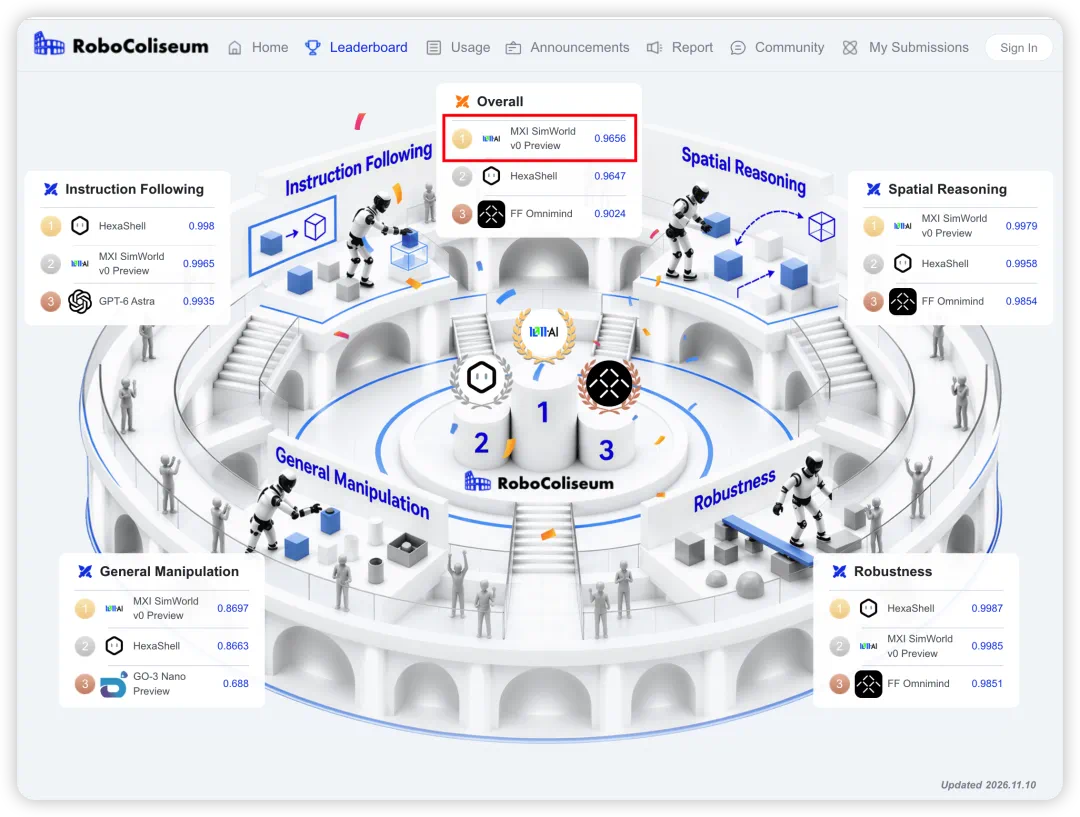
Robocolisuem Overall Leaderboard, as of November 11, 2026. Image source: RoboColiseum
As an authoritative evaluation platform jointly initiated by nearly 20 universities, companies, and research institutions worldwide, including Hugging Face, NVIDIA, and Tsinghua University, RoboColiseum is a highly regarded “real-robot pre-deployment benchmark” in today’s field of embodied intelligence. It rejects paper-based score chasing, using domain randomization and rules that strictly isolate training and test sets to avoid overfitting, while covering both in-distribution and out-of-distribution tests. The final evaluation results have a correlation of nearly 90% with real-robot performance, and the performance gap between simulation and the real world for the same model is less than 10%.
The leaderboard features four dimensions: Instruction Following, Spatial Understanding, Perturbation Adaptation, and General Manipulation. The first two assess the model’s cognitive ability to “see and make sense of things,” while the latter two directly test its physical execution capability—whether it can “actually get the job done by taking action.”
As general-purpose large models continue to advance, a question is drawing increasing attention: How can a model’s ability to understand tasks be translated into a robot’s ability to carry out physical operations?
Even when large models can write code fluently, perform complex logical reasoning, and direct robots to complete tasks such as tabletop grasping and object placement, they still have to address problems involving object positions, spatial relationships, and action execution. General-purpose large models such as GPT-6 Astra, GPT-6.1 Sol, Claude Opus 5.5, and Gemini 4 Argon have also participated in RoboColiseum evaluations. In a previous round of evaluation, their overall performance was already close to that of leading specialist embodied models.
However, although AI understands the instruction “put the pen in the pen holder,” it still needs to determine from what angle the robotic arm should approach, which way the object will slide after being touched, and when to release its grip. Large models have learned what the world “looks like” from vast amounts of text and images, but have not learned what it “will become after an action is taken.”
The physical world has no undo button. A single error in action execution can irreversibly change the state of the environment. This is precisely the fatal weakness of deploying general-purpose large models in robotic scenarios.
I. SimWorld: Let Robots Rehearse in Simulation First
What would happen if robots could try different approaches and see the possible results before actually executing an action?
This is precisely the idea behind MXI-SimWorld (referred to below as SimWorld):Rehearse before taking action.
Taking the desktop tidying task shown in the video above as an example, the robot’s first step is to put the black pen on the desk into the pen holder. But where should the robot grasp the pen? What path should the robotic arm take so that it does not collide with nearby objects?
SimWorld first obtains observations from the head and wrist cameras, identifies the objects on the desktop, and then retrieves similar simulation assets. It adjusts their size, shape, and position to build an interactive simulation scene.
Next, starting from the same desktop state, the system tries different grasp poses and motion paths in parallel across multiple simulation environments. Candidates that encounter obstacles or fail to complete the task are gradually eliminated, while successful trajectories are retained.
Finally, SimWorld brings the selected trajectory back to the original task scene, directing the robotic arm to pick up the black pen and place it in the pen holder.Before an action is executed, the system has already rehearsed multiple possibilities in simulation.
From scene observation to action selection, simulation is no longer used only to generate training data; it has also begun to participate in the model’s decision-making process. The MXI team calls this idea Simulation as Policy: using simulation to support policy decision-making.
II. Simulation Gives the Model a World in Which It Can Experiment Repeatedly
The desktop tidying task in the video is merely a microcosm of the robot’s interaction with the physical world.
Putting the pen into the pen holder requires determining the object’s position, the grasp orientation, and the robotic arm’s path of motion. If an object is moved, a differently shaped object is substituted, or an additional obstacle is added to the desktop, the original action plan may no longer be applicable.
For robots, the real world is not a set of fixed test questions. The shapes, materials, and arrangements of objects change, and the outcomes of actions may also differ from expectations. A model needs to gain enough interaction experience under different conditions before it has a chance to learn how to cope with these changes.
The most direct approach is to let the robot practice repeatedly in the real world.
But real-world interaction requires equipment, space, manpower, and time. After each attempt, researchers may need to rearrange the objects and reset the robot before beginning the next experiment. Repeated data collection is even more difficult in situations that are dangerous, rare, or likely to cause damage.
Simulation offers an alternative approach to these problems.
In a simulation environment, the same scene can be replicated, modified, and reset. Researchers can change the positions or shapes of objects or the conditions of the scene so that the model can try actions under different circumstances. They can also have multiple candidate paths start from the same initial state and observe what result each produces.
This means the value of simulation lies not only in generating more training data. It can also become an interactive, rollback-capable, parallel rehearsal environment: when the system needs to make a choice, it first tries the options there, then determines the next step based on feedback.
Of course, for rehearsal results to be genuinely useful as a guide, the simulation environment also needs to reflect, as accurately as possible, the contact, collision, and motion between objects. Real-world data remain important—they can help calibrate the simulation and can also be used to test the model’s performance in the real world.
From NVIDIA’s Isaac Sim to World Labs’ acquisition of the robotics simulation company SceniX, spatial understanding, physical interaction, and simulation capabilities are attracting increasing attention. Different companies are pursuing different technical paths, but they are all addressing the same question:How can AI better understand the physical world and take action within it?
In the MXI team’s view, simulation can go a step further: not only serve model training but also participate in action decision-making, providing the model with an environment in which it can observe outcomes and compare options before taking action.
But to achieve this, several specific questions need to be answered: How can a simulation environment be built based on the scene at hand? How can object interactions be made as close to reality as possible? And how can multiple action plans be rehearsed efficiently?
This is precisely what SimWorld will address next.
III. How SimWorld Rehearses: Scene Configuration, Interaction Calibration, and Action Rehearsal
To allow simulation to participate in model decision-making, first, based on observations, build an interactive scene ; next, have virtual objects produce feedback that serves as a useful reference when subjected to actions ; finally, try different approaches in multiple simulation environments , providing a basis for action selection. SimWorld connects these stages to form a complete process from scene reconstruction, calibration, and rehearsal.
Step 1: Reconstruction—“move” the scene at hand into the simulation.
The core component of SimWorld is the Interactive World Simulator. It transforms online visual observations and task instructions into an operable simulation environment.
The system first identifies objects relevant to the task and, together with depth information, estimates their 3D positions, orientations, sizes, and relationships with one another. It then leverages the MXI team’s in-house physics-based object simulation engine to reconstruct the scene following the “similar-asset retrieval—unseen-asset generation—instance-level editing” workflow.
Every reconstructed object has two “bodies”: a geometric mesh for appearance and a collider for contact computations. Parameters such as size, pose, and friction can all be adjusted. Once all assets are placed in the same scene coordinate system, a visual frame becomes an interactive scene with geometric structure, spatial layout, and physical properties.
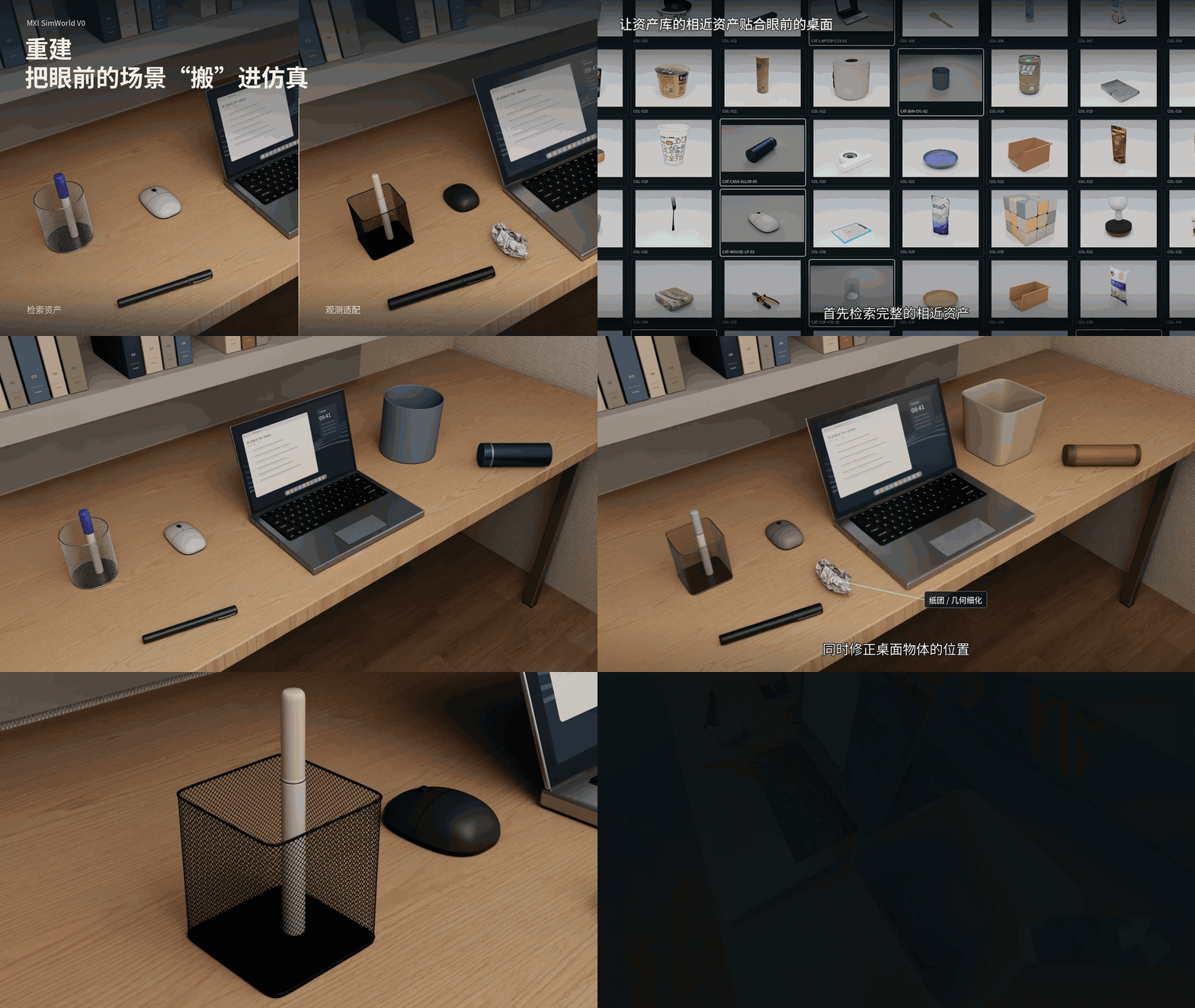
Simulation asset reconstruction process Video source: 1011.AI
Step 2: Calibration—make the simulation not only “look the same” but also “move the same way.”
Even if the scenes look the same, the forces acting on objects, their collisions, and their motion after release may not be the same.
For this purpose, SimWorld introduces in-context learning (In-Context Learning). It uses object interaction sequences from training samples as references and analyzes the correspondence between actions and object motion: where contact occurs, how an object moves after a collision, how it rolls after being released, and where it ultimately stops.
Next comes trajectory replay. The system compares the simulation results with the movement process and final state in the reference video, repeatedly adjusting the physical parameters. During calibration, it examines not only where the object ultimately stops, but also how it got there.
After this step, the reconstructed scene goes from visual “look-alikeness” to action-driven “interaction accuracy.”
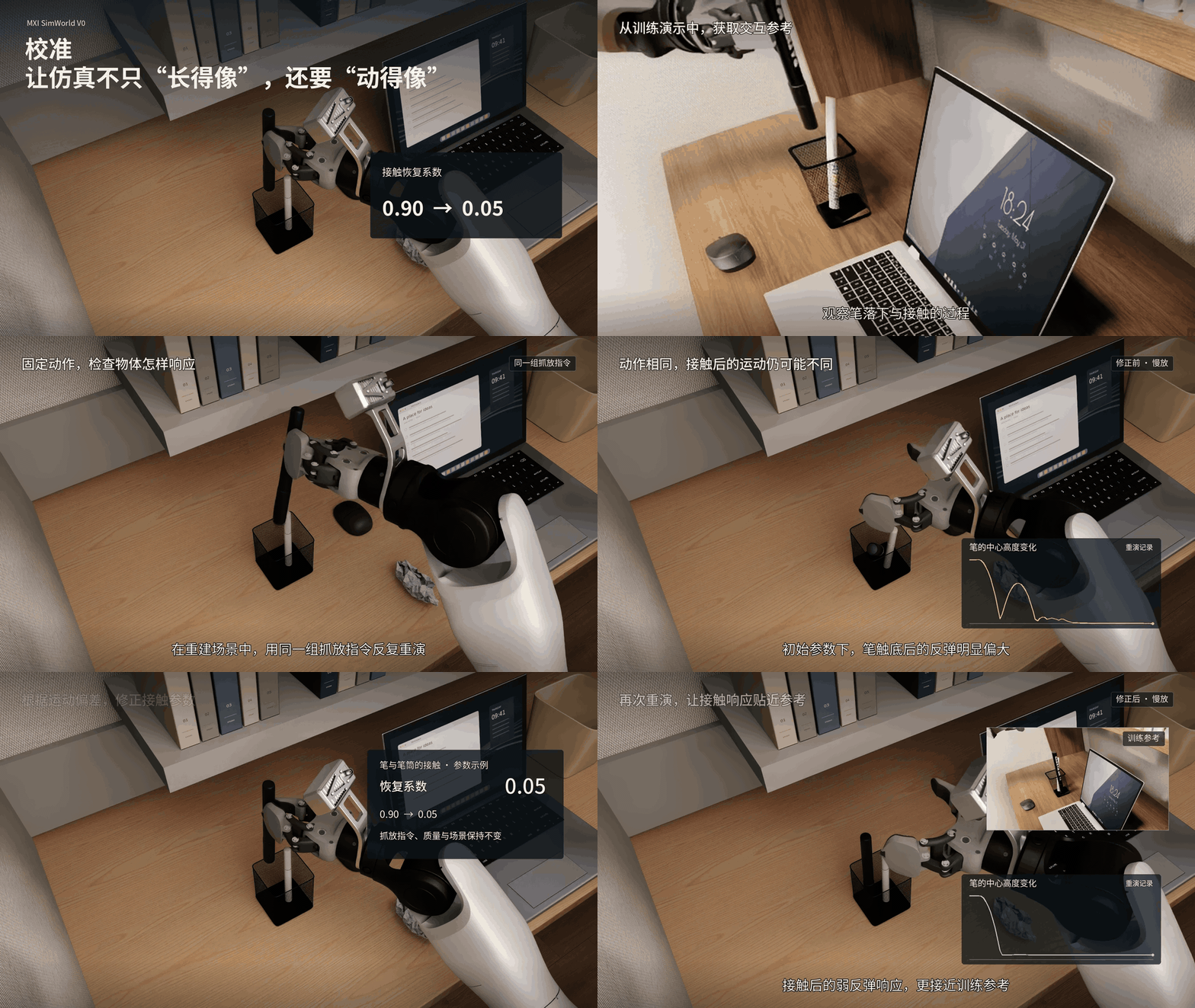
Video of the interactive simulation calibration process. Source: 1011.AI
Step 3: Rehearsal—test multiple options simultaneously in multiple parallel worlds, then execute the best one.
With a trustworthy environment, SimWorld’s self-evolving action policy (Self-Evolving Policy) copies the current state into multiple independent simulation worlds. Different candidate approaches start from exactly the same point and separately test the transport path, direction of approach, release position, and placement action.
The system filters the options based on whether the robotic arm can reach the object, whether the path involves collisions, the object’s landing point, and the stability of the placement, and then executes the selected option in the real world.After execution, new visual observations update the object's state and align the actual results with the simulation predictions, providing the starting point for the next round of search.
Multiple candidates are validated before execution, with continuous refinement afterward. The MXI team calls this approach “Using Simulation to Support Policy Decisions” (Simulation as Policy).
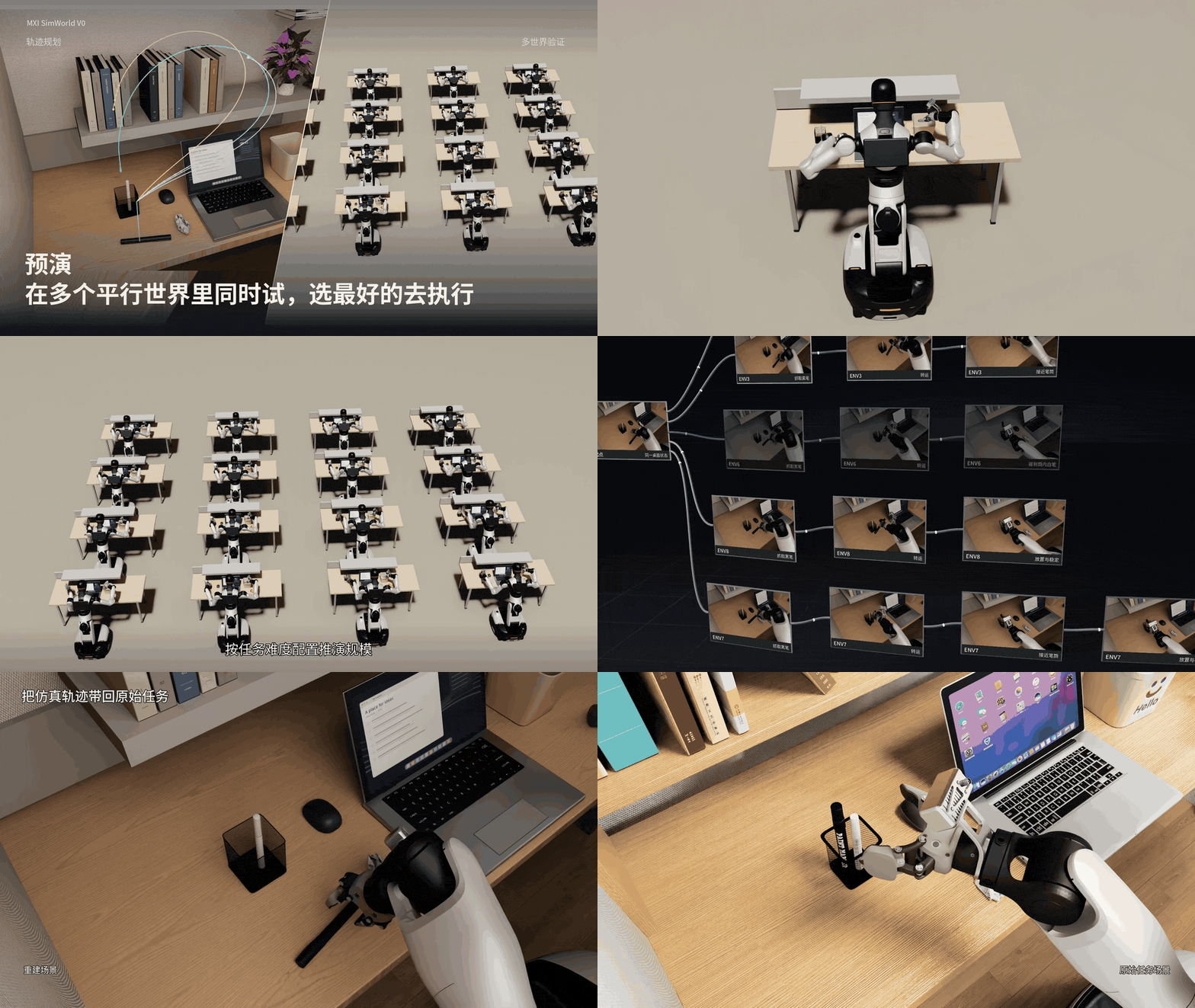
Parallel Rollouts Across Multiple Environments and Candidate Trajectory Filtering Process. Video source: 1011.AI
Worth noting, RoboColiseum is a time-limited evaluation. No matter how extensively one tests in simulation, actions must be produced within the time budget.
This requires the entire decision chain of “observation processing–scene updating–candidate generation–physics rollout–result filtering” to be fast. The rollout scale must also be balanced: a longer rollout reveals more of the rolling and instability after release, while a finer time step makes the contact process clearer. Both, however, increase computational cost.
This is exactly what 1011.AI excels at. The XieWu simulation engine optimizes both solver algorithms and hardware adaptation: on the one hand, shortening the rollout time of a single candidate trajectory and, on the other hand, running multiple independent environments simultaneously, increasing the number of candidates that can be validated per unit time.
Existing test data show that, on the RTX 5090 platform under double-precision computation, the in-house XieWu physics simulation engine achieves physics-solving speeds more than 2x those of leading physics engines such as Genesis, MuJoCo, and Newton in typical rigid-body and rigid-flexible coupling scenarios, as well as in large-deformation scenarios such as cloth and cables.

Comparison of the XieWu Simulation Engine with Genesis and Newton on Complex-Environment Tasks. Video source: 1011.AI
From scene observation and interactive rollout to action execution, how does SimWorld apply these capabilities to concrete tasks? The following video shows the team's exploration process in RoboColiseum and the system's performance in simulation tasks.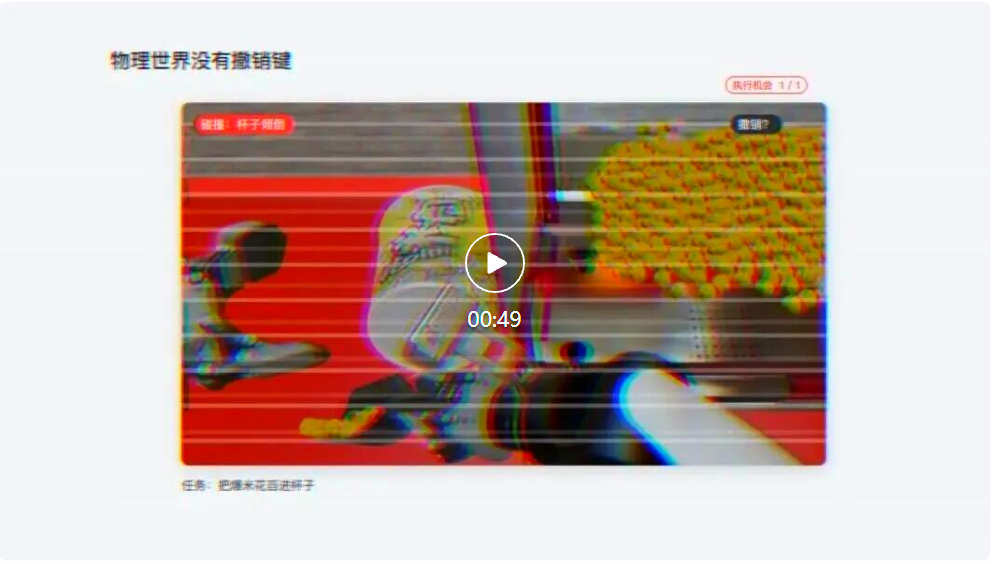
Selected SimWorld Demos in RoboColiseum. Video source: 1011.AI
However, no matter how good the simulation is, it must ultimately be tested on a real robot.
The MXI team conducted Sim2Real validation on tasks such as quantitative pouring.Fluid dynamics and fluid–container interactions are widely recognized as one of the hardest categories to simulate.On these tasks, XieWu's simulation results showed good agreement with real-robot performance.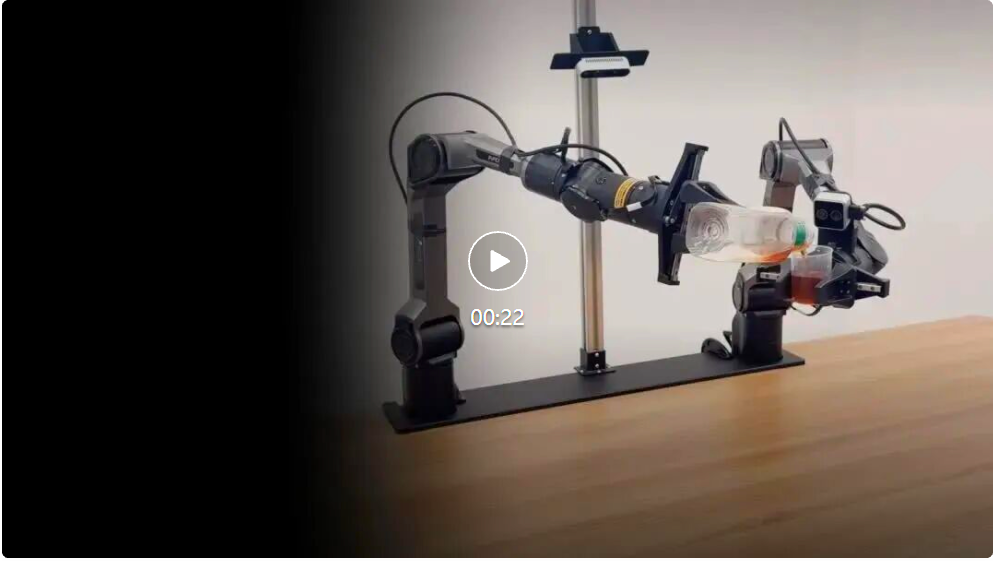
Comparison Between Simulation and Real-Robot Demonstrations of the Pouring Task. Video source: 1011.AI
IV. Peking University School of Mathematical Sciences Team: Reconstructing Physical Intelligence from Mathematical Principles
To embed high-fidelity simulation in every robotic decision, two capabilities are needed simultaneously: accurate physical modeling, and the engineering capability to make computation fast enough.These two capabilities are precisely the foundation of 1011.AI.
1011.AI founder Yang Chao is a professor at the School of Mathematical Sciences, Peking University. In 2016, he led his team to win the ACM Gordon Bell Prize, the highest award in international supercomputing, marking the first time China won the award. He is also the inaugural recipient of the Wang Xuan Outstanding Young Scholar Award and has long worked in high-performance computing, numerical simulation, and artificial intelligence.
1011.AI was founded in June 2026, focusing on physical AI infrastructure and model R&D. Since its founding, it has secured more than RMB 100 million in funding. The team is building a full-stack technology system based on “high-performance computing + physics simulation + AI.” According to the team, model families such as MXI-RoboICL and MXI-Hybrid-v0 will also be released in due course.
Large models can already “think things through.” To make them “perform well,” they also need to know what consequences their actions will entail.
The real world does not allow for repeated trial and error, so first give robots a trustworthy, interactive world where they can start over indefinitely. Let them take all the falls they need to take inside it before stepping onto the arena.
This is the answer SimWorld offers, and the reason it has reached the top of the RoboColiseum leaderboard.


