Vint Cerf (83), Google’s vice president and chief internet evangelist, will step down from the company in one week. This was revealed during a panel discussion at the “Open Frontier” conference hosted by the U.S. nonprofit Laude Institute.
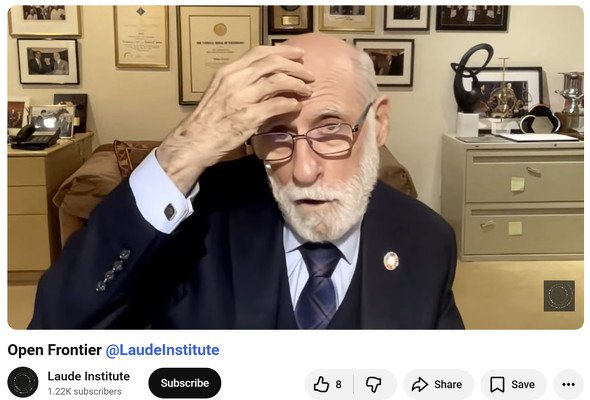 Vint Cerf participating in the event via video call (Image: from a Laude Institute video)
Cerf is known, along with Robert Kahn, as a co-developer of TCP/IP, the foundational technology of the internet, in the 1970s, and is regarded as one of the “fathers of the internet.” For this achievement, he received the 2004 ACM Turing Award, as well as numerous other major international awards, including the Japan Prize and the Queen Elizabeth Prize for Engineering. Before joining Google, he held positions including senior vice president of technology strategy at MCI, a major U.S. telecommunications company.
Cerf joined Google in October 2005 and continued to contribute to internet standardization and global policy discussions for more than 20 years as vice president and chief internet evangelist.
The news was revealed by Dave Patterson of the University of California, Berkeley, who is known as a co-developer of the RISC processor architecture. Patterson said he had learned of Cerf’s departure while selecting the panelists for the discussion. “While preparing this panel, I learned that Vint (Cerf) had been at Google for more than 20 years and would be stepping down one week from today. Let’s give him a round of applause for his wonderful career,” he told the audience, which responded with loud applause. Google has not yet made an official announcement.
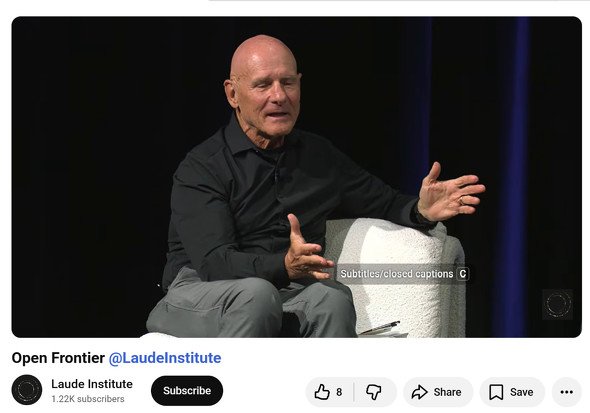 Dave Patterson, who announced Cerf’s departure (Image: from a Laude Institute video)
Cerf himself barely mentioned his departure and devoted much of the panel to discussions about AI agents. He expressed skepticism about using natural language as a means of communication between agents, saying, “I don’t think English is the best choice. It is flexible, but it also comes with ambiguity. In interactions between agents, accuracy is what matters.” Drawing an analogy to the telephone game, he described watching multiple AI agents communicate in natural language as “terrifying to watch.” He also argued that the proliferation of “agentic AI,” in which multiple AI agents work together, would steer the entire industry back toward open standards.
Recalling when he first met Cerf as a graduate student in the 1970s, Patterson said, “He was always wearing a shirt and tie. He was the most fashion-conscious computer scientist I knew.” Cerf laughed and replied, “That’s right. I wore a vest, too. Rather than long hair or a nose piercing, I wanted to distinguish myself through my clothing.”

