 © 01net
Claude Code has been responding faster since mid-October. To achieve this, Anthropic has brought back a compression tool older than the public Web, which its own users had been calling for, with evidence, since the end of the summer.
At the end of August, a developer submitted a detailed request on the Claude Code repository: the assistant sends the entire conversation to the servers with each exchange, without ever compressing it. On October 16, Anthropic’s official account for developers announced that this was now the case, in a post viewed 2.7 million times.Claude Code compresses the conversation with gzip on every turn, and cloud sessions start as soon as the first characters are typed.
Read also: The smartest ChatGPT can now respond 14 times faster – what’s the point?
A history that is resent with every message
A coding assistant does not keep the conversation in memory on the server side. With each new request, the entire history is sent over the network again: instructions, code, and results from previous commands. Over a long working session, the volume grows quickly, and plain text travels all the more slowly when the connection is modest.
Text compresses remarkably well, especially when it comes to exchanges with an AI chatbot: a conversation history is full of repetitions, filenames, code structures, and system messages, which the algorithm encodes once and then simply recalls. The request posted in late August put the added computational cost at a few milliseconds per message, three orders of magnitude below the transfer time saved. The server-side door had in fact already been open: Anthropic’s API accepted compressed requests without issue. The author of the request demonstrated this with a small local proxy that gzipped all traffic from their own sessions. All that was missing was enabling it by default.
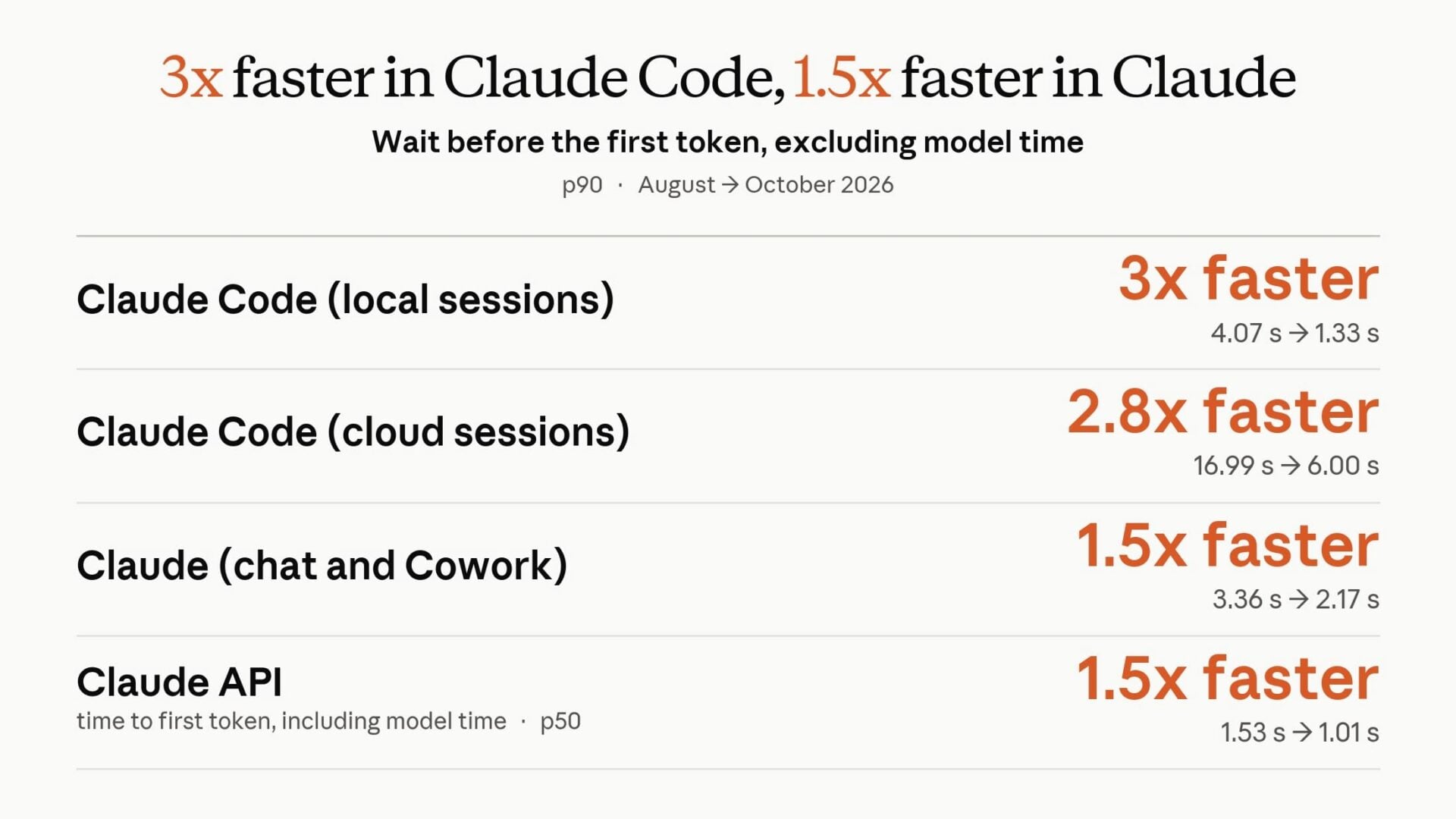
The announcement quantifies the gains, with all optimizations combined since August.The wait before the first words of a Claude Code response, excluding model computation time, was cut by three in the slowest cases, from 4.07 to 1.33 seconds. Cloud-hosted sessions, prepared while typing rather than upon submission, dropped from 17 to 6 seconds. The consumer-facing app gained a third, going from 3.36 to 2.17 seconds.
 © Anthropic
Created in 1992 to circumvent patents
gzip was published on October 31, 1992 by Jean-loup Gailly, a French engineer, and the American Mark Adler. Their goal: to give the free software world a replacement for Unix’s compress program, which was locked down by patents. Gailly handled compression, Adler handled decompression, and the program—its name a contraction of GNU zip—joined the GNU Project’s toolbox. Their format, Deflate, was standardized in 1996 and became one of the least conspicuous and most widespread standards in computing. It remains the most widely used compression format on the Web, ahead of its more recent successors, and the .tar.gz archives that have circulated on Linux servers for thirty years come from the same tool.
Mark Adler, for his part, later joined NASA’s JPL, where he led the cruise phase of the Spirit Mars rover. In 2004, he was the one who announced that he had restored the robot to operation after having thousands of files erased that were filling up its flash memory. In short, good news for anyone who codes with Claude. And a reminder: AI speed gains don’t always come from a new model or brand-new servers.
👉🏻 Follow tech news in real time: add 01net to your Google sources, and subscribe to our WhatsApp channel.
Source: Anthropic via X








- Google Play Store
- 4K Video Downloader Plus
- VLC Media Player
- Adobe Reader
- uTorrent
- WinRAR
- Xender
- Google Chrome
- CCleaner
- Mozilla Firefox
- Avast Free
- ChatGPT
- Microsoft 365
- Opera One
- Avast One











Download
- Google Play Store
- 4K Video Downloader Plus
- VLC Media Player
- Adobe Reader
- uTorrent
- WinRAR
- Xender
- Google Chrome
- CCleaner
- Mozilla Firefox
- Avast Free
- ChatGPT
- Microsoft 365
- Opera One
- Avast One