U.S. Apple is lobbying the Trump administration over the procurement of memory from CXMT, a major Chinese semiconductor maker. The British Financial Times (FT) reported on June 26 (local time), citing people familiar with the matter, and Bloomberg and Reuters subsequently followed with reports of their own. Apple declined to comment, and the White House did not respond to FT’s request for comment.
CXMT is China’s largest DRAM manufacturer. DRAM is a semiconductor that temporarily stores working data in smartphones and PCs, and is an indispensable component in most Apple products, including the iPhone, Mac and iPad. According to FT, since at least May, Apple has been lobbying the U.S. Commerce Department and officials within the administration to permit procurement from CXMT.
However, Apple is not currently prohibited from procuring from CXMT. CXMT is on the Pentagon’s “1260H” list, which the Defense Department cites in connection with links to the Chinese military, but this only constrains the department’s own procurement and does not have the authority to prohibit private companies’ transactions themselves.
FT reports that Apple is seeking an assurance that CXMT will not be added in the future to the Commerce Department’s “Entity List,” which severely restricts commercial transactions. U.S. companies need permission to export products or technology to entities on the list, and such permission is difficult to obtain. Apple is believed to be aiming to build a procurement relationship while eliminating regulatory uncertainty.
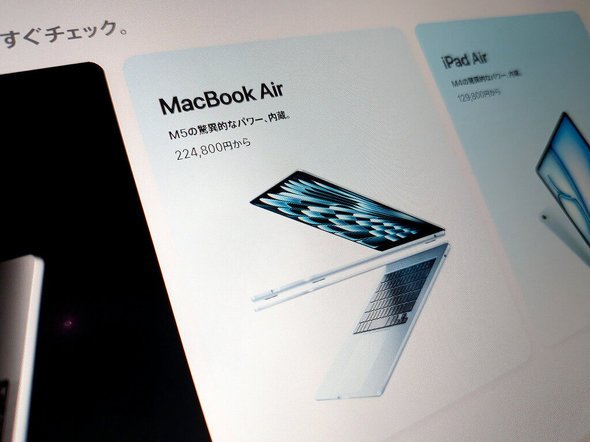 U.S. Apple raised retail prices for the Mac, iPad, Apple TV and HomePod at Apple Stores in Japan on June 25
The backdrop is a severe memory shortage and soaring prices. Major manufacturers such as South Korea’s Samsung and SK hynix and U.S. Micron have shifted production capacity toward high-bandwidth memory (HBM), whose demand is growing in generative AI data centers, resulting in shortages of general-purpose memory and pushing prices higher. On June 25, Apple raised prices on the Mac, iPad and other products citing this surge in semiconductor prices, and is now under pressure to secure new sources of supply.
This would not be the first time Apple has approached a major Chinese memory company. In 2022, Apple was moving forward with a plan to procure NAND flash memory from YMTC for iPhones sold in China. However, export controls on China were tightened under the Biden administration, and the U.S. Congress also raised national security concerns, prompting Apple to abandon the plan. YMTC was subsequently added to the Entity List at the end of that year.
This DRAM procurement plan also carries similar political risks. In fact, Representative John Moolenaar, chairman of the House Select Committee on the Chinese Communist Party, told FT that Apple’s decision to partner with a company linked to the Chinese military would be a “serious mistake,” and there is opposition within Congress.

Ming-Chi Kuo, an analyst familiar with the supply chain for Apple products, analyzed the latest move in a post on his own X account as preparation for “the memory supply-demand gap continuing to widen heading into 2027.”
According to the same source, 15–20% of the memory production capacity allocated to consumer electronics in 2026 is expected to be redirected to data centers in 2027, forcing Apple to secure new sources of supply. However, it also points out that even if the lobbying efforts succeed and Apple can procure DRAM from CXMT, this would not necessarily translate directly into cost reductions or narrowing the supply-demand gap.

