Imagine wishing for a castle and simply asking an artificial intelligence (AI) to build it. For Elon Musk, this scenario could be part of a future of abundance, in which technology will be capable of meeting virtually any human need.
The prediction was presented by the entrepreneur, CEO of Tesla and SpaceX, during a videoconference appearance at Baron Capital’s annual conference, held on Friday (6).
“You could wish for a castle, or basically anything you wanted, and the digital superintelligence could build it for you as a side project,” Musk said.
In the billionaire’s vision, advances in AI, robotics, and energy will expand humanity’s productive capacity so much that goods and services will no longer be scarce. He also predicts an era of extremely high universal income and access to better medical treatments than the most advanced currently available.
Musk foresees an economy transformed by AI
- The businessman believes that the arrival of digital superintelligence could drastically accelerate the global economy. During the conversation, he estimated that the technology could expand the global economy by between 20% and 30%, in addition to doubling the productivity of intellectual work;
- Musk also bets on humanoid robots as a central part of this transformation. According to him, these machines could be five times more productive than human workers, operating continuously, without vacations, breaks for meals, or other interruptions;
- The businessman even estimated that between 20 million and 30 million robots would be enough to match the current output of all workers in the United States;
- In this scenario, the current economic system would appear to have been surpassed. Musk compared money to shells used as currency, suggesting that the productive capacity of superintelligence would make today’s economic model largely irrelevant.
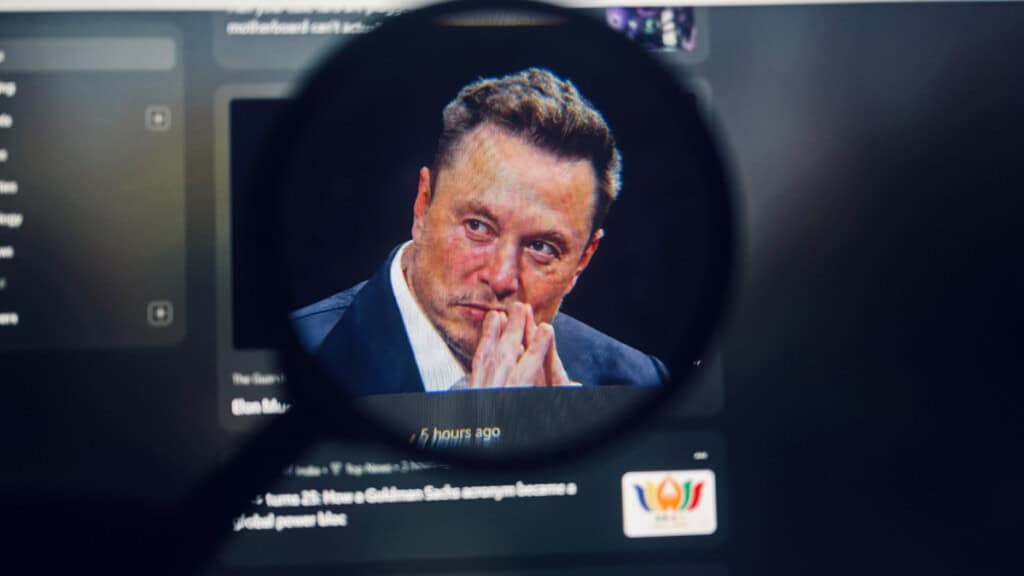 Entrepreneur believes the arrival of digital superintelligence could drastically accelerate the global economy – Image: favoritesphoto/Shutterstock
Read more:
- Musk spent more than US$ 400 million, but the Republicans lost
- Tesla and SpaceX lose R$2.49 trillion after U.S. elections
- Musk bet (almost) half a billion and lost: what comes next for Tesla and SpaceX
Promise of abundance also faces criticism
Musk’s predictions are not the consensus. The billionaire has already faced criticism for suggesting that people stop saving for retirement in light of the prospect that technology will make wealth irrelevant in the future. He has also advocated distributing government payments to everyone as a response to job losses caused by AI.
Other prominent names in the technology industry share part of this vision, but qualify the path to abundance.
Microsoft cofounder Bill Gates recently said AI could usher in an era of true abundance, in which robots will be able to build homes, grow food, and perform surgeries. However, he warned that the roughly 20-year transition will be turbulent, as many productive activities will no longer rely on human workers.
Anthropic CEO Dario Amodei also sees the potential for AI to improve the quality of life for the entire population. At the same time, he predicts unprecedented disruption before the benefits of this transformation are fully realized.
Musk defends the economic impact of data centers
During the conference, Musk also commented on community resistance to the construction of data centers that support the expansion of AI.The criticisms mainly concern water and energy consumption and the noise generated by the facilities.
The businessman cited Memphis (USA), where SpaceX maintains operations, as an example of the economic benefits these structures could bring. According to him, the city's restaurants and hotels are full, while the company pays up to twice the salary previously offered in certain positions.
Musk also stated that the company contributed to local schools and that tax revenue for the city and county increased considerably.

Rodrigo Mozelli is a journalist graduated from São Paulo Methodist University (UMESP) and is currently a writer at Olhar Digital.

